


Should I Have Multiple Bank Accounts?
Should I have multiple bank accounts?
Yes, for most people. At least two accounts is the right starting point: one checking account for everyday spending and bills, and one savings account for money you do not need right now. From there, many people add one or two more savings accounts, one for emergencies and one for a specific goal, such as a vacation or a car. That simple setup keeps your spending money separate from your saving money, earns you more interest, and makes it much harder to spend your emergency fund by accident.
You do not need ten accounts. Three to five accounts cover almost every beginner situation. The goal is not to collect accounts. The goal is to give every dollar a clear job, so you can see at a glance what is safe to spend and what is set aside for later.
This post is educational only. It is not financial advice.
Why multiple accounts help
The first reason is interest. Most checking accounts pay little or no interest. A high-yield savings account pays much more on the same money. 5,000 dollars in checking at almost no interest earns almost nothing. The same 5,000 dollars in savings at a 4 percent annual percentage yield earns about 200 dollars in a year. At a 0.4 percent yield, it earns about 20 dollars. The rates here are illustrations, not current offers, but the point holds at any rate.
The second reason is clarity. When all your money sits in one account, every dollar looks the same. Rent money, grocery money, and emergency money all blend together, and it is easy to spend money you meant to keep. Separate accounts draw a clear line: the bills account holds bill money, the spending account holds fun money, and the emergency account holds money you do not touch unless something breaks. You stop guessing, because each balance tells you the answer.
The third reason is protection. The Federal Deposit Insurance Corporation, the FDIC, insures deposits up to 250,000 dollars per depositor, per insured bank, per ownership category. If you have more than 250,000 dollars in cash, spreading it across different insured banks means more of it is covered. Credit unions have the same protection through the National Credit Union Administration, the NCUA, also up to 250,000 dollars per depositor. For most beginners this limit is far away, but it is good to know the rule.
The fourth reason is a backup. Banks sometimes have outages, cards get frozen, and accounts get locked while a fraud check runs. A second account at a different bank means you still have a working card and access to cash while the first problem gets fixed. Even a small backup balance covers groceries for a few days.
The fifth reason is shared money. If you live with a partner, a joint account for shared bills plus individual accounts for personal spending keeps things simple and fair.
How many accounts do most people need?
Most people do well with three to five accounts. A NerdWallet savings survey, run online by The Harris Poll in March 2025, found that more than 1 in 5 Americans, 21 percent, have multiple savings accounts for different goals. That is a common setup, not an extreme one.
Here is the core setup that works for most beginners.
One checking account for bills. Your pay lands here, or passes through here, and your fixed bills come out of it: rent, utilities, phone, insurance, and loan payments. Because bills are fixed, you can predict the balance you need each month.
One checking account for everyday spending, optional but useful. This holds your grocery, transport, and fun money. When it runs low, you know you have spent your fun money for the month, without touching bill money or savings. Some people skip this second checking account and use one checking account for everything. That is fine too, especially if your budget is simple.
One high-yield savings account for your emergency fund. This is the most important savings account you will open. Aim for 3 to 6 months of essential expenses over time, and start with a 1,000 dollar starter fund if that is what you can manage now.
One savings account per big goal. A vacation fund, a car fund, or a house deposit fund each get their own account, so you can watch each goal grow separately. If you have two goals, that is two accounts. If you have one goal, that is one account.
That adds up to four or five accounts for a typical beginner: two checking and two or three savings. It sounds like a lot, but each one has a single job, and most banks let you see all of them on one screen.
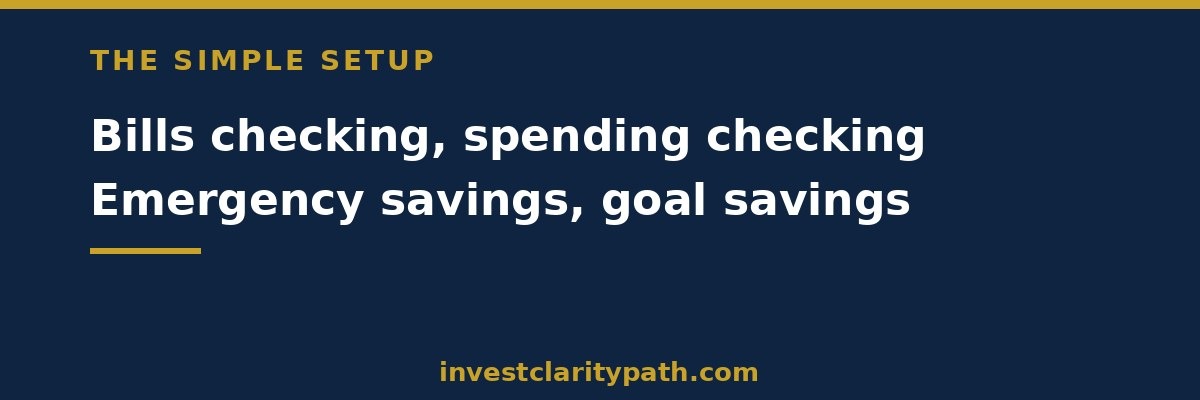
The simple setup that works for most people
If you are starting from one account today, do not open four accounts at once. Add them one at a time, in this order.
First, open a high-yield savings account for your emergency fund. Move your emergency money there, and set up a small automatic transfer on payday, even 25 dollars. This one change does the most good, because it separates safety money from spending money and starts earning interest.
Second, if your goal is a vacation or a car, open a second savings account for that goal. Name the account after the goal, so every time you see it, you remember what it is for. Most banks let you nickname an account for free.
Third, consider a second checking account for spending if you find yourself dipping into bill money. Keep your bills in the first checking account and your spending money in the second. Move your spending money over on payday, and when the spending account is empty, the month is done.
Fourth, only add more accounts when a new goal appears. A new goal means a new account. No new goal means no new account. That rule keeps the setup from growing out of control.
Worked example: Maya splits her 4,800 dollars
Maya takes home 4,800 dollars a month. She used to keep it all in one checking account, and she kept spending her emergency money by accident. Here is her new setup.
Her bills checking account gets 2,200 dollars a month. Rent is 1,400 dollars, utilities are 250 dollars, phone is 80 dollars, insurance is 220 dollars, and her car payment is 250 dollars. 1,400 plus 250 plus 80 plus 220 plus 250 equals 2,200. Every bill is paid by automatic payment from this account.
Her spending checking account gets 800 dollars a month. That covers groceries, transport, and fun money. When the 800 dollars is gone, she stops spending until next payday.
Her emergency savings account gets 800 dollars a month until it reaches 14,400 dollars, which is 3 months of her 4,800 dollar take-home pay. After that, she will cut the transfer to 200 dollars a month and send the rest to her other goals.
Her vacation savings account gets 300 dollars a month. In ten months, that is 3,000 dollars, enough for the trip she is planning.
Her car fund gets 400 dollars a month, and her extra debt payment gets 300 dollars a month. 2,200 plus 800 plus 800 plus 300 plus 400 plus 300 equals 4,800, her full take-home pay. Every dollar has a job before the month starts, and she can see each balance separately.
Maya keeps her emergency fund at a different bank from her checking accounts. That way, moving emergency money into spending takes a day or two, which stops impulse spending. Her spending account has a debit card. Her savings accounts do not.
To choose the right savings account for the emergency fund, read our guide on choosing a savings account. To compare keeping savings in one account or several, read our guide on that question.

When one account is enough
Multiple accounts are not right for everyone. One account can be enough if your finances are simple. If you earn a steady pay, your bills are few, and you have no savings goal yet, a single checking account plus a single savings account is plenty. That is two accounts, which is already the minimum most experts suggest.
One account may also be better if your balances are small. Some banks charge a monthly fee or require a minimum balance on each account. If splitting 500 dollars across four accounts means each one falls below the minimum and earns a fee, you lose money instead of saving it. In that case, keep one checking and one savings account, and split your money into goals with a simple list or a budgeting app instead of separate accounts.
Also, if you struggle to keep track of logins and balances, fewer accounts are better. A simple setup you use beats a perfect setup you ignore.
The downsides to watch
First, fees. Some accounts charge a monthly maintenance fee if your balance falls below a minimum or if you do not meet a direct deposit requirement. Spreading your money thin can trigger fees in several accounts at once. Before you open an account, check the fee rules and the minimum balance, and choose accounts with no monthly fee.
Second, tracking. More accounts mean more statements, more logins, and more balances to check. If you forget an account exists, money can sit idle for years. Use one banking app that shows all your accounts together, and close accounts you no longer use instead of leaving them empty.
Third, chasing promo rates. Some banks offer a high rate for a few months to attract new customers, then drop it. If you open a new account for every promo, you end up with money scattered across accounts that no longer pay well. Pick an account with a strong ongoing rate, and check it twice a year instead of chasing every offer.
How to set up your accounts step by step
Start by listing your monthly bills and your savings goals on one page. Write the fixed bills, the spending money, the emergency fund target, and each goal with its target amount and date.
Next, check your current bank. Does it offer a high-yield savings account with no monthly fee, and can you open extra savings accounts and nickname them? If yes, open your new accounts there. If no, open a high-yield savings account at a different bank or credit union. You do not have to move your checking account to move your savings.
Then set up automatic transfers for payday. Money that moves on its own gets saved. Money that waits for you to remember gets spent. Set the transfer for the day your pay arrives.
Then label every account clearly: Bills, Spending, Emergency, Vacation, Car. A clear name stops mistakes. You will never send bill money to the wrong account if the names are plain.
Finally, review once a month: check each balance, check for fees, and close any account you no longer need.
To compare banks and credit unions before you open anything, read our guide. To understand the difference between a savings account and a money market account, read our guide.
Common mistakes to avoid
The first mistake is opening too many accounts at once. Five new accounts in one week means five new logins, five new cards, and five new statements. Open one, use it for a month, then open the next.
The second mistake is keeping your emergency fund in the same account as your spending money. If the money is one tap away, it is not an emergency fund. It is a spending account with a hopeful name. Keep it separate, and ideally at a different bank.
The third mistake is forgetting about fees. A 5 dollar monthly fee on a small account wipes out a year of interest. Check the fee rules before you open the account, and check your statements for fees every month.
The fourth mistake is leaving old accounts open and empty. An empty account you forgot about can still be charged a fee, or closed by the bank without you noticing. If you stop using an account, close it properly and move the money.
The fifth mistake is saving in checking and spending from savings. Checking is for spending and savings is for saving. Do it backwards and the accounts cannot help you.
Frequently asked questions
How many bank accounts should I have?
Most people do well with three to five accounts: one or two checking accounts and two or three savings accounts. At minimum, have one checking account for spending and bills and one savings account for emergencies. Add one savings account per big goal, and stop there.
Is it bad to have multiple bank accounts?
No, it is not bad by itself. Multiple accounts help you earn more interest, separate your goals, and protect more of your money with deposit insurance. It only becomes a problem if the accounts charge fees, if you lose track of them, or if you open accounts just to chase short-term promo rates.
Does having multiple bank accounts hurt my credit score?
No. Bank accounts are not credit accounts, and opening a checking or savings account does not affect your credit score.
Should my emergency fund be at a different bank?
It helps. Keeping your emergency fund at a different bank adds a one to three day delay to transfers, which stops impulse spending. It also gives you a backup if your main bank has an outage. It is not required, but many people find it makes the fund easier to leave alone.
How many savings accounts should I have?
One for emergencies, plus one for each big goal you are saving for. If you have an emergency fund and one goal, that is two savings accounts. If you have three goals, that is four. More than that usually adds clutter without adding clarity.
Conclusion, and your first step today
Should you have multiple bank accounts? For most people, yes. One checking account for bills, one for spending, one high-yield savings account for emergencies, and one savings account per goal is a setup that works for years. It earns you more interest, keeps your goals separate, protects more of your money, and gives you a backup when something goes wrong. Just keep it simple, watch the fees, and close accounts you stop using.
Your first step today is simple. Open one high-yield savings account for your emergency fund, move your emergency money into it, and set up a small automatic transfer for payday. That single move does most of the work.
If money is tight and saving feels hard, read our guide on keeping saving when money is tight.
This post is educational only. It is not financial advice.
