


How Do I Earn Side Income From Selling Handmade Crafts?
How do I earn side income from selling handmade crafts?
You earn side income from handmade crafts by making something people want, pricing it so your time is paid, and selling it where buyers already shop. Most beginners start on Etsy, the largest marketplace for handmade goods, with three to five products, good photos, and a price that covers materials, your hours, and the platform fees. Others sell at local craft fairs and farmers markets, or through Instagram and their own small website.
You do not need a big budget or a business degree. You need one craft you enjoy, a small set of products, and a simple plan for pricing and selling. This guide shows how to pick your craft, price it properly, choose where to sell, and grow from a first sale to a steady side income.
This post is educational only. It is not financial advice.
Pick a craft people will pay for
Start with what you already enjoy making, then check whether buyers want it. The most popular handmade categories are jewellery, candles, soaps and bath products, crochet and knitted items, pottery and ceramics, woodwork and small decor, hand painted signs, greeting cards, stickers, and personalised gifts such as name signs, custom mugs, and wedding decor.
Pick one category, not five. A shop with five strong candle listings sells better than a shop with one candle, one scarf, one painting, and one soap. Buyers trust a focused shop, and you get faster at making one thing well.
Ask three questions before you commit. First, can you make it well and repeat it? A product you can make the same way every time is a product you can sell again and again. Second, is there demand? Search Etsy and see how many shops sell similar items and how many sales they show. Third, can you ship it safely? Heavy, fragile, or meltable items cost more to pack and post, and that eats your profit.
Custom and personalised crafts often earn more than standard ones, because buyers pay extra for their name, their date, or their pet on the product. Digital crafts, such as printable planners, colouring pages, and SVG files, are worth considering too, because they need no inventory and no shipping. They take time to create once and can sell many times.
Price your hours, not just your materials
The most common mistake new makers make is pricing for materials only. If your materials cost 4 dollars and you sell the item for 10 dollars, you have 6 dollars left for your time, your fees, and your profit. That is not a business. That is a hobby that pays less than minimum wage.
Use this simple pricing formula: materials plus your labour plus packaging plus platform fees, then add your profit. Work out your labour honestly. If a candle takes 30 minutes to make and you value your time at 20 dollars an hour, your labour cost is 10 dollars. Do not value your time at zero just because you enjoy the work.
Here are the Etsy fees you must include, from Etsy’s own Fees and Payments Policy. Each listing costs 0.20 dollars, and listings expire after four months. When you make a sale, Etsy charges a transaction fee of 6.5 percent of the price you display plus the amount you charge for shipping and gift wrapping. A payment processing fee also applies, and it varies by country, so check the current figure for your country on the Etsy fee page before you set your prices. If your shop makes less than 10,000 dollars in sales over the past year, Etsy may also charge a 12 to 15 percent Offsite Ads fee on orders that come from its outside advertising, unless you opt out while you are under that threshold.
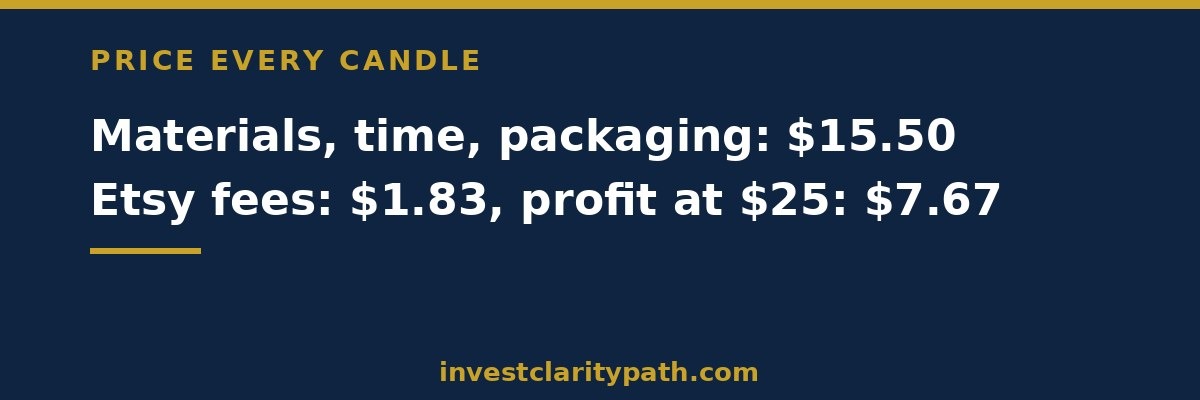
A quick check on a 25 dollar candle shows why the formula matters. Materials 4 dollars, labour 10 dollars, packaging 1.50 dollars, listing fee 0.20 dollars, and a transaction fee of 6.5 percent of 25 dollars, which is 1.63 dollars. The total cost is 17.33 dollars, so your profit is 7.67 dollars. That is a fair price for 30 minutes of skilled work. If you priced the same candle at 15 dollars, your profit would be almost nothing, and a single bad batch would wipe it out.
A common starting rule from experienced sellers is to price at two and a half to three times your materials cost, but always check that against your labour and fees. If the formula gives a higher price than the rule, trust the formula.
Where to sell: Etsy, markets, or your own site
Most makers use two or three channels at once, not all of them. Start with the channel closest to where your buyers already are.
Etsy is the best first step for most beginners. The buyers are already there, searching for handmade goods. The trade off is competition and fees, and Etsy’s algorithm changes often. Treat Etsy as your shop window, not your whole business.
Your own website, on Shopify, Squarespace, or Wix, gives you control and lower platform fees, but you must bring your own traffic. This is the right second step once you have regular buyers and you want to keep more of each sale.
Local markets and craft fairs give you direct feedback and no platform fees, but only on the days you are there. A farmers market, a holiday market, or a local art walk is a good place to test whether people will pay your price before you invest in an online shop.
Social media, mainly Instagram and TikTok, works well for visual crafts. Post the making process, not just the finished product. Buyers who watch you pour a candle or throw a pot are far more likely to buy one. Take commissions through direct messages, and ask every happy buyer for a review, because reviews drive the next sale.
Worked example: Ana sells candles and earns 307 dollars a month
Ana makes soy candles in her kitchen. Each candle costs 4 dollars in wax, fragrance, and a jar. It takes her 30 minutes to make one, and she values her time at 20 dollars an hour, so labour is 10 dollars. Packaging costs 1.50 dollars. She sells on Etsy at 25 dollars with free shipping, and she absorbs the shipping cost separately, so the example below leaves shipping out and treats it as a cost she tracks on its own.
Her cost per candle: materials 4 dollars, plus labour 10 dollars, plus packaging 1.50 dollars, plus the 0.20 dollar listing fee, plus the 6.5 percent transaction fee on 25 dollars, which is 1.63 dollars. That totals 17.33 dollars. Her profit per candle is 25 dollars minus 17.33 dollars, which is 7.67 dollars.
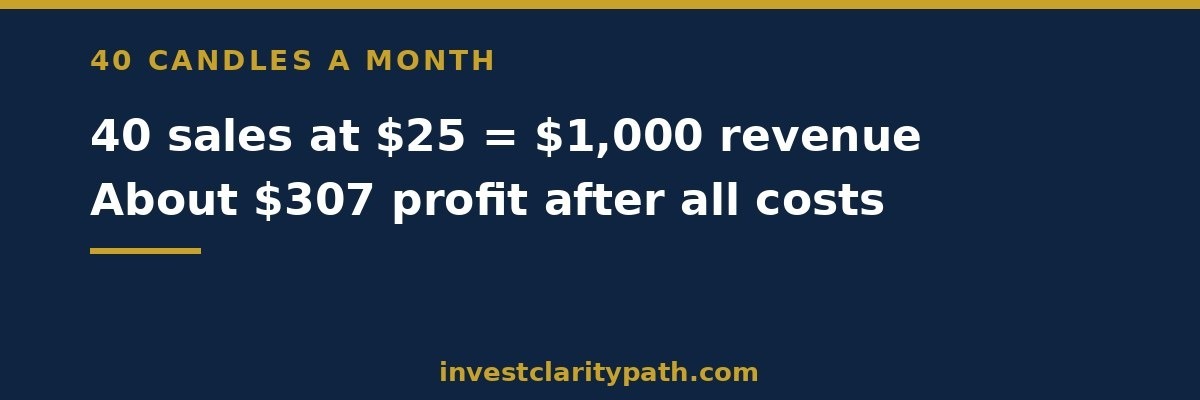
Ana sells 40 candles a month. Her revenue is 40 times 25 dollars, which is 1,000 dollars. Her costs are 40 times 17.33 dollars, which is 693.20 dollars. Her profit is 1,000 dollars minus 693.20 dollars, which is 306.80 dollars a month, or about 307 dollars.
That is a realistic first year side income, not a fortune. To grow it, Ana has three levers. She can sell more candles, she can raise her price as reviews build, or she can add a second product with a better margin, such as a larger candle or a gift set. What she should not do is cut her price to sell more, because at 15 dollars a candle her profit would fall to almost nothing.
Ana also sets aside money for tax. In the United States, self employment income is subject to self employment tax for Social Security and Medicare, and the IRS explains the rules on its self employment tax page. The exact tax depends on your country and your total income, so check your local rules or ask a tax professional. Keep a simple record of every sale and every cost from day one, so tax time is a small job, not a panic.
Your first four weeks: a simple launch plan
Week one: finalise three to five signature products. Work out the cost of each one with the pricing formula, and set the price. Order your materials from a reliable supplier.
Week two: take your photos. Use natural light and a clean background. Show several angles, a close up of the detail, and one lifestyle shot, such as a candle lit in a room, or jewellery worn on a wrist. Write each listing like a short story: what it is, what it is made of, how big it is, who it is for, and why you made it.
Week three: open your shop and list the products. Set up your shop name, your policies on shipping and returns, and your payment details. List one product a day so you learn the system without rushing.
Week four: tell people. Post the making process on social media. Tell friends and family. Book one local market or fair if you can. Ask your first buyers for a review, and answer every message within a day. A buyer who messages you is ready to buy, and a fast reply often closes the sale.
After the first month, look at the numbers. Which product sold? Which listing got the most views? Double down on the winner, drop or fix the loser, and add one new product a month. Growth in a craft business is slow and steady, not overnight.
To compare this side income with other beginner options, read our guide on the simplest side income for beginners. If you have no craft skills yet and want something with no startup cost, read our guide on side income you can start with no skills. And if you want a fast first win, read our guide on side income you can start in one weekend.
Common mistakes to avoid
The first mistake is underpricing. If you price for materials only, you will burn out by month three, because the hours do not pay. Price your time, every time.
The second mistake is listing too many products too soon. A shop with twenty half finished listings looks messy. Start with three to five strong products and add one a month.
The third mistake is bad photos. Buyers can only judge what they see. Blurry photos, dark rooms, and cluttered backgrounds lose sales that good photos would win. Natural light and a plain background cost nothing.
The fourth mistake is ignoring the fees. A 6.5 percent transaction fee, a listing fee, a payment processing fee, and possibly an Offsite Ads fee can take a quarter of a low price. Work the fees into the price before you list, not after the first sale.
The fifth mistake is treating it as a hobby with no records. Keep a simple sheet of sales, costs, and fees from the first day. It takes five minutes a week, and it makes pricing, tax, and growth decisions easy.
Frequently asked questions
How much money can I make selling handmade crafts?
It depends on your price, your volume, and your costs. A realistic example is 40 candles a month at 25 dollars, which gives about 307 dollars of profit after materials, labour, fees, and packaging. Some makers earn far more, but only after building reviews, repeat buyers, and several products.
Is Etsy worth it for beginners?
Yes, for most beginners. Etsy has the buyers already searching for handmade goods, which is the hardest part of selling. The fees are real, so price them in. Use Etsy for discovery, and build your own shop or social media following alongside it so you are not fully dependent on one platform.
What handmade crafts sell best?
Jewellery, candles, soaps, crochet and knitted items, pottery, personalised gifts, and paper crafts such as stickers and greeting cards are consistently popular. Custom and personalised items often earn more, because buyers pay extra for something made just for them.
How do I price handmade crafts?
Add materials, your labour at a fair hourly rate, packaging, and all platform fees, then add your profit. Check the result against the common rule of two and a half to three times materials cost. If your formula gives a higher price, trust the formula.
Do I need a business licence to sell crafts?
It depends on your country and your local area. Some places need a licence, a tax registration, or a food safety certificate for items such as soaps and candles. Check your local rules before your first sale, and keep records from day one.
How much does it cost to start selling handmade crafts?
You can start small. Materials for your first batch, packaging, a few listing fees at 0.20 dollars each, and a phone camera are often enough. Many makers start with less than 100 dollars of materials and grow by reinvesting their profits.
Conclusion, and your first step today
Handmade crafts can be a real side income, but only if you treat it like a small business. Pick one craft, price your hours as well as your materials, sell where buyers already shop, and grow one product at a time. A single candle that earns 7.67 dollars of profit becomes 307 dollars a month at 40 sales, and that is a solid start.
Your first step today is simple. Choose your craft, make three items, and work out the full cost of one of them with the pricing formula, including your time and the Etsy fees. If the price looks fair and the profit is real, take your photos and list it.
This post is educational only. It is not financial advice.
