


How Do I Plan for Retirement in My 20s?
How do I plan for retirement in my 20s?
To plan for retirement in your 20s, work in this order. First, build a small emergency fund of 1,000 dollars. Second, contribute enough to your workplace 401(k) to get the full employer match. Third, pay down high interest debt. Fourth, open a Roth IRA and contribute what you can. Fifth, work toward saving 15 percent of your pay for retirement in total, including the employer match. Automate every step so it happens on payday without you thinking about it.
You do not need a large salary to start. You need a habit, a little time, and the right order. Your 20s give you something no amount of money can buy later: forty years for small contributions to grow.
This post is educational only. It is not financial advice.
Why your 20s matter more than your salary
Retirement planning in your 20s is not about how much you earn. It is about how long your money has to grow. A dollar saved at 25 has forty years to grow before retirement at 65. A dollar saved at 35 has only thirty years.
Here is an illustration, using an assumed average return of 7 percent a year. This is an assumption for the example only, not a fact and not a forecast. If you save 200 dollars a month from age 25 to 65, you will have paid in 96,000 dollars. 200 times 480 months equals 96,000. At the assumed 7 percent average return, the balance grows to about 525,000 dollars. If you wait and start at 35, saving the same 200 dollars a month to 65, you will have paid in 72,000 dollars, and at the same assumed return the balance grows to about 244,000 dollars.
Step 1: Build a small emergency fund first
Before you put money into retirement accounts, build a small emergency fund of 1,000 dollars in a high yield savings account. This is not your full emergency fund. Your full fund should cover three to six months of expenses, and you will build it over time. The 1,000 dollar starter fund has one job: it stops a surprise bill from forcing you to raid your retirement savings or borrow on a credit card.
Retirement accounts are hard to reach before age 59 and a half. Taking money out early usually means tax plus a 10 percent penalty. An emergency fund keeps you from ever needing to do that. Once the 1,000 dollars is saved, capture the employer match first, then keep building the emergency fund alongside your retirement contributions.
Read our step by step guide to building an emergency fund from zero.
Step 2: Capture the full employer match
If your employer offers a 401(k) with a matching contribution, capturing the full match is your first retirement priority. A match is money your employer adds to your retirement account based on how much you contribute. A common formula is 50 percent of the first 6 percent of your pay that you contribute. If you earn 50,000 dollars and contribute 6 percent, which is 3,000 dollars a year, your employer adds 1,500 dollars.
To capture it, find out your plan’s match formula. Ask human resources or read the plan summary. Then set your contribution high enough to get the whole match.
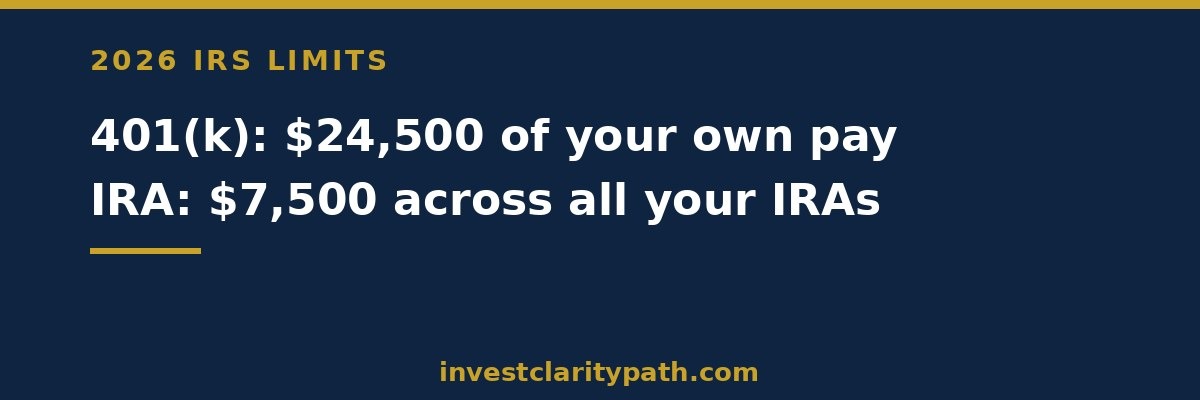
For 2026, the IRS limit on how much of your own pay you can put into a 401(k) is 24,500 dollars. That limit is far above what most people in their 20s contribute, so it will not hold you back. What matters now is the match, not the limit. Learn how a 401(k) works in our beginner guide. And read our guide to the employer match.
Step 3: Open a Roth IRA
After you capture the full employer match, the next step for most people in their 20s is a Roth IRA. An IRA is an individual retirement account that you open yourself, outside your employer. A Roth IRA uses after tax money, which means you pay tax on the money now, and qualified withdrawals in retirement are tax free. That trade is attractive in your 20s, because your tax rate is likely lower now than it will be later.
For 2026, the IRS limit for IRA contributions is 7,500 dollars a year across all your traditional and Roth IRAs combined, if you are under 50. That works out to 625 dollars a month. 7,500 divided by 12 equals 625. You do not need to contribute the full amount. Even 50 or 100 dollars a month is a strong start.
You can open a Roth IRA at most large brokerages, often with no minimum deposit. Inside the account, you choose investments. For most beginners, a low cost target date fund or a broad stock index fund is the simplest choice. A target date fund picks a mix of investments based on the year you plan to retire, and it adjusts the mix as you age. Do not leave the money sitting in cash inside the IRA. Cash in a retirement account does not grow the way invested money can.
Step 4: Work toward 15 percent of your pay
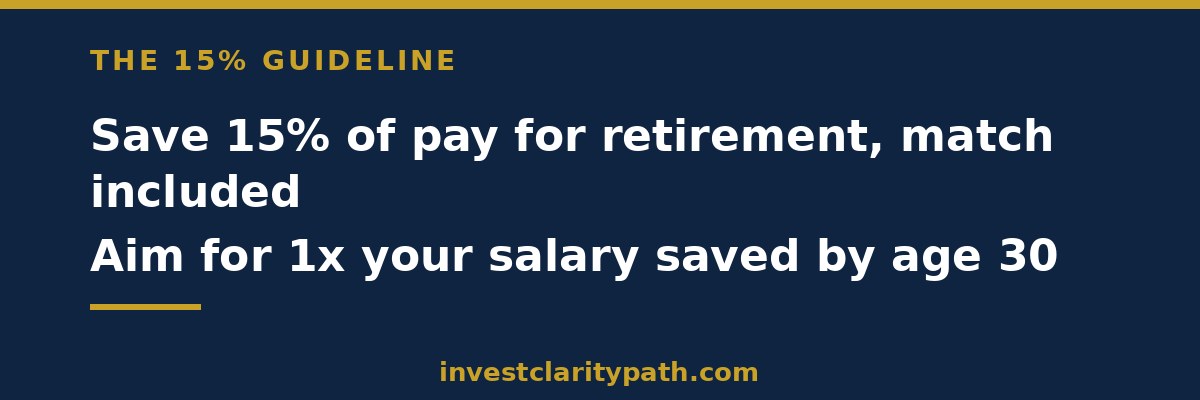
The most widely used guideline for retirement saving is to save 15 percent of your pre tax income each year, including any employer match. Empower, the financial services firm, states this guideline in its retirement guide, and Fidelity uses the same 15 percent figure in its savings guidelines. The guideline assumes you start saving at 25 and retire at 67. It is a guideline, not a rule.
Here is what 15 percent looks like in dollars. On a 40,000 dollar salary, 15 percent is 6,000 dollars a year, or 500 dollars a month. On a 60,000 dollar salary, it is 9,000 dollars a year, or 750 dollars a month. On an 80,000 dollar salary, it is 12,000 dollars a year, or 1,000 dollars a month.
If 15 percent feels impossible today, do not give up. Start with the match, then add 1 percent each year, or raise your contribution every time you get a pay rise.
Fidelity also gives age based milestones to check your progress. Aim to have saved about 1 times your salary by age 30, 3 times by 40, 6 times by 50, 8 times by 60, and 10 times by 67. These are guideposts, not pass or fail tests.
Step 5: Keep your investments simple and your fees low
In your 20s, the most important investment choices are simple ones. First, invest mostly in low cost stock index funds, which hold a broad mix of companies and charge low fees. Second, keep your fees low, because fees compound just like returns do. A fund that charges 1 percent a year takes a large bite out of your balance over forty years. A fund that charges 0.10 percent a year takes a small bite. Third, do not try to pick winning stocks or time the market.
A target date fund is a good default. It holds a mix of stock and bond index funds, and it slowly becomes more conservative as you approach retirement. Check the fees in your 401(k) and your IRA once a year. Look for the expense ratio, which is the yearly cost of a fund as a percentage of your balance. Below 0.20 percent is low. Above 1 percent is high. If your 401(k) only offers expensive funds, contribute enough to get the match, then put extra savings in your Roth IRA, where you can choose low cost funds yourself.
Step 6: Automate everything, and raise it with every raise
The best retirement plan is the one that runs without willpower. Set your 401(k) contribution to come out of every paycheck automatically. Set your Roth IRA contribution to transfer automatically on payday. When saving is automatic, you do not have to decide each month, and you do not spend the money first.
Then use a simple rule for raises. Every time your pay rises, send at least half of the raise to retirement before you get used to the extra money. If you get a 200 dollar a month raise, send 100 dollars to your 401(k) or Roth IRA.
Review your plan once a year. Check your contribution rate, your investment choices, and your fees. If you changed jobs, make sure your old 401(k) is not forgotten. You can usually roll it into your new employer’s plan or into an IRA. Do not cash it out, because cashing out means tax plus a 10 percent penalty. If you are still unsure when to begin, read our guide on when to start saving for retirement.
Worked example: Maya, age 25, earns 50,000 dollars
Maya is 25, earns 50,000 dollars a year, and has no retirement savings yet. Her employer matches 50 percent of the first 6 percent she contributes to her 401(k). First, she saves a 1,000 dollar starter emergency fund in four months, saving 250 dollars a month.
Second, she contributes 6 percent of her pay to her 401(k). 50,000 times 0.06 equals 3,000 dollars a year, or 250 dollars a month. Her employer adds 50 percent of that, which is 1,500 dollars a year, or 125 dollars a month. Together, 375 dollars a month goes into her 401(k).
Third, she opens a Roth IRA and contributes 100 dollars a month, which is 1,200 dollars a year. Her total retirement saving is 475 dollars a month, which is 5,700 dollars a year. 475 times 12 equals 5,700. On a 50,000 dollar salary, that is 11.4 percent of her pay. 5,700 divided by 50,000 equals 0.114. She is below the 15 percent guideline, but she is saving, and she has a clear path to raise it.
Fourth, she sets a rule. Every year, she raises her 401(k) contribution by 1 percent of her pay. By year five, she contributes 10 percent, which is 5,000 dollars a year, plus the 1,500 dollar match and the 1,200 dollar Roth IRA, for a total of 7,700 dollars a year. That is 15.4 percent of her pay, above the guideline.
Now the growth illustration, using the same assumed 7 percent average annual return as before. This is an assumption, not a forecast. If Maya saves 375 dollars a month in her 401(k) from 25 to 65, the balance grows to about 984,000 dollars at the assumed return. If she also keeps the 100 dollar Roth IRA contribution going, that adds about 262,000 dollars, for a combined total of about 1,246,000 dollars. Real returns go up and down, so the exact number will differ. The point is that starting at 25, with modest monthly amounts, puts a large balance within reach.
What about student loans and other debt?
Many people in their 20s carry student loans, and the question is always the same: pay off debt first, or save for retirement first? The answer is to do both, in order.
First, capture the full employer match, because no debt payoff beats a 50 percent instant return. Second, build the 1,000 dollar starter emergency fund. Third, pay down high interest debt, such as credit cards charging 20 percent or more, because no investment reliably earns that much. Fourth, contribute to a Roth IRA. Fifth, pay down lower interest debt, such as student loans at 5 or 6 percent, while keeping your retirement contributions going.
If your student loan rate is low and your employer offers a match, do not wait until the loan is gone to start saving. Ten years of lost growth costs more than the interest you save by paying the loan off a year early.
Common mistakes to avoid
The first mistake is waiting to start. Every year you wait costs more than the year before it, because lost growth compounds.
The second mistake is skipping the employer match. If you contribute less than the match requires, you are turning down free money.
The third mistake is cashing out a 401(k) when you change jobs. Cashing out means tax plus a 10 percent penalty, and it throws away decades of growth. Roll the money into your new plan or an IRA instead.
The fourth mistake is leaving IRA money in cash. A Roth IRA is an account, not an investment. You must choose investments inside it, or the money will not grow.
The fifth mistake is borrowing from your 401(k). A loan means your money stops growing while it is borrowed, and if you leave the job, the loan often comes due at once.
Frequently asked questions
How much should I save for retirement in my 20s?
Aim for 15 percent of your pre tax income each year, including any employer match. On a 50,000 dollar salary, that is 7,500 dollars a year, or 625 dollars a month. If you cannot reach 15 percent yet, start with enough to get the full employer match, then raise your rate by 1 percent a year.
Should I choose a 401(k) or a Roth IRA first?
Capture the full 401(k) match first, then open a Roth IRA. The match is an instant return you cannot get anywhere else. After the Roth IRA, go back and raise your 401(k) contributions. For a full comparison, read our guide on choosing between a 401(k) and an IRA.
What if my employer does not offer a 401(k)?
Use a Roth IRA as your main retirement account. For 2026, you can contribute up to 7,500 dollars a year to your IRAs combined. Our guide on setting up a Roth IRA explains the first steps.
How much should I have saved by 30?
Fidelity’s guideline is about 1 times your annual salary by age 30. On a 50,000 dollar salary, that is 50,000 dollars. It is a guidepost, not a test. Read our guide on how much to have saved by 30.
Is it too late to start at 29?
No. Starting at 29 still gives you 38 years before retirement at 67. Start with the match, open a Roth IRA, and raise your rate each year.
Conclusion, and your first step today
Planning for retirement in your 20s comes down to order and habit, not to a large salary. Build a 1,000 dollar starter emergency fund. Capture the full employer match. Open a Roth IRA. Work toward 15 percent of your pay, including the match. Keep your investments simple and your fees low, automate everything, and raise your rate with every raise.
Your first step today is simple. Log in to your workplace retirement plan, or ask human resources for the match formula, and set your contribution high enough to get the full match. If you have no workplace plan, open a Roth IRA and set up a 50 dollar monthly transfer.
This post is educational only. It is not financial advice.
Sources
- IRS, Retirement Topics, 401(k) and Profit-Sharing Plan Contribution Limits: https://www.irs.gov/retirement-plans/plan-participant-employee/retirement-topics-401k-and-profit-sharing-plan-contribution-limits
- IRS, Retirement Topics, IRA Contribution Limits: https://www.irs.gov/retirement-plans/plan-participant-employee/retirement-topics-ira-contribution-limits
- Empower, How Much Should I Save for Retirement?: https://www.empower.com/the-currency/life/how-much-should-i-save-for-retirement
