


How Much Income Will I Need in Retirement?
How much income will I need in retirement?
Most financial planners use a simple starting point: you will need about 70 to 80 percent of your pre-retirement income, each year, to keep a similar standard of living in retirement. If you earn 60,000 dollars a year now, that means about 45,000 dollars a year in retirement, because 60,000 times 0.75 is 45,000.
Why less than 100 percent? Because some costs stop when work stops. You no longer pay payroll taxes on that income, you are no longer saving 10 to 15 percent of your pay for retirement, and work costs like commuting and work clothes go away. If your mortgage is paid off by then, housing costs fall too. But some costs rise, especially healthcare, and travel and hobbies can add new spending, so the range is wide, and your own budget is always better than a rule of thumb.
This guide explains the 70 to 80 percent rule, the three sources of retirement income, the gap method for finding your own number, and the 4 percent rule for turning that number into a savings target. It is educational only. It is not financial advice.
The three sources of retirement income
Retirement income usually comes from three sources, often called the three-legged stool. If one leg is short, the other two have to carry more weight.
The first leg is Social Security. It pays a monthly benefit for life, based on your work history, and it usually rises most years to keep up with prices. For most people, it replaces only about 40 percent of pre-retirement income, so it is a base, not the whole plan. The amount depends on your earnings record and the age you claim. For anyone born in 1960 or later, full retirement age is 67. Claiming at 62 cuts the monthly check by about 30 percent for life, while waiting until 70 adds about 8 percent for each year past 67.
The second leg is employer plans, such as a 401(k), a 403(b), or a pension. This is the money you and your employer set aside during your working years, plus whatever it grows to. It is usually the biggest leg for people who had a workplace plan, and it is the one you have the most control over, through your contribution rate and your investment choices.
The third leg is personal savings and investments, such as an IRA, a taxable investment account, or other savings. This is the money you set aside yourself, outside work, and it fills whatever gap is left after the first two legs.
The 70 to 80 percent rule, and its limits
The 70 to 80 percent rule says a retiree needs 70 to 80 percent of pre-retirement income to live about the same way. T. Rowe Price, a large investment firm, suggests 75 percent. Research by Morningstar found the right figure can range from about 54 percent to 87 percent, depending on taxes, savings rates, and income level. So the rule is a starting point, not an answer.
The rule works best for people whose spending will stay similar in retirement. It works less well in two cases. If you plan to spend far less, because your home is paid off and your tastes are simple, you may need less than 70 percent. If you plan to spend far more, because you want to travel a lot, help family, or pay for expensive healthcare, you may need more than 80 percent.
The most accurate method is to build a real retirement budget, line by line, with your own numbers. List housing, healthcare, food, transport, travel, insurance, and taxes. Healthcare is the cost people underestimate most. But if you are years away from retirement and want a quick estimate, the 70 to 80 percent rule is the right place to start, and the gap method below turns it into a savings target.
The gap method, step by step
The gap method has three steps, and it is the clearest way to find your own number.
Step 1: Work out the yearly income you want in retirement, in today’s money. Use 75 percent of your current income as a starting point, or use your own budget if you have one. Step 2: Work out your guaranteed income, mainly Social Security, and any pension. Get your own Social Security estimate from your my Social Security account, rather than using an average, because your benefit depends on your own earnings record. Step 3: Subtract step 2 from step 1. The difference is the gap, the yearly income your savings must provide on their own.
The gap is the number that matters, because it is the only part your savings have to cover. Everything else is already paid for by Social Security or a pension. Once you know the gap, you can turn it into a savings target with the 4 percent rule.
A worked example: 60,000 dollars a year today
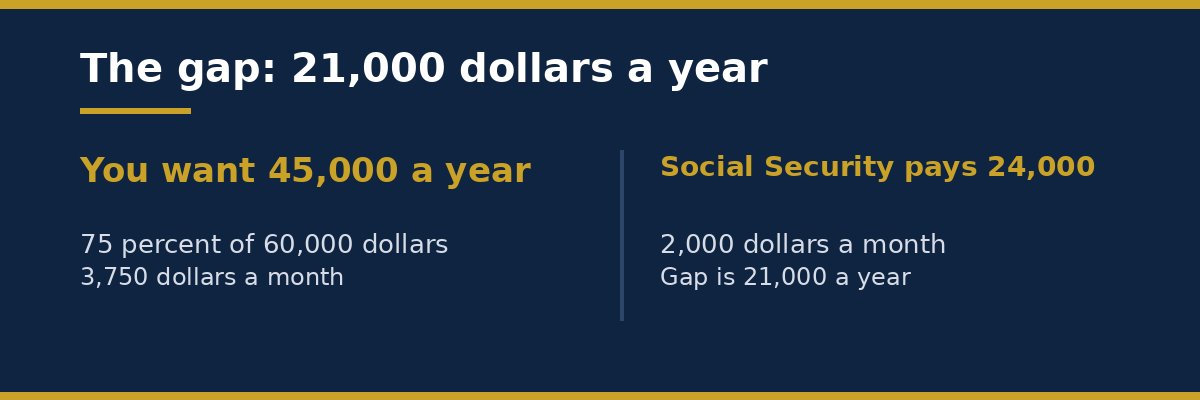
Imagine you earn 60,000 dollars a year now, and you want 75 percent of that in retirement. Step 1: 75 percent of 60,000 is 45,000 dollars a year, because 60,000 times 0.75 is 45,000. That is 3,750 dollars a month, because 45,000 divided by 12 is 3,750.
Step 2: Your Social Security estimate is 2,000 dollars a month, which is 24,000 dollars a year, because 2,000 times 12 is 24,000. You have no pension.
Step 3: The gap is 45,000 minus 24,000, which is 21,000 dollars a year, because 45,000 minus 24,000 is 21,000. That is 1,750 dollars a month, because 21,000 divided by 12 is 1,750. Your savings must provide 21,000 dollars a year, every year, for as long as you live in retirement.
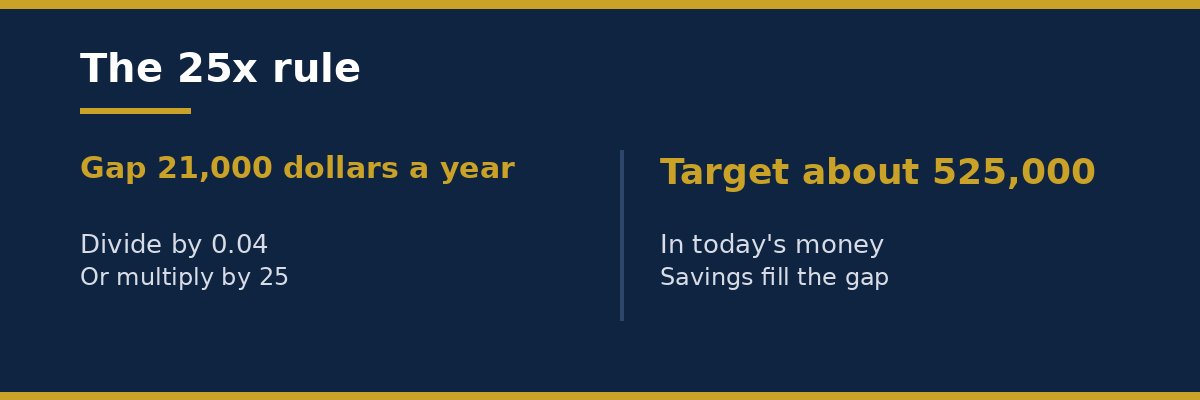
Now turn the gap into a savings target with the 4 percent rule. The rule says you can withdraw 4 percent of your savings in the first year of retirement, then adjust that amount for inflation each year, aiming for the money to last about 30 years. To find the target, divide the yearly gap by 0.04. For our example, 21,000 divided by 0.04 is 525,000 dollars, because 21,000 times 25 is 525,000. That is the 25x rule: your savings target is about 25 times the yearly gap.
So the answer for this example is a savings target of about 525,000 dollars, in today’s money, to go with a Social Security benefit of 2,000 dollars a month. Change any number, the income, the replacement rate, or the Social Security estimate, and the target moves. That is why your own numbers matter more than any round number you read online.
What if the target looks impossible?
A target of 525,000 dollars can look impossible from where you stand today, and that feeling is normal. The number is not a bill due tomorrow. It is a target for the day you retire, which may be 20 or 30 years away, and you have all that time to build toward it.
Three things move the target more than anything else. The first is starting early, because growth over decades does most of the work. The second is your contribution rate, because every extra percent of pay you save now is money that compounds for years. The third is the gap itself, because a smaller gap means a smaller target. Working a few years longer, claiming Social Security later, or planning to spend a little less, all shrink the gap, and the target with it.
If you are behind, do not try to fix it all at once. Raise your contribution by 1 percent now, and by 1 percent each year, or each time you get a raise. Catch-up contributions, extra amounts allowed for people aged 50 and over, help too. And remember that the target is in today’s money. Your pay will rise over time, and your savings will grow with it, so the target is a direction, not a verdict.
Related reading in the Retirement Planning cluster: how much should you save for retirement, what a 401(k) is in simple terms, what a Roth IRA is in simple terms, when you can retire, and what Social Security is in simple terms.
Frequently asked questions
Is the 4 percent rule still safe?
It is a guideline, not a guarantee. The rule was designed for a 30-year retirement, and it assumes a mix of stocks and bonds, with withdrawals rising with inflation each year. Recent research suggests a slightly lower starting rate, around 3.8 percent, may be safer in some cases. The exact safe rate depends on how long you live, how markets perform, and how flexible your spending is. Treat the 4 percent rule as a planning tool, not a promise.
Does Social Security alone cover retirement?
For most people, no. Social Security replaces only about 40 percent of pre-retirement income on average, while most people need 70 to 80 percent to keep their standard of living. That leaves a gap of 30 to 40 percent of income, which has to come from savings, a pension, or work. Social Security is a base, not a complete plan.
What if I retire early, before 65?
Retiring early makes the math harder in two ways. You need income for more years, and you have fewer years to save. You also need to cover healthcare before Medicare starts at 65, which can be expensive. If early retirement is your goal, the gap method still works, but use a longer retirement, and add healthcare costs explicitly, because they are the biggest surprise for early retirees.
How does inflation change my number?
Inflation means the same life costs more each year, so your target in today’s money is not the amount you will actually need on retirement day. In our example, the target is 525,000 dollars in today’s money. If prices rise 3 percent a year for 25 years, that same life would need about twice as much in future dollars. The 4 percent rule already accounts for this, because it adjusts withdrawals for inflation each year, but your savings target should be read in today’s money, not future money.
Should I use 70, 75, or 80 percent?
Use 75 percent as a starting point if you are unsure, then adjust it to your own life. Use a lower number if your home will be paid off, your spending is modest, and your healthcare costs are covered. Use a higher number if you plan to travel a lot, support family, or pay for care. The best number is the one from your own budget, not from a rule.
Conclusion, and your first step today
Most retirees need about 70 to 80 percent of their pre-retirement income, and Social Security covers only about 40 percent of it, so your savings have to fill the gap. In our example, a person earning 60,000 dollars a year wants 45,000 dollars a year in retirement, Social Security provides 24,000 dollars, and the gap is 21,000 dollars a year. The 4 percent rule turns that gap into a savings target of about 525,000 dollars, which is 25 times the gap.
Your first step today takes about 20 minutes. Get your Social Security estimate from your my Social Security account, write down your current yearly income, and work out your gap with the three steps in this guide. That one number, the gap, is the most useful figure in retirement planning, because it tells you exactly what your savings have to do.
Disclaimer: This article is for education only. It is not financial advice, and it does not guarantee any result. Retirement rules, Social Security benefits, tax treatment, and safe withdrawal rates change, and they differ by country and by personal situation. Your income, costs, debts, and goals are personal, and you should consider your own situation, and speak to a qualified professional if you need personal advice, before making a financial decision.
Sources
- Internal Revenue Service, Retirement Plans: https://www.irs.gov/retirement-plans
