

What Is a No-Spend Month, and How Do I Try One?
A no-spend month is a short challenge where you pause your nonessential spending for about 30 days while you keep paying for everything you truly need. You still pay rent, utilities, groceries, transport, and minimum debt payments. You stop the optional spending you choose in advance, such as restaurant meals, delivery, new clothes, gadgets, and impulse shopping. The goal is to save money, reset your habits, and see clearly where your flexible spending has been going.
It is an experiment, not a punishment. A good no-spend month has clear rules, a clear purpose, and a plan for the money you save. You pick the dates, name the categories you will pause, protect the spending that must continue, and decide in advance what happens if you slip. At the end of the month, you send the savings to one goal, such as an emergency fund or an extra debt payment, and you keep the habits that worked.
This guide shows you how to set up a no-spend month step by step, what to do with the money you save, and how to handle the hard parts, such as birthdays, social plans, and the urge to quit in week one. It is educational only. It is not financial advice.
What counts as essential, and what gets paused
The first job is to split your spending into two lists. Essential spending is what keeps your life running. Paused spending is the optional spending you choose to stop for the month.
Essential spending usually includes rent or mortgage, utilities, insurance, groceries and household basics, transport and fuel, minimum debt payments, health care, childcare, and anything your family depends on. These keep being paid, on time, as normal.
Paused spending is the part you choose. Common choices are restaurant meals and delivery, coffee shop drinks, new clothes, shoes, and accessories, home decor and gadgets, paid entertainment and streaming you do not use, impulse online shopping, and convenience spending such as vending machines and ride shares when walking or the bus would work. You do not have to pause everything. Pausing two or three categories is enough to learn something and save something.
The trick is to be specific. “Spend less” is not a rule you can follow. “No restaurant meals or delivery for 30 days” is a rule you can follow. Write your paused categories down before day one, and share them with someone in your home so the rules are real.
One more thing to decide in advance is your exceptions. A birthday, a work event, a medical need, or a broken appliance are real life, and real life does not stop for a challenge. Decide now how you will handle them. A common rule is that preplanned events get a small fixed amount, and true emergencies are always allowed. What matters is that the exception is decided before it happens, not in the moment when you are tempted.
How to set up your no-spend month in five steps
Step one is to look at last month. Open your bank and card statements and add up what you spent on the categories you plan to pause. If restaurant meals were 180 dollars and impulse shopping was 120 dollars, you now know the challenge could save about 300 dollars. That number is your target, and it makes the month feel real.
Step two is to give the challenge a job. Saving “in general” is easy to forget. Saving for a named goal is easier to protect. Pick one goal: build a starter emergency fund, make an extra payment on your highest interest card, or add to a down payment fund. Write the goal on your list of rules.
Step three is to pick your dates. Choose a normal month, not a month full of travel, holidays, or big events. A 30 day stretch is the usual length, but a shorter challenge still counts. If a full month feels too big, start with two weeks, or pause only one category for a month. A smaller challenge you finish beats a big one you quit.
Step four is to prepare your home. Meal plan for the first week so you are not stuck at 6 pm with nothing to cook. That is when takeout wins. Stock the pantry with the basics you will need. Pick free entertainment in advance, such as library books, films you already own, walks, and local trails. Tell your friends what you are doing, so they can suggest free plans instead of a restaurant.
Step five is to set up tracking. A notebook, a note on your phone, or a simple list works. Each day, write down what you spent, even if it is only the essentials. At the end of each week, add up the paused categories and move the saved money to your goal right away. Moving it weekly keeps it from sitting in your checking account, where it can be spent by accident.
A worked example: what a no-spend month can save
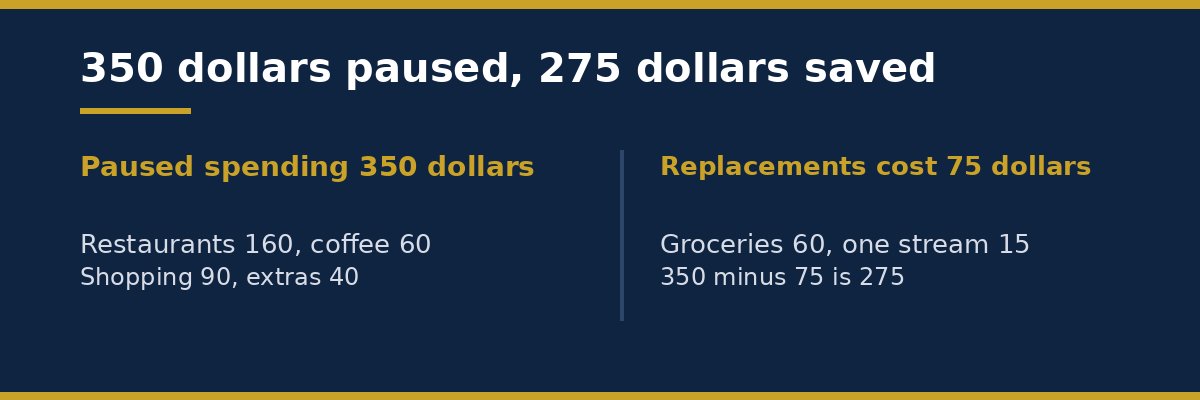
Imagine your normal month looks like this. Restaurant meals and delivery cost 160 dollars. Coffee shop drinks cost 60 dollars. Impulse online shopping costs 90 dollars. Paid entertainment and subscriptions you barely use cost 40 dollars. That adds up to 350 dollars of paused spending, because 160 plus 60 plus 90 plus 40 is 350.
During the no-spend month, you spend 60 dollars on groceries you already planned, which replaces some of the takeout, and you keep one streaming service for 15 dollars because you use it every evening. So your real extra cost is 75 dollars, because 60 plus 15 is 75. Your net saving is 275 dollars, because 350 minus 75 is 275.
Now give that money a job. If you send the 275 dollars to a credit card balance of 1,200 dollars at 24 percent APR, you cut the balance to 925 dollars, because 1,200 minus 275 is 925. That one payment also saves about 5 dollars and 50 cents of interest in the next month alone, because 275 times 0.24 is 66 dollars a year, and 66 divided by 12 is 5 dollars and 50 cents. If you send it to an emergency fund instead, you go from zero to 275 dollars in one month, which is more than a quarter of a 1,000 dollar starter fund.
The numbers are small on purpose. A no-spend month is not meant to fix your whole financial life. It is meant to show you that a few paused categories can free up a real amount of money, and to teach you which of those categories you can live without for good.
The hard parts, and how to handle them
The first week is usually the hardest. You are changing habits, and every ad, every smell of takeout, and every sale email is a reminder. Plan for it. Unsubscribe from shopping emails for the month. Delete saved payment details from shopping apps if that helps. Keep a list of free things to do when the urge hits, such as a walk, a call with a friend, or a film from your own shelf.
Social plans are the second hard part. If friends invite you to a restaurant, you do not have to say no to the friendship. Suggest a free alternative, such as a walk, a picnic with food from home, or cooking together. If you do go, decide the amount in advance and treat it as a planned exception, not a failure. Tell your friends about the challenge early, so they understand, and many will help you stick to it.
The third hard part is the slip. Most people slip at least once. The rule for a slip is simple: log it, learn from it, and keep going the next day. One unplanned purchase does not cancel the other 29 days. Some people add a reset rule, such as extending the challenge by one extra day for each slip. The point is that the challenge survives the slip, and you finish the month with a clear result.
The last hard part is what happens after the month ends. Do not celebrate by spending the savings. Send the saved money to your goal first, then look at what you learned. Which paused categories did you not miss at all? Those are the ones to keep paused, or at least to cut back permanently. Which ones made life harder? Those are the ones to bring back, with a planned amount. A no-spend month is most useful when it changes your normal budget, even by a little.
What to do with the savings
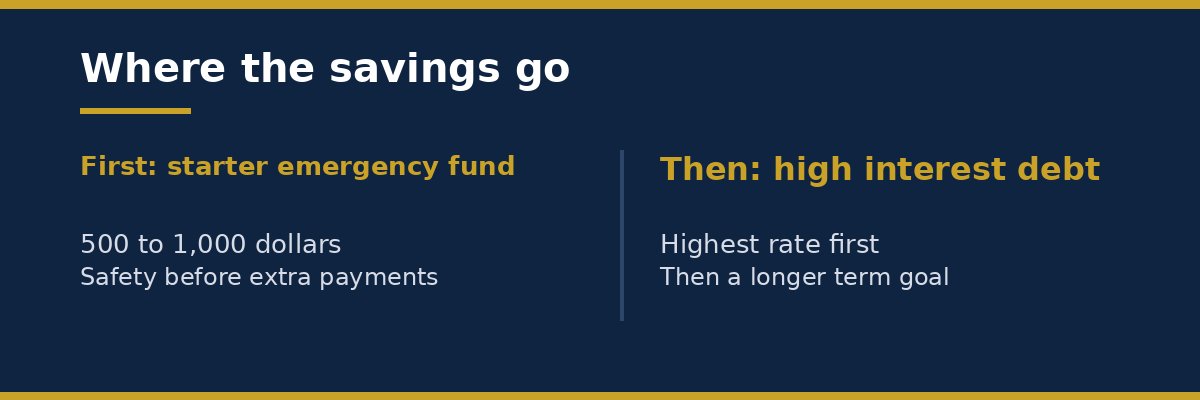
Send the money to one place, on a schedule, so it does not drift away. The simplest order is the one used across this site. First, build a starter emergency fund of 500 to 1,000 dollars if you do not have one. Second, pay down high interest debt, starting with the highest interest rate. Third, add to a longer term goal, such as a down payment fund or retirement savings.
Move the money weekly, not at the end of the month. If you save 275 dollars over four weeks, move about 69 dollars each week, because 275 divided by 4 is 68 dollars and 75 cents. A weekly transfer keeps the money out of your spending account, and it gives you a small win to look at each week.
If your challenge saves less than you hoped, that is still useful information. It tells you that your flexible spending was already tight, and your budget has little slack. In that case, the value of the month is the clarity, not the cash, and your next step is to look at the bigger costs, such as housing or transport, rather than repeating the same challenge.
Related reading in the Budgeting cluster: how to create a monthly budget that actually works, what the 50/30/20 budget rule is, how to cut food spending without cutting meals, how to set a weekly budget instead of a monthly one, and how to build an emergency fund from zero.
Frequently asked questions
Do I really spend nothing at all during a no-spend month?
No. A no-spend month is not a freeze on all spending. You keep paying for housing, utilities, groceries, transport, health care, and minimum debt payments. You only pause the nonessential categories you choose in advance, such as eating out, new clothes, and impulse shopping.
How long should a no-spend month last?
About 30 days is the usual length, because it is long enough to change a habit and short enough to finish. You can also try one week, two weeks, or a single category for a month. A shorter challenge you complete is better than a long one you quit.
What if I have a birthday or an emergency during the month?
Decide the rule before the month starts. Preplanned events can have a small fixed amount, and true emergencies are always allowed. The point is to plan the exception in advance, not to pretend real life will pause for a month.
Will a no-spend month fix my budget?
It will not fix a budget by itself, but it will show you where your flexible money goes and how much you can free up. Many people find one or two categories they can cut permanently, and that change stays in their budget long after the month ends.
What should I do with the money I save?
Send it to one named goal, and move it weekly. A starter emergency fund comes first if you do not have one, then high interest debt, then a longer term goal such as a down payment fund.
Conclusion, and your first step today
A no-spend month is a 30 day experiment with a clear shape. You keep paying for what you need, you pause a few named categories, and you send the savings to one goal. In our example, pausing 350 dollars of optional spending, minus 75 dollars of replacements, freed 275 dollars in one month. That is enough to start an emergency fund or to cut a credit card balance by more than a fifth.
Your first step today is to open last month’s statements and add up what you spent on eating out, coffee, and impulse shopping. That total is your target. Pick your dates, write your rules, and tell one person what you are doing. The month starts when the rules are written, not when you feel ready.
Disclaimer: This article is for education only. It is not financial advice, and it does not guarantee any result. Spending needs, debts, and goals differ from person to person, and by where you live. Your income, costs, debts, and goals are personal, and you should consider your own situation, and speak to a qualified professional if you need personal advice, before making a financial decision.
Sources
- Fidelity, How to do a no-spend month
- InCharge Debt Solutions, The No-Spend Challenge: A 30-Day Money Reset
