

What Is the 80/20 Budget Rule, and How Do I Use It?
What is the 80/20 budget rule, and how do I use it?
The 80/20 budget rule is the simplest budget there is. Save or invest 20 percent of your income first, then spend the other 80 percent on everything else. That is the whole rule. There are no categories to track, no apps to open, and no weekly reviews. You save first, and the rest is yours to spend.
If you take home 3,000 dollars a month, you save 600 dollars, and you spend 2,400 dollars. That is 3,000 times 20 percent, which is 600, and 3,000 times 80 percent, which is 2,400. The 600 dollars goes to savings or investing on payday, before you can spend it. The 2,400 dollars covers rent, food, transport, bills, and fun, all together.
This post shows how to use the rule, a worked example, how it compares with the 50/30/20 rule, and who it fits best. It is educational only. It is not financial advice.

How the 80/20 rule works, step by step
Step 1: Work out your income after tax. Use the money that actually lands in your bank account each month, not your salary before tax. If your income changes month to month, use your lowest normal month as the base.
Step 2: Work out 20 percent of that income. Multiply your monthly income by 0.20. On 3,000 dollars, that is 600 dollars. On 2,000 dollars, that is 400 dollars. On 5,000 dollars, that is 1,000 dollars.
Step 3: On payday, move the 20 percent to savings or investing first, automatically if you can. Pay yourself first. This is the part most people skip, and it is the part that makes the rule work.
Step 4: Spend the other 80 percent on everything else, without tracking every category. Rent, food, transport, bills, and fun all come from the same 80 percent. You only need to check one number: have you spent more than 80 percent this month? If yes, slow down. If no, you are on track.
That is the whole system. It works because it has only two numbers to remember, and only one decision to make each month: save 20 percent first.
The worked example: 3,000 dollars a month
Take Maya. She takes home 3,000 dollars a month after tax. She uses the 80/20 rule.
Save first: 3,000 times 20 percent is 600 dollars. On payday, 600 dollars moves automatically to her savings and investing. She splits it: 300 dollars to her emergency fund, and 300 dollars to her retirement account.
Spend the rest: 3,000 times 80 percent is 2,400 dollars. From that 2,400 dollars, she pays rent of 1,100 dollars, food of 400 dollars, transport of 200 dollars, utilities and phone of 250 dollars, and everything else, including fun, of 450 dollars. Add it up: 1,100 plus 400 is 1,500. Plus 200 is 1,700. Plus 250 is 1,950. Plus 450 is 2,400. It fits exactly.
After one year, Maya has saved 600 dollars times 12, which is 7,200 dollars. After five years, at the same pace, she has saved 36,000 dollars, before any interest or investment growth. The rule is simple, but the result is large, because it runs every month without a decision.
If 20 percent is too much right now, start at 10 percent and raise it by 1 percent every few months. A 10 percent start on 3,000 dollars is 300 dollars a month, which is 3,600 dollars a year. That is far better than 0 percent, and the habit is what matters most.
80/20 vs 50/30/20: which is better?
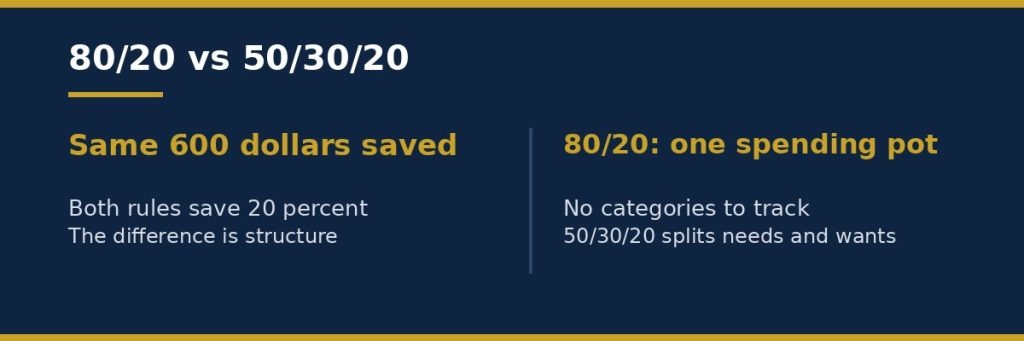
The 50/30/20 rule splits your income into three parts: 50 percent for needs, 30 percent for wants, and 20 percent for savings. The 80/20 rule has the same 20 percent for savings, but it does not split the other 80 percent. It treats needs and wants as one pot.
Here is the comparison on 3,000 dollars a month.
50/30/20: needs 1,500 dollars, wants 900 dollars, savings 600 dollars.
80/20: everything else 2,400 dollars, savings 600 dollars.
The savings amount is the same, 600 dollars, in both rules. The difference is how much structure you want. The 50/30/20 rule tells you how much to spend on needs and wants separately. The 80/20 rule lets you decide that yourself, month by month.
Pick 80/20 if you hate tracking categories, if your costs are simple, or if you have tried detailed budgets and quit them. Pick 50/30/20 if you want more guidance, or if your wants keep eating your needs. Both rules save the same 20 percent. The best rule is the one you will still use in six months.
Who the 80/20 rule fits, and who it does not fit
The 80/20 rule fits best when:
- Your income covers your essential costs inside the 80 percent, with room left over
- You hate detailed tracking and want one number to check
- You have no high-interest debt eating your money, or you have already dealt with it
- You want to start saving now, without a week of setup
The 80/20 rule does not fit well when:
- Your essential costs are more than 80 percent of your income. If rent and bills alone take 90 percent, the rule cannot work until costs fall or income rises.
- You have high-interest debt. In that case, send the 20 percent to the debt first, not to savings, until the debt is gone. See our guide on paying debt or saving first.
- You need strict limits on one category, like food or fun, because it keeps growing. A detailed budget, or the 50/30/20 rule, will help more.
If the rule does not fit today, it may fit later. Fix the debt or the cost problem first, then come back to 80/20.
The 80/20 calculator: work out your numbers in one minute
You do not need an app. You need two multiplications.
First, your monthly income after tax times 0.20 is your savings amount.
Second, your monthly income after tax times 0.80 is your spending amount.
Try it with your own numbers. If you take home 2,500 dollars: savings is 2,500 times 0.20, which is 500 dollars. Spending is 2,500 times 0.80, which is 2,000 dollars.
If you take home 4,000 dollars: savings is 4,000 times 0.20, which is 800 dollars. Spending is 4,000 times 0.80, which is 3,200 dollars.
Write both numbers down, set up the automatic transfer for the savings amount on payday, and you are done. Check once a month that your spending stayed inside the 80 percent. That is the whole calculator.
Related reading in the Budgeting cluster: the 50/30/20 budget rule and whether it works, the pay-yourself-first budget and how to use it, the first budget a beginner should try, and how to track spending without a spreadsheet.
Frequently asked questions
Is a 50/30/20 budget realistic?
For many people, yes, but it depends on rent. If your rent takes more than 50 percent of your income, the 50/30/20 split will not fit, and that is common in expensive cities. The 80/20 rule is more forgiving, because it does not set a limit on needs. It only asks you to save 20 percent and spend the rest wisely.
What is the 70-10-10-10 rule?
It is a different split: 70 percent for living costs, 10 percent for savings, 10 percent for investing, and 10 percent for giving or extra debt payments. It saves 20 percent in total, like the 80/20 rule, but it splits the saving into two parts and adds giving. It is a useful variation if you want to separate saving and investing.
Can a single person live off 2,000 dollars a month?
It depends on where you live and what your rent costs. On 2,000 dollars, the 80/20 rule saves 400 dollars and leaves 1,600 dollars for everything else. If rent is 800 dollars, that leaves 800 dollars for food, transport, bills, and fun, which is tight but possible in a cheaper area. If rent is 1,400 dollars, the rule will not fit, and the fix is a cheaper home, a higher income, or both.
What should the 20 percent go to first?
First, build a starter emergency fund of 1,000 dollars. Then, pay off any high-interest debt. Then, build the full emergency fund of three to six months of costs. After that, split the 20 percent between retirement saving and your next goal, like a house deposit.
Does the 80/20 rule work on an irregular income?
Yes, with one change. Use your lowest normal month as the base, and save 20 percent of that. In a good month, save 20 percent of the extra too, before you spend it. That way the rule still works when income moves up and down.
Conclusion, and your first step today
The 80/20 budget rule is the simplest budget that works: save 20 percent first, spend 80 percent on everything else. It saves the same amount as the 50/30/20 rule, with far less tracking. It fits anyone whose essential costs leave room inside the 80 percent, and who wants one number to check each month.
Your first step today is to multiply your monthly income after tax by 0.20, and set up an automatic transfer for that amount on payday. That one move is the whole rule, and it starts working this month.
Sources
Consumer Financial Protection Bureau, budgeting tools and guidance: https://www.consumerfinance.gov/consumer-tools/
Disclaimer: This article is for education only. It is not financial advice, and it does not guarantee any result. Your income, costs, debts, and goals are personal, and you should consider your own situation, and speak to a qualified professional if you need personal advice, before making a financial decision.
