
What Is the First Budget a Beginner Should Try?
What Is the First Budget a Beginner Should Try?
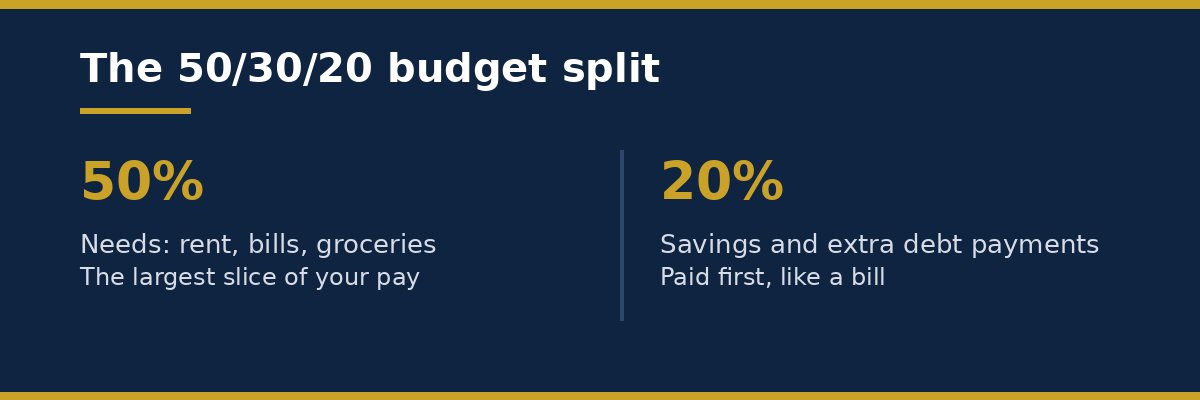
The best first budget for a beginner is the 50/30/20 budget. It splits your take home pay into three simple groups: 50 percent for needs, 30 percent for wants, and 20 percent for savings and extra debt payments.
It is the best first budget because it has only three numbers to remember, it takes one evening to set up, and it still leaves room for fun. You do not need a spreadsheet, an app, or a finance degree. You need your pay slip, your bank statement, and a pen.
If the 50/30/20 split does not fit your life, that is fine. You can change the numbers later. The point of a first budget is not perfection. The point is to see where your money actually goes, and to give every dollar a job before the month starts.
Why the 50/30/20 Budget Works for Beginners
Most budgets fail for beginners because they are too detailed. A budget with 30 categories is hard to keep up, and one missed week can feel like failure. The 50/30/20 budget avoids that problem in three ways.
First, it has only three groups. Needs, wants, and savings. That is easy to remember when you are standing in a shop deciding whether to buy something.
Second, it starts with your real pay. You use the money that actually lands in your bank account, not your salary before tax. That keeps the numbers honest.
Third, it builds saving into the plan from day one. Saving is not whatever is left at the end of the month. It is a fixed slice, paid first, like a bill.
What Counts as a Need, a Want, and Saving?
The three groups only work if you sort your spending honestly. Here is a simple guide.
Needs are the bills you must pay to live and work. Rent or mortgage, utilities, basic groceries, transport to work, insurance, and minimum debt payments all count as needs. A basic phone plan is a need. The newest phone is a want.
Wants are the things that make life enjoyable but are not required. Eating out, streaming services, holidays, new clothes beyond the basics, concerts, and hobbies all count as wants. Wants are not bad. They are simply the group to trim first when money is tight.
Savings and extra debt payments are the third group. This includes your emergency fund, retirement savings, and any payment above the minimum on a debt. Paying only the minimum on a card counts as a need, because it is a required bill. Paying extra counts here, in the 20 percent group.
If you are unsure where something belongs, ask one question: would my life stop working without it this month? If yes, it is a need. If no, it is a want.
A Worked Example With Real Numbers
Meet Sam. Sam takes home 3,000 dollars a month after tax. Here is Sam’s first 50/30/20 budget.
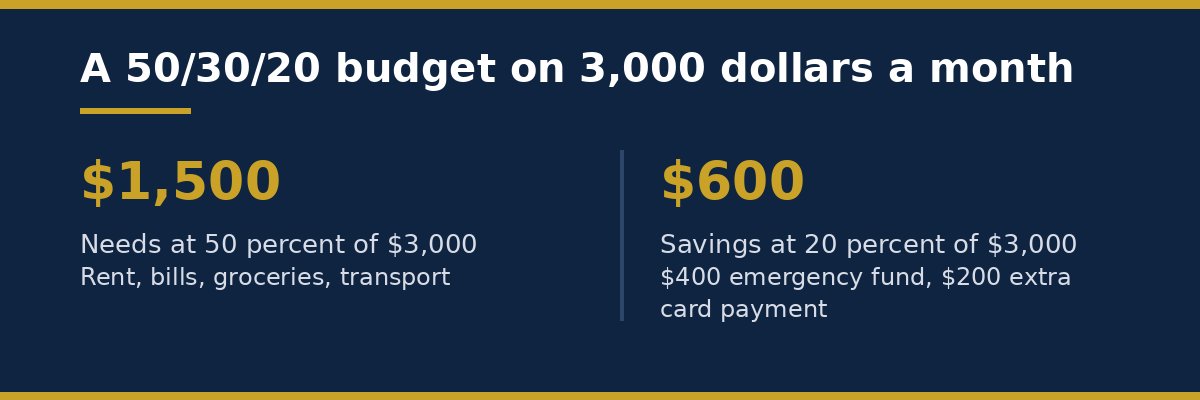
Needs, 50 percent: 50 percent of 3,000 dollars = 1,500 dollars.
- Rent: 900 dollars
- Utilities and phone: 150 dollars
- Groceries: 300 dollars
- Transport: 100 dollars
- Minimum card payment: 50 dollars
- Total needs: 1,500 dollars
Wants, 30 percent: 30 percent of 3,000 dollars = 900 dollars.
- Eating out and coffee: 200 dollars
- Streaming and apps: 60 dollars
- Clothes and fun: 340 dollars
- Weekend trips fund: 300 dollars
- Total wants: 900 dollars
Savings and extra debt payments, 20 percent: 20 percent of 3,000 dollars = 600 dollars.
- Emergency fund: 400 dollars
- Extra card payment: 200 dollars
- Total savings: 600 dollars
Add them up: 1,500 + 900 + 600 = 3,000 dollars. Every dollar has a job, and nothing is left unplanned.
Notice what Sam did not do. Sam did not cut out all fun. The 900 dollars for wants is real money for real life. A budget that bans fun lasts about two weeks. A budget that plans for fun can last for years.
How to Set Up Your First Budget in 5 Steps
Step 1: Find Your Take Home Pay
Look at your last pay slip or bank statement. Write down the amount that actually arrives in your account each month. If your pay changes month to month, use the lowest month from the last three as your starting point. You can adjust later.
Step 2: List Your Needs
Go through your last month of bank statements and write down every need. Rent, bills, groceries, transport, insurance, and minimum payments. Add them up. If your needs are above 50 percent, do not panic. Many beginners start at 60 percent or more, especially with high rent. The 50 percent is a target, not a test.
Step 3: List Your Wants
Now list the wants from the same statements. Eating out, subscriptions, shopping, and entertainment. Most beginners are surprised by this total. Small daily spending adds up fast, and seeing the number is the first step to changing it.
Step 4: Set Your Savings First
Decide your savings amount before you spend anything. Even 100 dollars a month is a real start. Set up an automatic transfer for payday, so the money moves before you can spend it. If 20 percent feels impossible right now, start with 10 percent and raise it by 1 percent each month.
Step 5: Check In Once a Week
Spend ten minutes each week checking your three totals. Are needs on track? Are wants under control? Did savings move on payday? A weekly check keeps small slips from turning into a broken month. For a full walkthrough of the monthly version, read How Do I Create a Monthly Budget That Actually Works?
What If 50/30/20 Does Not Fit Your Income?
The 50/30/20 split is a starting point, not a law. Two common situations need a different split.
If your rent is very high, your needs may take 60 or 65 percent. That is normal in expensive cities. In that case, aim for 60 percent needs, 25 percent wants, and 15 percent savings. The key is to keep savings above zero, even if it is small.
If your income is low or irregular, flip the order. Cover needs first, then set aside a small fixed amount for savings, even 50 dollars, and let wants take what is left. A budget that bends with your income is better than one you abandon.
For a deeper look at the 50/30/20 rule itself, including when it works and when it does not, read What Is the 50/30/20 Budget Rule, and Does It Work? If you want a method where every dollar is assigned before the month starts, read What Is a Zero-Based Budget?
Common First Budget Mistakes
Beginners usually make the same four mistakes. Avoid them and your first budget has a much better chance.
Mistake 1: Budgeting from memory. Memory is kind to spending. Use real bank statements, not guesses.
Mistake 2: Forgetting irregular costs. Car insurance, yearly subscriptions, and gifts are real costs. Set aside a little each month for them.
Mistake 3: Setting wants to zero. A budget with no fun fails fast. Keep a small wants amount, even if it is only 50 dollars.
Mistake 4: Quitting after one bad week. One overspend does not ruin a budget. It is one week of data. Adjust the numbers and keep going.
When to Try a Different Budget
Give the 50/30/20 budget at least two full months before you judge it. If after two months you still feel lost, try a different style.
If you like detail, try a weekly budget, where you plan seven days at a time instead of a whole month. Read How Do I Set a Weekly Budget Instead of a Monthly One? to see how that works.
If you hate tracking, try the envelope method in simple form, where you use set amounts for each group and stop when an amount is gone. If you want to track without a spreadsheet, read How Do I Track Spending Without a Spreadsheet?
The right budget is the one you will still be using in three months. Simple beats clever, every time.
Frequently Asked Questions
How much should a beginner save each month?
Aim for 20 percent of your take home pay if you can, but any regular amount is a good start. Even 50 or 100 dollars a month builds the habit, and you can raise the amount as your income grows or your debts shrink.
Should I pay off debt or save first?
Do both, in order. First, save a small emergency cushion of about 500 to 1,000 dollars. Then put extra money toward your most expensive debt while keeping the minimum payments on the rest. Then grow the emergency fund to three months of costs.
Do I need a budgeting app for my first budget?
No. A pen, paper, or a simple note on your phone is enough for a first budget. An app can help later, once you know your numbers. The method matters more than the tool.
What if my income changes every month?
Use your lowest recent month as your base. Budget your needs from that amount, and treat any extra income in a good month as a bonus for savings or extra debt payments. Never budget from your best month.
How long does it take to set up a first budget?
About one evening. Most of the time goes to reading your bank statements and sorting spending into needs and wants. After that, the weekly check takes about ten minutes.
Conclusion
The first budget a beginner should try is the 50/30/20 budget. It is simple, it takes one evening to set up, and it covers the three things that matter: your needs, your wants, and your future.
Start with your real take home pay, sort your spending into the three groups, pay your savings first, and check in once a week. If the exact split does not fit, adjust the numbers, but keep the habit. A simple budget you keep is worth far more than a perfect budget you quit.
Further reading
This article is for general information and education only. It is not legal or financial advice. Your numbers will differ from the example, so use your own pay and bills when you build your budget.
