

What Is a Pay-Yourself-First Budget and How Do I Use It?
A pay-yourself-first budget is a simple way to save money: you move a set amount into savings the moment you are paid, before you pay bills or spend on anything else. Then you live on what is left. It is sometimes called reverse budgeting, because the usual order is turned around. Most budgets start with bills and save whatever is left. This one starts with savings and budgets the rest.
The Consumer Financial Protection Bureau puts it plainly: if you get a regular paycheck, pay yourself first by putting a portion of it automatically into savings. That one change is the whole method. You do not need a new app, a complicated spreadsheet, or a perfect budget. You need a number, a date, and a place the money goes. It is educational only. It is not financial advice.
Why Saving First Works Better Than Saving What Is Left
Saving what is left sounds sensible, but it fails for a simple reason: by the end of the month, there is usually nothing left. Bills arrive first, everyday spending fills the gaps, and savings gets whatever survives. In most months, that is nothing, or close to it. The budget did not fail because you are bad with money. It failed because saving was last in line.
Paying yourself first fixes the order. Savings becomes a fixed cost, like rent, instead of a leftover. The money leaves your spending account before you can spend it by accident. You still pay your bills, but you plan them around a smaller number, and that smaller number is honest.
When saving is automatic, you do not decide to save every payday. You decided once, when you set it up, and the transfer does the rest.
There is real evidence behind the idea. In the Federal Reserve’s Survey of Household Economics and Decisionmaking, 86 percent of adults who said they always had money left over at the end of the month had savings to cover three months of expenses. Among adults who said they never had money left over, only 13 percent had that cushion. The difference is not income alone. It is whether anything is set aside before spending starts.
How Much Should You Pay Yourself First?
There is no official percentage, and no single number fits everyone. The Consumer Financial Protection Bureau’s saving guidance suggests 10 percent of net income as a rule to live by, while also saying you should decide what amount works at different points in your life. NerdWallet suggests many experts aim for 10 to 20 percent of take-home pay, and notes that any savings is good savings.
Think about it in steps, not in one leap. Start small if money is tight. Even 1 to 5 percent of take-home pay builds the habit, and a small amount that actually moves every payday beats a big amount you cancel after one month. Aim for 10 percent as a first real target. On a take-home pay of 3,000 dollars a month, 10 percent is 300 dollars, enough to build a starter emergency fund in a few months. Move toward 15 to 20 percent when you can. If you carry high interest credit card debt, part of that share may go to debt first, after you have a small emergency cushion and any employer 401(k) match.
The list below shows what different rates look like on a 3,000 dollar monthly take-home pay. These are example numbers only, to show the math.
- 5 percent: 150 dollars a month, 1,800 dollars a year
- 10 percent: 300 dollars a month, 3,600 dollars a year
- 15 percent: 450 dollars a month, 5,400 dollars a year
- 20 percent: 600 dollars a month, 7,200 dollars a year
Even 5 percent adds up to 1,800 dollars in a year. Small and steady is not a failure. It is the whole point. You can raise the amount later, by 1 percent at a time, each time you get a raise or a bill ends. Raising it before your lifestyle grows into the extra pay is the easiest raise you will ever give your savings.
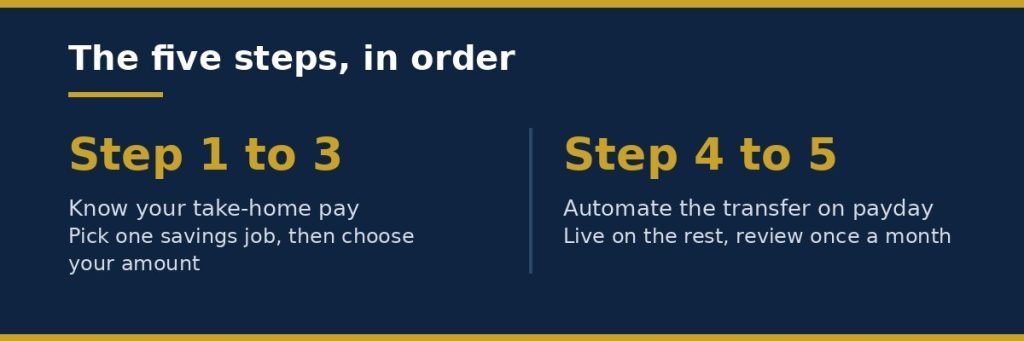
How to Set Up a Pay-Yourself-First Budget in 5 Steps
Step 1: Know your real take-home pay
Write down what actually arrives in your bank account in a normal month, after tax and after any deductions that already come out of your paycheck. If your income changes each month, use your lowest normal month as the base, and treat extra income as a bonus. Do not build the plan on gross pay, a hoped-for bonus, or money you have not received yet. If you have not made a budget before, start with our guide to How Do I Create a Monthly Budget That Actually Works?, which walks through listing income and costs with real numbers from your statements.
Step 2: Pick one savings job first
Before you pick an amount, pick the job the money will do. One job at a time keeps the plan simple and keeps you motivated, because you can see progress. Common first jobs, in order, are a starter emergency cushion of 500 to 1,000 dollars, your employer’s full 401(k) match if one is offered, high interest debt, and then a full emergency fund. Our guide to How Do I Build an Emergency Fund From Zero? explains how to build that first cushion, and How Much Should I Keep in an Emergency Fund? helps you pick a target size.
Step 3: Choose your amount
Pick a dollar amount or a percent of take-home pay that your bills can survive. The test is simple: after the transfer, can you still pay rent, utilities, food, transport, insurance, and minimum debt payments? If yes, the amount works, even if spending feels tighter. If no, the amount is too big for this paycheck, and you should lower it. A small amount that clears every month is better than a big amount that bounces or gets cancelled. Start with 5 percent if 10 percent feels impossible, or with a flat 50 or 100 dollars per paycheck. If your income is irregular, use a flat amount from your lowest normal month, so the transfer clears even in a slow month.
Step 4: Automate it on payday
Automation is what makes the method work. Set up a recurring transfer from checking to savings for payday, or the day after payday, so the money moves before you can spend it. Most banks and credit unions let you schedule this in their app in a few minutes. If your employer allows it, a split direct deposit works even better: part of each paycheck goes straight to savings, and the rest lands in checking. Make sure your checking account can cover the transfer on the transfer date, so you do not pay an overdraft fee, and check after the first payday that the transfer actually happened. Automation you never verify is a guess. Our guide to How Do I Automate Saving and Investing? covers the setups in more detail.
Step 5: Live on the rest, and review once a month
After the transfer, your budget is simple: the money left in checking is what you have to spend. Pay your fixed bills first, then plan food, transport, and other variable costs from what remains. If the month feels tight, cut wants first, not the transfer. Cutting the transfer is the old habit coming back, saving only what is left. Review the plan once a month, for five minutes. Ask three questions. Did the transfer clear every payday? Did any bill fail or come close to failing? Do I want to raise the amount by a little next month? Change one thing at a time, and keep what works. How Do I Review My Budget at the End of the Month? has a short checklist for that monthly review. If a bill ends or your pay rises, raise the transfer first, before your spending grows into the extra money.
Worked Example: A 3,000 Dollar Paycheck With 10 Percent Saved First
Here is the full math, with example numbers only. This is not a budget for any real person, and it is not a recommendation. It shows how the method works.
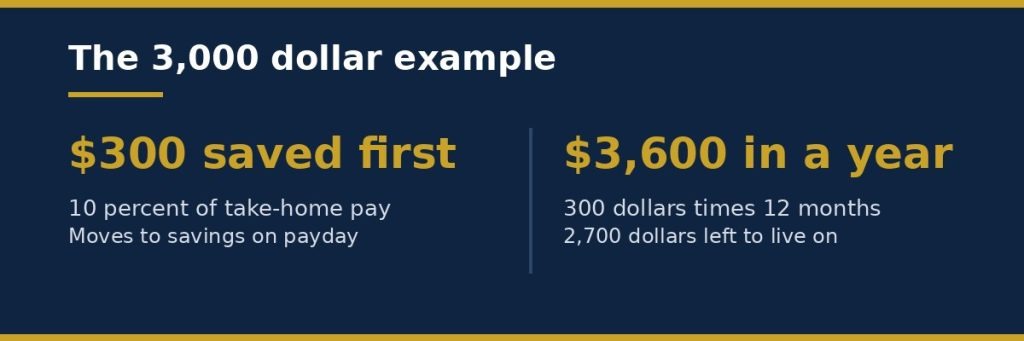
Maya takes home 3,000 dollars a month. She chooses 10 percent, so 300 dollars moves to savings on payday. That leaves 2,700 dollars for everything else. The arithmetic is simple: 3,000 minus 300 equals 2,700.
She splits the remaining 2,700 dollars into needs and wants. Needs are 1,800 dollars: rent 1,000, utilities 150, food 350, transport 150, phone 50, insurance 100. Wants are 900 dollars: eating out 200, streaming and hobbies 150, clothing and personal care 200, other wants 350. Check the total: 300 saved plus 1,800 needs plus 900 wants equals 3,000. Every dollar has a job.
After one year, the savings is 300 times 12, which is 3,600 dollars. That is enough for a starter emergency fund and the start of a bigger cushion. The same math works at any income: the percent stays the same, only the dollars change.
Where Should the Money Go First?
The order matters, because not all savings jobs are equal. A common order, and the one most guides agree on, is:
- A starter emergency cushion of 500 to 1,000 dollars, in a savings account you can reach quickly. This stops small surprises from going on a credit card.
- Your full employer 401(k) match, if your job offers one. A match is free money from your employer, and skipping it means turning down part of your pay.
- High interest debt, such as a credit card balance. Interest on that debt usually costs more than savings earns, so clearing it is a better return than extra saving.
- A full emergency fund, usually three to six months of essential costs. Keep it in a separate savings account, so it is not mixed with spending money.
- Other goals, such as a house deposit, a car, or extra retirement saving. A sinking fund works well for a goal with a known cost and date, because you save a little each month toward it.
If you are saving for a goal and an emergency fund at the same time, split the transfer between them and keep the accounts separate. How Do I Save for a Goal and an Emergency Fund at the Same Time? explains how to split one transfer across two jobs without losing track.
Common Mistakes to Avoid
The first mistake is setting the amount too high. If the transfer leaves you short for rent or food, you will cancel it, and then you will feel like the method failed. It did not fail. The amount was wrong. Lower it and try again.
The second mistake is saving into the same account you spend from. If the savings sits in checking, it will get spent. Move it to a separate savings account, ideally at the same bank so the transfer is instant, but in a different account that you do not use for daily spending.
The third mistake is stopping the transfer when a big cost arrives. A car repair or a medical bill is exactly what the emergency cushion is for. Use the cushion, then rebuild it with the same transfer. Stopping the transfer turns a one-time cost into a broken habit.
The fourth mistake is never raising the amount. A small raise each year, even 1 percent, adds up over time. Review it when your pay changes, when a debt is cleared, or when a bill ends.
Pay Yourself First vs the 50/30/20 Rule
The pay-yourself-first method and the 50/30/20 rule work well together, because they answer different questions. The 50/30/20 rule splits your take-home pay into 50 percent needs, 30 percent wants, and 20 percent savings and extra debt payments. It tells you how much should go to each group. Pay yourself first tells you when the savings moves: first, on payday, before anything else. You can use both at once. Set your savings rate at 20 percent, move it first, and then split the remaining 80 percent between needs and wants. Our guide to What Is the 50/30/20 Budget Rule, and Does It Work? explains that split in full, including when it does not fit and how to adjust it.
Frequently Asked Questions
What does pay yourself first mean in simple terms?
It means you move money to savings as soon as you are paid, before you pay bills or spend on anything else. The Consumer Financial Protection Bureau describes it as putting a portion of your paycheck automatically into savings. After the transfer, you live on what is left.
How much should I pay myself first?
There is no official percentage. Many guides suggest 10 to 20 percent of take-home pay, and the Consumer Financial Protection Bureau’s guidance uses 10 percent of net income as a rule to live by. If that is too much right now, start with 1 to 5 percent and raise it over time.
Does pay yourself first work if my income is irregular?
Yes, with a flat amount instead of a percent. Use your lowest normal month as the base, set a flat transfer that clears even in a slow month, and move extra money by hand in good months. Never set the automatic amount from your best month, or it will bounce in a slow month.
Should I pay myself first or pay off debt first?
Do both, in order. Build a small emergency cushion of 500 to 1,000 dollars first, capture any employer 401(k) match, then put extra money toward high interest debt. Once the high interest debt is gone, raise the savings transfer and build the full emergency fund.
Is a pay-yourself-first budget the same as the 50/30/20 rule?
No, but they work together. The 50/30/20 rule splits your pay into needs, wants, and savings. Pay yourself first decides when the savings moves, on payday, before spending. You can use a 20 percent savings rate from the 50/30/20 rule and move it first under this method.
Conclusion
A pay-yourself-first budget is the simplest budget that actually saves money, because it changes the order. Savings moves first, on payday, automatically. Everything else is planned from what is left.
Start today, with three small steps. Pick one savings job, pick an amount your bills can survive, and set up the automatic transfer for your next payday. Then review it once a month, and raise it by a little whenever a bill ends or your pay rises. Saving what is left has not worked, because there is rarely anything left. Saving first works, because the money is gone before spending starts.
This article is for general information and education only. It is not legal or financial advice.
