


When Should I Start Saving for Retirement?
When should I start saving for retirement?
Now. Whatever your age, the best time to start saving for retirement is now. If you are in your 20s, starting now is the cheapest way to build a large fund, because time does the heavy work. If you are in your 40s or 50s, starting now is still far better than waiting, because every year you wait costs you growth you cannot get back.
Retirement saving works on one simple idea: money you save early has more years to grow. A dollar saved at 25 has 40 years to grow before age 65. A dollar saved at 45 has only 20 years. The early dollar is worth much more, even though it is the same dollar.
This post gives you an age-by-age plan, a worked example that shows what starting ten years earlier is worth, and what to do if you are starting late. It is educational only. It is not financial advice.
The worked example: starting at 25 vs starting at 35
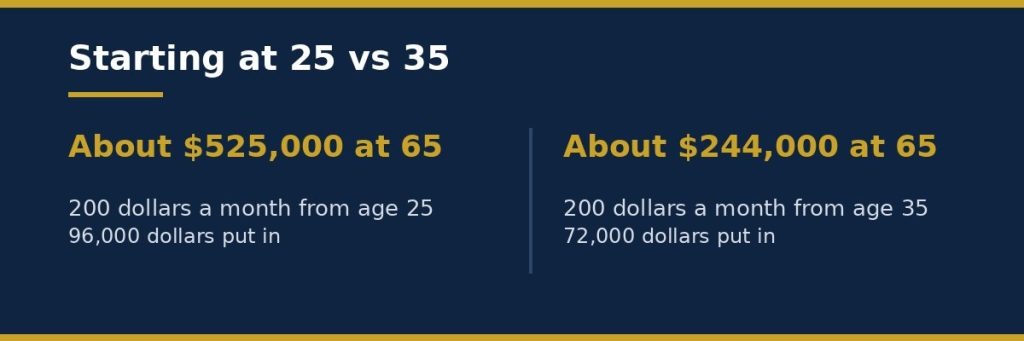
Take two people, Ana and Ben. Both save 200 dollars a month, every month, and both earn an average return of 7 percent a year. The 7 percent is an example to show the math, not a promise. Real returns go up and down.
Ana starts at 25 and saves until 65. That is 40 years, or 480 months. She puts in 200 dollars times 480 months, which is 96,000 dollars of her own money. With growth at 7 percent, her fund grows to about 525,000 dollars by age 65.
Ben starts at 35 and saves until 65. That is 30 years, or 360 months. He puts in 200 dollars times 360 months, which is 72,000 dollars of his own money. With the same 7 percent growth, his fund grows to about 244,000 dollars by age 65.
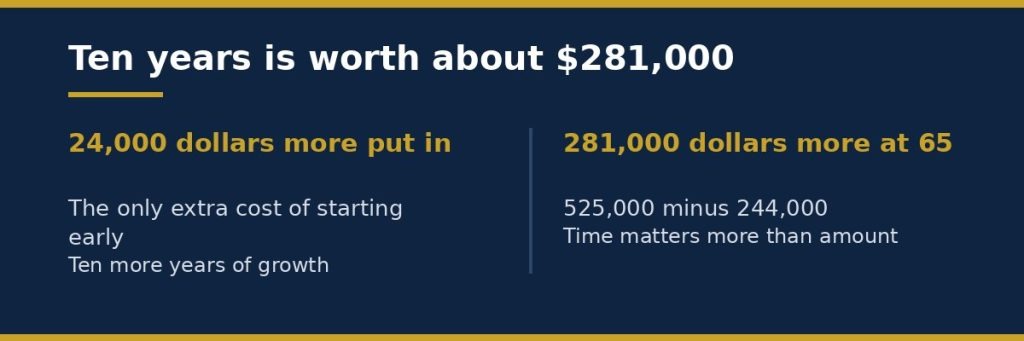
Ana put in only 24,000 dollars more than Ben, because 96,000 minus 72,000 is 24,000. But she ends with about 281,000 dollars more, because 525,000 minus 244,000 is 281,000. Those extra ten years at the start more than doubled the result.
That is the whole argument for starting now. Time matters more than the amount, when you start early. A small amount started early beats a larger amount started late.
Your 20s: start small, start now
In your 20s, retirement feels far away, and money is often tight. That is normal. The goal in your 20s is not a large fund. It is the habit, and the head start.
If your job offers a 401(k) with a match, join it and contribute enough to get the full match. That match is free money, and it is the best return you will ever get. If there is no match, open an IRA, a Roth IRA if your income fits the rules, and start with any amount you can keep, even 50 dollars a month.
A good target in your 20s is to save about 10 percent of your income for retirement, including any employer match. If 10 percent is too much right now, start at 5 percent and raise it by 1 percent a year. The habit matters more than the starting number.
The biggest mistake in your 20s is waiting until you earn more. You will always feel like you should wait. The example above shows what waiting ten years costs: about 281,000 dollars on 200 dollars a month. Start with what you have.
Your 30s: raise the amount, keep it automatic
In your 30s, income usually rises, and so do costs. A home, children, and a car all compete with retirement saving. The goal in your 30s is to raise the amount steadily, and to keep it automatic, so it happens before you can spend it.
By your late 30s, a common guide is to have saved about one times your yearly income for retirement. That is a guide, not a rule. If you are behind, do not panic. Raise your contribution by 1 percent every time you get a pay rise, and let the higher income do the work.
Check your investment mix too. In your 30s, most of your retirement money should be in a diversified mix of stocks, because you have decades for it to grow. A broad index fund is the simplest choice for a beginner. Avoid the temptation to chase single stocks or hot tips.
Your 40s: catch up with intent
In your 40s, retirement is no longer far away. It is about twenty years away, which is still a long time for money to grow. The goal in your 40s is to save with intent, and to close any gap.
A common guide is to have saved about three times your yearly income by age 40, and about four times by age 45. Again, that is a guide, not a judgement. If you are behind, the fix is to save more now, not to take big risks to catch up quickly.
If your job offers a 401(k), check that you are contributing at least enough to get the full match, then raise the amount toward the yearly limit if you can. If you have old 401(k) accounts from past jobs, look at them, and consider whether to combine them, so you can see the full picture in one place.
Your 50s: use the catch-up rules, and plan the finish
In your 50s, the rules give you extra room. Once you turn 50, you can contribute more than the normal limit to a 401(k) and an IRA. These are called catch-up contributions. Use them if you can, because they are the fastest legal way to add to your fund late.
A common guide is to have saved about six times your yearly income by age 50, and about seven times by age 55. If you are behind, do not give up. Saving 500 dollars a month for 15 years, at 7 percent growth, still adds up to a large sum. The exact number depends on the return, but the point is that starting at 50 still leaves 15 years of growth before 65.
In your 50s, also start thinking about the other side: when you will retire, what your costs will be, and how Social Security fits in. You do not need the full plan yet, but you should know your numbers. See our guides on how much to save for retirement at 40, how much to save by age, and how Social Security works, for the details.
Is it too late to start at 50 or 60?
No. It is late, but it is not too late. A person who starts at 50 and saves 500 dollars a month until 65, at 7 percent growth, puts in 90,000 dollars of their own money, and ends with about 158,000 dollars. That is not a full retirement fund on its own, but it is far better than zero, and it sits alongside Social Security and any other savings.
A person who starts at 60 and saves 500 dollars a month until 65 puts in 30,000 dollars, and ends with about 36,000 dollars. That is a smaller sum, but it still helps, and the habit of saving changes the rest of their budget for the better.
The worst choice at any age is to not start. Every year you wait removes a year of growth, and no later year can replace it. Start now, with what you can, and raise it when you can.
Related reading in the Retirement Planning cluster: how much to save for retirement by age, how much to have saved by age, what a 401(k) is in simple terms, what a Roth IRA is in simple terms, and how much to save for retirement at 30.
Frequently asked questions
Is it too late to start saving for retirement at 50?
No. You have about 15 years until 65, and you can use catch-up contributions to save more than the normal limit. Start now, save what you can, and combine it with Social Security and any other savings. Starting at 50 is far better than starting at 55.
Is it too late to start saving for retirement at 60?
No, but the plan is different. You have about five years, so the goal is to save what you can, cut costs, and plan carefully around Social Security and any pension. Even a small fund helps, and the saving habit improves the rest of your budget.
How much should you have saved by 30?
A common guide is about one times your yearly income by age 30. If you earn 50,000 dollars a year, that means about 50,000 dollars saved. It is a guide, not a rule. If you are behind, raise your contribution by a small amount each year, and do not panic.
How much retirement should I have at 50?
A common guide is about six times your yearly income by age 50. If you earn 60,000 dollars a year, that means about 360,000 dollars saved. If you are behind, use catch-up contributions, and remember that Social Security and any pension are part of the picture too.
What age should I start saving for retirement?
As early as you can, even in your 20s, with a small amount. If you did not start then, start now, whatever your age. The best age to start is the age you are today.
What is a good monthly retirement income?
It depends on your costs, not on a single number. A common guide is to aim for about 70 to 80 percent of your working income in retirement, from all sources together: savings, Social Security, and any pension. Work out your costs first, then work out what income you need.
Conclusion, and your first step today
When should you start saving for retirement? Now. In your 20s, time does the heavy work. In your 30s and 40s, steady saving builds the fund. In your 50s, catch-up contributions help close the gap. At any age, starting today beats starting next year, because every year of growth counts.
Your first step today is to check two numbers: does your job offer a 401(k) match, and are you getting the full match? If not, fix that first. Then set up an automatic contribution, even a small one, so the saving happens every month without you having to decide again.
Sources
US Social Security Administration, plan for retirement: https://www.ssa.gov/prepare/plan-retirement
US Department of Labor, Employee Benefits Security Administration, saving for retirement: https://www.dol.gov/agencies/ebsa/workers-and-families
Investor.gov, US Securities and Exchange Commission, free financial planning tools: https://www.investor.gov/free-financial-planning-tools
Disclaimer: This article is for education only. It is not financial advice, and it does not guarantee any result. Your income, costs, debts, and goals are personal, and you should consider your own situation, and speak to a qualified professional if you need personal advice, before making a financial decision.
