


How Do I Budget When I Get Paid Weekly?
When you get paid weekly, the trick is to plan by paycheck, not by month. Your income arrives every week in smaller amounts, but most of your big bills arrive once a month. So you match each paycheck to the bills that fall due before the next paycheck lands, and you set aside a share of each check for the big monthly bills that come later. That way rent is covered before it is due, and no single week has to carry a cost the whole month should have prepared for.
The most common mistake is to multiply one weekly paycheck by four and call that your monthly income. A weekly payroll has 52 pay periods a year, and four times a weekly check only counts 48 of them. The other four paychecks land in months that have five paydays, and those extra checks are the easiest money to save, because your monthly bills are already covered.
This guide walks through the paycheck by paycheck method step by step, with a worked example, and shows how to handle a five paycheck month, variable hours, and a bill that falls due before your next check. It is educational only. It is not financial advice.
Why weekly pay and monthly bills feel out of sync
Weekly pay gives you frequent deposits, but each one is smaller than a monthly salary. A 750 dollar weekly check feels comfortable on Friday, but rent of 1,200 dollars due on the 1st is bigger than any single check. If you treat each Friday as a fresh start and spend what is in front of you, the rent money can be gone before the 1st arrives.
The fix is to let earlier paychecks carry money forward for later bills. Instead of asking “what can I spend this week”, you ask “which bills are due before my next paycheck, and what share of the big monthly bills should this check cover”. That one change turns a weekly budget from guesswork into a plan.
Two ideas help here, and they work together. For planning the month, count the actual paychecks that will arrive in that month, and use their real dates. For long term planning, use the yearly figure: weekly pay times 52, divided by 12, gives you an average month. A 750 dollar weekly check is 39,000 dollars a year, because 750 times 52 is 39,000, and 3,250 dollars in an average month, because 39,000 divided by 12 is 3,250. But for this month’s bills, count the checks that actually land, not the average.
Step 1: list your paydays and your bills with due dates
Start with a calendar. Write down every payday for the next two months, with the take-home amount you expect. If your hours vary, use the lowest recent amount for the basic plan, and treat anything above it as extra that only counts after the current bills are covered.
Then list every bill with its due date: rent or mortgage, utilities, phone, insurance, loan minimums, and subscriptions. Do not forget the bills that come quarterly or once a year, such as car insurance or a yearly fee. Those need a small weekly set-aside too, or they will surprise you.
The Consumer Financial Protection Bureau recommends recording bill amounts and due dates on a calendar and checking it weekly. That habit is the core of the whole method: the calendar tells you what is due, and the paycheck tells you what is available.
Step 2: match each bill to a paycheck
Assign every bill to the paycheck that lands before it is due. If rent is due on the 3rd and you are paid on the 1st, the 1st check covers it. If a bill is due before your first check of the month, assign it to the last check of the previous month. A bill is only covered when the money is set aside, not when the due date arrives.
For big monthly bills, split the cost across the checks before the due date. If rent is 1,200 dollars and you receive four 750 dollar checks before the next rent date, reserve 300 dollars from each check, because 300 times 4 is 1,200. By the time the 1st arrives, the full rent is sitting ready, and no single week felt the whole cost.
Use partial reserves for costs that are too large or too awkward for one weekly check. The goal is not to create twenty mini envelopes. It is to stop one week from carrying a cost that the whole month should have prepared for.
Step 3: give every paycheck a job
For each payday, work in this order. First, cover the bills due before the next payday, and the essentials you need to get through that week, such as groceries and fuel. Second, move the planned share into a separate place for the big monthly bills, whether that is a second account, an envelope, or a line in a ledger. Keep spending money distinct from reserved bill money, so the same dollars do not get assigned twice. Third, set aside something for savings and irregular costs, even a small amount per check. Fourth, give any leftover a purpose, such as your buffer, a debt, or next check’s bills.
On payday, check the next due dates before deciding what is free to spend. That one minute of checking is what stops the mid-month surprise of a bill you forgot.
A worked example: four 700 dollar paychecks
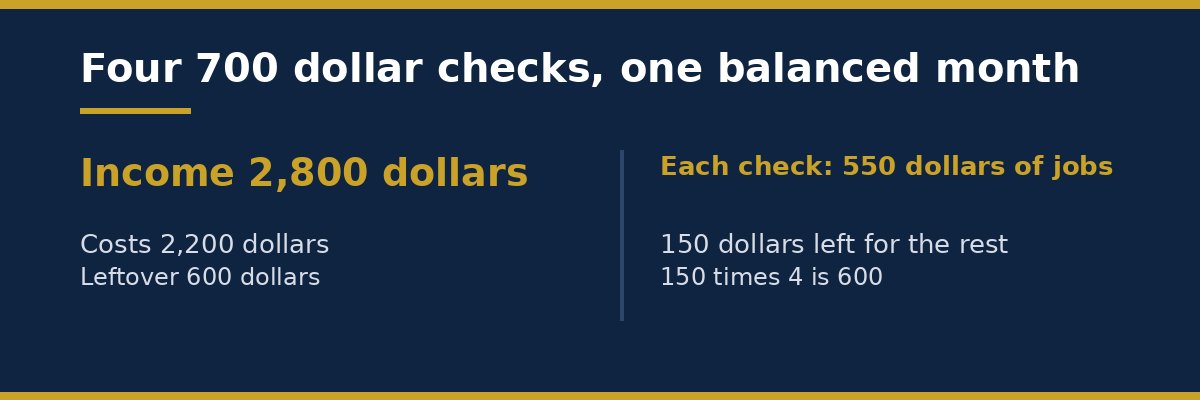
Suppose you take home 700 dollars each week, and in a certain month you receive four checks, which is 2,800 dollars, because 700 times 4 is 2,800. Your costs for the month are: rent 1,000 dollars, utilities 150 dollars, phone 60 dollars, groceries 400 dollars, transport 120 dollars, insurance 90 dollars, minimum debt payments 180 dollars, and savings 200 dollars. That adds up to 2,200 dollars, because 1,000 plus 150 plus 60 plus 400 plus 120 plus 90 plus 180 plus 200 is 2,200. That leaves 600 dollars for everything else, because 2,800 minus 2,200 is 600.
Now split the big bills across the four checks. Rent needs 250 dollars from each check, because 1,000 divided by 4 is 250. Utilities and phone together are 210 dollars, so 52 dollars and 50 cents from each check covers them, because 210 divided by 4 is 52.50. Insurance and debt minimums together are 270 dollars, so 67 dollars and 50 cents from each check covers them, because 270 divided by 4 is 67.50. Groceries and transport are weekly costs, so 130 dollars a week covers them, because 400 plus 120 is 520, and 520 divided by 4 is 130. Savings is 50 dollars per check, because 200 divided by 4 is 50.
Add one check’s jobs: 250 plus 52.50 plus 67.50 plus 130 plus 50 is 550 dollars. That leaves 150 dollars from each 700 dollar check for everything else, because 700 minus 550 is 150. Over four checks, that is 600 dollars, which matches the leftover above. The plan balances, and every bill is covered before it is due.
How to handle a five-paycheck month
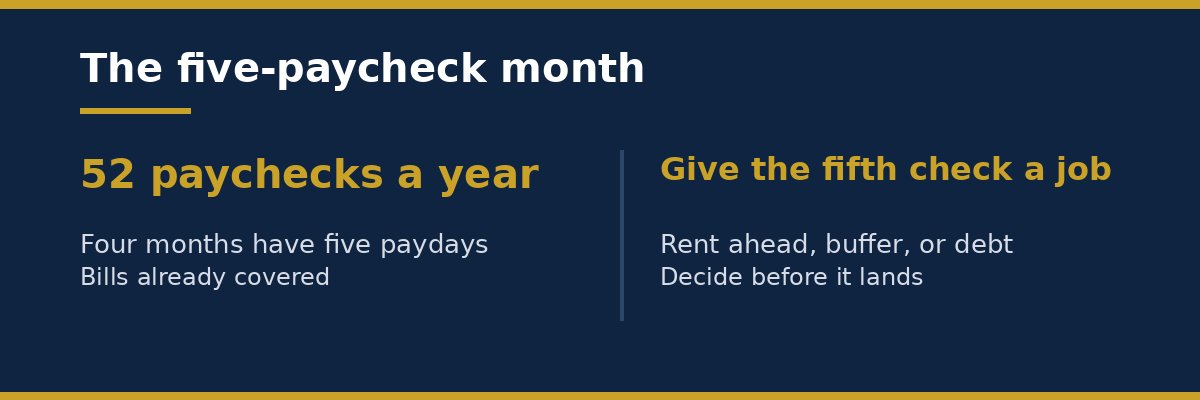
In most years, four months have five paydays instead of four, when you are paid weekly. That fifth check is a gift to your future self, because your monthly bills are already covered by the first four checks.
Before the five-paycheck month arrives, decide what the extra check is for. Common choices are to get ahead on next month’s rent, to rebuild a bill reserve, to add to an emergency fund, or to make an extra debt payment. Decide before the money lands, or it will feel like free spending money, and it will be gone by Monday.
If a bill comes due before you have built its reserve, protect the due date first. Assign the next check to the bill that arrives soonest, then use later checks to rebuild the reserve. A late fee and a damaged payment record cost more than a tight week.
When your hours or pay vary
If your income changes from week to week, build the basic plan on your lowest dependable amount. If your lowest recent check is 600 dollars and your best is 750 dollars, plan the bills on 600 dollars. When a bigger check arrives, send the extra to savings or to a debt, after the current bills are covered. Do not build a monthly plan on your best week, because a slow week will break it.
Keep a small buffer in checking for timing gaps, such as a bill that clears a day before payday. A buffer of 100 to 200 dollars, kept separate from spending money, turns a timing gap into a non-event.
Mistakes to avoid
Do not multiply your weekly paycheck by four to get your monthly income, because that counts 48 paychecks a year instead of 52. Do not treat each Friday as a fresh start, because the big monthly bills are still coming. Do not spend the fifth paycheck of a five-paycheck month before you have given it a job. And do not skip the calendar check on payday, because the bills due before your next check are the ones that matter most.
If your budget still feels tight after matching paychecks to bills, the problem may not be the timing. It may be that the total costs are higher than the total income, and that needs a different fix: lower costs, more income, or help with a debt. A weekly plan shows you that truth clearly, which is the first step to fixing it.
Related reading in the Budgeting cluster: how to budget on an irregular income, how to create a monthly budget that actually works, why your budget fails every month and how to fix it, how to set a weekly budget instead of a monthly one, and what a zero-based budget is.
Frequently asked questions
How many paychecks do I get in a year if I am paid weekly?
Fifty two. A weekly payroll has 52 pay periods a year. That is why multiplying one weekly check by four understates your income: four times 52 weeks is only 48 paychecks, so four paychecks a year are missed by that shortcut.
How do I pay a monthly bill that is bigger than one paycheck?
Split it across the paychecks that arrive before it is due. For a 1,200 dollar rent and four 750 dollar checks, reserve 300 dollars from each check. By the due date, the full amount is ready, and no single week carried the whole cost.
What should I do with a five-paycheck month?
Decide before the money lands. Good uses are getting ahead on next month’s rent, rebuilding a bill reserve, adding to an emergency fund, or making an extra debt payment. If you do not decide in advance, it tends to become extra spending.
What if my pay changes every week?
Plan on your lowest dependable amount, and treat anything above it as extra. When a bigger check arrives, send the extra to savings or a debt after the current bills are covered. Do not plan your bills on your best week.
Do I still need a monthly budget if I budget by paycheck?
Yes, but a light one. The monthly view tells you whether your total income covers your total costs. The paycheck view tells you what to do with each check. You need both: the month for the big picture, and the paycheck for the timing.
Conclusion, and your first step today
Budgeting on weekly pay is a timing problem, and the fix is to plan by paycheck. List your paydays and bill due dates on a calendar, match each bill to the check that lands before it, split big monthly bills across the checks before they fall due, and give every leftover dollar a job. In our example, four 700 dollar checks covered 2,200 dollars of costs and left 600 dollars, with every bill funded before its due date.
Your first step today is to write down your next four paydays and the bills due before each one. Match them up, and you will see at once whether the money lines up. If it does not, you will know which bill needs an earlier check, and that is the problem to solve first.
Disclaimer: This article is for education only. It is not financial advice, and it does not guarantee any result. Pay schedules, tax withholding, bills, and goals differ from person to person, and by where you live. Your income, costs, debts, and goals are personal, and you should consider your own situation, and speak to a qualified professional if you need personal advice, before making a financial decision.
Sources
- Consumer Financial Protection Bureau, Consumer tools
- Depo Budget, How to Budget a Weekly Paycheck With Monthly Bills
