

What Is a Robo-Advisor?
What is a robo-advisor?
A robo-advisor is an automated investing service that builds and manages a portfolio for you. You answer a short questionnaire about your goals, your time horizon, and how much risk you can handle. A computer program, called an algorithm, then picks a diversified portfolio of low-cost funds for you, invests your money, and keeps the portfolio balanced over time. There is no human picking stocks for you. The cost is low, usually 0.25 to 0.50 percent of your money per year, and many robo-advisors let you start with little or no minimum.
This post is educational only. It is not financial advice. It does not recommend any robo-advisor, fund, or portfolio, and it does not promise any return. Fees change, so check the provider’s current terms before you open an account.
How a robo-advisor works, step by step
A robo-advisor works in four steps, and the first three happen before you invest a single dollar.
Step one is the questionnaire. The robo-advisor asks about your age, your income, your goal, such as retirement or a house deposit, when you will need the money, and how you would feel if your investments fell 20 percent. Your answers build a picture of your risk tolerance, which is how much ups and downs you can handle without panicking.
Step two is the portfolio. Based on your answers, the algorithm picks a mix of low-cost exchange-traded funds, or ETFs, and index funds. A cautious portfolio holds more bonds and less stock. A bold portfolio holds more stock and less bonds. One portfolio can hold thousands of companies and bonds from around the world. To learn what an index fund is, read our guide.
Step three is the investing. You transfer money in, and the robo-advisor buys the funds in the right proportions. If you set up a monthly transfer, it invests each new deposit the same way, automatically. That regular buying is dollar-cost averaging: you buy more shares when prices are low and fewer when prices are high.
Step four is the maintenance. The robo-advisor watches your portfolio and rebalances it, which means selling a little of what has grown too big and buying a little of what has shrunk, so the mix stays close to your target. It does this on a schedule or when the mix drifts too far, and you do not have to do anything.
What a robo-advisor actually invests in
A robo-advisor does not usually buy single stocks for you. It buys baskets: low-cost ETFs and index funds that hold many investments at once. A typical portfolio might hold a United States stock fund, an international stock fund, a bond fund, and sometimes a real estate fund.
This matters for two reasons. First, diversification: one portfolio can hold thousands of companies and bonds, so a bad year for one company barely moves the total. Second, cost: the funds a robo-advisor uses usually charge very little, often 0.05 to 0.20 percent a year, on top of the robo-advisor fee.
A robo-advisor is not a stockbroker, and it does not day trade for you. It does not try to beat the market by picking winners. It builds a steady, diversified portfolio and keeps it on track.
What a robo-advisor costs, and why the fee matters
Robo-advisors are far cheaper than a human financial adviser. Most charge between 0.25 and 0.50 percent of your assets per year. A human adviser typically charges about 1 percent a year, and many will not take clients with less than $100,000 to invest.
The fee is small, but it is not zero, and it compounds. On a $10,000 portfolio, a 0.25 percent fee is $25 a year. A 0.50 percent fee is $50 a year. A human adviser at 1 percent is $100 a year. On a $100,000 portfolio, the same rates are $250, $500, and $1,000 a year.
Some robo-advisors charge no management fee at all, but check the fine print. A free service may hold a large share of your money in cash, which earns little, or may charge more for the funds inside the portfolio. The total cost is the management fee plus the fund fees. Add both before you compare providers.
Fees also explain why doing it yourself can be cheaper still. Buying one low-cost index fund yourself costs only the fund fee, often 0.03 to 0.20 percent a year, with no management fee on top. A robo-advisor charges extra for doing the choosing, the buying, and the rebalancing for you. For many beginners, that extra cost is worth it. Our guide to investing fees shows how small percentages quietly eat returns over time.
Rebalancing and tax-loss harvesting, in plain words
Rebalancing is the robo-advisor’s most useful everyday job. Suppose your target is 80 percent stocks and 20 percent bonds. After a good year for stocks, the mix might drift to 85 percent stocks and 15 percent bonds. The robo-advisor sells a little stock and buys a little bonds to bring the mix back to 80 and 20.
Tax-loss harvesting is a more advanced feature, offered by some robo-advisors in taxable accounts. When one of your funds falls below what you paid for it, the robo-advisor sells it, records the loss, and buys a very similar fund to keep your portfolio on track. The recorded loss can lower your tax bill, because it offsets gains elsewhere. The benefit is real but modest for small portfolios, and it does not apply inside a retirement account like a Roth IRA. Do not choose a robo-advisor only for tax-loss harvesting. Choose it for the portfolio, the fee, and the service.
Robo-advisor versus human adviser versus doing it yourself
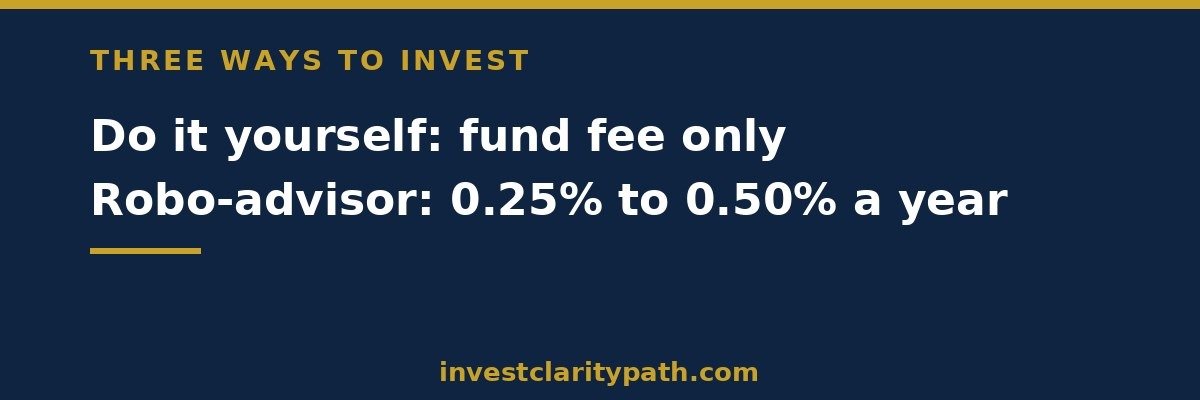
There are three ways to invest, and a robo-advisor sits in the middle.
Doing it yourself is the cheapest. You open a brokerage account, buy one or two low-cost index funds, and rebalance once a year. The cost is only the fund fee. The work is small, but it is yours: you choose the funds, you make the transfers, and you stay calm when the market falls. To learn how much money you need to start investing, read our guide.
A robo-advisor costs a little more, usually 0.25 to 0.50 percent a year, and does the choosing, the buying, and the rebalancing for you. It is available any time, it never gets emotional, and it takes small accounts that a human adviser would turn away.
A human adviser costs the most, usually about 1 percent a year, and often needs a large minimum. In return, you get a person who can help with tax planning, estate planning, or a big life decision, like selling a business. A robo-advisor cannot do that work. If your finances are simple, a human adviser is usually more than you need. If they are complex, a human is worth the fee.
Some providers now mix the two: a robo-advisor portfolio plus access to a human adviser for questions, for a fee between the pure robo-advisor and the pure human.
Who a robo-advisor suits, and who it does not
A robo-advisor suits beginners who want to invest but do not want to choose funds, watch the market, or rebalance a portfolio. It suits people starting small, because many take accounts with no minimum, and people who know they might panic and sell in a market fall, because the automation keeps buying without emotion. It suits busy people who want investing handled, and retirement savers who want a steady portfolio in an IRA.
It does not suit everyone. If you need the money in a year or two, no investment portfolio is the right home for it, robo-advisor or not. Keep short-term money in savings. If you want to pick individual stocks, a robo-advisor will not let you, because that is not its job. If your finances are complex, a human adviser can help in ways a questionnaire cannot.
A robo-advisor also does not suit someone who wants to beat the market. Its portfolios are built to match the market, not to beat it. Most professional fund managers fail to beat the market over long periods, so a steady portfolio that matches it is a reasonable goal for a beginner.
Worked example: the fee gap on $10,000 over 30 years
Lena has $10,000 to invest and is choosing between three options. She wants to see what the fee gap means in dollars.
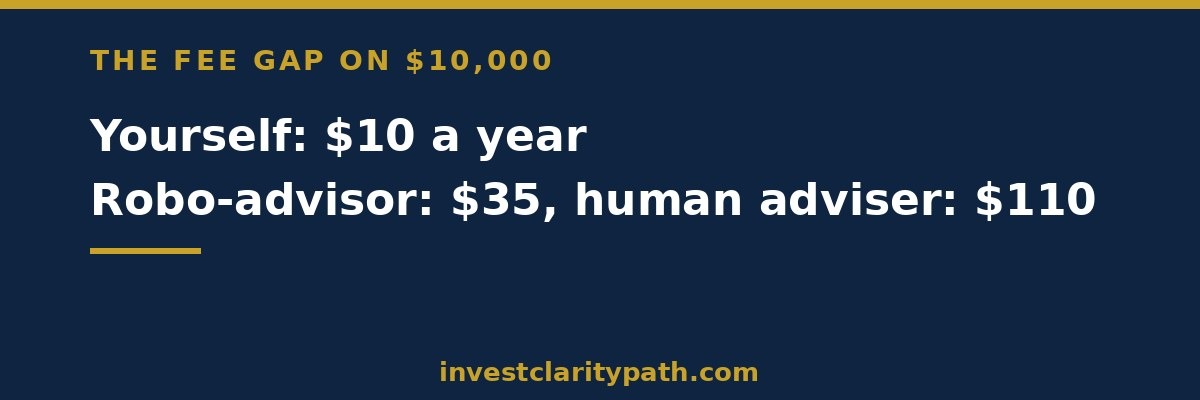
Option one is doing it herself with one low-cost index fund charging 0.10 percent a year, which is $10 a year on $10,000. Option two is a robo-advisor charging 0.25 percent a year, plus fund fees of 0.10 percent, for a total of 0.35 percent, or $35 a year. Option three is a human adviser charging 1 percent a year, plus fund fees of 0.10 percent, for a total of 1.10 percent, or $110 a year.
The yearly gap looks small: $25 a year between doing it yourself and the robo-advisor, and $100 a year between doing it yourself and the human adviser. But the fee is charged every year, and it grows as the portfolio grows. If the portfolio grows to $50,000, the yearly fees become $50, $175, and $550. At $100,000, they become $100, $350, and $1,100.
Over 30 years, a fee gap of 0.25 percent a year, which is the difference between doing it yourself at 0.10 percent and a robo-advisor at 0.35 percent, costs roughly 7 percent of the final portfolio in a simple illustration where the market returns 7 percent a year before fees. A gap of 1 percent a year costs roughly 24 percent of the final portfolio in the same illustration. The exact numbers depend on real returns, which will differ, but the shape is clear: a small fee gap, charged every year for decades, becomes a large gap in the end.
That does not mean the robo-advisor fee is wasted. Lena pays $25 a year more than doing it herself, and in return she never has to choose a fund, rebalance, or decide what to do in a market fall. For many beginners, that is a fair price.
How to choose a robo-advisor, in five checks
First, check the fee. Add the management fee and the fund fees inside the portfolio, and compare the total, not just the headline rate. Second, check the minimum. Many robo-advisors have no minimum, some need $500, and a few need more.
Third, check the account types. If you want a Roth IRA, make sure the provider offers one. Fourth, check the portfolio. It should hold broad, low-cost funds, not expensive or narrow ones. If you cannot see what funds it uses before you sign up, be cautious.
Fifth, check the extras. Tax-loss harvesting matters only in a taxable account, and only once the balance is large enough for the saving to matter. Human adviser access matters if you want a person for big questions. Pick the provider whose extras match your needs, not the one with the longest list.
Before you open any account, check that the provider is registered with the Securities and Exchange Commission in the United States, or the equivalent regulator where you live. The SEC’s investor bulletin on robo-advisers explains what to check and what questions to ask.
Common mistakes to avoid
The first mistake is choosing by brand name alone. Compare the total fee, the minimum, the account types, and the funds. The second mistake is ignoring the fund fees inside the portfolio. A robo-advisor charging 0.25 percent with funds at 0.50 percent costs more than one charging 0.50 percent with funds at 0.05 percent.
The third mistake is answering the questionnaire dishonestly, or rushing it. If you say you can handle a 30 percent fall but you panic at a 10 percent fall, the portfolio will be too bold for you, and you will sell at the worst time. Answer slowly, and imagine the fall happening to your real money. The fourth mistake is opening a robo-advisor account with money you need soon.
The fifth mistake is expecting the robo-advisor to beat the market. It is built to match the market with a diversified portfolio. If you want market-beating returns, you are asking for something no service can promise.
Frequently asked questions
What is a robo-advisor in simple terms?
A robo-advisor is an automated investing service that builds and manages a portfolio for you. You answer questions about your goals and risk tolerance, and a computer program picks low-cost funds, invests your money, and keeps the portfolio balanced over time.
How much does a robo-advisor cost?
Most robo-advisors charge 0.25 to 0.50 percent of your assets per year, plus the small fees of the funds inside the portfolio. A human adviser typically charges about 1 percent a year. Doing it yourself costs only the fund fee, often 0.03 to 0.20 percent a year.
Is a robo-advisor safe?
A robo-advisor is a regulated investment service in the United States, and your money is normally held at a custodian broker, not by the robo-advisor itself. But no investment is safe from market falls. Your portfolio can lose value, and the robo-advisor cannot prevent that.
Can I lose money with a robo-advisor?
Yes. A robo-advisor invests in the market, and markets fall. A diversified portfolio can fall 20 percent or more in a bad year. The robo-advisor rebalances and keeps your plan on track, but it cannot stop losses.
Do I need a lot of money to use a robo-advisor?
No. Many robo-advisors have no minimum, and some let you start with $100 or less. A human adviser, by contrast, often needs $100,000 or more before they will take you on.
Is a robo-advisor better than doing it yourself?
It depends on what you value. Doing it yourself is cheaper, because you pay only the fund fee. A robo-advisor costs 0.25 to 0.50 percent a year more, and in return it chooses the funds, buys them, and rebalances for you. If you want the work done for you, a robo-advisor is a fair price.
Conclusion, and your first step today
A robo-advisor is an automated service that builds and manages a diversified portfolio of low-cost funds for you, based on a short questionnaire about your goals and risk tolerance. It costs 0.25 to 0.50 percent a year, far less than a human adviser, and it rebalances your portfolio for you. It suits beginners who want a managed portfolio without a high fee or a high minimum.
Your first step is simple. Decide what you want the money for and when you will need it. If it is for years from now, compare three robo-advisors on total fee, minimum, account types, and funds. Then start with the amount you have, even if it is only $100, and automate the next deposit.
This post is educational only. It is not financial advice.
Sources
- United States Securities and Exchange Commission, Investor Bulletin: Robo-Advisers (200, verified 2026-11-29). Source for the definition of a robo-adviser, the questionnaire, lower costs and lower minimums than traditional advisers, and what to check before using one.
- Britannica Money, Robo-Advisor (curl returned 403 on 2026-11-29, page content read from search results). Source for robo-advisors as automated portfolio management, the goals and risk tolerance questionnaire, AI in portfolio management, and advisers who will not take clients under $100,000.
- Motley Fool, What Is a Robo Advisor? (200, verified 2026-11-29). Source for robo-advisors choosing ETFs or index funds, rebalancing, tax-loss harvesting, and fees of 0.25% to 0.50% versus 1% to 2% for human advisers.
- SoFi, What Is a Robo Advisor and How Do They Work? (200, verified 2026-11-29). Source for robo-advisors as computer algorithms that select portfolios from goals, risk preferences, and time horizon, low-cost ETFs and index funds, and fees of 0.25% to 0.50%.
