

What Is Index Investing?
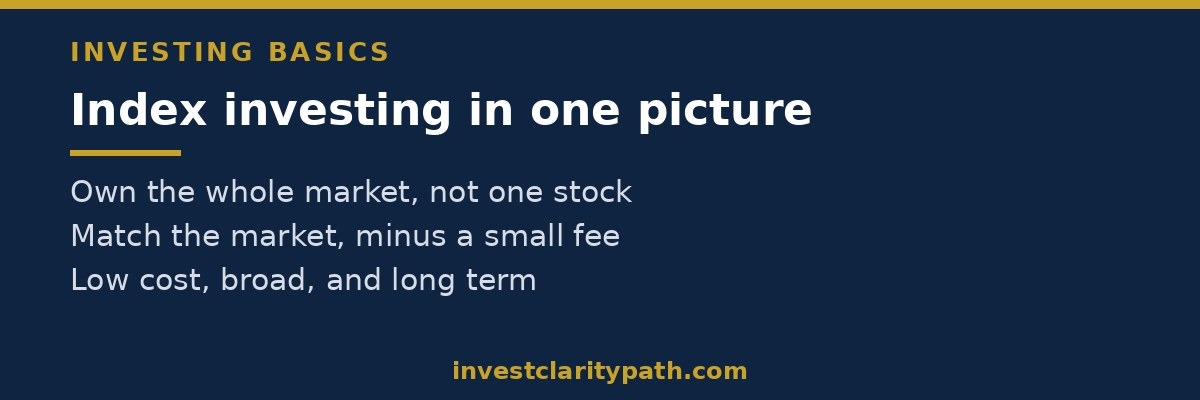
Index investing is a strategy where you buy a whole market index through a low-cost fund instead of trying to pick the winning stocks. You accept the market return, minus a small fee, rather than betting you can beat it. An S&P 500 index fund holds all 500 companies in proportion to market value and accepts the index return. That is the whole idea: own the market, keep costs low, and let time do the work.
This post is educational only. It is not financial advice. It explains a strategy. It does not recommend any fund, and it does not promise any return.
Index investing is a strategy, not a product
Beginners often mix up three things: the index, the fund, and the strategy. The index is a rule-based list, such as the S&P 500, which holds 500 large United States companies chosen by a committee and weighted by market value. You cannot buy an index. It is just a calculation. The fund is the product that copies the index: an index fund or ETF that holds the same securities in the same proportions. The strategy is the decision to use those funds to match the market instead of trying to beat it.
That distinction matters. You can buy an index fund and still trade it every week and chase hot sectors. That is not index investing. Index investing means buying broad funds, holding them for years, adding money regularly, and leaving the picking to the index rules.
Our site already explains what an index is and what an index fund is. This guide goes further: it explains why an investor would choose this strategy, what evidence supports it, what it costs, where it falls short, and how to build a simple plan around it. To learn what an index fund is first, read our guide.
How index investing works in three steps
Step one is choosing an index. The index decides what you own. A broad United States stock index, like the S&P 500, gives you large companies across many industries. A total market index adds smaller companies too. A global index adds companies from other countries. A bond index adds loans to governments and companies. Most beginners start with one broad stock index, because it is the simplest way to own a whole market in one purchase.
Step two is buying a fund that tracks that index, either a mutual fund or an ETF. The fund manager does not pick stocks. The manager buys the index securities in the index proportions, and trades only when the index changes or when money flows in or out. Vanguard explains that an index fund seeks to track a specific benchmark as closely as possible, rather than relying on analysts to pick the securities they think will outperform.
Step three is staying with the plan. You add money on a regular schedule, reinvest any dividends the fund pays, and rebalance only when your mix drifts far from your target. You do not sell because the news is bad, and you do not buy a hot sector because it is rising.
Why match the market instead of trying to beat it
The case for index investing rests on simple arithmetic. Before costs, all investors as a group earn the market return, because every share is owned by someone. Split all owners into two groups: those who hold the market in index proportions, and everyone else. The index holders earn the market return before costs. The active investors, as a group, also earn the market return before costs, because they are the other side of the same market. After costs, the average active dollar must earn less, because active funds charge more for picking, trading, and research.
The evidence matches the arithmetic. In the S&P Dow Jones Indices SPIVA United States Year-End 2025 scorecard, 78.8 percent of United States large-cap active funds trailed the S&P 500 in 2025, and 89.9 percent trailed it over 15 years. Most funds that try to beat the market fail to do so, and the longer the period, the fewer succeed. Past performance is not a guarantee of future results, and a minority of active funds do beat their benchmark. But the odds are against the picker, and the picker charges more for the try. An index fund does not pay a team to research stocks or trade often, so it can charge far less: stock index funds typically charge 0.03 percent to 0.20 percent a year, while many actively managed funds charge 0.50 percent to 1.00 percent or more.
Index fund or ETF: the wrapper, not the strategy
Index investing can use two wrappers: an index mutual fund or an index ETF. Both track the same index. The difference is how you buy and sell them. An index mutual fund is bought from the fund company at the end-of-day price, and you can often set up automatic monthly investing in exact dollar amounts. An index ETF trades on a stock exchange during the day, like a stock, and its price moves during the day.
For a beginner who invests a fixed amount every month, the mutual fund wrapper is often simpler, because automatic investing is easy and you can invest any dollar amount. The ETF wrapper suits a beginner who already has a brokerage account and likes control over the buying price. The wrapper does not change the strategy. What matters is the index it tracks, the fee it charges, and whether you keep adding money. Do not confuse an ETF with index investing: most ETFs track indexes, but some are actively managed or track narrow themes. Check what the fund tracks before you judge it. To learn how an ETF differs from a stock, read our guide.
What index investing costs, and what tracking error means
The main cost is the expense ratio: the annual fee the fund takes from your money, shown as a percentage. A fund with a 0.03 percent ratio takes 3 dollars a year for every 10,000 dollars invested. A fund with a 1.00 percent ratio takes 100 dollars a year. For a broad United States stock index fund, a competitive ratio is below 0.10 percent a year.
The second cost is tracking error: how closely the fund follows its index. A good index fund returns almost exactly the index return, minus its fee. You can check it in the fund fact sheet, as the difference between the fund return and the index return over one, three, and five years. Small differences are normal. Large or growing differences are a warning sign.
The third cost is your own trading. Buying and selling often creates tax bills and trading costs, and it usually makes results worse. Index investing keeps trading low by design, and you should trade little too.
Which index should a beginner pick?
Start broad. A broad index spreads your money across hundreds or thousands of companies, so one company failing cannot sink your plan. A narrow index, like one industry or one country, can fall hard when that industry or country struggles.
Here are the common choices, in plain words. A United States large company index, like the S&P 500, holds 500 large companies. A United States total market index holds large, medium, and small companies, usually several thousand. A bond index holds many bonds, which are steadier than stocks but usually grow more slowly. Most beginners start with one broad stock index, then add a bond index later, when they want less risk. The exact mix depends on your age, your goal, and how much a fall would worry you. A young investor saving for retirement in 30 years can usually hold mostly stocks, because there is time to recover from falls. To think about saving versus investing first, read our guide.
How much to invest, and how often
Index investing works best as a habit, not a one-time bet. Pick a monthly amount you can keep paying even in a bad month, and automate it. A small amount every month beats a large amount once, because regular investing buys more shares when prices fall and fewer when prices rise.
How much is enough? Start with what you can afford after bills, debt payments, and a starter emergency fund. Many beginners start with 50 or 100 dollars a month. What matters more than the starting amount is that it happens every month, without fail, for years. The plan should be boring: same amount, same day, every month. Do not try to time the market. Nobody knows the best day to buy. If a fall scares you, hold a mix with more bonds instead of selling everything and waiting.
Worked example: Sara invests 200 dollars a month for 30 years
Sara is 30 years old and starts index investing with 200 dollars a month. She buys a broad index fund, reinvests the dividends, and never stops, even in bad years. Nobody knows the future return, so we use a steady 7 percent a year as an illustration only. It is not a promise, and real returns will be higher in some years and lower, even negative, in others.
At a steady 7 percent a year, 200 dollars a month for 30 years grows to about 243,994 dollars. Sara paid in 72,000 dollars over those 30 years, because 200 dollars times 360 months equals 72,000 dollars. The rest, about 171,994 dollars, is growth. That growth comes from compounding: the returns earn returns of their own, year after year. To learn how compounding works, read our guide.
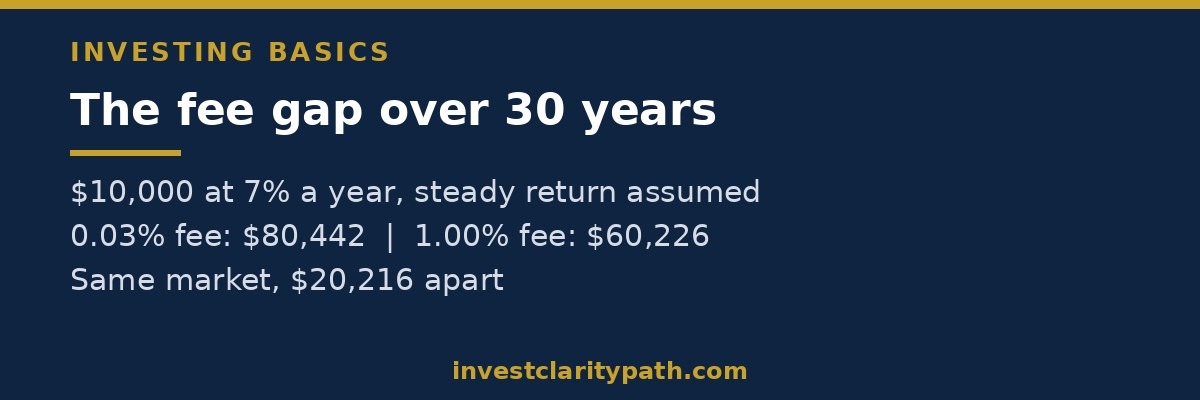
Now look at what fees do. Take a lump sum of 10,000 dollars, growing at 7 percent a year for 30 years. With a 0.03 percent expense ratio, it grows to about 80,442 dollars. With a 1.00 percent expense ratio, the same 10,000 dollars grows to only about 60,226 dollars. The difference is about 20,216 dollars, on the same market and the same return, lost to fees alone. Two things decide most of the outcome: how much you put in, and how much you keep after fees. You control both.
The limits of index investing
Index investing has real limits. First, you will never beat the market. By design, you get the market return, minus a small fee. In a year when the market falls 20 percent, your index fund falls about 20 percent too. There is no manager to move you to cash. If that fall would make you sell in a panic, the plan needs a mix with more bonds.
Second, a broad index is heavily weighted toward the biggest companies, because the index weights by market value. In early 2026, the top 10 holdings of the S&P 500 made up over 36 percent of the index. Your broad fund is not as evenly spread as it sounds. Third, index investing does not protect you from a long flat market. If the market goes sideways for ten years, your returns will be low too. Fourth, some indexes are badly built or too narrow. Always check what the index holds, how many securities it has, and what the fund charges.
Common mistakes to avoid
The first mistake is buying an index fund and then trading it like a stock. Checking the price every day, selling after a bad week, and buying a hot sector fund undo the strategy. Buy the broad fund, automate the monthly amount, and check it once a quarter at most.
The second mistake is picking a fund by its past return instead of its index and fee. A fund that did well last year usually did well because its index did well, not because the fund is clever. Pick by the index, the fee, and how closely it tracks. To compare fees, read our guide.
The third mistake is owning five index funds that all track the same market. That is not diversification. It is the same bet five times, with five fees. One broad fund is usually enough for the stock part of a plan. Add a bond index fund when you want less risk, not a second copy of the same stocks.
The fourth mistake is stopping the monthly investing when the market falls. That is when regular investing buys the most shares for the same money. If you cannot keep investing through a fall, your mix has too much stock in it. Change the mix, not the plan.
Frequently asked questions
What is index investing in simple terms?
Index investing means owning a whole market index through a low-cost fund instead of picking individual stocks. You buy a fund that copies an index like the S&P 500, hold it for years, add money regularly, and accept the market return minus a small fee.
Is index investing the same as buying an index fund?
Not quite. An index fund is a product that tracks an index. Index investing is the strategy of using those funds to match the market: broad funds, low fees, regular investing, and holding for years.
Is index investing safe?
No investment is safe from loss. An index fund falls when its market falls, and it can fall a lot in a bad year. Index investing lowers the risk of picking the wrong stocks, but it keeps market risk. A mix with bonds and cash lowers the falls, and a long time horizon gives the plan time to recover.
How much money do I need to start index investing?
Many funds let you start with 50 or 100 dollars a month, and some let you start with less. What matters more than the starting amount is that you can keep paying it every month for years. Start small, automate it, and raise the amount when your pay rises.
What is a good expense ratio for an index fund?
For a broad United States stock index fund, a competitive expense ratio is below 0.10 percent a year, and many widely used funds charge 0.03 percent to 0.07 percent. Over 30 years, the gap between 0.03 percent and 1.00 percent can cost tens of thousands of dollars on the same investment.
Conclusion, and your first step today
Index investing means owning a whole market through a low-cost fund, accepting the market return, and letting time and low fees do the work. Most active funds fail to beat their benchmark, and the ones that try charge more. The limits are honest: you will fall with the market, and you will never beat it.
Your first step today is simple. Pick one broad index you understand, check the expense ratio of a fund that tracks it, and decide on a monthly amount you can pay every month. Then automate it and check the plan once a quarter, not once a day.
This post is educational only. It is not financial advice.
