

How Do I Use Cash Envelopes to Budget?
You use cash envelopes to budget by putting real cash into labeled envelopes for each spending category, then spending only from the matching envelope. When an envelope is empty, that category is closed until next month. Start with three to six envelopes for the categories where you overspend most, such as groceries, eating out, and fun money. Fill them on payday, carry only the envelope you need, and move leftover cash to savings or debt at month end.
This post is educational only. It is not financial advice.
What is the cash envelope system?
The cash envelope system, also called cash stuffing or envelope budgeting, is a budgeting method where you put physical cash into envelopes, each labeled for a specific expense. You decide ahead of time what you will spend in each category, and you put that amount of cash in the labeled envelope. When you go shopping, you pay from the matching envelope. When the envelope is empty, you stop spending in that category until you add more money next month.
NerdWallet describes it the same way: cash stuffing is a budgeting method of putting cash into marked envelopes for spending, and when an envelope runs out of cash, that is your signal to pause spending in that category. Ramsey Solutions adds the key rule: spend only what is in each envelope, and when the cash is gone, you are done spending in that category. The idea is old: variations have been around for far longer than the modern version.
The system is not about using cash for everything. You may also see it called cash stuffing, often done in a binder with clear pockets instead of paper envelopes. The rules are the same either way. Rent, utilities, insurance, and loan payments stay on autopay from your checking account. Envelopes are for the spending you decide day by day: groceries, gas, eating out, fun, clothes, gifts, and personal care. Those are the categories where cards make overspending easy, because a tap feels like nothing. Cash makes every purchase visible.
Why cash envelopes work when apps do not
Cash envelopes work because they add friction. Handing over a physical bill feels different from tapping a card, and that feeling slows spending down. You can see the money getting thinner. You can count what is left before you reach the checkout. A card balance is a number on a screen that you check later, if you check it at all. An envelope is a limit you can hold in your hand.
Envelopes also make the budget visible to everyone in the household. A partner can see that the grocery envelope is nearly empty without opening an app.
Choose your envelopes first
Most people start with three to six envelopes. Adding twelve categories on day one is a fast way to give up by week two. Pick the categories where your money has a habit of disappearing. Ramsey Solutions suggests starting with the problem categories: groceries, restaurants, gas, fun money, medicine, hair care, car maintenance, personal care, entertainment, and gifts. NerdWallet gives a similar list, and Fidelity lists groceries, gas, household supplies, going out, clothing, pet care, medicine, gifts, car maintenance, and personal care.
Start with five if you are not sure: groceries, gas, eating out, fun money, and personal care. Add gifts and clothes later, once the first five feel normal. Keep the categories broad at first. One envelope for eating out is easier than three for restaurants, coffee, and takeaway.
Do not put fixed bills in envelopes. Rent, utilities, insurance, and loan payments are the same every month, and they are already handled by autopay. Envelopes are for variable spending, the kind that changes with your choices.
Set the amount in each envelope
Set each amount from your real spending, not from a guess. Look at your bank and card statements for the last two or three months. If you spent 520 dollars a month on groceries, do not set the envelope at 300 dollars. Set it at 480 dollars, a small cut you can keep, and tighten it next month.
Build the amounts inside a full budget. To create a monthly budget first, read our guide. List your take-home pay, subtract fixed bills, debt payments, and savings, and what is left is the money for all your envelopes together. A zero-based budget, where income minus expenses equals zero, is the frame for this step. If the envelope amounts add up to more than what is left, cut the least important one first, usually fun money or eating out, not groceries or gas. The envelopes must fit the pay, or the system fails in week two.
A simple split helps if you are starting from zero. The 50/30/20 budget puts about 50 percent of after-tax income toward needs, about 30 percent toward wants, and at least 20 percent toward savings and debt repayment. Your envelopes sit inside the needs and wants shares: groceries and gas from needs, eating out and fun from wants. To learn the 50/30/20 rule in detail, read our guide.
Fill the envelopes on payday
Once the amounts are set, fill the envelopes when the money arrives. If you are paid twice a month, fill each envelope with half its monthly amount on each payday. Fidelity gives a clear example: if you budgeted 600 dollars a month for groceries and get paid twice a month, take out 300 dollars from your first paycheck and put it in the grocery envelope, then put 300 dollars in on the second payday. That is your grocery budget for the month.
Use the right denominations: tens and twenties, plus a few fives. An envelope with five 20 dollar bills is easy to count and easy to spend from. Keep a small card in each envelope and write down what you spend, so it always shows what is left.
Withdraw the cash in one trip, on payday, and fill all the envelopes at once. One trip, one fill, one month. If you prefer a weekly rhythm, read our guide.
The spending rules: only four, and they matter
First, spend only from the matching envelope. Buy groceries only with grocery money. Buy gas only with gas money. Do not borrow from the grocery envelope to pay for fun, and do not use the fun envelope at the grocery store. When envelopes mix, the system is just a wallet full of cash, and the budget is gone.
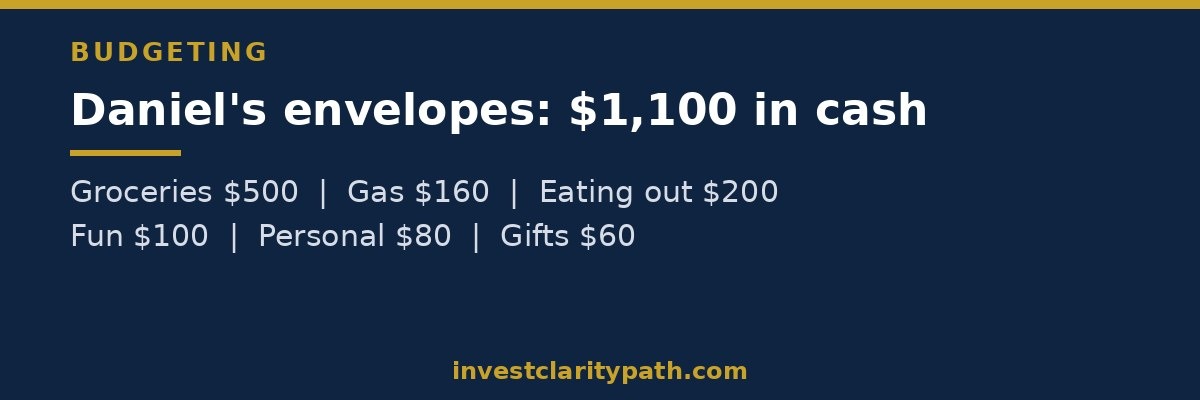
Second, when an envelope is empty, the category is closed. You wait until next month, or you move money on purpose from another envelope, in the open, knowing what you are giving up. Ramsey Solutions is blunt about this: when the money is gone, it is gone. That hard stop is the whole advantage of the system.
Third, keep the envelopes with you only when you need them. Take the grocery envelope to the grocery store and leave the rest at home. Fourth, count what is left once a week. If the grocery envelope has 100 dollars left and ten days to go, you know you have 10 dollars a day. To track spending without a spreadsheet, read our guide.
What if cash feels unsafe or impractical?
Cash has real downsides, and you should know them before you start. Cash at home earns no interest, is not insured if it is stolen, and is easy to spend by accident. Do not keep a whole month of cash in one place if you can avoid it. Keep only the envelopes you need for the week at home, and keep the rest in your bank until you need it. Fill weekly instead of monthly if that feels safer.
Some places no longer take cash, and some bills can only be paid by card. That is fine. Envelopes are for the shops where you pay in person. For online spending, use a digital version: a budgeting app with category balances that work like envelopes. Set a balance for each category, spend only from that balance, and stop when it hits zero. A hybrid works well: cash envelopes for groceries and fun, digital envelopes for gas and online shopping.
What to do with leftover cash
Leftover cash is the best part of the system, because it is proof the plan worked. At the end of the month, count every envelope. Put the leftover toward your current goal: your emergency fund, a debt payment, or a savings goal. Ramsey Solutions suggests putting leftover cash toward your current step at the end of the month instead of letting it disappear back into spending.
Do not roll leftover fun money into next month fun money by default. Move it to the goal first. If one envelope is always empty by week three and another always has money left, move money between them for next month. Adjust the amounts once a month, based on what actually happened.
Worked example: Daniel runs six envelopes on 3,000 dollars a month
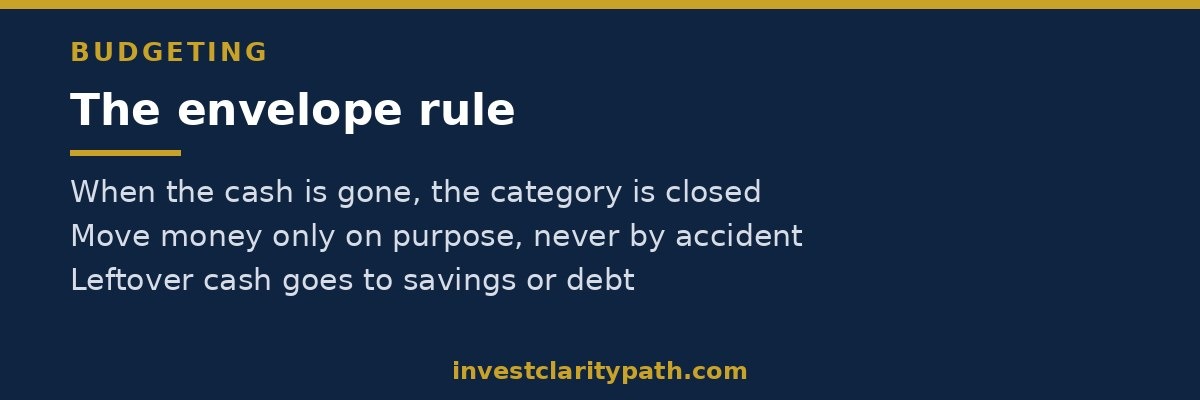
Daniel takes home 3,000 dollars a month, paid twice a month. His fixed bills, debt payments, and savings take 1,900 dollars. That leaves 1,100 dollars for envelopes. He picks six: groceries 500 dollars, gas 160 dollars, eating out 200 dollars, fun 100 dollars, personal care 80 dollars, and gifts 60 dollars. Add them up: 500 plus 160 plus 200 plus 100 plus 80 plus 60 equals 1,100 dollars. The envelopes fit his pay exactly.
He is paid twice a month, so he fills each envelope with half on each payday: groceries 250 dollars, gas 80 dollars, eating out 100 dollars, fun 50 dollars, personal care 40 dollars, and gifts 30 dollars. He withdraws 550 dollars in cash on each payday, in twenties and tens, and fills the envelopes at home the same evening.
In week three, his grocery envelope has 120 dollars left and ten days to go, so he plans cheaper meals. In week four, his eating out envelope is empty after a birthday dinner, so he cooks at home instead of moving money from groceries. At month end, he counts the envelopes: groceries has 40 dollars left, fun has 25 dollars left, and the rest are empty. He moves the 65 dollars to his emergency fund. Over a year, that kind of leftover adds up to 780 dollars, and that is before any other saving.
Daniel tried twelve envelopes in his first month and quit by week two. Six envelopes fit his life. If your first month feels hard, you probably have too many envelopes or amounts that are too low.
Common mistakes to avoid
The first mistake is putting fixed bills in envelopes. Rent and utilities do not need envelopes, and filling them with cash only adds trips to the bank and risk. Keep fixed bills on autopay. Envelopes are for variable spending.
The second mistake is setting amounts from hope instead of history. If you spent 500 dollars a month on groceries, a 300 dollar envelope will be empty by week three, and you will quit. Set the first month close to your real spending, then cut a little each month. A small cut that sticks beats a big cut that fails.
The third mistake is borrowing between envelopes in secret. Moving money is allowed, but only on purpose, in the open, knowing what you give up. If you take 40 dollars from groceries for fun without writing it down, the grocery envelope will run out and you will not know why. Write every move on the envelope card.
The fourth mistake is keeping all the cash at home in one place. Cash at home earns no interest, is not insured, and is easy to spend. Keep a week worth at home and the rest in the bank, or fill weekly. And the fifth mistake is quitting after one bad week. One empty envelope is not a failed system. Adjust the amount next month and carry on.
Frequently asked questions
How many cash envelopes should I start with?
Start with three to six envelopes, for the categories where you overspend most. Groceries, gas, eating out, fun money, and personal care are a good first set. Adding twelve categories on day one is a fast way to give up by week two. You can add more later, once the first ones feel normal.
How much cash should I put in each envelope?
Use your real spending from the last two or three months of bank and card statements. Set the first month close to that number, with a small cut of about 10 percent if you can. If the total is more than the money left after fixed bills and savings, cut fun money or eating out first.
What happens when an envelope runs out of money?
The category is closed until next month. You wait, or you move money on purpose from another envelope. Do not use a card to keep spending in that category, or the envelope is just decoration.
Is cash stuffing the same as the envelope system?
Yes. Cash stuffing is a newer name for the same method, often done in a binder with clear pockets instead of paper envelopes. The rules are the same: labeled categories, fixed amounts, and a hard stop when the cash is gone. Use a binder if it helps you stick with it, or plain envelopes if they work.
Is the cash envelope system safe?
It is safe if you keep the amounts small and the cash secure. Fill weekly, keep only the envelopes you need for the week at home, and keep the rest in the bank. For online spending and places that do not take cash, use a digital envelope in a budgeting app instead.
Conclusion, and your first step today
Cash envelope budgeting is simple: pick three to six categories, set each amount from your real spending, fill the envelopes on payday, spend only from the matching envelope, and stop when one is empty. Move leftover cash to savings or debt at month end, and adjust the amounts monthly. The system works because cash is visible, the limit is physical, and the hard stop is real.
Your first step today is simple. Look at last month statements, pick the one category where you overspend most, and put one envelope together for it this week. Try it for seven days. If it helps, add two more envelopes next payday, and keep going until the system covers the spending that used to run away from you.
This post is educational only. It is not financial advice.
