

How Do I Choose a Savings Account as a Beginner?
How do I choose a savings account as a beginner?
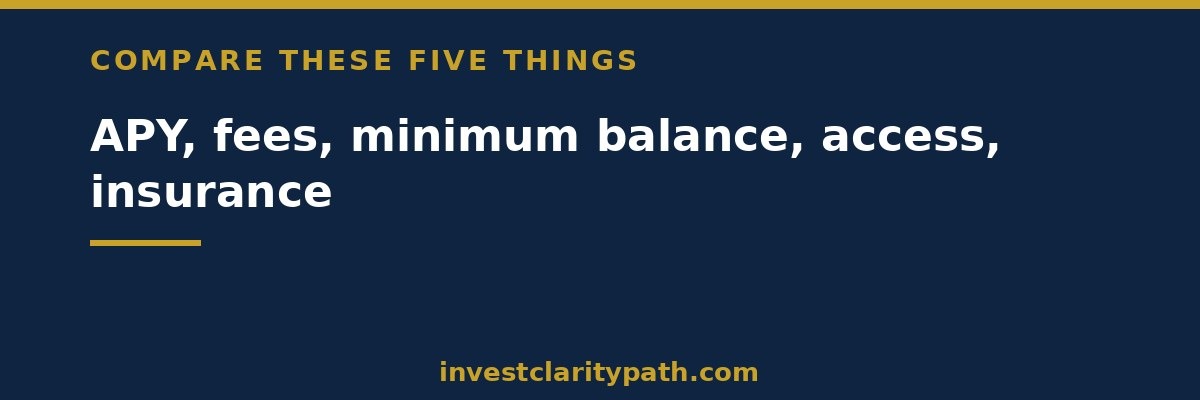
To choose a savings account, start with your goal, then compare five things: the interest rate (APY), the fees, the minimum balance rules, how fast you can reach your money, and whether the account is insured. The best account for you is the one that pays a fair rate, charges no monthly fee, has no minimum you cannot meet, and lets you reach your money when you need it.
Do not pick an account just because it is at the bank you already use, and do not pick one just because it has the highest advertised rate. A high rate with a monthly fee can earn you less than a slightly lower rate with no fee at all. Compare the whole account, not one number.
This post is educational only. It is not financial advice.
Step 1: Start with your savings goal
Before you compare accounts, ask what the money is for. Different goals need different accounts.
If the money is your emergency fund, you need quick access and safety. A high yield savings account is usually the best fit, because it pays more interest than a basic account and you can reach the money in a day or two. If the money is for a holiday or a purchase in the next few months, you also need quick access, and a high yield savings account fits again.
If the money is for a goal more than a year away, such as a house deposit, you could still use a high yield savings account, or you could split the money and put some in a certificate of deposit, known as a CD, which locks the money away for a set time in exchange for a fixed rate. If the money is for everyday spending, it does not belong in a savings account at all. It belongs in a checking account.
Write your goal down in one sentence, with the amount and the date. That sentence tells you how much access you need and how fast the money must grow.
Step 2: Learn the four types of savings account
There are four main types of savings account, and they differ in rate, access, and rules.
A basic savings account is the simplest type. It sits at a traditional bank, often next to your checking account. It pays a low rate, often close to zero, but it is easy to open and easy to use. It is a poor choice for growing money.
A high yield savings account pays a much higher rate than a basic account. Most high yield accounts are offered by online banks, which have no branches and can afford to pay more. The rate is variable, which means it can go up or down over time. Your money stays easy to reach by transfer, usually in one to two business days. For most beginners saving for an emergency fund or a short term goal, this is the best type.
A money market account is similar to a high yield savings account, but it often comes with a debit card or cheque writing, so you can spend from it directly.
A certificate of deposit, or CD, locks your money away for a fixed term, such as six months, one year, or five years. In exchange, you get a fixed rate that does not change during the term. If you take the money out early, you usually pay a penalty. A CD fits money you are sure you will not need before the term ends. It does not fit an emergency fund.
For most beginners, the choice is simple. Start with a high yield savings account for your emergency fund and short term goals.
To learn how a high yield account differs from a basic one, read our comparison.
Step 3: Compare the APY, and do the math
APY stands for annual percentage yield. It is the rate your money earns in a year, including compound interest. The higher the APY, the more your money grows.
The gap between a basic account and a high yield account is large. According to the FDIC, the average savings rate in the United States was 0.38 percent in August 2026, while many high yield accounts pay several percent. Rates change over time, so always check the current rate on the bank’s own site before you open an account.
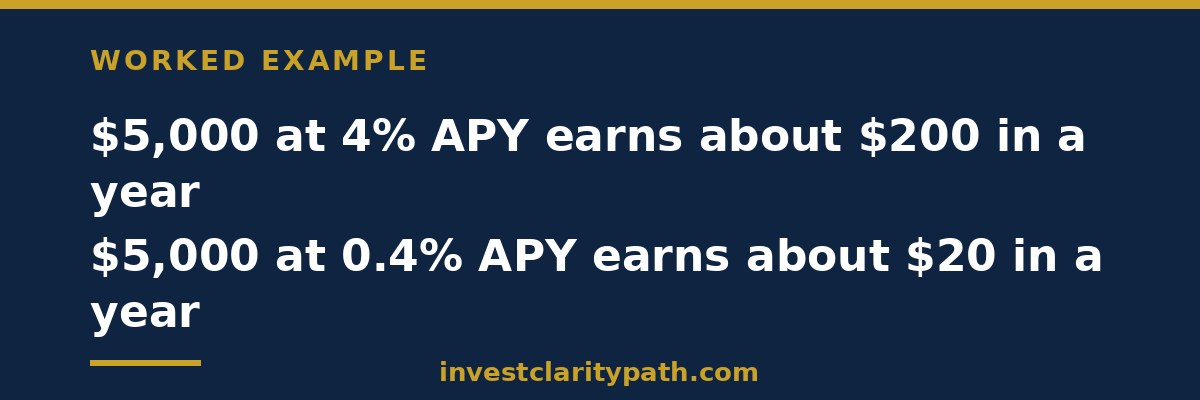
Here is what the difference means in dollars. Suppose you keep 5,000 dollars in an account for one year. At 4 percent APY, you earn about 200 dollars. 5,000 times 0.04 equals 200. At 0.4 percent APY, you earn about 20 dollars. 5,000 times 0.004 equals 20. The high yield account earns ten times as much on the same money.
But do not stop at the headline rate. Ask whether the rate is variable or fixed, whether it is only for new customers or only for the first few months, and whether it applies to your whole balance or only above a certain amount. A slightly lower rate with no conditions is often better in real life.
Step 4: Check the fees and the minimums
Fees quietly eat your interest. A 5 dollar monthly fee costs 60 dollars a year. On a 1,000 dollar balance earning 4 percent, the interest is only 40 dollars a year, so a 5 dollar monthly fee wipes out the interest and then some.
Look for a monthly maintenance fee, an excess withdrawal fee, an ATM fee, a paper statement fee, and a dormant account fee. Many accounts waive the monthly fee if you keep a minimum balance or set up a direct deposit.
Also check the minimums. Some accounts need a minimum deposit to open, such as 25, 100, or 500 dollars. Some need a minimum balance to earn the advertised APY, or to avoid the monthly fee.
The best accounts for beginners have no monthly fee and no minimum balance. Many online high yield accounts work this way. If an account charges a fee you cannot avoid, cross it off your list, no matter how good the rate looks.
Step 5: Check how fast you can reach your money
Access matters, because savings are only useful if you can reach them when you need them. Ask how long a transfer takes. Moving money from a savings account to a checking account at a different bank usually takes one to two business days by ACH transfer. Some banks offer instant transfers to their own checking accounts.
Ask whether there are withdrawal limits. Savings accounts used to be limited to six withdrawals a month under a United States rule called Regulation D, but that limit was removed in 2020. Many banks still set their own limits, so check the account terms before you open it.
Ask about branches and ATMs. If you like to deposit cash or talk to someone in person, a bank with branches near you matters. Online banks have no branches, but they usually have good apps and phone support, and many refund ATM fees. Ask about the app too. You will use it every month, so it should be simple and reliable, with automatic transfers that work without calling the bank.
A good test is to imagine an emergency on a Sunday night. Could you reach your money before Monday morning? If the answer is no, the account may still be fine for a long term goal, but it is not the right home for your emergency fund.
Step 6: Confirm the insurance
Before you open any savings account, confirm that your money is insured. In the United States, the Federal Deposit Insurance Corporation, known as the FDIC, insures deposits up to 250,000 dollars per depositor, per insured bank, per ownership category. Credit unions have the same protection through the National Credit Union Administration, known as the NCUA, also up to 250,000 dollars.
Insurance means that if the bank fails, your money is protected up to the limit. It does not protect you from losing money in investments, and it does not cover cash kept at home. It only covers deposits in an insured bank or credit union. Look for “Member FDIC” or “Federally insured by NCUA” on the bank’s site, and do not open a savings account at a company that is not insured, no matter how high the rate is.
To learn more about how this protection works, read our guide on whether a high yield savings account is safe.
Step 7: Compare bank, credit union, and online bank
Where you open the account matters as much as which type you pick. A traditional bank has branches, ATMs, and a full range of products. It is convenient if you want everything in one place. But its savings rates are usually the lowest, and its fees are often the highest.
A credit union is a not for profit owned by its members. It often pays better rates than a traditional bank and charges lower fees. It may have fewer branches, but many credit unions share ATMs with each other. You need to qualify for membership, usually by living in an area or working for an employer.
An online bank has no branches, so it can pay higher rates and charge lower fees. Its app is usually strong, and it often refunds ATM fees. The trade off is that you cannot walk into a branch, and depositing cash can be awkward.
For a beginner, an online high yield savings account is often the best starting point. If you prefer a branch, a credit union is usually a better choice than a traditional bank. To compare the two in detail, read our guide on choosing between a credit union and a bank.
Worked example: choosing between two accounts
Suppose you have 2,000 dollars to save as the start of an emergency fund, and you can add 200 dollars a month. You narrow it down to two accounts. Account A is an online high yield savings account. It pays 4 percent APY, charges no monthly fee, has no minimum balance, and is FDIC insured. Account B is a basic savings account at your local bank. It pays 0.5 percent APY and charges a 5 dollar monthly fee unless you keep 1,500 dollars in the account.
In the first year, your average balance is about 3,100 dollars, because you start at 2,000 and add 200 a month. Account A earns about 124 dollars of interest. 3,100 times 0.04 equals 124.
Account B earns about 15.50 dollars of interest. 3,100 times 0.005 equals 15.50. But the fee is 5 dollars a month, which is 60 dollars a year, and your balance is below 1,500 dollars for the first few months, so the fee applies at least some of the time. Even if the fee only applies for six months, that is 30 dollars, which is more than the 15.50 dollars of interest.
The lesson is clear. A high rate with no fee beats a low rate with a fee, even before you count the convenience of branches. Account A is the better choice for this saver.
Your choosing checklist
Use this checklist every time you compare accounts. One, the account matches your goal. Two, the APY is competitive and you understand the conditions. Three, there is no monthly fee you cannot avoid, and no minimum balance you cannot meet. Four, you can reach your money fast enough for your goal. Five, the account is FDIC or NCUA insured up to 250,000 dollars. Six, the bank, credit union, or online bank suits how you like to bank. Seven, you have read the account terms, not just the advertisement. If an account fails any one of these checks, keep looking.
When you are ready to open the account, read our step by step guide on how to open a high yield savings account. You can also read our general guide on how to open a savings account.
Common mistakes to avoid
The first mistake is picking the account with the highest advertised rate and ignoring the fees. A 5 percent rate with a 10 dollar monthly fee earns less than a 4 percent rate with no fee on a small balance. Always do the math after fees.
The second mistake is opening an account at a bank that is not insured. No rate is worth the risk of losing your savings if the company fails. Check FDIC or NCUA insurance first.
The third mistake is locking your emergency fund in a CD. A CD pays a fixed rate, but you cannot reach the money without a penalty. Your emergency fund must stay easy to reach.
Frequently asked questions
What is the best savings account for a beginner?
For most beginners, a high yield savings account with no monthly fee, no minimum balance, and FDIC or NCUA insurance is the best starting point.
What APY should I look for in a savings account?
Look for a rate well above the national average. The FDIC reported an average savings rate of 0.38 percent in August 2026, so an account paying several percent is far better. Check the current rate on the bank’s own site, because rates change.
Are online savings accounts safe?
Yes, if the account is held at an FDIC insured bank or an NCUA insured credit union. The insurance covers up to 250,000 dollars per depositor, per institution, per ownership category, whether the bank has branches or not.
Do I need a minimum balance to open a savings account?
It depends on the account. Many online high yield accounts have no minimum at all. Some traditional banks need 25, 100, or 500 dollars to open, and some need a minimum balance to earn the top rate or avoid a fee.
Conclusion, and your first step today
Choosing a savings account is not about finding the highest number on a list. It is about matching the account to your goal, then checking the rate, the fees, the minimums, the access, and the insurance. A high yield savings account with no monthly fee, no minimum balance, and FDIC or NCUA insurance is the best starting point for most beginners.
Your first step today is simple. Write down your savings goal, the amount, and the date you want to reach it. Then compare three accounts using the checklist in this guide: the APY, the monthly fee, the minimum balance, the transfer time, and the insurance. Pick the one that passes all seven checks, open it, and set up an automatic transfer from your checking account on payday. Even 50 dollars a month is a strong start.
To learn how compound interest grows your savings once the account is open, read our guide on compound interest in a savings account.
This post is educational only. It is not financial advice.
Sources
- MoneyLion, How To Choose the Right Savings Account: https://www.moneylion.com/learn/banking/savings/how-to-choose-savings-account
- FDIC, Deposit Insurance: https://www.fdic.gov/resources/deposit-insurance/
- Motley Fool, How to Choose a Savings Account: https://www.fool.com/the-ascent/banks/guides-tools/how-choose-savings-account/
