


How Do I Deal With Debt Collectors in Simple Terms?
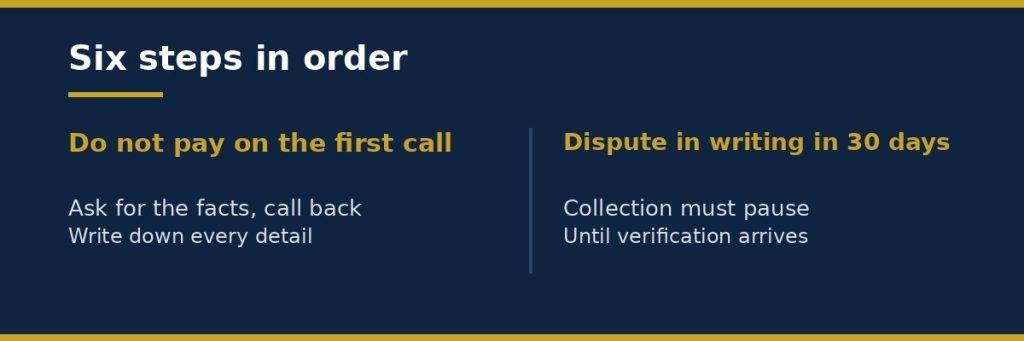
When a debt collector contacts you, do not pay on the spot, do not promise to pay, and do not give payment information on the first call. Ask for information about the debt, say you will call back, and then check whether the debt is yours, whether the amount is right, and whether it is still legally collectible. Under US federal law, the collector must send you a written validation notice, and you have 30 days from receiving it to dispute the debt in writing, during which the collector must stop collection activity until it sends you verification.
Debt collectors can be annoying, and some break the law. But you have clear rights, and a calm, written process protects you far better than arguing on the phone. This guide walks through the six steps in order, explains your rights in plain words, and shows what to do if the debt is yours, if it is wrong, or if it is too old to collect. It is educational only. It is not legal or financial advice.
Step 1: do not pay, promise, or panic on the first contact
Debt collectors may pressure you to act quickly, but you do not have to. Do not pay, do not promise to pay, and do not give any payment information the collector can use later. Ask for information about the debt, and say you will call back to discuss it later.
This matters more than it sounds. Making a single payment, even 5 or 10 dollars, can be treated as an acknowledgment of the debt. If the debt is past the statute of limitations, which is the time limit for suing over a debt, making a payment can restart that clock in many states, which could lead to a lawsuit or wage garnishment. So the first rule is simple: nothing is paid, and nothing is promised, until the debt is checked.
Write down the date, the time, the name of the caller, the name of the collection company, the amount they claim, and what they said. Keep every letter and message. Good records are your protection if anything is disputed later.
Step 2: get the validation notice and check the facts
Under the Fair Debt Collection Practices Act, a collector must send you a written validation notice, either in the first communication or within five days of it. Under the Consumer Financial Protection Bureau’s Regulation F, that notice must include the name of the company that currently owns the debt, the name of the original creditor if it is different, the account number or a shortened version of it, an itemized breakdown of the amount owed, and the date by which you can dispute the debt, which is 30 days after you receive the notice. If a collector contacts you without ever providing this information, that alone is a sign something is wrong.
Many sold debts have errors about the amount owed, or even about who owes it. Compare the notice with your own records: your old statements, your payment history, and the original creditor’s name. Check the amount, the dates, and the account number. If anything does not match, or if you do not recognize the debt at all, you will dispute it in the next step.
Also check whether the debt is time-barred, meaning the statute of limitations has passed. The time limit varies by state and by debt type, often between three and six years, and it usually runs from the date of your last payment or last activity on the account. A time-barred debt can still be reported on your credit report for up to seven years, but the collector cannot sue you to collect it, and in many states it cannot threaten to sue you either. Do not assume a debt is time-barred without checking your state’s rules, and do not make a payment before you check, because a payment can restart the clock.
Step 3: dispute in writing within 30 days if anything is wrong
You have 30 days from receiving the validation notice to dispute the debt in writing. Your letter does not need a special format. A clear written statement saying you dispute the debt and are requesting verification is enough. Send it to the mailing address on the validation notice, and use certified mail with a return receipt, so you have proof the collector received it.
Once the collector receives your written dispute, it must pause all collection activity, no calls, no letters, no credit reporting, until it mails you either verification of the debt or a copy of a court judgment. If you also want the name and address of the original creditor, include that request in the same letter. The collector must provide it before resuming collection.
If you do not dispute within 30 days, the collector is allowed to treat the debt as valid. You can still dispute later, but only a dispute inside the 30 day window forces the collector to pause collection until it verifies the debt.
Step 4: know what collectors cannot do
The Fair Debt Collection Practices Act applies to third-party collectors, which includes collection agencies hired by creditors, lawyers who regularly collect debts, and companies whose main business is debt collection. It generally does not apply to the original creditor collecting its own debt, though state laws may cover that case. It protects personal, family, and household debts, such as credit cards, medical bills, and auto loans.
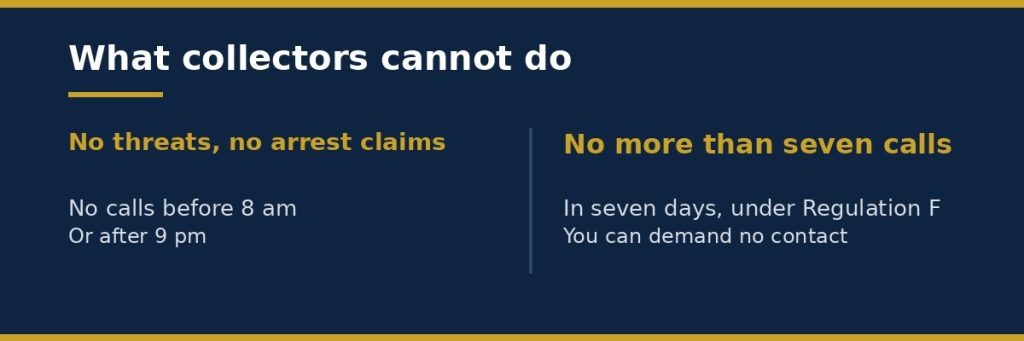
Under the law, collectors cannot harass or threaten you, mislead you about who they are, how much you owe, or the legal consequences of not paying, or threaten you with arrest. They cannot call you before 8 in the morning or after 9 at night, or call you at work if you tell them not to. Under Regulation F, they are presumed to break the law if they place more than seven phone calls to you within seven days, or call within seven days after speaking with you about the debt.
You can also tell a collector, in writing, to stop contacting you. Once it receives your written request, it must stop, with three narrow exceptions: it may contact you once to say collection efforts are ending, to say certain remedies may be invoked, or to say a specific remedy is being pursued. A letter asking for no contact does not erase the debt. The collector can still report it to the credit bureaus, sue you, or take other legal steps.
If a collector breaks these rules, you can file a complaint with the Consumer Financial Protection Bureau, and you can also talk to a consumer protection lawyer. Keep your records, because they are the evidence.
Step 5: decide what to do if the debt is yours
If the debt is verified, the amount is right, and it is still collectible, you have choices. You can pay it in full, which is the fastest way to close it. You can set up a payment plan, paying a fixed amount each month until it is done. Or you can try to settle, which means offering a lump sum that is less than the full balance, in exchange for the account being marked as settled. Collectors often accept less than the full amount, because they bought the debt for less than its face value, but a settled account can still affect your credit report, so get any agreement in writing before you pay, including the amount, the date, and a statement that the payment settles the account in full.
A worked example shows how a settlement can look. Imagine a collector claims you owe 2,400 dollars on an old credit card. You verify the debt, and you have 1,200 dollars available. You offer 1,200 dollars as a lump sum to settle the account in full. If the collector accepts, you pay 1,200 dollars, which is half the balance, because 1,200 divided by 2,400 is 0.50, or 50 percent, and you save 1,200 dollars, because 2,400 minus 1,200 is 1,200. Get that agreement in writing first, pay by a method you can trace, and keep the proof forever.
Do not agree to a payment you cannot keep. A broken payment plan can restart collection, and it can be used against you. It is better to offer a smaller amount you can actually pay, every month, than a larger amount that fails in month two.
Step 6: never ignore a court summons
If a collector sues you, you will receive a court summons. Never ignore it. If you do not respond, the court can enter a default judgment against you, which can lead to wage garnishment or a bank levy. Respond by the deadline on the summons, and if you cannot afford a lawyer, look for low cost or free legal aid near you through the Legal Services Corporation or LawHelp.org.
A summons does not mean you have lost. You may have a defense, such as a time-barred debt, a wrong amount, or a collector that cannot prove it owns the debt. But a defense only helps if you show up and use it.
A worked example: one call, handled calmly
Imagine a collector calls on a Tuesday and says you owe 900 dollars on a store card you closed three years ago. You do not pay, promise, or argue. You ask for the company name, the account number, and the amount, and you write them down. You say you will call back, and you end the call.
The validation notice arrives on Friday. It says the current creditor is a collection agency, the original creditor is the store, and the amount is 900 dollars, with an itemization date and a 30 day dispute deadline. You check your records: you closed the card with a zero balance, and you have the final statement to prove it. You send a written dispute by certified mail within the 30 days, saying you dispute the debt and requesting verification. The collector must now pause all collection activity until it sends you verification or a judgment. If it cannot verify the debt, it must stop.
That is the whole process: no payment on the phone, a written check of the facts, and a written dispute inside the window. It takes one letter, and it protects you far better than a long argument on the phone ever could.
Related reading in the Debt Payoff cluster: how to talk to a lender if you cannot pay, what happens if you miss a loan payment, how to make a debt payoff plan you can stick to, what debt settlement is in simple terms, and how long it will take to pay off your debt.
Frequently asked questions
Do I have to pay a debt collector on the first call?
No. Do not pay, promise to pay, or give payment information on the first call. Ask for information about the debt, say you will call back, and check the facts first. A payment, even a small one, can restart the clock on an old debt in many states.
What is a validation notice?
It is a written notice the collector must send you, in the first communication or within five days of it. It must include the current creditor, the original creditor, the account number, an itemized breakdown of the amount, and the date by which you can dispute, which is 30 days after you receive it.
How long do I have to dispute a debt?
Thirty days from receiving the validation notice. If you dispute in writing within that window, the collector must stop all collection activity until it sends you verification or a copy of a judgment. You can still dispute later, but the collector is not forced to pause.
Can a debt collector threaten me or call me at work?
No. Collectors cannot harass or threaten you, mislead you about the debt, or threaten arrest. They cannot call before 8 in the morning or after 9 at night, or at work if you tell them not to. You can also tell them in writing to stop contacting you, with a few narrow exceptions.
What if I am sued over a debt?
Never ignore a court summons. Respond by the deadline, and look for low cost or free legal aid if you cannot afford a lawyer. A summons does not mean you have lost, but a defense only helps if you show up and use it.
Conclusion, and your first step today
Dealing with a debt collector is a process, not a fight. Do not pay on the first call. Get the validation notice, check the facts against your records, and dispute in writing within 30 days if anything is wrong. Know what collectors cannot do, and complain to the Consumer Financial Protection Bureau if they break the rules. If the debt is yours, pay it, plan it, or settle it, with the agreement in writing first. And never ignore a court summons.
Your first step today is to make a folder, paper or digital, for any collector letter you have, and write down the date, the company, and the amount for each one. That record is the start of every step above, and it costs nothing to create.
Disclaimer: This article is for education only. It is not legal or financial advice, and it does not guarantee any result. Debt collection law, time limits, and credit reporting rules differ by state and by debt type, and by where you live. Your income, costs, debts, and goals are personal, and you should consider your own situation, and speak to a qualified professional, such as a consumer protection lawyer or a nonprofit credit counselor, if you need personal advice, before making a financial decision.
Sources
- NerdWallet, Dealing With Debt Collectors: Your Rights and How to Protect Yourself
- Consumer Financial Protection Bureau, Debt collection
