


What Is a Bull Market in Simple Terms?
What is a bull market in simple terms?
A bull market is a long period when stock prices mostly rise, and investors expect them to keep rising. The simple rule is a rise of 20 percent or more from a recent low, in a broad market index like the S&P 500. If the index falls to 4,000 and then climbs to 4,800, that is a rise of 800 points, which is 20 percent of 4,000, so it counts as a bull market.
It is called a bull market because a bull attacks by thrusting its horns upward, and prices move upward too. The opposite is a bear market, where prices fall 20 percent or more from a recent high, because a bear attacks by swiping its paws downward.
A bull market does not mean prices rise every day. Prices still fall on some days and some weeks. It means the general direction, over months, is up, and most investors feel hopeful about the future. This post explains the 20 percent rule, how bull markets compare with bear markets, and what a beginner should and should not do when prices keep rising. It is educational only. It is not financial advice.
The 20 percent rule, with a worked example
The 20 percent rule is the line most people use. A bull market starts when a broad index rises 20 percent from its recent low point. A bear market starts when it falls 20 percent from its recent high point.
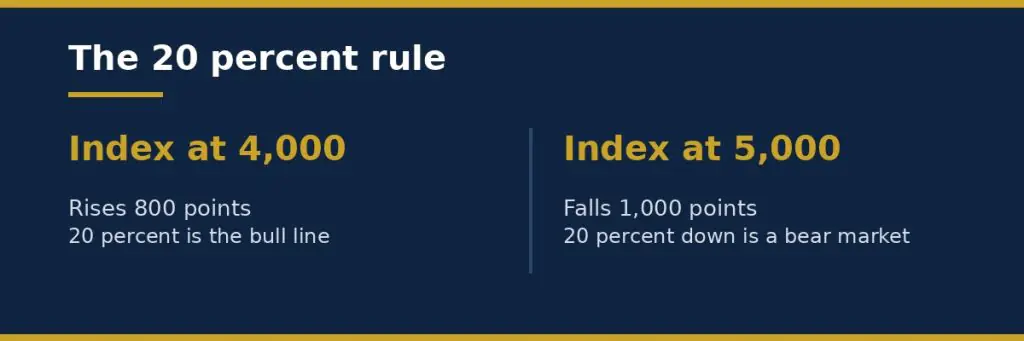
Here is the math. Imagine the S&P 500 falls to 4,000 points. That is the low. Then it climbs back up. A rise of 20 percent from 4,000 is 800 points, because 20 percent of 4,000 is 800. So when the index reaches 4,800, it is up 20 percent from the low, and people call it a bull market.
Now imagine the index is at 5,000 points and falls. A fall of 20 percent from 5,000 is 1,000 points, because 20 percent of 5,000 is 1,000. So when the index reaches 4,000, it is down 20 percent from the high, and people call it a bear market.
The 20 percent line is a convention, not a law of nature. It is simply the number investors agreed to use, so everyone means the same thing when they say bull or bear market. What matters for a beginner is the direction and the mood, not the exact day the line is crossed.
Why do bull markets happen?
Bull markets usually happen when the economy is growing, companies are earning more money, and people expect things to keep improving. Low unemployment, rising company profits, and low interest rates all help, because they make investing look more attractive than keeping money in cash.
Confidence matters as much as the numbers. When investors believe prices will rise, they buy, and their buying pushes prices up, which makes more people believe prices will rise. The same loop works in reverse in a bear market, which is why markets can move fast in both directions.
Bull markets can last a long time. They can run for months, or for years. The longest one in recent history ran from 2009 to 2020, about 11 years, after the financial crisis. But no bull market lasts forever. Every one of them has ended, usually when the economy slows, company profits fall, or a shock hits.
Bull market vs bear market, side by side
The two markets are opposites, and it helps to see them together.
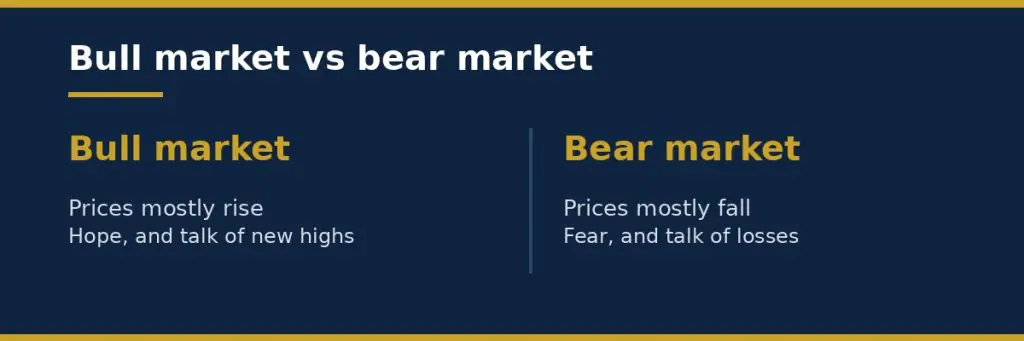
In a bull market, prices mostly rise, investors feel hopeful, and the news talks about new highs. People buy more, and even bad news is often shrugged off. In a bear market, prices mostly fall, investors feel fearful, and the news talks about losses. People sell, and even good news is often ignored.
In a bull market, it is easy to feel clever, because almost everything you buy goes up. In a bear market, it is easy to feel foolish, because almost everything goes down. Both feelings are misleading. The market rises and falls in cycles, and neither mood lasts.
A beginner should know both, because you will live through both. The plan that works in one should also work in the other, and that plan is the subject of the next section.
What a beginner should do in a bull market
First, keep investing regularly, the same amount on the same schedule, as you did before. If you put in 100 dollars a month, keep putting in 100 dollars a month. In 12 months you will have put in 1,200 dollars, because 100 times 12 is 1,200. Regular investing means you buy at many different prices, high and low, instead of trying to guess the best day.
Second, check that your mix still fits you. If stocks have risen a lot, they may now be a bigger share of your investments than you planned. Rebalancing, which means selling a little of what grew and buying a little of what did not, brings the mix back to your plan. Our guide to rebalancing explains the steps.
Third, keep your emergency fund full. A bull market is a good time to top it up, because your income and your investments are both likely to be doing well. The fund is what keeps you from selling investments at a bad time when life surprises you.
What a beginner should not do in a bull market
Do not chase prices. When a stock or a fund has already risen a lot, buying it because it went up is not a plan, it is following the crowd. The crowd is often wrong at the top.
Do not borrow money to invest more, and do not put your emergency fund into stocks because prices are rising. A bull market can turn, and borrowed money and emergency money are the two things you cannot afford to lose.
Do not sell everything because prices look high. Nobody knows when a bull market will end, and selling everything means you also miss the gains that may still come. If your plan is to invest for many years, a bull market is a normal part of the journey, not a signal to jump in or out.
Do not believe that a rising market makes you an expert. In a bull market, almost every choice looks smart. The test of a plan is how it holds up when prices fall, not when they rise.
Related reading in the Investing Basics cluster: what a bear market is, what diversification is and why it matters, what risk in investing means, how much money you need to start investing, and what market timing is and why it rarely works.
Frequently asked questions
Is it better to buy in a bull or bear market?
Neither, if you are trying to time the market. Nobody can reliably predict when a bull market will end or a bear market will begin. The approach most beginners use is to invest a fixed amount regularly, in both markets, and let time do the work. That way you buy at high prices and low prices, and you do not need to guess.
How long does a bull market usually last?
There is no usual length. Some last months, some last years. The longest in recent history ran from 2009 to 2020, about 11 years. Short ones can last less than a year. Because the length is not predictable, a plan that depends on guessing it is not a good plan.
Why is it called a bull market?
It is called a bull market because of how a bull attacks, thrusting its horns upward, and prices move upward in a bull market. A bear market is named the same way, because a bear swipes its paws downward, and prices move downward in a bear market.
Are we in a bull market now?
That depends on the date you are reading this, and on which index you look at. Market conditions change, so check a current source, such as the S&P 500 level compared with its recent low, rather than relying on an article written months ago. What does not change is the plan: invest regularly, keep a mix that fits you, and keep an emergency fund.
What was the longest bull market in history?
The longest bull market in recent history ran from March 2009 to February 2020, about 11 years, after the financial crisis. It ended when the pandemic hit markets in early 2020. Longer or shorter runs are possible, and no record tells you how long the next one will last.
Conclusion, and your first step today
A bull market is a long period when stock prices mostly rise, usually defined as a rise of 20 percent or more from a recent low. It is named after the bull’s upward thrust, and it is the opposite of a bear market. Bull markets can last months or years, and they always end, so the beginner’s job is not to predict the end, but to keep a steady plan through the whole cycle.
Your first step today is to check your own plan, not the market. Write down how much you invest each month, what mix you hold, and whether your emergency fund is full. If those three are in place, a bull market is just good weather on a long journey.
Disclaimer: This article is for education only. It is not financial advice, and it does not guarantee any result. Your income, costs, debts, and goals are personal, and you should consider your own situation, and speak to a qualified professional if you need personal advice, before making a financial decision.
Sources
- Investor.gov, US Securities and Exchange Commission, stocks: https://www.investor.gov/introduction-investing/investing-basics/investment-products/stocks
- Investor.gov, US Securities and Exchange Commission, free financial planning tools: https://www.investor.gov/free-financial-planning-tools
- Google keyword research, 2026-11-28, keyword “what is a bull market in simple terms”. Top results included Fidelity, Investopedia, Investor.gov, Citizens Bank, J.P. Morgan, tastylive, Oregon State Credit Union, and Reddit. People also ask included “Is it better to buy in a bull or bear market?” and “How long does a bull market usually last?” No volume, difficulty, or CPC figure was shown on any Google results page.