

How Do I Protect My Savings From Inflation, in Simple Terms?
How do I protect my savings from inflation, in simple terms?
Inflation means your money buys less over time. If prices rise 3 percent in a year, 100 dollars buys what 97 dollars bought a year ago. You protect your savings by keeping your money where it earns at least as much as inflation takes away, and by not keeping more cash than you need in an account that pays almost nothing.
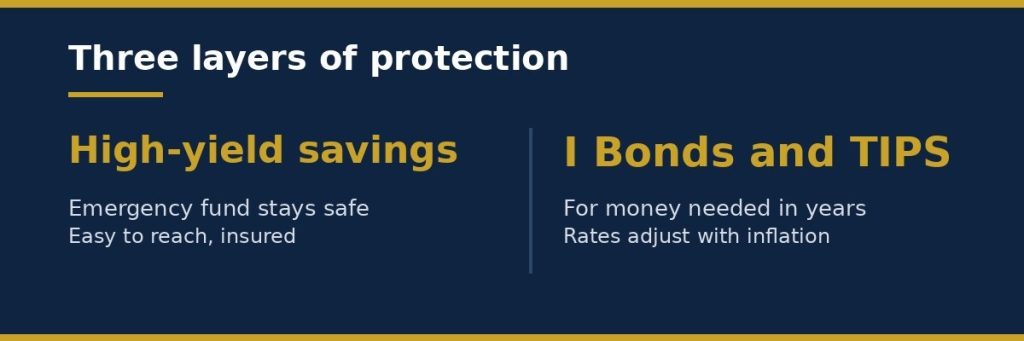
The simple plan has three parts. First, keep your emergency fund in a high-yield savings account, not a normal account that pays almost no interest. Second, for money you will not need for years, use inflation-protected options like Series I savings bonds, known as I Bonds, or Treasury Inflation-Protected Securities, known as TIPS. Third, for long-term goals like retirement, invest in a diversified mix of stocks and bonds, because over long periods, investing has usually grown faster than inflation.
This post explains each part in plain words, with a worked example, and the mistakes to avoid. It is educational only. It is not financial advice.
What inflation does to your savings
Start with the basic math. Suppose you have 10,000 dollars in a savings account, and prices rise 3 percent in a year. After that year, you need 10,300 dollars to buy what 10,000 dollars bought before. Your money has lost about 300 dollars of buying power.
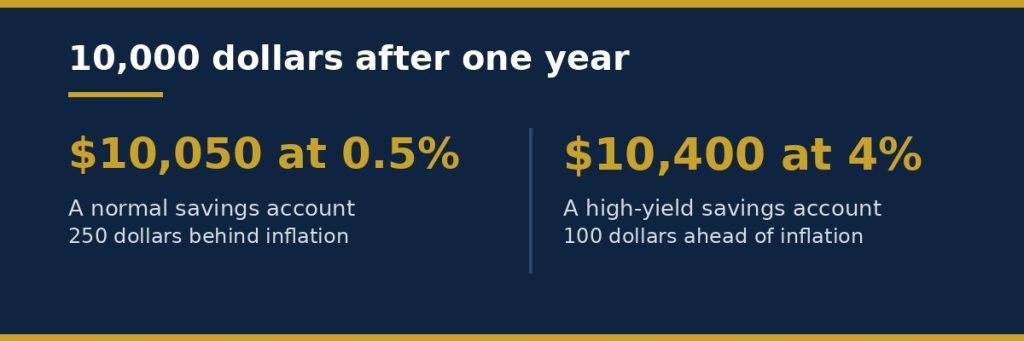
Now suppose your account pays 0.5 percent interest, which is common for a normal savings account. After a year, you have 10,050 dollars. That is 10,000 plus 50 dollars of interest. But you need 10,300 dollars to keep up with prices. You are 250 dollars behind, even though your balance went up.
Now suppose a high-yield savings account pays 4 percent. After a year, you have 10,400 dollars. That is 10,000 plus 400 dollars of interest. You needed 10,300 dollars to keep up with prices. You are 100 dollars ahead. The account did not make you rich, but it protected your buying power.
The lesson is simple. The interest rate on your savings matters, and it must be compared with inflation, not judged on its own. An account that pays almost nothing loses value every year, quietly.
Step 1: Move your emergency fund to a high-yield savings account
Your emergency fund should stay safe and easy to reach. That means a savings account, not the stock market. But it should be a high-yield savings account, which pays much more interest than a normal savings account at a big bank.
A high-yield account is still a normal savings account. Your money is still insured, up to 250,000 dollars per depositor per bank by the FDIC for banks, or by the NCUA for credit unions. The difference is the interest rate, which is often several times higher than a normal account.
Check the rate on your current account today. If it pays less than 1 percent, and a high-yield account pays several percent, moving your emergency fund is the easiest win in this whole post. It takes one application, and the extra interest arrives every month after that.
Keep your emergency fund at three to six months of essential costs. That money must stay safe and reachable. Do not put your emergency fund in stocks, or in any investment that can fall in value, just to beat inflation. Safety comes first for this money.
Step 2: For money you will not need for years, look at I Bonds and TIPS
For money you can leave alone for years, the US government offers two inflation-protected options. Both are designed to keep up with inflation, and both are backed by the US government.
Series I savings bonds, or I Bonds, are bought through TreasuryDirect, the US Treasury website. An I Bond pays a rate that changes every May and November, and part of that rate is tied to inflation. You must hold an I Bond for at least one year, and if you sell it before five years, you lose the last three months of interest. You can buy up to 10,000 dollars of I Bonds per person per year online, plus up to 5,000 dollars more with a tax refund. I Bonds are a good fit for money you will not need for at least a year, like a house deposit a few years away.
Treasury Inflation-Protected Securities, or TIPS, are government bonds whose value rises with inflation. You can buy them through TreasuryDirect, or through a fund in a retirement or brokerage account. TIPS are a good fit for money you will not need for many years, as part of a long-term plan.
Neither option is right for your emergency fund, because both have limits on when you can take the money out. They are for the middle layer: money you will need in one to ten years.
Step 3: For long-term goals, invest in a diversified mix
For money you will not need for ten years or more, like retirement savings, the usual answer is a diversified mix of investments, mainly stocks and bonds. Over long periods, a diversified mix has usually grown faster than inflation. Over short periods, it can fall, which is why it is only for long-term money.
Diversified means spread out, not all in one stock or one company. A broad index fund, which holds hundreds of companies at once, is the simplest way for a beginner to diversify. You do not need to pick winners. You own a small piece of the whole market.
The key point is time. If you need the money next year, do not invest it. If you need it in twenty years, leaving it in a low-interest savings account is the riskier choice, because inflation will eat it year after year.
Related reading in the Saving and Banking cluster: what inflation is in simple terms, whether a high-yield savings account is safe, what APY is and why it is different from the interest rate, the TreasuryDirect guide for beginners, and when to move money from savings to investing.
The worked example: 10,000 dollars, three choices
Take 10,000 dollars, inflation at 3 percent a year, and three choices for one year. These rates are examples to show the math, not a promise of what any account pays today.
Choice 1, a normal savings account at 0.5 percent. After one year: 10,000 plus 50 dollars of interest, which is 10,050 dollars. Buying power needed to keep up: 10,300 dollars. Result: about 250 dollars behind.
Choice 2, a high-yield savings account at 4 percent. After one year: 10,000 plus 400 dollars of interest, which is 10,400 dollars. Buying power needed: 10,300 dollars. Result: about 100 dollars ahead.
Choice 3, an I Bond that pays 4 percent in its first year. After one year: 10,400 dollars, the same as choice 2, but the rate will change with inflation next year, which is the point of an I Bond. Result: about 100 dollars ahead, and the protection adjusts if inflation rises.
Check the math: 10,000 times 3 percent is 300 dollars. 10,000 times 0.5 percent is 50 dollars. 10,000 times 4 percent is 400 dollars. The difference between earning 4 percent and earning 0.5 percent on 10,000 dollars is 350 dollars in one year.
Over ten years, the gap grows much bigger, because interest compounds, which means you earn interest on your interest. That is why the account you choose matters more the longer you save.
Common mistakes to avoid
First, do not keep a large amount of cash in an account that pays almost nothing. Cash feels safe, because the number never falls. But inflation falls on it every year, quietly. Check your rate today.
Second, do not put your emergency fund in the stock market to beat inflation. Stocks can fall 20 percent in a bad year. An emergency fund that falls 20 percent right when you lose your job is not an emergency fund.
Third, do not buy gold, crypto, or any single asset because someone said it beats inflation. A single asset can fall hard, and it can stay down for years. Diversification is the boring answer, and it is boring because it works.
Fourth, do not forget that inflation is not the same every year. It was low for years, then high, then lower again. A plan that only works if inflation stays at one number is not a plan. High-yield savings, I Bonds, and diversified investing work across different inflation levels, which is why they are the three parts of the plan.
Frequently asked questions
How do I protect my money from inflation?
Keep your emergency fund in a high-yield savings account, use I Bonds or TIPS for money you will not need for years, and invest a diversified mix for long-term goals like retirement. Check that every account you use pays a rate close to or above inflation.
What is the safest investment against inflation?
For money you cannot afford to lose, Series I savings bonds and TIPS are backed by the US government and designed to track inflation. A high-yield savings account is also safe and insured, but its rate does not automatically rise with inflation.
Where should I put my money to beat inflation?
It depends on when you need it. Money you need soon goes in a high-yield savings account. Money you need in a few years can go in I Bonds. Money you need in ten years or more can go in a diversified mix of stocks and bonds. No single place fits all three.
What is the best way to protect money from inflation?
There is no single best way. The best plan is a mix: safe and reachable money for emergencies, inflation-protected bonds for the middle term, and diversified investing for the long term. The mix matters more than any one product.
Are I Bonds a good idea for beginners?
Yes, for money you will not need for at least a year. They are simple, backed by the US government, and their rate adjusts with inflation. You buy them at TreasuryDirect, up to 10,000 dollars a year online. They are not right for an emergency fund, because you cannot sell them in the first year.
Does a high-yield savings account really beat inflation?
Not always. It depends on the rate and the inflation rate at the time. When the account pays 4 percent and inflation is 3 percent, it beats inflation. When inflation is higher than the rate, it does not. Even then, it loses far less than an account paying almost nothing.
Conclusion, and your first step today
Inflation takes a little of your money every year. You cannot stop it, but you can fight it with three moves. Move your emergency fund to a high-yield savings account. Use I Bonds or TIPS for money you will not need for years. Invest a diversified mix for long-term goals. Check your current savings rate today, because that one number tells you whether your money is keeping up or falling behind.
Your first step today is to look up the interest rate on your savings account and compare it with the inflation rate. If your account pays far less than inflation, move your emergency fund to a high-yield account this week.
Sources
US Department of the Treasury, TreasuryDirect, Series I savings bonds: https://www.treasurydirect.gov/savings-bonds/i-bonds/
US Department of the Treasury, TreasuryDirect, Treasury Inflation-Protected Securities: https://www.treasurydirect.gov/marketable-securities/tips/
Federal Deposit Insurance Corporation, deposit insurance: https://www.fdic.gov/resources/deposit-insurance/
Disclaimer: This article is for education only. It is not financial advice, and it does not guarantee any result. Your income, costs, debts, and goals are personal, and you should consider your own situation, and speak to a qualified professional if you need personal advice, before making a financial decision.
