
What Is Inflation in Simple Terms?
What Is Inflation in Simple Terms?
Inflation is a general rise in prices over time. It means the same amount of money buys less than it used to buy. If a loaf of bread cost 2 dollars last year and 2.10 dollars this year, that is inflation at work on one item. When prices rise across most things you buy, from rent to food to petrol, that is inflation for the whole economy.
The number you hear in the news is the inflation rate. It tells you how much more expensive, on average, a typical basket of goods and services has become compared with a year ago. When the news says inflation is 3.7 percent, that basket costs 3.7 percent more than it did twelve months earlier, so 100 dollars buys what about 96.40 dollars bought a year ago.
Inflation is not one price going up. One shop raising the price of coffee is not inflation. It is the average of thousands of prices moving up together, while some prices fall. It is educational only. It is not financial advice, and it does not tell you what to buy or sell.
How Inflation Is Measured: The CPI Basket
The main measure in the United States is the Consumer Price Index, or CPI, published every month by the U.S. Bureau of Labor Statistics, known as the BLS. The BLS tracks the prices of a fixed basket of goods and services that a typical household buys, then compares the cost of that basket now with its cost in the past.
The basket covers food, housing, clothing, transport, medical care, education, entertainment, and more. Housing, called shelter in the CPI, is the largest part, about a third of the total, so rent changes move the inflation number more than most other items.
The CPI is reported as an index number, not a dollar amount. The base period is 1982 to 1984, set to 100. In October 2026, the CPI for all urban consumers stood at 337.511. That means the same basket that cost 100 dollars in the early 1980s cost about 337.51 dollars in October 2026. The change in the index, from one month to the next and from one year to the next, is the inflation rate.
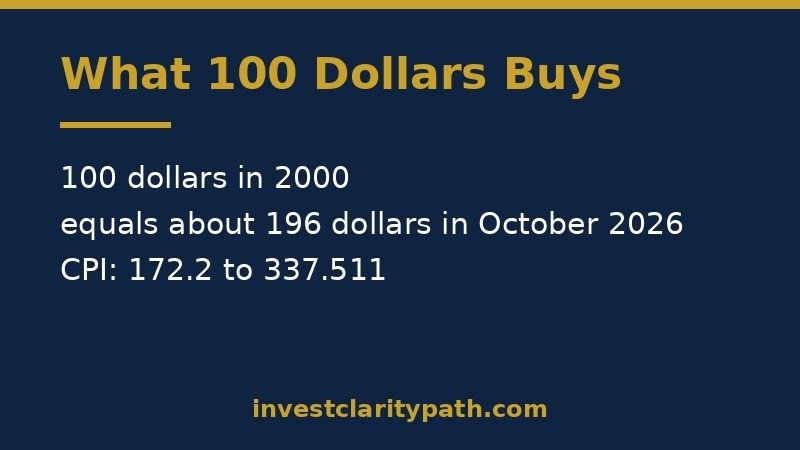
Here is a plain example. The average CPI for the year 2000 was 172.2, and by October 2026 it was 337.511. Divide 337.511 by 172.2 and you get 1.96, so 100 dollars in 2000 buys what about 196 dollars buys in October 2026.
Headline Inflation vs Core Inflation
You will often hear two inflation numbers: headline and core. Headline inflation is the full CPI, everything in the basket. Core inflation is the same index with food and energy taken out. Food and energy prices swing fast, so core inflation strips those swings out to show the slower, steadier trend underneath.
In October 2026, headline CPI rose 0.4 percent for the month, after rising 0.6 percent in September. Core CPI rose 0.3 percent in October. Food rose 0.5 percent in the month, and energy rose 0.7 percent. Shelter rose 0.3 percent and accounted for over thirty percent of the monthly rise in the whole index. Gasoline was up 37.4 percent over the previous twelve months, which is why petrol felt so expensive at the pump even while the monthly change was small.
There is one gap in the October 2026 numbers worth knowing. The BLS did not publish a 12-month inflation rate for October 2026, because it did not collect survey data in October 2025 during the lapse in government funding. The last official 12-month rate was 3.7 percent for September 2026. The next CPI release, for November 2026, is scheduled for December 10, 2026.
What Causes Inflation?
Inflation has a few common causes, and they often work together. The first is demand. When many people want to buy the same things and there is not enough to go around, sellers can raise prices. This happened after the pandemic, when households wanted cars, furniture, and holidays while factories and shipping were still catching up.
The second cause is cost. When it costs more to make or move something, the price often follows. When oil prices rise, transport gets dearer, and almost everything that travels costs more to deliver. Wages are another cost. When employers pay more to hire and keep workers, some of that cost reaches the price tag.
The third cause is the money supply. When much more money enters the economy, each unit can lose value if the amount of goods does not grow as fast. The fourth cause is expectations. If people expect prices to rise, they ask for bigger pay rises and shops raise prices early, which can turn a short rise into a lasting one.
Why the Federal Reserve Targets 2 Percent
The Federal Reserve, the U.S. central bank, aims for inflation of 2 percent a year over the longer run. It adopted that target in January 2012, and it has reaffirmed it every year since. The target is measured by the annual change in the PCE price index, the Fed’s preferred measure, rather than the CPI.
Why 2 percent, and not zero? A little inflation gives the economy room to work. Prices and wages are slow to fall. If inflation were zero, a weak economy could easily slip into deflation, a general fall in prices. When prices keep falling, people delay buying, shops earn less, wages fall, and debts get heavier in real terms. A 2 percent target keeps the economy safely above zero while keeping price rises small enough that households can plan.
The Fed moves inflation toward its target mainly by setting interest rates. When inflation is too high, it raises rates. Higher rates make borrowing dearer, cool spending, and slow price rises. When inflation is too low, it cuts rates to encourage spending and borrowing. Inflation has stayed above the Fed’s 2 percent target since 2021 on the PCE measure, which is why interest rates rose sharply in 2022 and 2023, and why the Fed has been slow to cut them since.
A Worked Example: What 3 Percent Inflation Does to 100 Dollars
Percentages feel abstract until you run the numbers. Here is what steady 3 percent inflation does to 100 dollars over ten years.
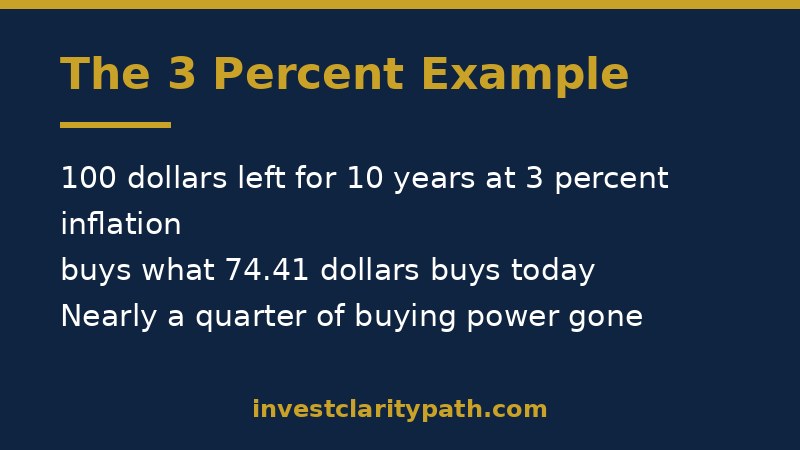
Prices rise 3 percent a year. After one year, what cost 100 dollars costs 103 dollars. After ten years, it costs 134.39 dollars, because 100 times 1.03 to the power of 10 equals 134.39. So your 100 dollars, left untouched for ten years, buys only what 74.41 dollars buys today. Nearly a quarter of its buying power is gone.
Now look at it from the other side. Suppose you keep 10,000 dollars in a savings account paying 0.5 percent interest while inflation runs at 3.7 percent, the last official 12-month rate from September 2026. After a year, your account holds 10,050 dollars. But prices rose 3.7 percent, so you need 10,370 dollars to buy what 10,000 dollars bought a year ago. In today’s buying power, your 10,050 dollars is worth 10,050 divided by 1.037, which is 9,692.19 dollars. You are about 308 dollars worse off in real terms, even though the balance went up.
What Inflation Does to Savers, Borrowers, and Investors
Savers lose, because cash and low-interest savings fall behind rising prices, as the example above shows. Anyone holding a large amount of cash for years is slowly losing buying power, even if the balance never falls. That is why an emergency fund belongs in an account that pays a competitive rate.
Borrowers can gain, within limits. If you borrowed 200,000 dollars at a fixed rate and inflation runs high, you repay the loan with money that is worth less than the money you borrowed, and the monthly payment takes a smaller share of your pay as wages rise. But the gain only holds if your income keeps up with prices and the rate was fixed before inflation rose.
Investors face a mixed picture. Shares can hold up over long periods, because companies can raise prices and earnings often grow with the economy, but high inflation can squeeze profits and push share prices down in the short term. What Is Risk in Investing, in Simple Terms? explains why prices move in both directions. Bonds suffer more directly. A bond that pays a fixed 3 percent a year loses real value when inflation is 4 percent, because the payments buy less each year. What Is a Bond in Simple Terms? explains how bond payments work, and What Is a Treasury Bond in Simple Terms? covers the government version.
The practical point for a beginner is to avoid leaving long-term money in cash while prices rise year after year. What Is the Difference Between Saving and Investing? explains where the line sits, and How Much Money Do I Need to Start Investing? shows that the first step can be small.
How to Protect Your Money From Inflation in 5 Steps
Step 1: Check what your cash earns
Look at the interest rate on every account you hold. If your savings pay 0.5 percent while inflation is near 4 percent, you are losing buying power every year. What Is a Money Market Account? explains one type of account that often pays more than a basic savings account. Move money you do not need this month to the best-paying safe account you can find.
Step 2: Keep the emergency fund, but do not overfill it
You still need cash you can reach fast. An emergency fund of three to six months of costs is the usual beginner guide. Keep it in a safe, competitive account. But money above that level should not sit in cash earning less than inflation.
Step 3: Invest for the long term, in small regular amounts
Over long periods, a broad mix of shares has usually grown faster than inflation, though it can fall sharply in any single year. What Is an Index Fund, and Why Do Beginners Use It? explains the simplest way to own a broad mix in one purchase. How Does Compound Interest Work? shows why starting early and adding regularly matters more than picking the perfect moment. What Is Diversification, and Why Does It Matter? explains why spreading money across many companies lowers the risk of one bad pick.
Step 4: Ask for pay rises that beat inflation
Your salary is your largest source of money, and it is the one most exposed to inflation. When you discuss pay, ask what the rise means after inflation, not just in dollars. A 3 percent rise when inflation is 3.7 percent is a pay cut in real terms.
Step 5: Review your budget once a year for price rises
Inflation changes the cost of your life, so your budget must change with it. Once a year, check the price of your biggest costs: rent, food, transport, and insurance. If food costs 5 percent more than last year, your food budget needs 5 percent more money.
Common Mistakes to Avoid
The first mistake is ignoring inflation when you save. A savings account balance that goes up slowly feels safe, but if prices rise faster, you are getting poorer in real terms. Always compare the interest rate with the inflation rate. The gap between them is the real return.
The second mistake is panicking when inflation rises. Some people rush to buy gold, property, or crypto the moment inflation makes the news. Those moves are often made at the worst time, after prices have already risen. A steady plan beats a rushed reaction almost every time.
The third mistake is borrowing more because inflation helps borrowers. It only helps if your income rises with prices and your rate is fixed. Borrowing to buy things that lose value, at a high rate, during high inflation, is a fast way to trouble. Trust the trend, not one month: headline inflation, core inflation, CPI, and PCE can disagree in any given month, so look at six to twelve months before you change a plan.
Frequently Asked Questions
What is inflation in simple terms?
Inflation is a general rise in prices over time, so your money buys less than it used to. If prices rise 3 percent in a year, 100 dollars buys what about 97.09 dollars bought a year ago. It is measured with the Consumer Price Index, which tracks a basket of goods and services.
How is inflation measured?
In the United States, the Bureau of Labor Statistics measures it with the Consumer Price Index, or CPI. It tracks the price of a fixed basket of goods and services each month. The Federal Reserve’s preferred measure is the PCE price index, which covers a slightly wider basket.
What is the inflation rate right now?
The CPI rose 0.4 percent in October 2026, after 0.6 percent in September, and core CPI rose 0.3 percent. The BLS did not publish a 12-month rate for October 2026, because October 2025 prices were not collected during the funding lapse. The last official 12-month rate was 3.7 percent for September 2026.
Why does the Federal Reserve target 2 percent inflation?
The Fed judges that 2 percent inflation over the longer run is most consistent with stable prices and maximum employment. A small positive rate keeps the economy safely away from deflation, where falling prices can damage spending, wages, and debt repayment. The target was adopted in January 2012 and is measured by the PCE price index.
Does inflation make my debt smaller?
In real terms, yes, if your income rises with prices and your interest rate is fixed. You repay the loan with money that is worth less than the money you borrowed. It does not help if your income does not keep up, or if you borrowed at a high variable rate after inflation rose.
Is inflation good or bad for investors?
It depends on the asset and the time frame. Cash and fixed-rate bonds usually lose real value when inflation is high. Shares in companies can hold up over long periods because earnings often grow with prices, but they can fall sharply in the short term. No asset is a guaranteed shield.
Conclusion
Inflation is the slow fall in what your money can buy. At 3 percent a year, 100 dollars loses nearly a quarter of its buying power in ten years. At the October 2026 pace, with the CPI up 0.4 percent in the month and the last 12-month rate at 3.7 percent, the same pressure is still there. Your money must earn more than prices rise, or it buys less each year.
Start with the simple steps. Check what your cash earns, keep a proper emergency fund in a competitive account, invest small regular amounts for the long term, ask for pay that beats inflation, and review your budget once a year.
This article is for general information and education only. It is not legal or financial advice.
