
What Is a REIT, in Simple Terms?
A REIT is a company that owns property that earns income, and lets ordinary investors buy a small piece of that property through shares.
The letters REIT stand for Real Estate Investment Trust. That sounds formal, but the idea is simple. Instead of buying a whole apartment building or shopping centre yourself, you can buy shares in a company that owns buildings like those. The company collects rent from tenants. It then pays most of its income to shareholders as dividends.
This article explains what a REIT is, how it works, the two main kinds, how dividends work, the main risks, and how a REIT differs from owning a rental property and from an index fund. It also gives you simple steps to learn more.
The Direct Answer
A REIT is a company that owns, runs, or lends money on income-producing property. You buy shares in the company, just as you would buy shares in any other public company. If the property earns rent, and the company makes a profit after its costs, it must pay most of that taxable income to shareholders as dividends.
That last point is important. A REIT is not a normal company that can keep most of its profit and spend it as it likes. Under the rules in the United States, a REIT must distribute most of its taxable income as dividends to shareholders. That is one reason many people first hear about REITs when they are learning about dividends.
You do not need to buy a building, find tenants, or fix a leaking roof to invest in a REIT. You buy shares. The company does the property work. You take the risk that the shares can fall in value, and that dividends can change or stop.
The Two Main Kinds of REIT
There are two main kinds of REIT. They work in different ways, and it helps to know which kind you are reading about.
1. Equity REITs
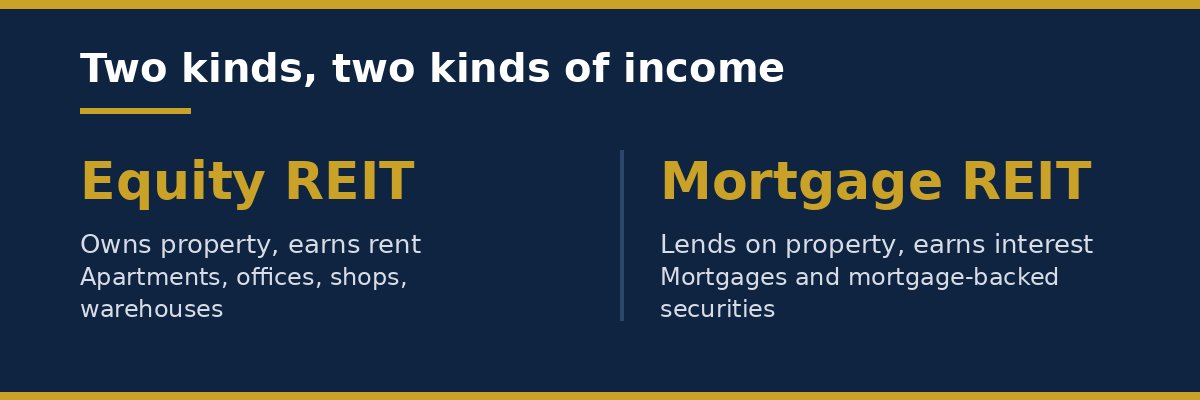
An equity REIT owns property and runs it. It buys buildings, rents space to tenants, collects rent, pays for upkeep, and keeps the difference after costs.
Most REITs that beginners hear about are equity REITs. When someone says a REIT owns apartments or warehouses, they are usually talking about an equity REIT.
Its income depends on how full its buildings are, how much rent it can charge, and how well it controls costs. If more space sits empty, income can fall. If rents rise and costs stay steady, income can rise.
2. Mortgage REITs
A mortgage REIT does not own the buildings. It lends money to property owners, or buys mortgages and mortgage-backed securities. Its income comes mainly from the interest on those loans.
Mortgage REITs work more like a lending business than a property business. They can be more sensitive to interest rates than equity REITs, because the cost of borrowing affects their profit.
For a beginner, the simple rule is to check which kind a REIT is before you compare it with another REIT. An equity REIT and a mortgage REIT are not the same kind of business, even though both use the name REIT.
How Do You Buy Shares in a REIT?
You buy shares in a publicly traded REIT in the same way you buy shares in other public companies. You need a brokerage account, you place an order for the shares, and the shares sit in your account.
If you do not yet know what a brokerage account is, start with this guide: What Is a Brokerage Account? It explains the account in plain terms.
You can also buy a REIT through a fund. Some index funds and exchange traded funds hold many REITs together. That is different from buying one REIT on its own, and we explain that difference later in this article.
A beginner does not need to rush to buy anything. Learning how a REIT works, how dividends are paid, and what the risks are comes first. A simple plan helps more than a quick purchase. See What Is a Simple First Investment Plan? for a calm starting point.
How Do REIT Dividends Work?
A dividend is a payment a company makes to its shareholders from its income. For a REIT, dividends are central, because the rules require it to pay out most of its taxable income.
Here is a simple worked example. All figures in this example are made up to show the maths, and are not a promise of what any real REIT will pay.
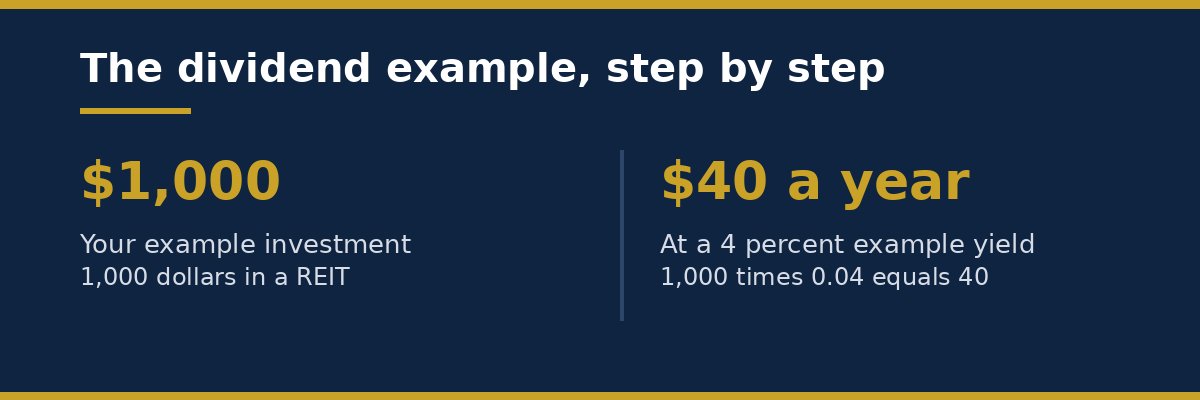
Suppose you invest 1,000 dollars in a REIT. Suppose that REIT pays a dividend yield of 4 percent a year. A yield is the dividend as a share of the price, shown as a percent.
Step 1: Take your investment, 1,000 dollars.
Step 2: Take the yield, 4 percent. As a decimal, 4 percent is 0.04.
Step 3: Multiply 1,000 dollars by 0.04. That is 1,000 times 0.04.
Step 4: The answer is 40 dollars. That is 40 dollars a year in dividends in this example.
If the yield stayed at 4 percent and the price stayed at 1,000 dollars, you would receive about 40 dollars a year. If the price fell to 800 dollars and the dividend stayed the same, the yield would look higher, but your shares would be worth less. If the price rose to 1,250 dollars and the dividend stayed the same, the yield would look lower, but your shares would be worth more.
Dividends are usually paid every three months, which is called quarterly, but the timing can vary. Some REITs pay monthly. Some pay once a year. The payment can also change. A REIT can cut its dividend if its income falls. It can raise it if its income rises. A dividend is not guaranteed, and past payments do not promise future payments.
If you want a plain explanation of dividends in general, read What Is a Dividend in Simple Terms? Tax rules for REIT dividends can differ from other dividends and can change, so this article does not give tax advice.
What Are the Main Risks?
A REIT can lose value, and its dividends can fall. Property prices can fall when demand drops, too much new space is built, or the wider economy slows down, and the share price can fall with them. Rents can also fall, and buildings can sit empty. An office REIT can suffer if many offices sit empty, a shop REIT if shops close, and a hotel REIT if fewer people travel.
Interest rates matter too. Property businesses often borrow to buy buildings, so higher rates raise costs and can cut profit. Higher rates can also make other income investments look more attractive, which can push REIT share prices down.
Dividends are not guaranteed. A REIT must pay out most of its taxable income, but if its income falls, the dividend can fall too, and a cut can happen quickly if a large tenant leaves. Share prices can also move fast during the day, even when building values change slowly.
Buying one REIT is not diversified on its own. Your money depends on that one company and its properties, so if it has problems, your shares can fall even if other property does well. Diversification means spreading money across different investments so one problem does not affect everything. You can read more here: What Is Diversification and Why Does It Matter?
None of these risks means a REIT is good or bad. They mean you need to understand what you own, and what can go wrong, before you decide to learn more or to invest.
How Is a REIT Different From Owning a Rental Property?
When you own a rental property directly, you buy the building and pay for the deposit, mortgage, insurance, repairs, and upkeep. You find tenants, collect rent, and deal with empty months. If the property rises in value, you may gain, but if it falls or sits empty, you still pay the costs.
When you own shares in a REIT, you do not own a building. You own a small piece of a company that owns many buildings, and the company manages the property. You can usually sell your shares on a stock exchange during trading hours, much faster than selling a house, and you can start with far less than a property deposit. A direct rental gives you control over the property, tenants, and rent, while a REIT gives you no control and you trust the company to run it well. A REIT is not the same as being a landlord. It is a share in a property company, with share market risk as well as property risk.
How Is a REIT Different From an Index Fund?
An index fund is a fund that holds many shares and aims to track a market index, such as the S&P 500. It spreads your money across many companies in many industries. A REIT is one company in one sector, which is property. In plain words, an index fund gives you broad exposure, while a REIT gives you narrow exposure to property income.
Some index funds do hold REITs. A broad index fund may include a small share of REITs among its many holdings, and there are also index funds and exchange traded funds that focus only on REITs. Those funds hold many REITs together, which spreads the risk across many property companies, but still keeps the focus on property.
If you are new to index funds, read What Is an Index Fund and Why Do Beginners Use It? If you want to know how an exchange traded fund differs from a single stock, read What Is an ETF and How Is It Different From a Stock?
Simple Steps a Beginner Can Take to Learn More
You do not need to become a property expert overnight. First, learn the terms in your own words: REIT, equity REIT, mortgage REIT, and dividend. Second, check the kind of REIT and the property it focuses on, since apartments, offices, shops, and warehouses face different risks, and check where its income comes from, rent or interest, how full its buildings are, and whether it depends on one large tenant.
Third, look at the dividend history, not just the yield. A high yield can be a warning sign if the share price has fallen, so check whether the dividend has been steady, rising, or falling, and remember it is not guaranteed. Also look at debt: property companies often borrow, and higher debt can mean higher risk when rates rise. Compare a single REIT with a broad index fund, since one REIT is a narrow bet and a broad fund spreads money across many companies.
Finally, read an official source to check what you have learned. The investor.gov guide explains REITs in simple terms: Real Estate Investment Trusts (REITs) on investor.gov Then write a short note in your own words, what kind of REIT you looked at, what property it owns, how it earns income, and its main risks, and wait before any decision. A pause helps you avoid buying from excitement or fear.
Do not borrow money to buy a REIT, and do not use money you need for rent, food, or an emergency fund. If you are also thinking about retirement accounts, read What Is a Retirement Account in Simple Terms?
FAQ
Is a REIT the same as owning property?
No. A REIT is a company that owns property, or lends on property. When you buy shares in a REIT, you own shares in that company, not a building. You do not choose tenants, set rent, or pay for repairs directly. The company does that work, and you take share price risk and dividend risk.
Do REITs always pay dividends?
No. A REIT must pay out most of its taxable income as dividends under the rules, but if its income falls, the dividend can fall too. A dividend can be cut or stopped. Past dividends do not guarantee future dividends.
Can a REIT lose money?
Yes. The share price can fall if property values fall, if rents fall, if buildings sit empty, or if interest rates rise. The company can also make poor choices, such as buying property at a high price or borrowing too much. You can lose part or all of the money you invest in shares.
What is the difference between an equity REIT and a mortgage REIT?
An equity REIT owns property and earns income mainly from rent. A mortgage REIT lends money on property and earns income mainly from interest on loans. They are different businesses, and they react differently to interest rate changes.
Can a beginner buy a REIT through a fund?
Yes. Some index funds and exchange traded funds hold many REITs together. That spreads the risk across many property companies, but it still focuses on property. A broad index fund may also hold a small share of REITs among many other companies. Buying through a fund is still investing, and it still carries risk.
Is a REIT a safe investment?
No investment in shares is guaranteed. A REIT can offer income through dividends, but its price can fall and its dividends can change. This article does not tell you whether a REIT is right for you.
Conclusion
A REIT is a simple idea with real risks. It is a company that owns income-producing property, or lends on property, and pays most of its taxable income to shareholders as dividends. You can buy shares in it through a brokerage account, or through a fund that holds many REITs.
An equity REIT owns buildings and earns rent. A mortgage REIT lends on property and earns interest. Dividends can be a useful source of income, but they are not guaranteed, and they can fall if the property income falls. Property prices can drop, rents can drop, buildings can sit empty, and higher interest rates can raise costs.
A REIT is not the same as owning a rental property, and it is not the same as a broad index fund. It is narrower than an index fund, and it gives you no control over the property, unlike a direct rental. Learn the terms, check the kind of REIT, look at how it earns income, look at its dividend history and debt, compare it with a broad fund, and read an official source before you decide anything.
Start with learning. Take the simple steps above. Write down what you find. Then, if you decide to invest at all, do it as part of a simple plan, with money you can afford to put at risk, and with a clear view of what can go wrong.
This article is for general information and education only. It is not legal or financial advice.
