
What Is a Dividend, in Simple Terms?
The Short Answer
A dividend is a payment a company makes to its shareholders from its profit. When you own shares in a company that pays a dividend, the company sends you a small amount of money for each share you own, usually four times a year.
Think of it this way. A share is a small piece of a company. If that company makes a profit, it can keep the money to grow the business, or it can share some of it with the people who own it. A dividend is the share of profit it pays out. It is not a wage, and it is not interest from a bank account. The amount can change, and it can stop.
What a Dividend Really Is
When a company earns money, it pays its costs, taxes, and bills first. What is left is profit. The company leaders, called the board of directors, decide what to do with it. Some stays in the company. Some may be paid out to shareholders as a dividend, normally stated as an amount per share, for example 50 cents per share each quarter.
You do not need to do anything to receive it, apart from owning the shares on the date the company sets. The payment is usually made into your brokerage account as cash.
Dividends are paid per share, so the more shares you own, the more you receive. If a company pays 25 cents per share each quarter, and you own 100 shares, you receive 25 dollars that quarter. If you own 10 shares, you receive 2 dollars and 50 cents. A big dividend per share means little if you own only one share.
Most large companies in the United States pay dividends four times a year, once each quarter. Some pay monthly, and some once or twice a year. The company sets a date by which you must own the shares to receive each payment.
If you are still learning how shares work, start with our guide What Is an ETF and How Is It Different From a Stock? to see how single shares and funds differ.
A Worked Example: 100 Shares and a Simple Dividend
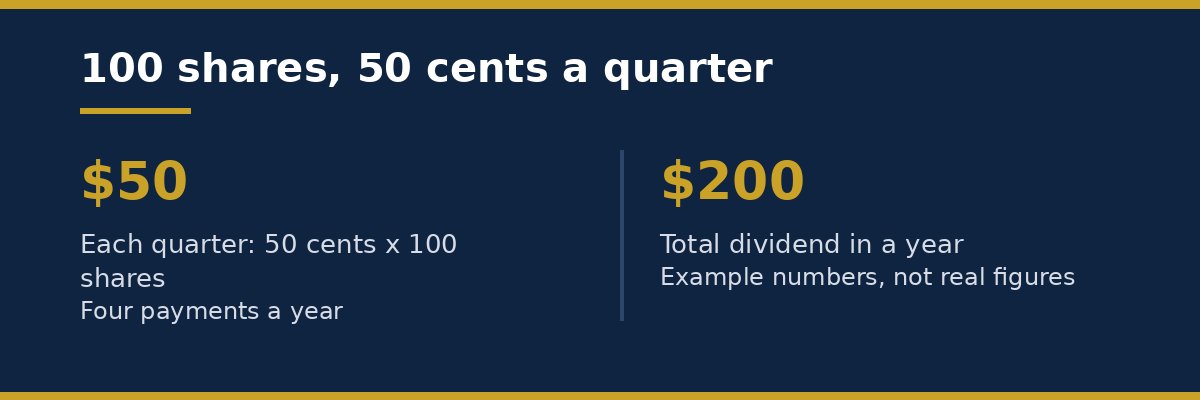
Here is a simple example with round numbers, clearly labelled as an example. Suppose a made up company, Example Foods, pays 50 cents per share each quarter, which is 2 dollars per share over a full year. Suppose you own 100 shares.
- Dividend per share each quarter: 0.50 dollars
- Shares you own: 100
- Payment each quarter: 0.50 times 100, which is 50 dollars
- Payments per year: 4
- Total dividend in a year: 50 dollars times 4, which is 200 dollars
So, in this example, owning 100 shares brings in 200 dollars a year, paid as four payments of 50 dollars. The share price can still go up or down separately, and that movement is not part of the dividend. If you owned only 20 shares, the payment each quarter would be 10 dollars, and the yearly total would be 40 dollars. These are example numbers, not real figures for any real company. They show the maths, nothing more.
What Is Dividend Yield?
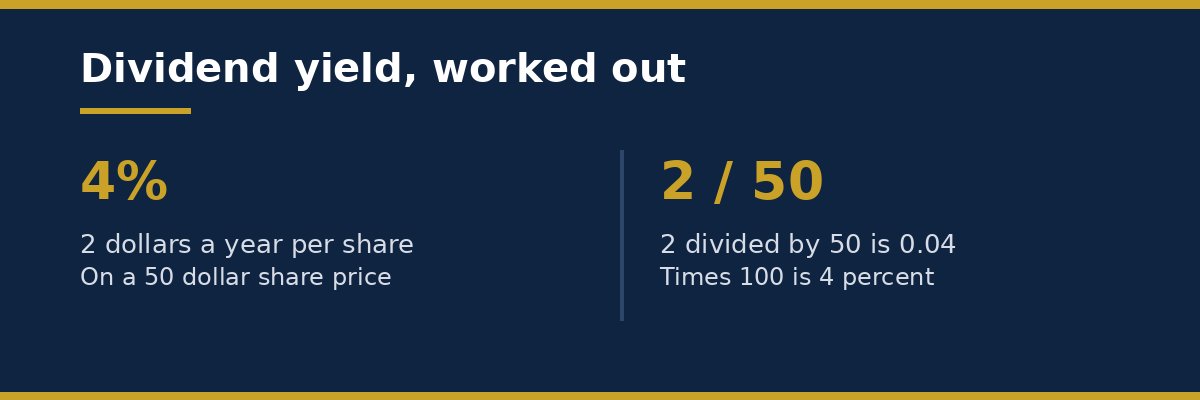
Dividend yield is a way to compare dividend payments between companies with different share prices. It tells you how much dividend you receive in a year compared with the price of one share, shown as a percentage. Take the dividend paid per share in a year, divide it by the share price, and multiply by 100.
Use another clearly labelled example. Suppose a made up company pays 2 dollars a year per share in dividends, and one share costs 50 dollars. The yield is 2 divided by 50, which is 0.04, times 100, which is 4 percent. So you would receive 4 dollars a year for every 100 dollars of shares you owned, if the dividend and the price stayed the same.
If the share price fell to 40 dollars while the dividend stayed at 2 dollars, the yield would be 5 percent. The dividend did not change. The price changed, so the yield looks higher.
That is why a high yield is not always good news. A very high yield can mean the share price has fallen because the company is in trouble, and the dividend may be cut next. A low yield can mean the share price has risen because the company is doing well. Yield is a starting point for questions, not a ranking.
To see how many dividend paying companies can sit inside one fund, read What Is an Index Fund and Why Do Beginners Use It?
Why Some Companies Pay Dividends and Some Do Not
Large, established companies often pay dividends. They earn steady profit, they have fewer places to spend it on fast growth, and they return some of it to shareholders. Many household name companies in the S&P 500 pay a dividend, though not all of them do. They often raise it slowly over years, when profit allows. A long record of paying is often seen as a sign of a stable business, not a promise.
Young or fast growing companies often pay no dividend at all. They keep the profit and spend it on growth: new products, new markets, more staff, or research. The money is worth more inside the company, growing the business, than paid out now. That does not make a company bad. Some well known growth companies have paid no dividend for years. Others start paying later, when growth slows and profit becomes steady.
Paying a dividend is a choice, and companies can change it. As a beginner, the useful question is not “does it pay a dividend?” but “why does it pay, or why does it not pay, and can it afford the payment?” A small, affordable dividend is often more reliable than a large, stretched one. Our guide What Is Risk in Investing? explains how the chance of a loss and the size of a return sit together, and dividends do not remove that risk.
Dividend Reinvestment in Simple Terms
Dividend reinvestment means using the dividend payment to buy more shares, instead of taking it as cash. Many brokers offer this as an automatic option, often called a dividend reinvestment plan. The dividend buys a little more of the same company or fund, so next time you own slightly more shares, and the next dividend is slightly larger. Over many years, that slow build up can matter, because of compounding.
Use the earlier example again, with clearly labelled example numbers. You own 100 shares of Example Foods, paying 50 dollars per quarter. Suppose one share costs 50 dollars, and you reinvest each payment. The first payment buys 1 new share, so you own 101 shares. The next payment is 101 times 0.50, which is 50 dollars and 50 cents, which buys about 1 more share. In real life, prices move and the payment may not buy a whole share. Some brokers allow fractional shares, so a small payment can still buy a small piece of a share.
Reinvestment is not right for everyone. If you need the income now, taking the cash makes sense. If you are building for the future, reinvesting is a simple way to keep the money working. This is the same compounding idea behind our guide How Does Compound Interest Work? which shows how small regular gains build up over time.
Dividends Are Not Guaranteed
This is the part beginners most often miss. A dividend is not a contract like bank interest. A company can cut it or stop it, usually when profit falls, debt rises, or the business hits a hard time. When a company cuts its dividend, the share price often falls too, because many investors were holding the shares for that payment. That is a double hit: less income, and a lower share value.
Watch for simple warnings: profit falling for more than a year, debt rising fast, or a dividend larger than the profit the company makes. A yield far higher than similar companies can also be a warning. A dividend is a payment from a real business, and real businesses have good years and bad years. Do not build a plan that depends on a dividend never changing.
A company can also pay a steady dividend while its share price falls. If you own shares worth 1,000 dollars, receive 40 dollars in dividends in a year, and the shares fall to 900 dollars, you are still down overall. The dividend softens the fall, it does not prevent it. A dividend alone should never be the reason to buy a share. Look at the business first, the dividend second.
Do Dividends Make a Stock Good?
A dividend paying company can be strong or weak. A company that pays no dividend can be strong or weak. The dividend tells you how the company shares profit, not how good the business is.
Ask four plain questions: does the company earn steady profit over years, not just one good year? Can it afford the dividend from its profit, with money left over? Does it have manageable debt, not debt that grows every year? Is the business one you understand, selling products or services people keep buying? If the answers are mostly yes, a dividend is a welcome extra. If the answers are mostly no, a high dividend is not a reason to buy.
Many beginners do not pick single dividend shares at all. They hold a broad fund, such as an index fund, which owns hundreds of companies. The fund collects the dividends and either pays them out or reinvests them. That spreads the risk, because if one company cuts its dividend, the others still pay theirs. Before putting money into anything, read How Much Money Do I Need to Start Investing?
How to Think About Dividends as a Beginner
Keep five ideas in mind. First, know the difference between income and growth. Some investments are held mainly for income, such as dividends. Others are held mainly for growth, meaning the value rises over time. A good plan often has some of both.
Second, check the yield, then ask why. Is it high because the dividend is generous, or because the price has fallen? Is it low because the price has risen, or because the company pays very little? The answer matters more than the number.
Third, look at the history, not one payment. A record over five or ten years tells you more than a single quarter. Did the company pay through hard years, or cut it when times got tough?
Fourth, decide cash or reinvestment in advance. If you are building for the future, reinvesting is a simple default. If you need income now, taking the cash is the point.
If you want to understand how shares compare with bonds, which pay a different kind of income, read What Is the Difference Between a Stock and a Bond?
For the basic facts behind this article, see investor.gov, the investor education site of the U.S. Securities and Exchange Commission: Stocks, investor.gov
Common Mistakes Beginners Make
Chasing the Highest Yield
The highest yield often belongs to the company in the most trouble. A 10 percent yield is not twice as good as a 5 percent yield if the first company cuts its dividend next year. Start with the business, then look at the yield.
Treating a Dividend as Safe Income
A dividend feels like interest, but it is not. Bank interest is promised by the bank, within its terms. A dividend is a choice by a company, and it can change. Never count on a dividend as if it were a wage.
FAQ
What is a dividend in simple terms?
A dividend is a share of a company’s profit paid to its shareholders, usually as cash, per share owned, often four times a year.
How much dividend will I get?
Multiply the dividend per share by the number of shares you own. In the example in this article, 100 shares at 50 cents a quarter gives 50 dollars a quarter, or 200 dollars a year.
What is dividend yield?
Dividend yield is the yearly dividend per share divided by the share price, shown as a percentage. In the example in this article, a 2 dollar yearly dividend on a 50 dollar share is a 4 percent yield.
Are dividends guaranteed?
No. A company can raise, lower, or stop its dividend. A long record of paying is a good sign, not a promise.
What is dividend reinvestment?
Dividend reinvestment means using the dividend payment to buy more shares automatically, instead of taking it as cash. Your share count rises slowly, and the next dividend rises with it.
Is a high dividend yield better?
Not always. A very high yield can mean the share price has fallen because the company is in trouble, and the dividend may be cut. Check why the yield is high before deciding anything.
Conclusion
A dividend is simple at heart: a company makes a profit, and it shares some of that profit with the people who own its shares, usually four times a year, per share owned. Dividend yield tells you how that payment compares with the share price. Reinvestment lets the payment buy more shares, so the next payment can be larger.
The cautions matter as much as the idea. Dividends are not guaranteed, they can be cut, and they do not protect a share price from falling. Use dividends as one feature of a business you understand, not as the reason to buy.
This article is for general information and education only. It is not legal or financial advice.
