

What Happens If I Miss a Credit Card Payment?
If you miss a credit card payment, the first result is usually a late fee, and interest keeps building on the balance you still owe. If the payment stays unpaid for 30 days, the card issuer can also report it as late to the credit bureaus, and that late mark can stay on your credit report for years. The exact fee, the interest rate, and the effect on your credit score depend on your card and your credit history, so the steps below help you limit the damage and get back on track.
What counts as a missed payment?
A payment is missed when you do not pay at least the minimum amount by the due date and time shown on your statement. The due date is the date your card issuer sets each month. The minimum payment is the smallest amount you must pay to keep the account in good standing for that month.
Paying one day late still counts as late with your card issuer, even if it is not yet reported to the credit bureaus. Paying less than the minimum also counts as a missed payment for that month.
Check your statement for three facts before you act: the due date, the minimum payment due, and the total balance. Those three numbers tell you what is due, what is late, and what is still owed.
What happens right away
A late fee can be charged
Most card issuers can charge a late fee when the minimum payment is not received by the due date. The fee is added to your balance. Fees and rates vary by card, and the fee for your card is shown in your card agreement and on your statement. A fee does not make the missed payment go away. You still owe the original minimum payment, plus the fee, plus any interest.
Interest keeps building
If you carry a balance, interest is charged on that balance. Missing a payment does not pause interest. In many cases, interest is charged on the unpaid balance from the date of the purchase or from the end of the grace period, depending on your card terms. A grace period is the time between the end of your billing cycle and the due date when no interest is charged if you pay the full balance.
To understand how interest adds up, read how credit card interest charges work.
Your account can be marked past due
Your card issuer will show the account as past due. That can lead to reminders by email, text, or post. Some card agreements allow the issuer to raise the interest rate after a late payment. This is often called a penalty rate. Check your card agreement to see if this applies to your card.
What happens after 30 days
A payment usually is not reported late to credit bureaus until it is 30 days past due. That is the general rule. The card issuer can still charge a late fee earlier, and the account can still be shown as past due with the issuer before day 30.
Once a payment is 30 days past due, the issuer can report it to the credit bureaus. That report can lower your credit score, because payment history is a large part of many credit scoring models. The late payment can stay on your credit report for up to seven years from the date it first became late, although its effect often lessens over time as you add on-time payments.
For general information about how late payments are treated, the Consumer Financial Protection Bureau explains credit card rules and consumer rights on its credit card pages at consumerfinance.gov.
How a late payment can affect your credit score
A single late payment does not have the same effect for every person. The effect depends on your credit history, your current score, how late the payment is, and whether you have other late payments. A person with a long record of on-time payments may see a smaller change than a person with a short history or past late payments. A payment that is 90 days late usually has a larger effect than a payment that is 30 days late.
A lower credit score can make future borrowing more costly. Lenders may offer a higher interest rate, a lower credit limit, or no approval at all. The practical point is simple: one missed payment is a warning sign, and repeated missed payments are a pattern that lenders notice.
You cannot remove a true late payment from your credit report by asking for it to be deleted. If the late mark is wrong, you can dispute it with the credit bureau and with the card issuer. If it is correct, the best step is to bring the account current and keep it current, so newer on-time payments build a stronger record over time.
A worked example with real math
This example uses clearly labelled example numbers only. It is not a promise about your card. Fees and rates vary by card.
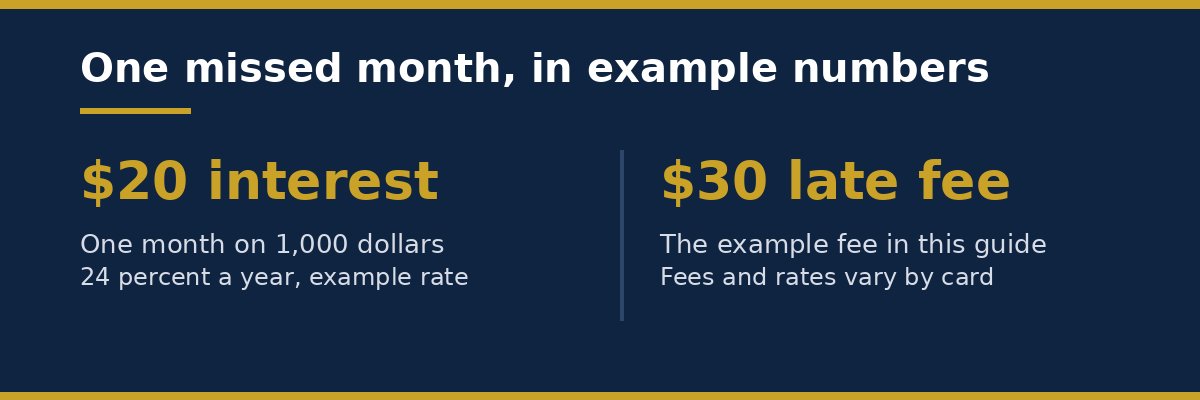
Suppose you have a balance of $1,000. Suppose your card charges a late fee of $30 in this example, and the annual interest rate in this example is 24 percent.
First, work out one month of interest on $1,000 at 24 percent a year:
$1,000 x 24 / 100 = $240 interest in one year
$240 / 12 = $20 interest in one month
Next, add the example late fee:
$20 interest + $30 late fee = $50 extra cost in that month
If you make no payment that month, your balance can grow like this:
$1,000 starting balance + $20 interest + $30 late fee = $1,050 new balance
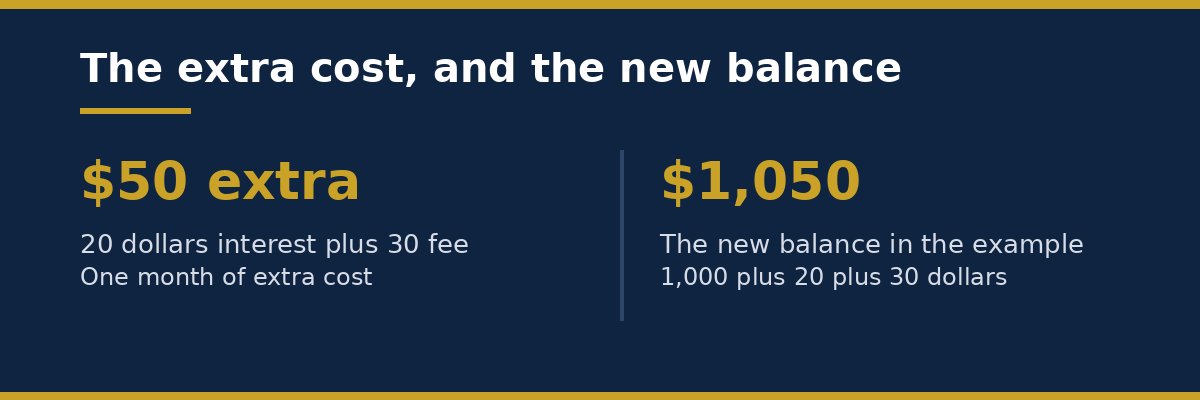
That $50 does not pay down your original purchases. It is the cost of being late for one month in this example. If you then pay only the minimum in the next month, interest will be charged on the larger $1,050 balance, not on the original $1,000. That is why a missed payment can make a balance harder to clear, even when the fee itself looks small.
Try the same math with your own numbers. Replace $1,000 with your balance, replace 24 percent with the rate on your statement, and replace $30 with the late fee shown in your card agreement.
Paying only the minimum can also stretch out repayment. To see why, read what happens if I only pay the minimum on a credit card.
What to do if you miss a payment
Act fast. The sooner you pay, the smaller the extra cost and the lower the risk of a credit report mark.
1. Pay at least the minimum now
Pay the minimum payment as soon as you can, even if it is a few days late. If you can pay more, pay more. Paying the full past-due amount brings the account current faster than paying a small part of it.
2. Check for a fee and ask about it
Look at your statement or online account to see if a late fee was added. Some issuers may remove a first late fee if you call and ask, especially if you have a good payment history. There is no guarantee, but it is worth asking in a calm, polite way. Note the date and time of the call.
3. Set the account to current
Confirm that your payment went through and that the account shows as current. If you paid by bank transfer, check that the money left your bank account. If you paid by another method, keep the confirmation number or receipt. Do not assume a payment is complete until you see it in your card account.
4. Make a simple payoff plan
A missed payment is often a sign that the plan needs a change. Write down each card balance, the minimum payment, the due date, and the interest rate. Then pick a clear order for extra payments.
Start with how do I make a debt payoff plan and which debt should I pay first, smallest or highest interest.
5. Talk to your lender if you cannot pay
If you cannot pay the minimum, contact the card issuer before the account falls further behind. Explain the problem in plain words and ask what options exist. Some issuers offer a short hardship plan, a lower payment for a set time, or a waived fee. Get any offer in writing before you agree to it.
For help with that conversation, read how do I talk to a lender if I cannot pay.
How to avoid missing the next payment
A missed payment is often caused by a missed date, not by a lack of care. A few simple systems can help.
Set up autopay for at least the minimum
Autopay can pay the minimum amount on the due date from your bank account. This helps when you forget a date or travel. Keep enough money in the bank account to cover the payment, and check the first autopay to make sure it worked. You can still pay more by hand when you have extra money.
Set a reminder a few days early
Set a phone reminder three days before the due date. That gives you time to move money, check the balance, and fix a problem before the due date. A second reminder on the due date can help as well.
Change the due date if it does not fit your pay cycle
Many issuers let you change the due date. If you are paid on the 1st and your card is due on the 28th, the timing may feel tight. Ask if you can move the due date to a few days after payday. This is a simple change that can prevent a repeat miss.
Keep a small buffer in your bank account
A small buffer, for example one minimum payment kept aside, can cover a tight month. It is not an emergency fund, but it can stop a short delay from becoming a missed payment.
Check your statements each month
Open each statement, even if you pay by autopay. Check the due date, the minimum, the balance, and any fee or rate change. A quick check each month can catch a problem early.
When to think about consolidation
If you have several cards and you keep missing payments, you may wonder about combining the debt into one loan or one card. Consolidation can simplify payments into one due date and one monthly amount, but it does not erase the debt. It can also come with fees, a new interest rate, and a longer repayment time.
Do not choose consolidation because it sounds simple. Compare the total cost, the monthly payment, the interest rate, and the fees. Also check what happens if you miss a payment on the new loan. For a careful look at this choice, read should I consolidate my debt.
FAQ
Will one missed payment ruin my credit?
One missed payment can hurt your credit score, but it does not ruin your credit for good. The effect depends on your history and how late the payment is. A payment only a few days late and paid quickly is less likely to be reported than a payment 30 days late. Pay the amount due, bring the account current, and keep future payments on time.
How long does a late payment stay on my credit report?
A late payment can stay on your credit report for up to seven years from the date it first became late. Its effect often lessens over time as you add on-time payments. A correct late payment cannot be removed early by paying a fee or by asking for it to be deleted.
Can I be charged a late fee if I am only one day late?
Yes, in many cases. The card issuer can charge a late fee when the minimum payment is not received by the due date, even if it is only one day late. The fee and the rate vary by card. The payment is usually not reported late to credit bureaus until it is 30 days past due, but the fee can still apply earlier.
What should I do if I cannot afford the minimum payment?
Contact the card issuer as soon as possible and explain the problem. Ask what help is available. Do not wait until the account is 60 or 90 days past due. Review your budget, cut a non-essential cost for one month, and use the saved money toward the minimum payment.
Does paying the minimum after a miss fix everything?
Paying the minimum brings the account closer to current, but it does not erase the late fee or the interest that was added. It also does not remove a late mark if the payment was already reported. It does stop the account from falling further behind, and that is an important first step.
Conclusion
Missing a credit card payment can lead to a late fee, extra interest, and, after 30 days, a late mark on your credit report. The cost in the worked example was $50 in one month on a $1,000 balance, and that cost can grow if the balance stays unpaid. The fix is simple to state and worth doing at once: pay at least the minimum now, check for a fee, confirm the account is current, and set up a system so the next payment is not missed. If you cannot pay, talk to the lender early and make a clear plan for the debt. A single miss does not define your finances. A steady run of on-time payments after it does far more to rebuild trust with lenders.
This article is for general information and education only. It is not legal or financial advice.
