
What Is a Brokerage Account, in Simple Terms?
The Short Answer
A brokerage account is an account you open with a brokerage firm so you can buy and hold investments, such as stocks, exchange traded funds, and mutual funds. You put money into the account, then you use that money to buy investments inside it.
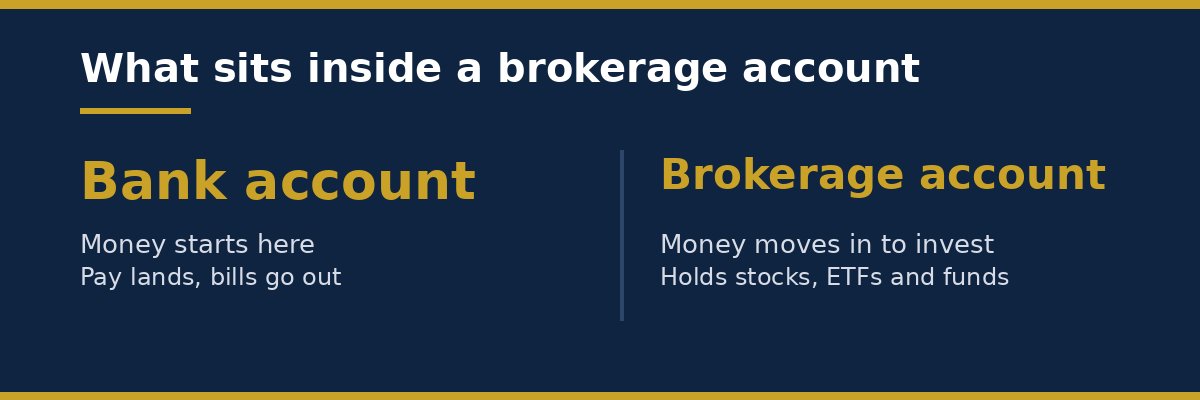
Think of it this way. A bank account is a place to keep cash safe and spend it when you need it. A brokerage account is a place to hold investments you hope will grow over time. The account itself is not the investment. It is the container that holds the investments you choose.
What a Brokerage Account Really Is
A brokerage firm is a company that gives you access to the markets where investments are bought and sold. When you open an account, the firm holds your cash and your investments for you and carries out your buy and sell orders.
You own what is inside the account. If you buy 10 shares of a fund, those shares belong to you. The broker handles the buying and selling, the paperwork, and the safekeeping. It does not own your investments for itself.
Most accounts today are opened online. You fill in your personal details, confirm your identity, link a bank account, and move money in. Once the money arrives, you can place an order. If you are still learning what goes inside such an account, start with our guide What Is an ETF and How Is It Different From a Stock? to see how single shares and funds differ.
How a Brokerage Account Is Different From a Bank Account
A bank account and a brokerage account look similar on a screen, because both show a balance, but they do very different jobs. A bank account is built for safety and everyday use. A brokerage account is built for investing, and investing always carries risk. A bank account holds cash, and in the United States deposits are usually protected by federal deposit insurance up to set limits. Its balance does not fall because the stock market fell.
A brokerage account holds investments, and the value of those investments can go up or down. If the investments inside the account fall in value, your account balance falls with them. No protection scheme makes up for that fall. That is the key difference, and it is the one beginners most often miss.
Tax is different too. In a normal taxable brokerage account, you may owe tax on dividends, interest, and gains when you sell for more than you paid. In a bank account, you normally owe tax only on the interest the bank pays you.
Access is different as well. Money in a bank account is made for quick spending. Money in a brokerage account is made for holding investments over time. A brokerage account is not a good place for money you need next week for rent or bills.
What You Can Hold Inside a Brokerage Account
A brokerage account is flexible. You can hold many types of investment inside one account, and change what you hold over time.
The most common holdings for beginners are stocks, exchange traded funds, and mutual funds. A stock is a small piece of one company. An exchange traded fund, often called an ETF, holds many stocks or bonds at once and trades like a single share. A mutual fund is similar, but it is bought and sold once a day at a set price.
You can also hold bonds inside a brokerage account. A bond is a loan you make to a government or a company, which pays interest over time and returns the original amount at the end of the loan term, if the borrower can pay. What you can hold depends on the broker, so check the list before you open an account.
Holding many investments inside one account does not remove risk. If you hold shares of one company, and that company does badly, your account falls. If you hold a broad fund that owns hundreds of companies, one company doing badly matters less. To see how a broad fund works, read What Is an Index Fund and Why Do Beginners Use It?
Taxable Brokerage Accounts and Retirement Accounts Held at a Broker
Not every account at a broker is the same. The two main types a beginner will meet are a taxable brokerage account and a retirement account, such as an individual retirement account, often called an IRA, held at the same broker.
A taxable brokerage account is the plain, general purpose type. There is no special tax break for putting money in. You can add money at any time, take money out at any time, and buy or sell when you wish. The trade off is tax. You may owe tax each year on dividends and interest, and you may owe tax when you sell an investment for a gain.
A retirement account held at a broker is built for a long term goal, retirement. In the United States, an IRA can offer tax benefits, such as tax deferred growth or tax free withdrawals in retirement, depending on the type. In return, there are rules about how much you can add each year, and when you can take money out without a penalty.
The investments inside the two accounts can look the same. You might hold the same fund in a taxable account and in an IRA. What differs is the wrapper around it, meaning the tax rules and the withdrawal rules.
Simple Steps to Open a Brokerage Account
Opening a brokerage account is usually a short online process. The steps below describe the normal order, in plain language.
Step 1: Choose a Broker and an Account Type
First, decide which firm you want to use, and which type of account you want: a plain taxable brokerage account, or a retirement account such as an IRA. Compare what investments are offered, what the fees are, and whether there is a minimum to open the account.
Step 2: Fill In Your Details and Confirm Your Identity
Next, give your name, address, date of birth, and tax details, and confirm your identity. Brokers are required to check who you are, so you may need to upload a photo ID.
Step 3: Link a Bank Account and Add Money
Then, link your bank account and move money into the brokerage account. The first transfer may take a day or two to arrive. Until it arrives, you cannot buy anything.
Step 4: Choose What to Buy, in Small Steps
Once the money is in, you can place an order. Many beginners start with a small amount and a broad fund. Before you buy anything, read How Much Money Do I Need to Start Investing? and What Is a Simple First Investment Plan? so the first buy fits a simple plan, not a guess.
Step 5: Check the Account, but Not Every Hour
After you buy, check the account from time to time, not every hour. Check once a month, confirm the holdings are the ones you meant to own, and leave the rest alone unless your plan has changed.
A Worked Example: 100 Dollars a Month
Suppose you add 100 dollars to a brokerage account every month, and you invest it. These are clearly labelled example numbers.
- Monthly amount added: 100 dollars
- Months in a year: 12
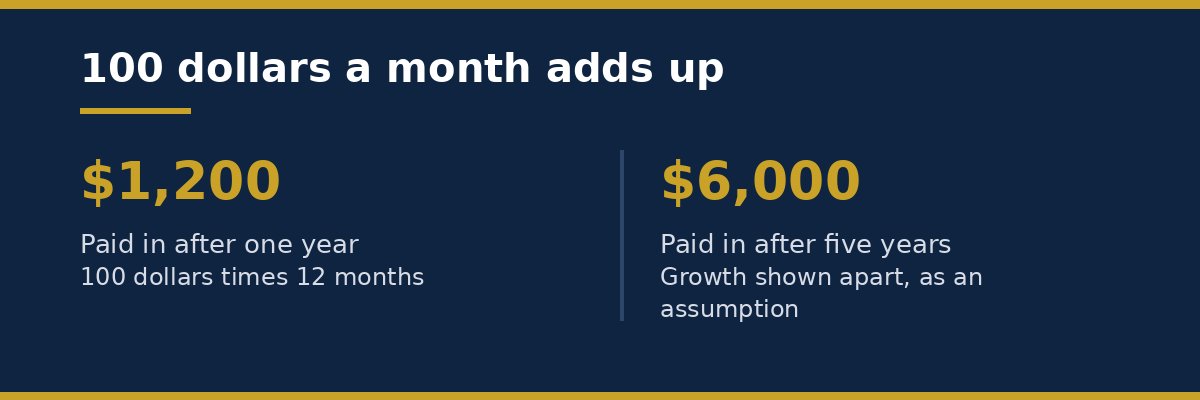
- Total added in one year: 100 dollars times 12, which is 1,200 dollars
- Total added in five years: 1,200 dollars times 5, which is 6,000 dollars
So, in this example, the money you put in yourself is 1,200 dollars after one year and 6,000 dollars after five years. That part is simple addition, and it does not depend on the market at all.
Growth is a separate question, and it needs a clearly labelled assumption. Suppose, only as an assumption for this example, that the investments grow at 5 percent a year on average. That 5 percent is an assumption, not a promise, and real returns vary from year to year and can be negative. If the 1,200 dollars added in the first year grew at that assumed rate for a full year, the assumed growth would be 60 dollars, and the example balance would be 1,260 dollars.
Over five years, using the same 5 percent a year assumption, and the same 100 dollars a month, the example balance after five years would be about 6,800 dollars. That is about 6,000 dollars you added, plus about 800 dollars of assumed growth. These are example numbers, not real figures for any real investment. The lesson is the habit: a small, regular amount, added every month, builds up over time.
Fees to Watch
A brokerage account is not free to run, even when the broker says there is no commission. The costs are often small, but they add up over years, so it is worth knowing where they sit.
First, check the trading commission, meaning the charge for buying or selling. Many brokers in the United States now charge no commission for buying stocks and ETFs online, but some still charge for other trades. Check the fee list before you trade.
Second, check the fund expense ratio, meaning the yearly cost of running a fund, shown as a small percentage. A broad index fund may charge a very low percentage each year, while an actively managed fund may charge much more. The fee is taken from inside the fund, but it still reduces your return over time.
Third, check the account fee, meaning a charge for keeping the account open. Many brokers charge no yearly account fee, but some charge for paper statements or for closing an account. Read the fee schedule once, before you open the account. Low, clear fees are better than high, hidden ones.
SIPC Protection in Simple Terms
SIPC stands for the Securities Investor Protection Corporation. It is a non profit organisation in the United States that protects customers if their brokerage firm fails and customer assets go missing. It is not the same as bank deposit insurance.
SIPC protection covers up to 500,000 dollars per customer, including up to 250,000 dollars in cash, if a member brokerage firm fails. If your firm is a SIPC member, and it fails, SIPC steps in to return your investments and cash, up to those limits.
Here is what SIPC does not do, and this part matters more. SIPC does NOT protect you against market losses. If your investments fall in value because the market fell, SIPC does not make up the loss. It only covers the case where the firm itself fails and your assets are missing.
Before you open an account, check that the broker is a SIPC member. Most large brokers in the United States are members, and they usually state this clearly on their website. For the exact rules and limits, see the SIPC site itself: SIPC, sipc.org. For general investor education, see investor.gov: Brokerage accounts, investor.gov
Common Mistakes Beginners Make
Treating the Account as the Investment
Opening a brokerage account is not the same as investing. Until you buy an investment inside it, your money is just sitting as cash. Check that your money is actually invested, in the way you planned.
Putting Short Term Money in a Brokerage Account
Money you need soon, for rent, bills, or an emergency, does not belong in investments that can fall in value. Keep short term money in a bank account, and keep only long term money in a brokerage account.
Buying Without a Plan
Buying an investment because someone else mentioned it, without a plan of your own, is a common mistake. A simple plan helps you decide what to buy and how much to add. Our guide What Is Risk in Investing? explains how the chance of a loss and the size of a return sit together.
FAQ
What is a brokerage account in simple terms?
A brokerage account is an account with a brokerage firm that lets you buy and hold investments, such as stocks, ETFs, and funds. The account holds the investments for you. It is not the investment itself.
How is a brokerage account different from a bank account?
A bank account holds cash for everyday use, and its balance does not fall when the stock market falls. A brokerage account holds investments, and its value can go up or down with the market.
What can I hold in a brokerage account?
You can hold stocks, ETFs, mutual funds, bonds, and cash, depending on the broker. Many beginners hold a broad fund that owns many companies at once.
Is a brokerage account the same as a retirement account?
No, though both can be held at the same broker. A plain taxable account has no special tax break and lets you add or take out money at any time. A retirement account, such as an IRA, can offer tax benefits, but it has rules about yearly limits and when you can take money out.
Is my money safe in a brokerage account?
Your investments are held in your name, and SIPC protection covers up to 500,000 dollars per customer, including up to 250,000 dollars in cash, if a SIPC member firm fails. SIPC does NOT protect you against market losses.
How much money do I need to open a brokerage account?
It depends on the broker. Many brokers let you start with a small amount, and some have no minimum at all. In the example in this article, 100 dollars a month adds up to 1,200 dollars in a year.
Conclusion
A brokerage account is simple at heart: it is an account with a brokerage firm that holds the investments you buy, such as stocks, ETFs, and funds. It is different from a bank account, because its value can fall as well as rise, and it is different from a retirement account, because the tax and withdrawal rules are different.
Open one in small, clear steps: choose a broker and an account type, confirm your identity, link a bank account, add money, and buy in line with a simple plan. Watch the fees, keep short term money in the bank, and remember that SIPC protection covers a firm failing, not the market falling. A regular amount, added every month, is a steadier start than a large one off guess.
This article is for general information and education only. It is not legal or financial advice.
