

How to Save Money on Utilities: Lower Bills With Simple Changes
Learning how to save money on utilities starts with one clear idea: most utility bills are made of small daily habits, not one big cost. Lights left on, long showers, heating an empty room, and a fridge working too hard all add a little each day. Change a few of those habits, fix a few low-cost problems, and the bill usually falls without making your home uncomfortable.
You do not need new appliances or a big budget to start. This post shows you how to read your bill, cut electricity, water, and heating costs, and work through a full example with real math. It is educational only. It is not financial advice.
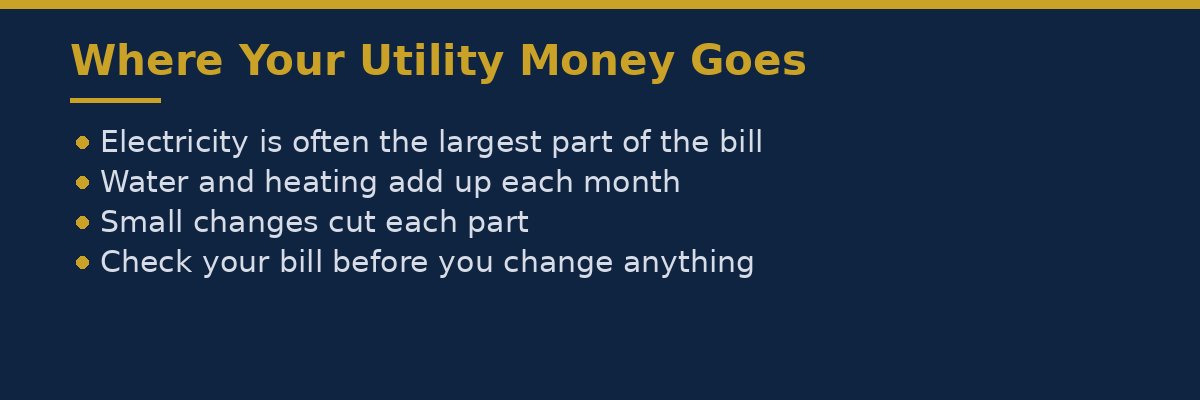
Start by reading your utility bill
Before you change anything, look at one recent bill. Most bills show the same basic facts: how much you used, the charge for that use, fixed fees, taxes, and the total due. Write down the total and the amount used, so you can compare next month with this month.
Check these three things on the bill:
- The total amount due, and the date it covers. A bill that covers 35 days will look higher than one that covers 28 days, even if your habits did not change.
- The amount used, often shown in kilowatt hours for electricity, gallons or cubic feet for water, and therms or similar units for gas. This is the number your habits control.
- Fixed fees and taxes. These stay about the same each month, so focus your effort on the usage part of the bill.
If your bill is much higher than usual, check for a simple cause first. A running toilet, a dripping tap, a heater left on, or an estimated reading can explain a sudden jump. Fix the cause before you change anything else.
Keep one note of your monthly totals. A short list on paper or in a notes app is enough. It shows whether a change worked, and it stops you from guessing.
How to lower your electricity bill
Electricity is often the largest part of a home utility bill, and it is also the part with the most small habits to fix. Work through these steps in order, starting with the easiest.
Turn off what you are not using
Turn off lights when you leave a room. Turn off the TV, game console, and computer when no one is using them, instead of leaving them on standby. Unplug chargers when they are not charging anything. Each item uses only a little power on its own, but several items left on all day add up over a month.
Make it easy to remember. Put a small note near the door, or make switching off part of leaving a room, like taking your keys. Habits work better than willpower.
Use light and appliances with care
Use daylight when you can, and open curtains instead of switching on a light during the day. When you replace a bulb, choose a long-life, low-energy bulb that fits the room. Use the washing machine and dishwasher with full loads, and use a shorter or cooler wash when the clothes are not very dirty. Dry clothes outside or on a rack when the weather allows, instead of using the dryer for every load.
Check the fridge and freezer
The fridge runs all day and all night, so it is worth a quick check. Keep the door closed as much as you can, and do not leave it open while you decide what to eat. Let hot food cool before you put it in the fridge. Check that the door seal is clean and closes tightly, so cold air does not leak out. Keep the fridge full enough to stay cold, but not so full that air cannot move around inside.
How to lower your heating and cooling bill
Heating in winter and cooling in summer can be a large share of utility costs. Small changes to temperature and airflow often save more than people expect.
Set a sensible temperature
In winter, try setting the heating one or two degrees lower than usual, and wear a jumper indoors if you feel cool. In summer, set cooling one or two degrees higher, and use a fan to move air around the room. A small change in the setting is often hard to notice in comfort, but easy to see on the bill.
Stop air leaking in and out
Close doors to rooms you do not use, and close curtains at night in winter to keep heat in. In summer, close curtains on sunny windows during the hottest part of the day, and open windows at night if the air outside is cooler. Check for gaps around doors and windows, and use low-cost draught strips or sealant where you find a gap. A door that closes well makes a real difference.
Keep vents and radiators clear. Do not put furniture, curtains, or boxes in front of them, because blocked airflow makes the system work harder for the same result.
Look after your heating and cooling system
Change or clean filters as often as the maker suggests, because a dirty filter makes the system work harder. Keep the area around outdoor units clear of leaves and clutter. If your system is very old or noisy, ask a qualified technician to check it, and ask what a service would cost before you agree. Regular care is cheaper than a breakdown, and a well-kept system uses less energy.
How to lower your water bill
Water is easy to waste without noticing, because it runs for only a few seconds at a time. Shorter showers, fixed leaks, and full loads are the three biggest wins.
Fix leaks fast
A dripping tap or a running toilet wastes water all day and all night. Check taps, shower heads, and toilets once a month. Put a small note on a leak when you find it, and fix it the same week if you can. If you are not sure how to fix it, ask a plumber for a price first. A small leak fixed early is almost always cheaper than the water it wastes over months.
Shorten showers and use water with care
Take shorter showers, and turn the water off while you brush your teeth or wash your face. Use a basin of water to wash vegetables instead of running the tap. Run the washing machine and dishwasher only with full loads, and choose a shorter cycle when the load is light. Water the garden early in the morning or late in the evening, so less water is lost to heat, and only water when the soil is dry.
Use low-cost water savers
Low-cost items can cut water use without changing how you live. A low-flow shower head, a tap aerator, or a simple device in the toilet tank can reduce each use by a little. These items are usually cheap and easy to fit, and they pay for themselves over time through lower bills. Check the instructions or ask the shop for help if you are unsure which size fits your tap or shower.
Build a simple monthly plan
A one-week effort will not lower your bills for long. A simple monthly plan will. Use this plan to keep the changes going.
Week 1: Measure
Write down last month’s bill total and usage. Walk through the house and list every leak, draught, light left on, and device on standby. Pick the three easiest fixes and do them this week.
Week 2: Change habits
Start the new habits: lights off, shorter showers, full loads, heating set one degree lower or cooling set one degree higher. Tell everyone in the home what is changing and why, so they can help.
Week 3: Check the next bill
When the next bill arrives, compare the total and the usage with last month. Remember that a longer billing period or a cold snap can change the result, so look at usage, not just the total. If usage fell, the habits are working.
If your income is tight, put the money you save into your budget first. Our guide on how to create a monthly budget shows how to give every dollar a job, and our guide on how to save money on a tight budget has more ideas that cost nothing to start. Saving on utilities and saving on groceries go together too, so see how to save money on groceries for the food side of the same plan.
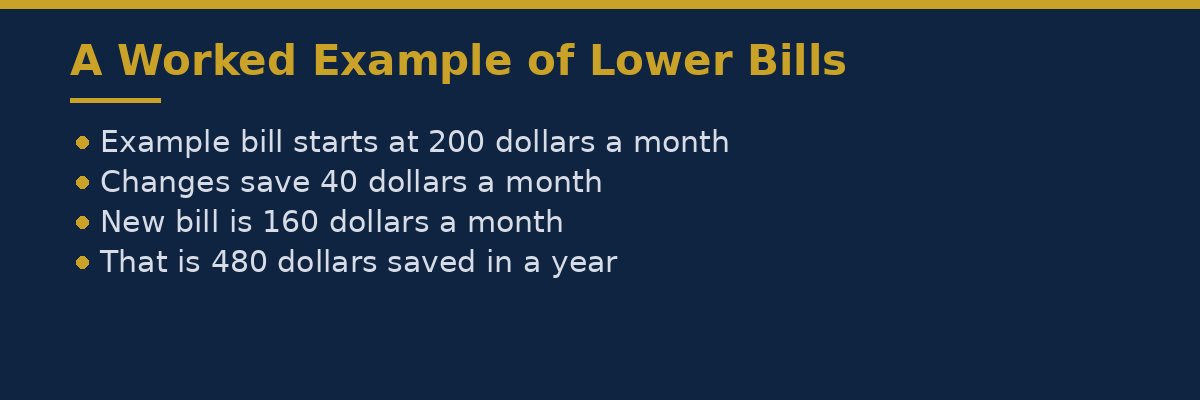
Worked example: a 200 dollar monthly utility bill
Here is a worked example using round numbers that we state clearly. This is an example only, not a promise of what you will save. Your bills and your savings will be different.
Suppose a household has an example monthly utility bill of 200 dollars, broken down like this:
- Electricity: 110 dollars
- Water: 40 dollars
- Heating: 50 dollars
- Total: 110 plus 40 plus 50 equals 200 dollars
Now suppose the household makes three changes:
- Electricity: shorter showers with an electric water heater, lights off, and standby power cut, saving 18 dollars. New electricity cost: 110 minus 18 equals 92 dollars.
- Water: shorter showers and a fixed dripping tap, saving 8 dollars. New water cost: 40 minus 8 equals 32 dollars.
- Heating: temperature set one degree lower and draught strips on two doors, saving 14 dollars. New heating cost: 50 minus 14 equals 36 dollars.
Add the savings: 18 plus 8 plus 14 equals 40 dollars saved each month.
Add the new costs: 92 plus 32 plus 36 equals 160 dollars. So the new example bill is 160 dollars a month, down from 200 dollars.
Over a year, 40 dollars a month times 12 months equals 480 dollars saved in a year. That is the power of small changes: none of the three savings is large on its own, but together they cut the example bill by 20 percent.
Try the same math with your own bill: write your real total, split it into electricity, water, and heating, estimate a small saving for each part, add the savings, and multiply by 12 for a full year.
Common mistakes to avoid
Do not try to change everything on day one. Pick three changes, keep them for a month, then add more. A plan with ten new habits is a plan that stops in week two.
Do not compare your bill with a neighbour’s bill. House size, number of people, heating type, and climate all change the bill. Compare your bill with your own bill from last month, or the same month last year.
Do not ignore a sudden jump in a bill. Check for a leak, a running toilet, a heater left on, or an estimated reading first. A sudden jump usually has a cause, and finding it early saves money.
Do not buy an expensive new appliance only to save on bills, unless you have checked the numbers. A new appliance can cost hundreds or thousands, and it may take years to pay for itself through lower bills. Fix habits and low-cost problems first, and only replace an appliance when it breaks or when the numbers clearly make sense.
Frequently asked questions
What is the fastest way to save money on utilities?
The fastest wins are usually switching off lights and devices, taking shorter showers, fixing a dripping tap or running toilet, and setting heating or cooling one degree closer to the outside temperature. These cost nothing and can show up on the next bill. For more no-cost ideas, see how to cancel subscriptions to save money, which cuts a different monthly cost in the same way.
How much can I save on utilities?
It depends on your home, your habits, and your starting bill. A household that leaves lights on, takes long showers, and heats empty rooms can often save more than a household that already does those things well. Work out your own example with the method in this post, keep the savings modest, and check the next bill to see what really happened.
Should I switch utility providers to save money?
It can help in some areas, but only if you compare the full cost, not just the headline price. Check fixed fees, the price per unit, contract length, and any fee for leaving early. Read the terms carefully before you switch.
Do low-energy bulbs really save money?
They use less electricity than old bulbs for the same amount of light, and they usually last longer. The saving per bulb is small, but across a whole house, over a year, it adds up. Replace bulbs as they burn out, rather than replacing every working bulb at once.
How do I find where my home wastes energy?
Walk through the house slowly and look for the signs: lights on in empty rooms, hot or cold air near doors and windows, dripping taps, a fridge door that does not seal, and devices left on standby. The United States Department of Energy has a free guide to home energy saving at energy.gov/energysaver, and ENERGY STAR has home saving tips at energystar.gov. The Consumer Financial Protection Bureau also has free budgeting tools at consumerfinance.gov/consumer-tools that can help you plan where the savings go.
Is it worth buying a smart thermostat?
It can help if your household keeps irregular hours, because it can turn heating or cooling down when no one is home. But it is not needed to save money. A simple timer, a manual change to the setting, and closing doors to unused rooms can give most of the same saving at no cost.
Conclusion, and your first step today
Learning how to save money on utilities is not about one big change. It is about reading your bill, fixing the leaks and draughts, switching off what you do not use, and keeping the habits that work. Start today with one step: find your last bill, write down the total, and walk through the house to find three easy fixes. Do those three this week, check the next bill, and add one more change next month.
Small changes, kept for a year, add up to real money. In our example, 40 dollars a month became 480 dollars in a year. Your numbers will be different, but the method is the same.
This article is for general information and education only. It is not legal or financial advice.
