

How to Save Money on Travel Without Ruining the Trip
How to save money on travel without ruining the trip? The short answer is to cut the costs that do not change how much you enjoy the trip, and protect the spending that makes the trip special. Flights, stays, food, and timing are usually the biggest costs, and they are also where the biggest savings hide. A cheaper flight on a less busy day, a stay a short walk from the centre, and a few home cooked meals can save hundreds, while the views, the walks, and the time with family stay the same.
Saving on travel is not about skipping everything fun. It is about choosing on purpose. Pick one or two experiences that matter most, such as a good meal, a tour, or a show, and spend on those. Cut the costs that add little joy, such as a costly airport taxi when a train is easy, or a hotel breakfast you could make for far less. When you plan this way, the trip still feels like a holiday, and your budget still holds.
This post shows how to cut travel costs step by step, with a worked example of a trip budget before and after savings, and simple rules to keep the trip enjoyable. It is educational only. It is not financial advice.

Start with a trip budget, not a wish list
Before you book anything, set a total trip budget. This is the most you will spend on the whole trip, including travel, stays, food, activities, and a small buffer for surprises. Without a total, each booking feels small on its own, and the total only becomes clear when the money is already gone.
Write down the trip in five buckets: getting there, staying there, eating, doing things, and a buffer. Getting there means flights, trains, buses, fuel, parking, and airport transfers. Staying there means hotels, rentals, or stays with family. Eating means restaurants, cafes, snacks, and groceries. Doing things means tours, tickets, and activities. The buffer is a small amount for costs you did not plan, such as a delayed flight or a forgotten item.
Set the total first, then fit the buckets inside it. If the first total is too high, change the timing or the stay before you change the fun. A trip that fits your budget is a trip you can enjoy without worry, and that matters more than one extra night in a costly hotel.
If you are new to budgeting, our guide on how to create a monthly budget shows a simple method you can use for a trip budget too. The Consumer Financial Protection Bureau also offers general budgeting tools at consumerfinance.gov that can help you plan trip spending in advance. The same idea applies: list income, list costs, and make the total balance.
How to save money on flights
Flights are often the largest single cost, so they deserve the most attention. A few simple habits can cut the price without making the journey miserable.
Be flexible with dates and times where you can. Flying on a less busy day, or at an early or late time, is often cheaper than flying at the most popular time. If you can move your trip by one or two days, compare the prices before you book, because a small shift can change the fare a lot.
Book early enough to have choice, but do not rush into the first fare you see. Compare at least two or three options for the same route, and check what is included. A low fare that charges extra for a bag, a seat, and food may cost more in total than a slightly higher fare that includes those things.
Travel light where you can. Pack only what you need, and check the bag rules before you leave. Paying for an extra bag at the airport is usually more costly than planning your packing at home. Wear your heaviest shoes and jacket on the plane if that helps you fit everything in one bag.
Avoid paying for things you do not need on a short flight. A seat with extra legroom may be worth it on a long flight, but on a short flight it is often money you could spend on the trip itself. Choose the standard seat, and save the difference for a meal or a tour at your destination.
How to save money on where you stay
Where you stay is usually the second largest cost, and small changes here can save a lot over several nights.
Stay a little outside the centre. A hotel or rental a short walk, bus ride, or train ride from the centre is often much cheaper than one in the middle of everything, and the area may be quieter too. Check the transport time before you book, so the saving is not lost to long, costly journeys each day.
Compare a rental with a kitchen against a hotel without one. A rental may cost less per night for a family, and a kitchen lets you cook some meals, which saves more. A hotel may be better for a short stay, where you want no cooking and no cleaning. Choose based on the length of the trip and how you like to eat.
Book a stay that fits your real needs, not your dream needs. A pool, a gym, or a large room sounds nice, but if you spend most of the day out, you may not use them. Pay for the bed, the location, and the quiet, and skip the extras you will not use.
Check the total price, not just the nightly price. Some stays add cleaning fees, service fees, or local taxes that change the total a lot. Add all fees before you compare, so you compare real totals.
How to save money on food without eating badly
Food is a daily cost, so small daily savings add up fast on a trip. The goal is to eat well for less, not to eat badly to save money.
Eat one main meal out each day, and make the other meals simple. Breakfast can be bread, fruit, and yoghurt from a local shop. Lunch can be a sandwich, a market meal, or leftovers. Dinner can be the meal you sit down for and enjoy. This keeps food fun without paying restaurant prices three times a day.
Shop at local markets and grocery stores. They often have fresh food at lower prices than restaurants and tourist cafes, and they show you how local people eat. Buy fruit, bread, cheese, and drinks for the day, and carry water with you.
Avoid eating every meal in the most touristy street. Walk one or two streets away from the main sights, and prices often fall while quality stays the same or improves. A cafe full of local people is often a good sign.
Carry snacks and water. A small bag with snacks, fruit, and a refillable bottle stops you from buying costly snacks when you are hungry or thirsty. This is simple, but on a family trip it can save a noticeable amount each day.
Set a daily food limit. For example, decide on a daily food amount for the group, and check it each evening. If one day goes over, eat more simply the next day. A daily limit keeps food spending visible, without turning every meal into a maths test.
Our guide on how to cut food spending without cutting meals has more ideas that work at home and on a trip, because the same habits apply in both places.
How to save money on timing and transport
When you travel matters almost as much as where you go. Timing can change the price of flights, stays, and activities, sometimes by a lot.
Travel just outside the busiest season where you can. The weeks just before or just after the peak season often have lower prices, fewer crowds, and weather that is still good. This is sometimes called the shoulder season, and it is one of the easiest ways to save without losing the trip.
Stay longer in one place instead of moving every day. Each move costs money for transport, and it costs time for packing, checking in, and finding your way. A longer stay in one place lets you learn the area, use local transport well, and often get a better nightly price.
Use public transport at your destination. A bus or train pass for a few days is often far cheaper than taxis or rental cars, especially in a city. Learn the main routes before you arrive, and keep a simple map on your phone. If you do need a taxi, check the price before you get in, and share the ride where you can.
Worked example: a trip budget before and after savings
This worked example uses round numbers that are stated clearly and labelled as an example only. It is not a price quote for any real trip.
Meet Ana and her family, an example family of four, planning a 5 night trip. Here is their first trip budget, before any savings.
Flights for four: 800.
Stay for 5 nights: 600.
Food for 5 days: 400.
Activities and tickets: 150.
Local transport: 50.
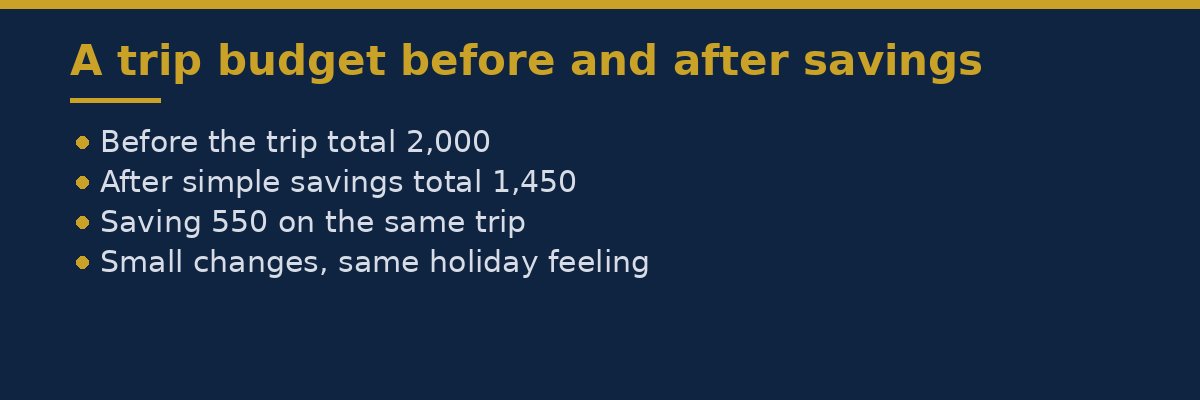
Total before savings: 800 plus 600 plus 400 plus 150 plus 50 equals 2,000.
Now Ana makes four simple changes, and none of them removes the fun from the trip.
First, she moves the flights by one day to a less busy day, and the flights fall from 800 to 650, a saving of 150.
Second, she chooses a stay a short bus ride from the centre, with a small kitchen, and the stay falls from 600 to 450, a saving of 150.
Third, she plans one main meal out each day and simple meals for the rest, and food falls from 400 to 250, a saving of 150.
Fourth, she swaps one paid activity for a free museum day and a park walk, and she buys a bus pass instead of taking taxis, so activities fall from 150 to 100, a saving of 50, and local transport falls from 50 to 0, a saving of 50, because the bus pass is included in the new activities figure in this example. To keep the math clear, the new totals are shown below.
Flights for four: 650.
Stay for 5 nights: 450.
Food for 5 days: 250.
Activities and tickets: 100.
Local transport: 0, covered by the bus pass in the activities total for this example.
Total after savings: 650 plus 450 plus 250 plus 100 plus 0 equals 1,450.
Total saving: 2,000 minus 1,450 equals 550.
That is a saving of 550 on the same 5 night trip, or 550 divided by 2,000, which equals 0.275, or 27.5 percent less. The family still flies, still stays for 5 nights, still eats out once a day, and still enjoys paid activities. They simply changed the day, the location, the food pattern, and one activity.
You can do the same check for your own trip. Write your before total, change one bucket at a time, and add up the new total. Even a saving of 100 or 200 can pay for an extra day, a special meal, or a buffer for surprises.
Frequently asked questions
How can I save money on travel without ruining the trip?
Cut the costs that do not change your enjoyment, such as a less busy flight day, a stay a short ride from the centre, and simple meals for part of the day. Protect the spending that makes the trip special, such as one or two paid highlights and one good meal a day. Set a total trip budget first, and fit the trip inside it.
Is it cheaper to travel in the shoulder season?
In many places, yes. The weeks just before or just after the busiest season often have lower prices for flights and stays, and fewer crowds. Weather can still be good, but it is wise to check the normal weather for those weeks before you book, so you know what to expect.
How much should I budget for food on a trip?
It depends on where you go, how many people travel, and how often you eat out. A simple way to start is to plan one main meal out each day, and simple meals for the rest, using local shops. Set a daily food amount for the group, check it each evening, and adjust the next day if you go over.
Should I use a travel pass or pay for single tickets?
A pass is often cheaper if you plan to use transport often or visit several sights that the pass covers. Single tickets may be cheaper if you plan to walk most of the time and only use transport once or twice. Add up the single tickets you expect to buy, compare that total with the pass price, and choose the lower total.
What is the best way to save for a trip?
Save a fixed amount each month into a separate place, so the trip money does not mix with daily spending. Start as early as you can, even with a small amount, and add any extra income to the trip fund. A clear trip budget makes saving easier, because you know the exact total you are aiming for.
How do I avoid overspending on a trip?
Set a total trip budget and a daily spending limit before you leave. Check spending each evening for one minute. Keep a small buffer for surprises, separate from daily spending. If one day goes over, eat more simply or choose a free activity the next day, rather than giving up on the budget.
Conclusion
How to save money on travel without ruining the trip comes down to choice, not sacrifice. In the worked example, a family of four saved 550 on a 2,000 trip, a cut of 27.5 percent, by changing the flight day, choosing a stay a short ride from the centre, eating one main meal out each day, and swapping one paid activity for a free day. The trip still had flights, a 5 night stay, daily meals out, and paid activities. It simply cost less.
Start your next trip the same way. Set a total budget, compare flights by date and time, check the total stay price with fees, plan food in a simple pattern, and pick one or two highlights to protect. Check spending each evening, and keep a small buffer for surprises. A trip planned this way feels like a holiday, and it leaves your budget intact when you return home.
This article is for general information and education only. It is not legal or financial advice.
