

How to Save Money on Weddings: Where to Cut With the Least Impact
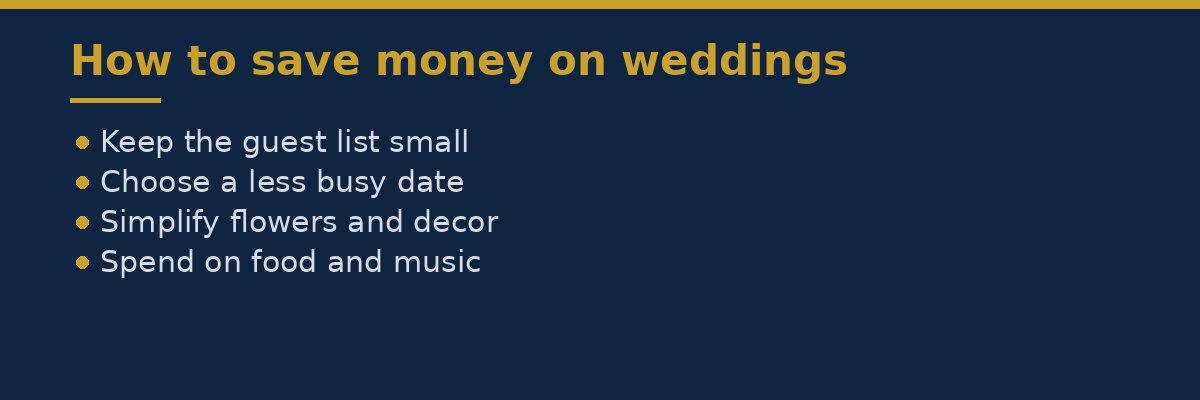
How to save money on weddings? The short answer is to cut where guests will not notice, and protect what guests will remember. Guests remember good food, good music, a warm welcome, and time with the couple. They rarely remember the exact flowers, the costly invitations, or the brand of the cake. A wedding can feel beautiful and joyful at a lower cost, if the cuts are made in the right places.
Weddings are costly because many small choices add up. A venue, food, clothes, photos, flowers, music, and invitations each seem reasonable on their own, but together they can grow far beyond the first plan. The fix is not to cut everything. The fix is to set a total budget first, agree on what matters most, and cut the costs with the least impact on the day itself.
This post shows a simple wedding budget to start from, explains where to cut with the least impact, and gives a worked example showing savings from three specific cuts. It is educational only. It is not financial advice.
Start with a simple wedding budget
Before you book anything, agree on a total wedding budget. This is the most you will spend on the whole wedding, including the venue, food, clothes, photos, music, flowers, and a small buffer. Without a total, each supplier feels like a separate choice, and the total only becomes clear when deposits are already paid.
A simple starting budget uses these buckets: venue and hire, food and drink, clothes, photos and video, music, flowers and decor, invitations and stationery, transport, and a buffer. Write a limit for each bucket, and make the buckets add up to your total. If the first total is too high, change the largest buckets first, such as the venue and the guest list, before you argue about small details.
Agree on the top three priorities as a couple, before you look at suppliers. For many couples, the top three are food, photos, and music, or venue, food, and clothes. Your top three may be different, and that is fine. The point is to protect those three, and cut elsewhere first. When a new cost appears, ask whether it supports one of the top three. If it does not, it is a good candidate to cut or simplify.
If you are new to budgeting, our guide on how to create a monthly budget shows a simple method that works for a wedding budget too. The Consumer Financial Protection Bureau also offers general budgeting tools at consumerfinance.gov that can help you plan a large cost in advance. The same idea applies: list the total, list the buckets, and make the numbers balance.
The guest list is the biggest lever
The guest list is the biggest lever in a wedding budget, because almost every cost grows with the number of guests. Food, drink, chairs, tables, invitations, favours, and transport all cost more when more people come. Cutting the guest list by a small amount can save more than cutting many small details.
Start with a simple rule: invite the people you both know well and see often, plus close family. If you have not spoken in a year, or you would not invite the person to a small dinner, ask whether they need to be at the wedding. This is not about being unkind. It is about keeping the day close and personal, which most guests prefer anyway.
Consider a smaller ceremony with a larger, simpler celebration later, if that fits your family and culture. A small ceremony with close family, followed by a simple meal or party for a wider group, can cost far less than one large formal event for everyone, and it can feel more relaxed.
Be clear and kind about plus ones and children. Decide the rule together, such as plus ones only for partners you both know, or children only for close family, and apply it fairly. A clear rule is easier to explain than a different choice for each guest, and it keeps the guest count under control.
Every 10 guests you cut can save a real amount on food and drink alone, plus chairs, tables, and invitations. Talking about the guest list early helps, and our guide on how couples budget together without arguments has ideas that help with wedding money talks too. That saving can then protect the food quality or the music for the guests who do come.
Where to cut with the least impact
Some wedding costs can be cut a lot with almost no impact on how the day feels. These are the best places to start.
Choose a less busy date and time. A wedding on a weekday, a Sunday, or in a less busy month is often cheaper for the venue and for some suppliers, while the day itself feels the same. A morning or afternoon wedding with lunch can also cost less than an evening wedding with a full dinner, and many guests enjoy a daytime celebration.
Simplify flowers and decor. Flowers are beautiful for a few hours, then they are gone. Use fewer flowers, choose flowers that are in season, and reuse the same arrangements in different places, such as moving ceremony flowers to the reception tables. Candles, simple greenery, and a clean table setting can look elegant for far less than large floral displays in every corner.
Simplify invitations and stationery. Many guests keep the invitation for a short time, then recycle it. A simple printed invitation, or a clear digital invitation for most guests with a printed copy for close family, can save a lot. Spend the saving on food or music, which guests will remember longer.
Simplify the cake and dessert. A large, costly tiered cake looks impressive, but most guests eat a small slice and do not remember the details. A smaller display cake, with a simple sheet cake in the kitchen for serving, or a dessert table with a few choices, can cost far less and still feel special. Our worked example below shows a saving of 500 from this one change.
Simplify transport and favours. A single transport plan for the wedding party, rather than several separate cars, is often cheaper and simpler. Small favours are kind, but they are rarely remembered, so choose something simple and useful, or skip favours and spend the money on a better meal or a longer music set.
Use your own skills and help from family where it fits. A family member who bakes well, plays music, or takes good photos can help, but only if they truly enjoy it and it does not add stress. Do not turn a loved one into an unpaid supplier on a day when they should be enjoying the wedding. A simple, paid professional for the most important jobs is often worth it.
Where not to cut
Some costs are worth protecting, because cutting them changes how the day feels for you and your guests.
Do not cut food quality too far. Guests remember a good meal, and they also remember a poor one. It is better to serve a simpler menu well, such as two good main choices instead of four average ones, than to serve a large menu badly. A simpler menu, cooked well, is a good saving with little impact.
Do not cut photos and video too far. Photos are what remain after the day ends. A good photographer who knows weddings is worth protecting in the budget, even if you cut flowers or invitations to pay for it. If the budget is tight, choose a shorter photo package that covers the ceremony and the main reception, rather than a cheap all day package from someone with little wedding experience.
Do not cut music that keeps guests together. Music sets the mood, fills quiet moments, and brings people to the dance floor. A good DJ or a small live group can make the evening feel alive. Cutting music to silence, or to a playlist with no one to manage it, can make the reception feel flat.
Do not cut the buffer. Every wedding has a surprise cost, such as extra chairs, a late change, or a forgotten item. If you are saving for the wedding over several months, our guide on how to save for a goal and an emergency fund at the same time shows how to save for a goal without dropping your safety net. A buffer of a small share of the total, kept separate from the main buckets, stops a surprise from becoming a debt or a worry.
Do not cut comfort for guests. Enough seating, shade or heating, water, and clear directions matter more than costly decor. Guests who are comfortable enjoy the day, and they remember feeling looked after.
Worked example: a wedding budget with three specific cuts
This worked example uses round numbers that are stated clearly and labelled as an example only. It is not a price quote for any real wedding.
Meet Maya and Tom, an example couple, planning a wedding for 100 guests. Here is their first wedding budget, before any savings.
Venue and hire: 6,000.
Food and drink for 100 guests: 8,000.
Clothes: 2,000.
Photos and video: 2,500.
Music: 1,500.
Flowers and decor: 2,000.
Invitations and stationery: 500.
Cake and dessert: 1,000.
Transport: 500.
Buffer: 1,000.
Total before savings: 6,000 plus 8,000 plus 2,000 plus 2,500 plus 1,500 plus 2,000 plus 500 plus 1,000 plus 500 plus 1,000 equals 25,000.
Now Maya and Tom make three specific cuts, and they protect food, photos, and music.
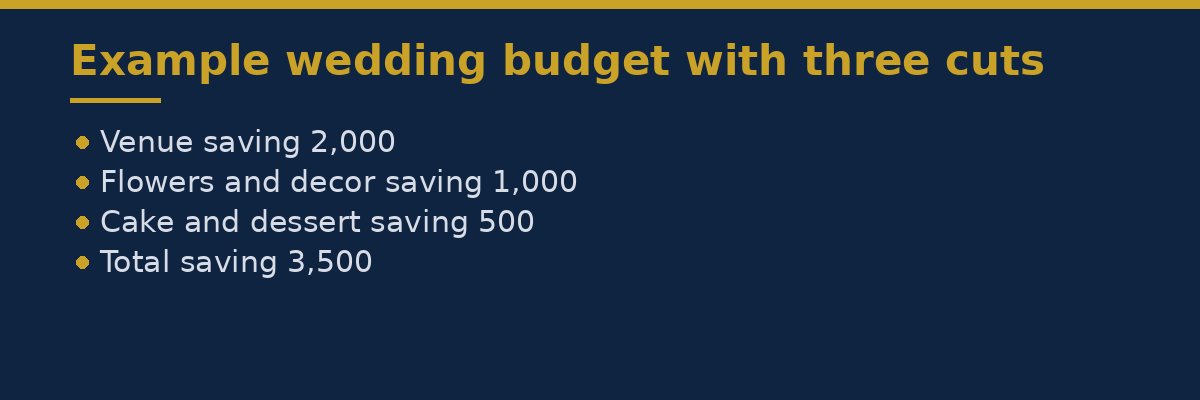
Cut 1, venue: they move the wedding from a Saturday in the busiest month to a Friday in a less busy month, at the same venue. The venue cost falls from 6,000 to 4,000, a saving of 2,000. The day still has the same venue, the same ceremony, and the same reception.
Cut 2, flowers and decor: they choose seasonal flowers, use fewer arrangements, and reuse the ceremony flowers on the reception tables. Flowers and decor fall from 2,000 to 1,000, a saving of 1,000. The tables still look clean and elegant, with candles and simple greenery.
Cut 3, cake and dessert: they choose a smaller display cake, with a simple sheet cake in the kitchen for serving. Cake and dessert fall from 1,000 to 500, a saving of 500. Guests still get cake, and the display still looks special in photos.
Total saving from the three cuts: 2,000 plus 1,000 plus 500 equals 3,500.
New total after savings: 25,000 minus 3,500 equals 21,500.
That is a saving of 3,500 on a 25,000 wedding, or 3,500 divided by 25,000, which equals 0.14, or 14 percent less. Food, photos, and music are unchanged. The guest list is unchanged. The venue is the same, just on a different day. The day still feels like a wedding, and the couple starts married life with 3,500 less to pay.
You can do the same check for your own wedding. Write your before total, change one bucket at a time, and add up the new total. Even one cut, such as a less busy date, can save enough to cover the buffer or a better meal.
Frequently asked questions
How can I save money on a wedding without it looking cheap?
Cut where guests will not notice, such as a less busy date, simpler flowers, simpler invitations, and a smaller display cake. Protect what guests will remember, such as good food, good music, and good photos. A clean, simple style with good food feels elegant, not cheap.
What is the biggest wedding cost to cut first?
The guest list is usually the biggest lever, because food, drink, seating, and invitations all grow with the number of guests. After that, the venue date is often the next biggest saving, because a less busy date at the same venue can cost far less than a busy Saturday.
How much should I budget for a wedding?
It depends on where you live, how many guests you invite, and what matters most to you. Start with a total you can pay without borrowing, then split it into buckets for venue, food, clothes, photos, music, flowers, invitations, transport, and a buffer. Check the total every month, and adjust one bucket when another goes over.
Is a weekday wedding cheaper?
In many cases, yes. Venues and some suppliers often charge less on a weekday, a Sunday, or in a less busy month, because demand is lower. The day itself can feel just as special, but it is wise to check with key guests first, because some guests may find it harder to take time off work.
Should I skip wedding favours to save money?
You can simplify favours or skip them, and most guests will not mind. Favours are a kind gesture, but they are rarely remembered for long. If you keep them, choose something simple and useful, and spend the saving on food, music, or your buffer.
How do I avoid going over my wedding budget?
Set a total budget and a buffer before you book anything. Check the total every month, and keep a simple record of deposits paid and amounts still to pay. If one bucket goes over, cut another bucket by the same amount, so the total stays the same. Agree on the top three priorities first, so cuts are made in the right places.
Conclusion
How to save money on weddings comes down to cutting with the least impact. In the worked example, Maya and Tom saved 3,500 on a 25,000 wedding, a cut of 14 percent, by moving to a less busy Friday, simplifying flowers and decor, and choosing a smaller display cake with a simple sheet cake for serving. Food, photos, music, and the guest list stayed the same. The venue stayed the same. The day still felt like a wedding.
Start your own wedding the same way. Set a total budget first, agree on your top three priorities, set the guest list with a clear rule, and book the venue and date together. Simplify flowers, invitations, cake, transport, and favours, and protect food, photos, music, and comfort for guests. Check the total every month, keep a buffer for surprises, and do not borrow for one day. A wedding planned this way can be beautiful, joyful, and kind to your budget.
This article is for general information and education only. It is not legal or financial advice.
