


How Do I Budget for Home Maintenance?
How do I budget for home maintenance?
To budget for home maintenance, set aside 1 to 2 percent of your home value each year, keep it in a separate savings account, and split it into three parts: routine upkeep, emergency repairs, and saving for big replacements like a roof or a heating system. A home worth 350,000 dollars needs about 3,500 to 7,000 dollars a year under this rule, which is roughly 290 to 585 dollars a month. The money is not an extra cost. It is the real cost of owning a home, paid in small pieces instead of one painful bill.
This post is educational only. It is not financial advice. It does not tell you which repairs to make or which contractor to hire. If a repair affects safety, such as gas, electricity, or structure, get a qualified professional.
Why most homeowners get caught out by repairs
Most homeowners budget for the mortgage, the bills, and the groceries, and forget the house itself. A house is not a finished purchase. It is a machine with parts that wear out on different schedules. The roof, the heating system, the water heater, the appliances, the gutters, and the paint all age at their own pace, and they all need money at some point.
The problem is timing. In a good year, a house may need almost nothing beyond filters and a gutter clean. Then one bad year brings a broken water heater, a leaking roof, and a dead washing machine in the same season. Homeowners who saved nothing pay for that year with a credit card, and the interest turns a 2,000 dollar repair into a much bigger bill.
The 1 percent rule, the simplest starting point
The most widely used rule is simple: save 1 to 2 percent of your home value each year for maintenance and repairs. Some guides stretch the range to 1 to 4 percent for older homes, but 1 to 2 percent is the common starting point, and it is the figure used by Wells Fargo, Redfin, and Bob Vila in their home maintenance guides.
Here is how the rule works in plain numbers. Take your home value and multiply by 1 percent, then by 2 percent. That gives you a yearly range.
- Home worth 200,000 dollars: 2,000 to 4,000 dollars a year, or about 165 to 335 dollars a month.
- Home worth 350,000 dollars: 3,500 to 7,000 dollars a year, or about 290 to 585 dollars a month.
- Home worth 500,000 dollars: 5,000 to 10,000 dollars a year, or about 415 to 835 dollars a month.
Pick your point in the range by the age and condition of your home. A home under 10 years old with new systems can sit near 1 percent. A home over 30 years old, or one with an aging roof and heating system, should sit near 2 percent or higher. Weather matters too. A home in a damp climate or an area with heavy storms wears faster than a home in a mild, dry place.
The 1 percent rule is a starting point, not a promise. Some years you will spend far less than the rule suggests, and some years far more. The rule works because the quiet years build the fund that pays for the loud years.
The square foot rule, a second way to set your number
If you do not know your home value, or if local house prices have moved a lot, use the square foot rule instead. Save about 1 dollar per square foot of your home each year.
A 1,500 square foot home needs about 1,500 dollars a year, or 125 dollars a month. A 2,500 square foot home needs about 2,500 dollars a year, or about 210 dollars a month. A 3,000 square foot home needs about 3,000 dollars a year, or 250 dollars a month.
This rule is simpler, but it is less accurate than the value rule, because the cost of replacing a roof or a heating system depends on where you live as well as how big the house is. Use it when you need a quick starting number, then check it against the 1 percent rule once you know your home value. If the two numbers are far apart, use the higher one until you have a proper list of your systems and their ages.
Split the fund into three buckets
One lump of savings is better than none, but three buckets work better, because they stop you from spending replacement money on routine jobs. Here are the three buckets.
Bucket one is routine maintenance. This is the predictable work that keeps the house running: heating tune-ups twice a year, gutter cleaning, air filters, pest control, lawn care, and small fixes like a dripping tap. For most homes this costs about 1,500 to 4,000 dollars a year, or roughly 125 to 335 dollars a month.
Bucket two is the emergency repair reserve. This is money for the failures you cannot predict: a burst pipe, a broken water heater, a fridge that stops cooling. Keep this in a savings account you can reach at once. A good target is 1 percent of your home value, held as cash. For a 350,000 dollar home, that is 3,500 dollars sitting ready. Once the reserve is full, you stop adding to it and send the money to bucket three instead.
Bucket three is the replacement fund. This is the long game. Every big system has a lifespan and a replacement price. A water heater lasts about 6 to 10 years, according to the International Association of Certified Home Inspectors. A roof lasts about 20 to 25 years. A heating system lasts about 15 to 20 years. When you know the age and the price of each system, you can save a fixed amount each month toward its replacement, so the bill never arrives as a shock.
If you want a simple split for the rest of your money, the 80/20 budget rule puts 20 percent to savings first and lets you spend the rest.
To work out a monthly replacement amount, use this formula: replacement cost divided by months of life left. A roof that costs 12,000 dollars and has 8 years of life left needs 12,000 divided by 96 months, which is 125 dollars a month. A water heater that costs 1,200 dollars and has 4 years left needs 1,200 divided by 48 months, which is 25 dollars a month. Add the monthly amounts for every big system, and that is your replacement fund contribution.

List your systems and their ages before you set the number
A percentage rule is a guess. A list of your systems is a plan. Before you lock in your monthly amount, walk through your home and write down every major system: roof, heating, cooling, water heater, kitchen appliances, washer and dryer, garage door, and any large item you own.
For each one, write down three things: the year it was installed, its expected lifespan, and what a replacement costs in your area. If you do not know the install year, look for a label or a plate on the unit, or check the paperwork from when you bought the home. If you do not know the replacement cost, get one quote from a local contractor.
Then sort the list by urgency. Anything with less than 3 years of life left goes to the top. Those are the systems your replacement fund must cover first. Anything with more than 10 years left can wait, but it still gets a small monthly amount, because small amounts over long periods add up.
If you bought the home recently, a home inspection report is a good starting point. A formal inspection costs about 200 to 400 dollars, and it lists the condition and likely remaining life of the big systems.
Keep the money separate and automatic
A maintenance fund only works if the money is there when you need it, and money in your main checking account gets spent. Open a separate savings account, name it Home Maintenance, and set up an automatic transfer on payday. If your monthly number is 440 dollars, move 440 dollars the day your pay arrives, before you can spend it on anything else.
Keep the routine bucket and the replacement bucket in the same account if you like, but track them separately in a simple spreadsheet or a notebook. One column for routine, one for repairs, one for replacements. When you spend from one bucket, write it down the same day.
Do not invest this money. It is money you may need in a hurry, so it belongs in a savings account you can reach at once, not in stocks or a locked account.
If money is tight, start small. Even 50 to 100 dollars a month builds a cushion over time, and it builds the habit. A homeowner who saves 100 dollars a month for a year has 1,200 dollars ready, which covers a water heater repair or a washing machine replacement without touching a credit card. Start with what you can afford, and raise the amount when your income rises or another cost falls away. Home repairs are one of the irregular costs every household faces, and our guide to budgeting for irregular expenses like car repairs explains the same sinking-fund idea.
Worked example: Maya budgets for a 350,000 dollar home
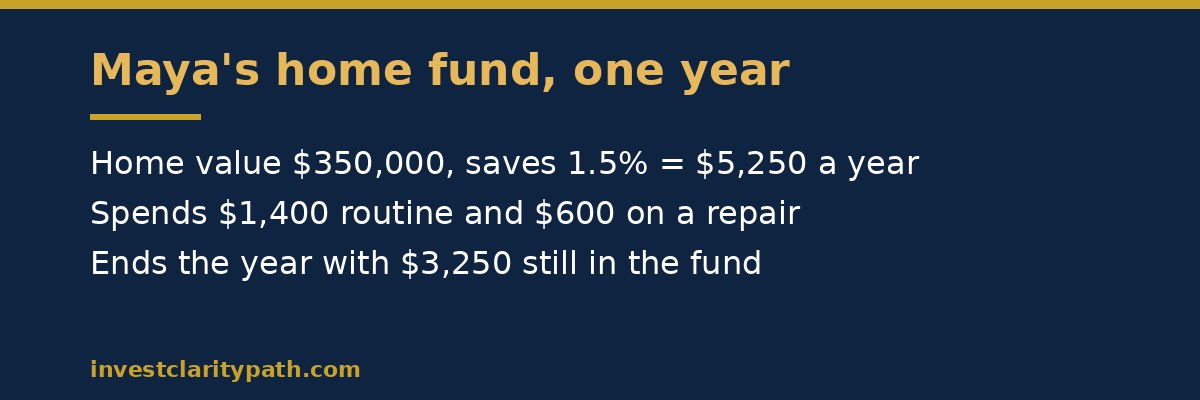
Maya owns a home worth 350,000 dollars. It is 18 years old, with a roof that is 12 years old and a water heater that is 7 years old. She uses the 1 percent rule as her floor and the age of her home to push higher, so she saves 1.5 percent of the home value each year.
First, the yearly number. 1.5 percent of 350,000 dollars is 5,250 dollars a year. Divide by 12 months, and her monthly transfer is 437.50 dollars. She rounds it up to 440 dollars a month, so her yearly saving is 5,280 dollars.
Next, she splits the monthly amount into her three buckets. Routine maintenance gets 150 dollars a month, or 1,800 dollars a year. The replacement fund gets 200 dollars a month, or 2,400 dollars a year. The emergency repair reserve gets 90 dollars a month, or 1,080 dollars a year, until the reserve reaches 3,500 dollars. Check the split: 150 plus 200 plus 90 equals 440 dollars a month. The numbers add up.
In her first year, Maya spends 1,400 dollars on routine work: two heating tune-ups, gutter cleaning twice, filters, and pest control. Her water heater fails in November, and the repair costs 600 dollars, paid from the emergency reserve. Her total spending for the year is 2,000 dollars, plus a 30 dollar tap repair, so 2,030 dollars in all. Her fund started the year at zero and received 5,280 dollars, so she ends the year with 3,250 dollars still in the fund. Check the math: 5,280 minus 2,030 equals 3,250.
She also checks her replacement list. Her roof costs about 12,000 dollars and has 8 years left, so it needs 125 dollars a month. Her water heater needs about 35 dollars a month, and her heating system needs 100 dollars a month. Those three add up to 260 dollars a month, more than the 200 dollars in her replacement fund, so she raises that bucket to 260 dollars a month in year two and trims 60 dollars from fun money.
The lesson is simple. Maya does not need to guess what will break. She needs a monthly number, three buckets, and a list of her systems. After one year, she has money in the bank and a plan for the roof. If her income had dropped at the same time, the survival budget in our guide to budgeting when income drops shows how to rebuild from the new pay.
Common mistakes to avoid
The first mistake is saving nothing because the house looks fine. A house that looks fine is a house whose parts are quietly aging. The bill arrives whether you saved for it or not.
The second mistake is mixing the maintenance fund with the emergency fund. Your emergency fund covers job loss and medical bills. Your home fund covers the house. If one pot pays for both, it will be empty when you need it most.
The third mistake is spending the fund on improvements. A new kitchen is not maintenance. If you spend the roof money on a kitchen, the roof still needs paying for, and now the money is gone.
The fourth mistake is skipping the small routine work to save money. A 150 dollar heating tune-up can catch a problem that becomes a 2,000 dollar repair. Skipping gutter cleaning can cause water damage that costs far more than the cleaning.
The fifth mistake is waiting for a quote before saving. You do not need a perfect number to start. Start with the 1 percent rule this month, list your systems next weekend, and adjust the number when you know more.
Frequently asked questions
How much should I budget for home maintenance each year?
A common rule is 1 to 2 percent of your home value each year. A home worth 350,000 dollars needs about 3,500 to 7,000 dollars a year, or 290 to 585 dollars a month. Older homes should sit near the top of the range, and newer homes near the bottom.
What is the 1% rule for home maintenance?
The 1% rule says to save 1 percent of your home value each year for maintenance and repairs. For a 300,000 dollar home, that is 3,000 dollars a year, or 250 dollars a month. Many guides suggest 1 to 2 percent, or up to 4 percent for homes over 30 years old.
Should I use the $1 per square foot rule instead?
The square foot rule says to save about 1 dollar per square foot each year, so a 2,000 square foot home needs about 2,000 dollars a year. It is a simple starting point when you do not know your home value, but the value rule is more accurate, because replacement costs depend on where you live as well as size.
How do I save for a new roof or heating system?
List the system, its age, its expected lifespan, and its replacement cost. Divide the replacement cost by the months of life left. A 12,000 dollar roof with 8 years left needs 125 dollars a month. Save that amount in a separate replacement fund.
Where should I keep my home maintenance money?
Keep it in a separate savings account you can reach at once, with an automatic transfer on payday. Do not invest it, because you may need it in a hurry, and do not keep it in your main checking account, where it will get spent.
What counts as home maintenance, and what counts as an improvement?
Maintenance keeps the house working as it should: repairs, tune-ups, cleaning, and replacing worn parts. An improvement adds something new or upgrades what is there, like a new kitchen or an extension. Budget for maintenance first, and save for improvements separately.
Conclusion, and your first step today
Budgeting for home maintenance means accepting that a house always costs money, and paying that cost in small monthly pieces instead of one large bill. Start with the 1 percent rule, split the money into routine, repair, and replacement buckets, and list your systems and their ages so the number fits your actual home.
Your first step is simple. Today, work out 1 percent of your home value, divide it by 12, and set up an automatic transfer for that monthly amount into a separate savings account named Home Maintenance. This weekend, walk through your home and list your big systems and their ages.
This post is educational only. It is not financial advice.
