


What Is a 529 Plan, and How Does It Work?
What is a 529 plan?
A 529 plan is a tax-advantaged savings account designed to pay for education. It is named after Section 529 of the United States Internal Revenue Code, which created it. You put money in after tax, the money grows without current federal tax, and withdrawals are free of federal income tax when they pay for qualified education expenses, such as college tuition, room and board, books, and fees.
The plans are run by states, through financial firms that manage the investments, but you can usually enroll in any state’s plan, no matter where you live. Anyone can open one, but parents and grandparents most often open them for a child or grandchild, who is called the beneficiary. The account owner, usually the parent, keeps control of the money. Naming a child as beneficiary does not give the child control.
There are no income limits for contributors, and no age limits for beneficiaries. Most plans have high lifetime contribution limits, often 350,000 dollars or more per beneficiary, though the exact limit varies by state. That makes a 529 plan one of the most flexible ways to save for education.
This guide explains the two types of 529 plan, how the tax benefit works, what the money can pay for, and what happens if there is money left over. It is educational only. It is not financial advice, and tax rules change, so check the current rules for your state before you decide anything.
The two types of 529 plan
There are two types, and they work very differently. The first, and far more common, is the college savings plan. The second is the prepaid tuition plan.
A college savings plan is an investment account. You contribute money, choose investments from the plan’s menu, and the account grows over time. Most plans offer age-based portfolios, which start with more growth investments when the child is young, and shift toward safer holdings as college approaches. You can also choose a static portfolio and manage the mix yourself. When the time comes, you withdraw money to pay for qualified expenses, and the withdrawal is tax-free at the federal level.
A prepaid tuition plan lets you pay for tuition in advance, at today’s prices, for use later at participating colleges, usually public colleges in the same state. You buy tuition credits or a contract now, and the plan promises to cover a set amount of future tuition. Because tuition usually rises over time, paying today’s price can save money later. But you are limited to the plan offered by your state, and to the colleges that take part, so it is far less flexible than a savings plan.
For most families, a savings plan is the better choice, because it works at any college, and you are not locked into one state’s schools. A prepaid plan can make sense if you are sure the child will attend a participating in-state public college, and you want to lock in today’s tuition.
How the tax benefit works
The tax benefit has three parts, and each one matters.
First, contributions are made with after-tax money. There is no federal tax deduction for putting money into a 529 plan, though some states offer a state tax deduction or credit, so check your own state’s rules.
Second, the money grows tax-deferred. Dividends and gains inside the account are not taxed each year, the way they would be in a regular investment account. The money compounds without a yearly tax bill slowing it down.
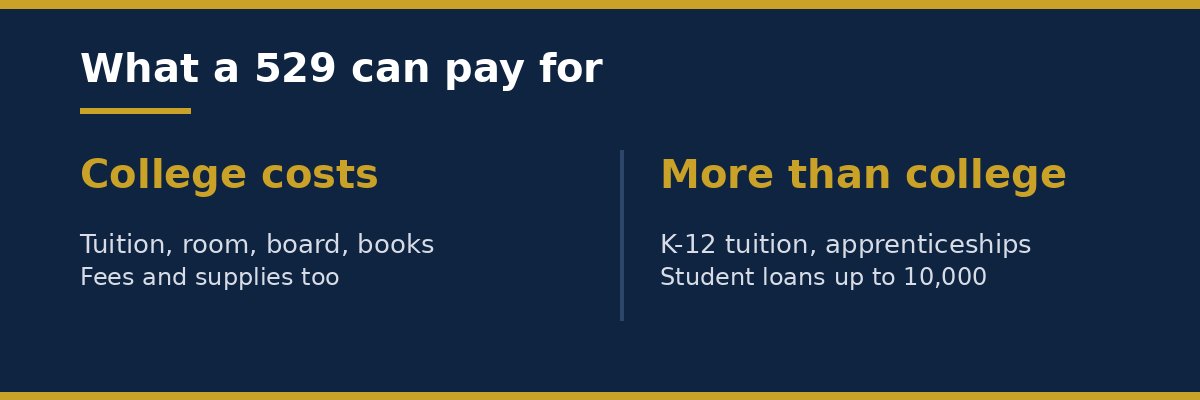
Third, withdrawals are tax-free at the federal level, and often at the state level too, when they pay for qualified education expenses. Qualified expenses include tuition, fees, room and board, books, supplies, and equipment needed for study. In recent years, the list has grown to include certain K-12 costs, apprenticeship programs, and student loan payments, up to set limits. Check the current list before you withdraw, because the rules change.
If you withdraw money for something that is not a qualified expense, the earnings portion is taxed as income, and usually carries an extra 10 percent penalty. The part you contributed is not taxed again, because you already paid tax on it, but the growth is. That is why it matters to use the money for education, or to use one of the options in the next section.
A worked example: 100 dollars a month for 18 years
Imagine parents who open a 529 savings plan when their child is born, and contribute 100 dollars a month, every month, for 18 years. The total they put in is 21,600 dollars, because 100 times 12 is 1,200 dollars a year, and 1,200 times 18 is 21,600.
If the investments grow at an average of 5 percent a year, the account holds about 34,900 dollars after 18 years. That means the growth is about 13,300 dollars, because 34,900 minus 21,600 is 13,300. The growth is not taxed each year, and if the whole amount is used for qualified college expenses, the withdrawal is tax-free too. In a regular taxable account, part of that 13,300 dollars of growth would have been taxed along the way, so the 529 plan keeps more of it.
This is an illustration, not a promise. Real investment growth varies, and 5 percent a year is an assumption, not a guarantee. Some years the account will grow more, some years less, and some years it may fall. What the example shows is the shape of the benefit: steady contributions over many years, plus tax-free growth, add up to far more than the contributions alone.
Starting early matters more than starting big. A family that saves 100 dollars a month from birth has 18 years of growth. A family that starts at age 10 has only 8 years, and would need to save far more each month to reach the same total. Even a small monthly amount, started early, is worth doing.

What can a 529 plan pay for?
Qualified education expenses are the costs the tax rules allow, and the list is wider than most people expect.
For college, it covers tuition and fees, room and board if the student is enrolled at least half time, books, supplies, and equipment, including a computer in many cases. For K-12, it can cover tuition at a private or religious school, up to 10,000 dollars a year per beneficiary, under current federal rules. It can also cover certain apprenticeship program costs, and up to 10,000 dollars in student loan payments per beneficiary over a lifetime.
To keep the tax benefit, withdraw the money in the same tax year that the expense is paid, and keep records showing that the withdrawal matched the expense. If you withdraw more than the qualified expenses for the year, the extra part counts as a non-qualified withdrawal, and the earnings on it are taxed, with the usual 10 percent penalty.
What happens to money left over?
Not every child uses all the money in a 529 plan. Some get scholarships, some choose a cheaper school, and some do not go to college at all. There are several good options for leftover money.
You can change the beneficiary to another family member, such as a sibling, a cousin, or even yourself, without tax or penalty, as long as the new beneficiary is a family member of the old one. You can keep the money for later education, such as graduate school, or for another child’s education down the line.
You can also roll some of the money into a Roth IRA for the beneficiary, under strict conditions. The 529 plan must have been open for at least 15 years, and the rollover is limited each year, with a lifetime limit, under current rules. This is a newer option, and the exact limits change, so check the current rules before you use it.
If none of those fit, you can withdraw the money for a non-education use. You will pay income tax on the earnings, plus the usual 10 percent penalty on the earnings, though the penalty is waived in some cases, such as when the beneficiary receives a scholarship. Even with the tax and penalty, the money is not lost. It is simply no longer tax-advantaged.
How to open a 529 plan
Opening a plan takes a few steps, and none of them is hard.
First, compare plans. Look at your home state’s plan first, because it may offer a state tax benefit, then compare it with out-of-state plans on fees and investment choices. Low fees matter, because they compound over 18 years, just like growth does.
Second, choose the account owner and the beneficiary. The owner controls the money, and the beneficiary is the student it is for. You can open a plan for yourself too, if you are saving for your own education.
Third, choose an investment portfolio. Most families pick an age-based portfolio, which adjusts itself as the child grows, and that is a sensible default. You can usually change the investment choice twice a year.
Fourth, set up regular contributions. A monthly automatic transfer, even a small one, is the habit that makes the plan work. You can add extra money at birthdays or holidays, and grandparents can contribute too.
Related reading in the Saving and Banking cluster: FAFSA due date explained, Pell Grant eligibility and income, how to save for a goal and an emergency fund at the same time, how to build an emergency fund from zero, and how to automate saving and investing.
Frequently asked questions
Does a 529 plan affect financial aid?
It can, but usually only a little. A 529 plan owned by a parent counts as a parent asset on the federal financial aid form, and parent assets have a much smaller effect on aid than student income or student assets. A plan owned by a grandparent is treated differently, and the rules have changed in recent years, so check the current financial aid rules for your situation.
Can I use a 529 plan for K-12 school?
Yes, for tuition at a private or religious elementary or secondary school, up to 10,000 dollars a year per beneficiary, under current federal rules. Room and board and other K-12 costs are generally not qualified expenses, so check the list before you withdraw.
What if my child gets a scholarship?
A scholarship does not trap the money. You can withdraw an amount equal to the scholarship without paying the 10 percent penalty, though you still pay income tax on the earnings. Or you can change the beneficiary to another family member, or keep the money for graduate school, or roll some of it into a Roth IRA under the rules above.
Can I open a 529 plan in another state?
Yes. You can enroll in any state’s plan, no matter where you live or where the beneficiary will go to school. The main reason to pick your home state’s plan is the state tax benefit, if your state offers one. If it does not, compare plans on fees and investment choices alone.
Is there a limit on how much I can put in a 529 plan?
There is no yearly federal limit, but each state sets a lifetime limit per beneficiary, often 350,000 dollars or more. There is also a gift tax rule: a lump sum gift of up to five times the yearly gift tax exclusion can be made in one year, and spread over five years for gift tax purposes. Check the current gift tax figures before making a large lump sum gift.
Conclusion, and your first step today
A 529 plan is a tax-advantaged savings account for education, named after Section 529 of the US tax code. You contribute after-tax money, it grows without yearly federal tax, and withdrawals are tax-free when they pay for qualified education expenses. There are two types, a savings plan that invests your money, and a prepaid tuition plan that locks in today’s prices, and the savings plan fits most families. In our example, 100 dollars a month for 18 years is 21,600 dollars of contributions, growing to about 34,900 dollars, with the growth tax-free if used for college.
Your first step today is to look at your home state’s 529 plan, and check two things: whether it offers a state tax benefit, and what its fees are. Then compare it with one other state’s plan on fees alone. If you have a child, or a grandchild, and you can save even 50 or 100 dollars a month, opening the plan now, while the child is young, gives the money the most time to grow.
Disclaimer: This article is for education only. It is not financial advice, and it does not guarantee any result. Tax rules, contribution limits, and qualified expenses change, and they differ by state and by country. A 529 plan is a United States program. Your income, costs, debts, and goals are personal, and you should consider your own situation, and speak to a qualified professional if you need personal advice, before making a financial decision.
Sources
- Internal Revenue Service, Topic No. 313, Qualified Tuition Programs (QTPs): https://www.irs.gov/taxtopics/tc313
