

What Is the Difference Between Growth and Value Stocks, in Simple Terms?
What is the difference between growth and value stocks, in simple terms?
Growth stocks are shares of companies that are growing fast, and investors pay a high price for that growth. Value stocks are shares of companies that look cheap compared with what they earn or own, and investors buy them hoping the price will rise to match their real worth.
In one sentence: growth investors pay more today for growth tomorrow, and value investors pay less today for worth that is already there. Both approaches can work, and both can fail. Neither is better in general. The difference is what you are paying for, and what you are waiting for.
This post explains both types in plain words, shows how to tell them apart with one simple number, gives examples, and tells you what a beginner should do. It is educational only. It is not financial advice, and it does not recommend any stock.
What is a growth stock?
A growth stock is a share of a company that is growing its sales and profits much faster than the average company. The company usually reinvests most of its profits back into the business, to grow even faster, instead of paying them out to shareholders as dividends.
Growth companies are often younger, or in fast-changing industries, like technology or healthcare. Their share price is often high compared with their current earnings, because investors expect the earnings to grow a lot in the future. You are paying for tomorrow, not for today.
A growth stock can rise fast when the company grows as expected. It can also fall fast when growth slows, because the high price was built on high hopes. Growth stocks tend to move more than the market as a whole, up and down.
What is a value stock?
A value stock is a share of a company that looks cheap compared with what it earns, owns, or pays out. The company is often older, steadier, and slower growing, in industries like banking, energy, or consumer goods. It often pays a dividend, which is a regular cash payment to shareholders.
Value investors look for companies whose share price is low for a reason that will not last, or whose price does not reflect the real worth of the business. They buy the stock, wait for the price to rise toward that worth, and collect the dividend while they wait.
A value stock can rise steadily when the market recognises its worth. It can also stay cheap for a long time, or fall further, if the company is in real trouble. A cheap stock is not always a bargain. Sometimes it is cheap because the business is shrinking.
How to tell them apart: the P/E ratio
The simplest number for telling growth and value apart is the P/E ratio, which means price-to-earnings ratio. It is the share price divided by the earnings per share. It tells you how much you pay for one dollar of yearly earnings.
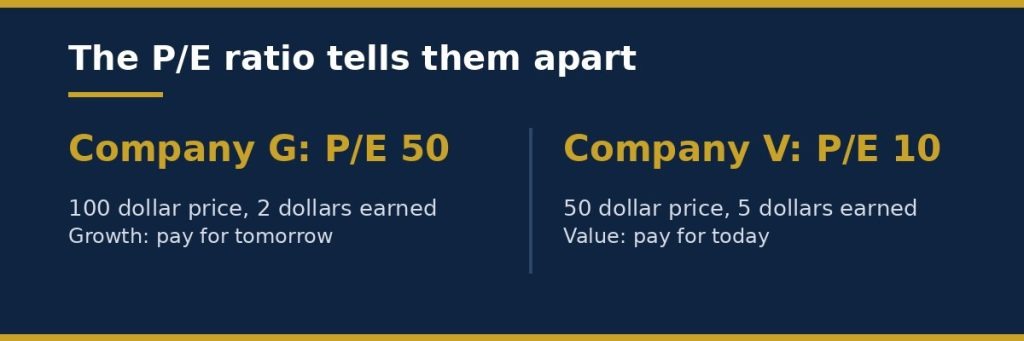
Worked example with two fictional companies, Company G and Company V. These are made-up examples to show the math, not real companies.
Company G, a growth company, has a share price of 100 dollars, and earns 2 dollars per share in a year. Its P/E is 100 divided by 2, which is 50. You pay 50 dollars for each 1 dollar of yearly earnings. That is a high P/E, and it is normal for a growth stock, because investors expect earnings to grow.
Company V, a value company, has a share price of 50 dollars, and earns 5 dollars per share in a year. Its P/E is 50 divided by 5, which is 10. You pay 10 dollars for each 1 dollar of yearly earnings. That is a low P/E, and it is normal for a value stock, because investors are paying less for the same dollar of earnings.
Check the math: 100 divided by 2 is 50. 50 divided by 5 is 10. The growth stock costs five times as much per dollar of earnings as the value stock.
A high P/E does not mean a stock is bad, and a low P/E does not mean a stock is good. A high P/E can be fair if the company really does grow fast. A low P/E can be a trap if the company is shrinking. The P/E is a starting point, not a verdict.
Growth vs value, side by side
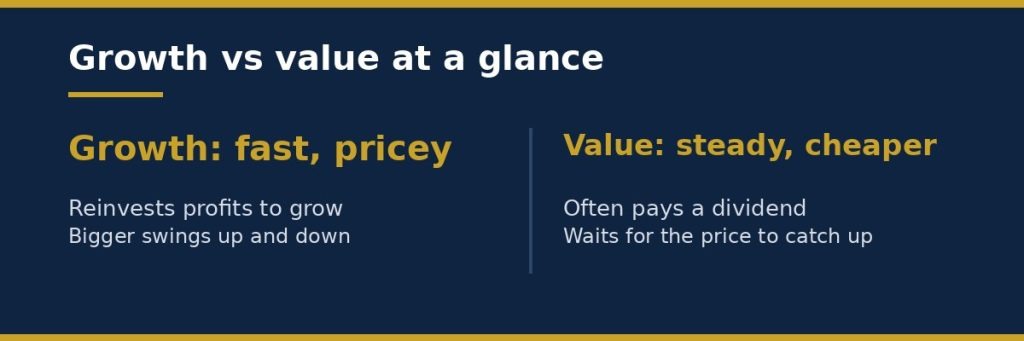
| Feature | Growth stocks | Value stocks |
|---|---|---|
| Company type | Fast growing, often younger | Steady, often older |
| Earnings growth | High, expected to keep rising | Slow, or flat |
| P/E ratio | Usually high | Usually low |
| Dividends | Often none, or small | Often paid, sometimes large |
| Price moves | Bigger swings, up and down | Usually steadier |
| What you pay for | Future growth | Current worth |
| Main risk | Growth slows, price falls hard | Cheap for a reason, stays cheap |
Neither column is better. Growth has done better in some years, value in others. Over long periods, they have taken turns leading the market. That is why many beginners do not pick one side at all, as explained below.
Which is better, growth or value?
There is no fixed answer. In some years, growth stocks rise more. In other years, value stocks rise more. The lead changes, and no one can predict the change in advance.
The common beginner mistake is to chase whichever type did best last year. That is like driving by looking in the rear mirror. Last year’s winner is often next year’s loser, because prices already reflect the good news.
A simpler approach for a beginner is to own both, through a broad index fund. A broad index fund holds hundreds of companies, growth and value together, so you do not have to guess which side will win. You own the whole market, and you let the two types balance each other.
If you do want to pick a side, do it with a small part of your money, learn how it behaves, and keep the rest diversified. Never put all your money in one type, one company, or one idea.
Related reading in the Investing Basics cluster: what a stock is in simple terms, how to read a stock quote as a beginner, what diversification is and why it matters, what an index fund is and why beginners use it, and what risk in investing means in simple terms.
Frequently asked questions
What are growth and value stocks?
Growth stocks are shares of fast-growing companies, priced high for their future growth. Value stocks are shares of companies that look cheap compared with their earnings or assets. Growth investors pay for tomorrow, value investors pay for worth that is already there.
Which is better, growth or value stocks?
Neither, in general. Growth has led in some years, value in others, and the lead changes. A beginner is usually better off owning both through a broad index fund, instead of betting on one side.
What are some examples of growth and value stocks?
Growth examples are often found in technology and healthcare, where companies reinvest profits to grow fast. Value examples are often found in banking, energy, and consumer goods, where companies are older, steadier, and often pay dividends. This post uses fictional companies to show the math, and does not recommend any real stock.
Do value stocks outperform growth stocks?
Sometimes. Over very long periods, value stocks have often done well, but growth stocks have led for long stretches too, including much of the last decade. The answer depends on the period you pick, which is why it is not a good reason to bet everything on one side.
Should a beginner buy growth or value stocks?
A beginner should usually start with a broad index fund, which owns both growth and value stocks together. That way you learn how the market works without betting on one style. If you want to try one style, use a small amount, and keep the rest diversified.
What is a good P/E ratio for a stock?
There is no single good number. A P/E of 10 is low and looks cheap, and a P/E of 50 is high and looks expensive, but both can be fair for the right company. Compare a stock with similar companies in the same industry, and remember that the P/E is only one number, not a full picture.
Conclusion, and your first step today
Growth stocks are fast growers priced for tomorrow. Value stocks are steady companies priced low for today. You tell them apart with the P/E ratio, which shows how much you pay for each dollar of earnings. Neither is better in general, and the lead changes over time, so most beginners are better off owning both through a broad index fund.
Your first step today is to look at what you already own, if you invest, and ask: do I own only one type? If you own an index fund, you already own both, and you are diversified. If you own only a few single stocks, read our guide on diversification next, and think about spreading out.
Sources
Investor.gov, US Securities and Exchange Commission, stocks: https://www.investor.gov/introduction-investing/investing-basics/investment-products/stocks
Disclaimer: This article is for education only. It is not financial advice, and it does not guarantee any result. It does not recommend buying or selling any stock. Your income, costs, debts, and goals are personal, and you should consider your own situation, and speak to a qualified professional if you need personal advice, before making a financial decision.
