


How Do I Budget for Irregular Expenses Like Car Repairs?
How do I budget for irregular expenses like car repairs?
Irregular expenses are costs that do not happen every month, but do happen every year. Car repairs, car insurance paid twice a year, gifts, medical bills, and home repairs are the common ones. The way to budget for them is simple. Add up what they cost in a full year, divide by 12, and set that amount aside every month in a separate pot of money. Then, when the cost arrives, the money is already there.
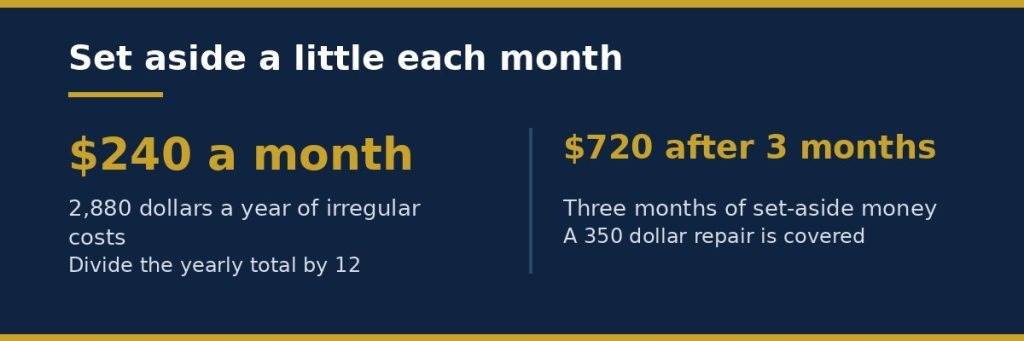
If you take home 2,800 dollars a month and your irregular costs add up to 2,880 dollars a year, you set aside 240 dollars a month. That is 2,880 divided by 12. The money sits in its own place until you need it. A car repair of 350 dollars in March is then a planned payment, not a budget emergency.
This post shows how to list your irregular costs, how to work out the monthly amount, where to keep the money, and what to do when a cost is bigger than the pot. It is educational only. It is not financial advice.
What counts as an irregular expense
An irregular expense is any cost that is real and expected, but does not arrive monthly. It is not a surprise. You know your car will need repairs. You know gifts come every year. You know your car insurance renews. The only surprise is the exact date and the exact amount.
Common irregular expenses for beginners are:
- Car repairs, servicing, tyres, and inspections
- Car insurance, if you pay twice a year or once a year
- Home repairs, appliances, and plumbing
- Medical and dental costs not covered by insurance
- Gifts, birthdays, and holidays
- Annual subscriptions and memberships
- School costs, uniforms, and supplies
- Pet vet visits
- Travel for family events
If a cost happens every month, it belongs in your normal monthly budget, not here. Rent, food, phone, and transport are monthly costs. This post is only about the costs that arrive a few times a year and wreck a monthly budget when they are not planned.
Step 1: List your irregular costs for a full year
Take a pen and list every irregular cost you paid in the last 12 months. Use your bank and card statements, not your memory. Memory forgets the small ones, and the small ones add up.
Write each cost once, with the amount you actually paid. If a cost varies, use the amount from the last year, or a fair average of the last two years. Do not guess low to make the number look nicer. A low guess is how the plan fails.
Here is an example list for one person with a car, a rented home, and a small family:
- Car repairs and servicing: 600 dollars
- Car insurance, two payments of 450 dollars: 900 dollars
- Gifts and holidays: 480 dollars
- Medical and dental out of pocket: 300 dollars
- Home repairs and appliances: 600 dollars
- Total for the year: 2,880 dollars
Check the addition: 600 plus 900 is 1,500. Plus 480 is 1,980. Plus 300 is 2,280. Plus 600 is 2,880. That is the yearly total.
If your first list looks short, look again. Most people forget at least one cost, usually gifts, car servicing, or a yearly subscription. Add it now, while you are planning, not later when it arrives.
Step 2: Divide the yearly total by 12
This is the whole method. Take the yearly total and divide it by 12. The answer is the amount you set aside every month.
For the example above: 2,880 divided by 12 is 240 dollars a month.
That 240 dollars is a fixed line in your monthly budget, just like rent or food. It is not spare money. It is not savings for a holiday. It is money already promised to future bills.
If 240 dollars a month is too much for your budget right now, do not drop the plan. Start with what you can set aside, even 100 dollars a month, and raise it in small steps. A partial pot still helps. But be honest with yourself: the costs will still arrive, so the gap has to be closed over time, by cutting a want, or by raising income, or both.
A second example, for a smaller list. If your yearly total is 1,200 dollars, your monthly set-aside is 100 dollars. That is 1,200 divided by 12. In three months, the pot holds 300 dollars. In six months, it holds 600 dollars.
Step 3: Keep the money in its own place
The set-aside money must sit apart from your daily spending money. If it sits in the same account you spend from, you will spend it. That is normal human behaviour, not a personal failure.
The simplest setup is a separate savings account, or a separate pot inside your banking app, named for its job. Call it “Irregular costs” or “Car and home repairs”. When payday arrives, move the monthly amount into that pot on the same day, before you spend anything else.
Some people use one pot for all irregular costs. Others use two or three pots, for example one for the car, one for gifts, and one for the home. One pot is simpler, and simpler is better for a beginner. Use one pot until you have done this for six months, then split it only if you want more detail.
Do not keep this money as cash at home. Cash is easy to spend and hard to track. A bank account or app pot keeps the record for you.
Step 4: Pay the cost from the pot, and refill it
When an irregular cost arrives, pay it from the pot, not from your monthly budget. That is the point of the pot.
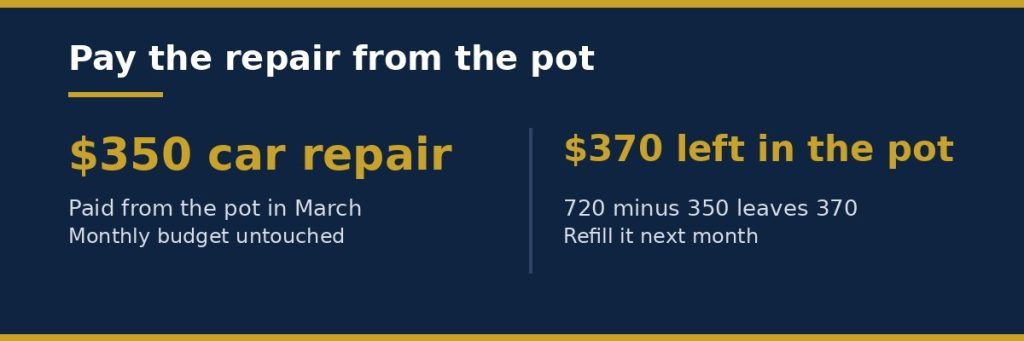
Worked example, using the 240 dollars a month plan. In January, you put in 240 dollars, so the pot holds 240. In February, you add 240, so it holds 480. In March, you add 240, so it holds 720. Then a car repair arrives for 350 dollars. You pay it from the pot. The pot now holds 370 dollars. Your monthly budget is untouched. You did not borrow, you did not skip a bill, and you did not panic.
In April, you add 240 again, and the pot is back to 610 dollars. The system keeps working because you keep adding the same amount every month, even in months when nothing breaks.
If a cost is bigger than the pot, pay what the pot holds, and cover the rest from your monthly budget if you can, or from your emergency fund if you must. Then raise your monthly set-aside for the next few months to refill the pot faster. Do not stop the plan because one cost was large. One large cost is exactly why the pot exists.
How this is different from a sinking fund
A sinking fund is the same idea with a different name. You set aside money each month for a known future cost. Some people use the term sinking fund for one specific goal, like a car repair fund or a holiday fund. This post uses “irregular expenses pot” for the whole group of yearly costs together.
The method is the same either way. List the costs, add them up, divide by 12, set the money aside monthly, and pay from the pot. If you want to read more about the single-goal version, see our guide on what a sinking fund is, which explains the same method for one goal at a time.
Related reading in the Budgeting cluster: how to budget for car expenses as a beginner, how to budget for holidays and big expenses, and how to review your budget at the end of the month.
Common mistakes to avoid
First, do not leave irregular costs out of the budget and hope for the best. Hope is not a plan. The costs arrive whether they are in the budget or not. The only choice is whether the money is ready.
Second, do not use a credit card for a cost you knew was coming. A car repair on a credit card that you cannot pay off in full becomes interest on top of the repair. If you already used a card, make a plan to pay it off, and start the monthly set-aside so it does not happen again.
Third, do not raid the pot for everyday spending. The pot is for irregular costs only. If you take 100 dollars from it for a night out, the next car repair will be 100 dollars short. If you need fun money, put a small fun line in your monthly budget instead.
Fourth, do not forget to update the list once a year. Costs change. Insurance goes up, a car gets older, a child grows. Once a year, redo the list from your statements, recalculate the yearly total, and change the monthly amount. A five minute yearly update keeps the plan accurate.
Fifth, do not mix this pot with your emergency fund. Your emergency fund is for true surprises, like losing a job or a major medical emergency. Your irregular costs pot is for expected costs. Keeping them separate means one does not eat the other.
Frequently asked questions
How much should I set aside for irregular expenses each month?
Add up your irregular costs for a full year and divide by 12. For many beginners, the answer is between 100 and 300 dollars a month. Your number depends on your car, your home, your family, and your insurance. Use your real statements, not a guess.
What if I do not know what my irregular costs will be?
Use last year as your guide. Look at 12 months of bank and card statements and add up every cost that was not monthly. If you are new to this, start with a simple list: car repairs, insurance, gifts, medical, and home repairs. Add anything else you find in the statements.
Is a sinking fund the same as an emergency fund?
No. A sinking fund, or an irregular costs pot, is for costs you expect, like a car repair. An emergency fund is for surprises you cannot predict, like losing a job. Keep them separate, so a car repair does not empty your emergency fund.
Where should I keep the money?
In a separate savings account, or a separate pot inside your banking app, named for its job. Do not keep it in the account you spend from every day, and do not keep it as cash at home.
What if a car repair costs more than my pot holds?
Pay what the pot holds, cover the rest from your monthly budget or your emergency fund if you must, then raise your monthly set-aside for the next few months to refill the pot. Do not stop the plan. A large repair is the reason the pot exists.
Should I include gifts in irregular expenses?
Yes. Gifts, birthdays, and holidays are some of the most forgotten irregular costs. They arrive every year, on dates you know in advance. List them, add them to the yearly total, and the monthly set-aside will cover them.
Conclusion, and your first step today
Irregular expenses only feel irregular when they are not in the budget. The fix takes one hour. List the costs from your last 12 months of statements, add them up, divide by 12, and set that amount aside every month in its own pot. Then pay each cost from the pot when it arrives, and keep refilling it.
Your first step today is to open your bank statements and write the list. Start with car repairs, insurance, gifts, medical, and home repairs. Add the numbers up. Divide by 12. That monthly number is your irregular expenses line, and it turns next year of surprises into planned payments.
Sources
Consumer Financial Protection Bureau, budgeting tools and guidance: https://www.consumerfinance.gov/consumer-tools/
Disclaimer: This article is for education only. It is not financial advice, and it does not guarantee any result. Your income, costs, debts, and goals are personal, and you should consider your own situation, and speak to a qualified professional if you need personal advice, before making a financial decision.
