

What Is Direct Deposit, and How Does It Work?
What Is Direct Deposit, and How Does It Work?
Direct deposit is a way for money to go straight into your bank account electronically, without a paper cheque. Instead of your employer printing a cheque and handing it to you, your employer sends your pay through an electronic system, and the money appears in your account on payday. You give your employer your bank account details once, and after that your pay arrives automatically each payday.
If you get paid by direct deposit, you do not need to visit a bank branch or use a mobile app to deposit a cheque. Your pay arrives in your account on the scheduled payday, and you can use it from that day. Many employers, government agencies, and pension providers use it because it is faster and more reliable than posting a cheque.
How Does Direct Deposit Move Money?
Direct deposit in the United States usually moves through a system called the Automated Clearing House, or ACH, a network that banks use to send electronic payments to each other. Your employer’s bank sends the payment through the ACH network, and your bank receives it and adds it to your balance.
Here is what happens step by step on a normal payday.
First, your employer prepares the payroll, working out how much each worker should be paid after tax and other deductions.
Second, your employer sends the payroll file to its bank, listing each worker, the amount, and the bank account where the money should go.
Third, the bank sends the payments through the ACH network, which sorts them and sends each one to the correct receiving bank.
Fourth, your bank receives the payment and posts it to your account, usually early in the morning on payday.
The whole process takes one to two business days behind the scenes, which is why employers ask for payroll details a few days before payday. From your side, the money simply appears in your account on the right day.
How to Set Up Direct Deposit
Setting up direct deposit is a one time task, and it usually takes only a few minutes.
Step 1: Get your bank account details
You will need your bank’s routing number and your account number. The routing number identifies your bank, and the account number identifies your account at that bank. You can find both numbers on a paper cheque, in your bank’s mobile app, or by asking your bank. Do not guess these numbers. A wrong digit can send your pay to the wrong account or delay it.
Step 2: Fill in the direct deposit form
Your employer will give you a direct deposit form, either on paper or through an online payroll portal. Enter your name, your bank’s name, the routing number, the account number, and the type of account, usually checking or savings. Some employers also ask for a voided cheque or a bank letter to confirm the details.
Step 3: Choose how much goes to each account
Many employers let you split your pay between two or more accounts. For example, you can send part of your pay to your checking account for bills and part to your savings account. If you only want one account, you can send the full amount there.
Step 4: Wait for a test deposit
Some employers send a small test deposit of a few cents to check that the details are correct. This is called a prenote, and it can take a few days. Your first pay after signing up may still come as a paper cheque, so ask your employer when the first electronic payment will arrive.
Step 5: Check your first deposit
On your first direct deposit payday, check your bank account early in the day and confirm the amount is correct. If the amount is wrong or the money is missing, tell your employer the same day.
How to Split Your Deposit Between Accounts
One of the most useful features of direct deposit is the split. You can send part of your pay to one account and the rest to another automatically, without moving the money yourself. Many people use this to save without thinking about it, because the savings portion never sits in the spending account.
Here is a worked example with real math, step by step.
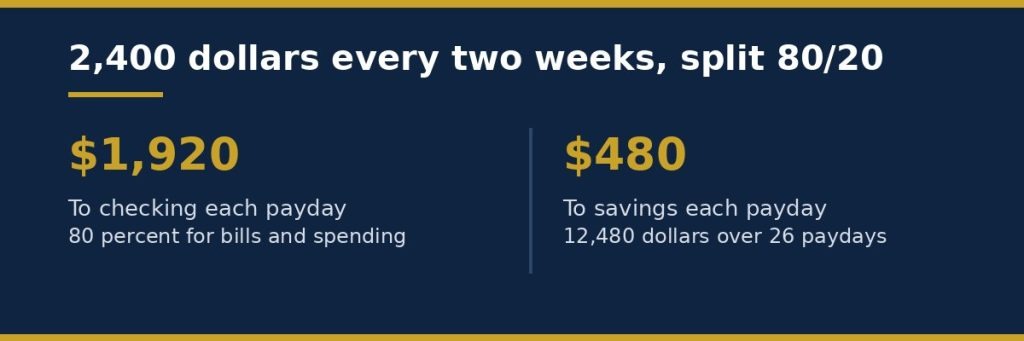
Suppose your take home pay is 2,400 dollars every two weeks, after tax and deductions. You decide to send 80 percent to your checking account for bills and daily spending, and 20 percent to your savings account.
Step 1: Work out the checking amount. Multiply your pay by 80 percent. 2,400 dollars times 0.80 equals 1,920 dollars. So 1,920 dollars goes to your checking account each payday.
Step 2: Work out the savings amount. Multiply your pay by 20 percent. 2,400 dollars times 0.20 equals 480 dollars. So 480 dollars goes to your savings account each payday.
Step 3: Check that the two amounts add up to your full pay. 1,920 dollars plus 480 dollars equals 2,400 dollars. The split is correct, and no money is missing.
Step 4: Work out what this means over a month. You are paid every two weeks, which means two paydays in most months. Two paydays times 480 dollars equals 960 dollars into savings each month. Over a full year with 26 paydays, 26 times 480 dollars equals 12,480 dollars into savings in a year.
If you are building savings for the first time, it helps to know how much to keep in an emergency fund and to read a simple plan for how to build an emergency fund from zero. Sending the savings part of your pay straight to a separate account is one of the easiest ways to follow that plan.
When Will the Money Arrive?
Direct deposit usually arrives in your account early in the morning on payday. Many banks make the money available as soon as they receive it. Some banks also offer early direct deposit, which can make your pay available a day or two early, depending on when the employer’s bank sends the payment.
Here is a timing example. Suppose your payday is Friday. Your employer sends the payroll file to its bank on Wednesday, the ACH network processes the payment on Thursday, and your bank posts it to your account early on Friday morning.
Weekends and public holidays can change the timing. If payday falls on a Saturday, Sunday, or public holiday, your employer will usually pay you on the business day before. Ask your employer what happens in that case so you are not surprised.
The first direct deposit after you sign up can take longer, because payroll teams often need one full pay cycle to set up the details and run the test deposit. If your first payday still comes as a paper cheque, that is normal, and the next payday should arrive electronically.
What to Do If a Deposit Is Late
A late direct deposit is stressful, but it is usually easy to fix. Follow these steps in order.
First, check your bank account and confirm the money really is missing. Look at the date, the expected amount, and any pending transactions. Sometimes a deposit shows as pending before it posts to the balance.
Second, check with your employer or payroll team. Ask whether the payroll was sent on time and whether there was a delay, a holiday, or a change in the pay schedule.
Third, check that your bank details are still correct. If you changed banks or opened a new account, your employer may still have the old details. Update the direct deposit form if anything has changed.
Fourth, keep a record. Note the expected payday, the amount, who you spoke to, and what they said. If the delay lasts more than one business day, follow up again and ask for a clear date for when the money will arrive. Do not assume a late deposit means your employer has not paid you. Ask first, and get the answer in writing where possible.
What to Do If a Deposit Goes to the Wrong Account
A deposit that goes to the wrong account is rare, but it can happen if the routing number or account number on the form was wrong.
Act quickly. Tell your employer or payroll team as soon as you notice the problem. The sooner they know, the sooner they can ask the bank to trace the payment.
Ask your employer to start a trace. The employer’s bank can trace the ACH payment through the network and find where it went. This can take a few business days, so follow up regularly.
Contact your bank as well. Your bank can confirm whether it received the payment. If the money went to an account at a different bank, your bank may not be able to see it, and the trace will need to come from the employer’s bank.
If the money went into an old account of yours that is still open, your bank can usually move it once you prove the account is yours. If it went to someone else’s account because of a wrong number, the receiving bank will usually return it once the error is confirmed, but this can take time.
To prevent this happening again, double check your routing number and account number before you hand in the form. If you switch banks, update your direct deposit details straight away, and check your first payday at the new bank carefully.
Is Direct Deposit Safe?
Direct deposit is generally considered a safe way to receive pay. The money moves through the banking system, not through the post, so a cheque cannot be lost or stolen from a mailbox. There is a clear electronic record of each payment, which makes a missing deposit easier to trace than a missing paper cheque.
There are still a few safety habits worth following.
Keep your bank details private. Only give your routing number and account number to your employer through the proper payroll form or portal. Do not send these details by email or text message to an unknown person.
Check your pay each payday. Make sure the amount is correct and that it arrived on the day you expected. If something looks wrong, report it the same day.
Use your bank’s alerts. Most banks let you set up a notification when a deposit arrives. This tells you quickly that the money is in, and it also tells you quickly if it is not.
Be careful with requests to change your direct deposit details. Scammers sometimes pretend to be an employer and ask a worker to change the account by email. Real payroll changes go through your employer’s proper payroll system, not through a link in an unexpected email. If you receive a strange request about your pay, check with your employer through a known contact before you act.
Deposits in United States banks are generally insured by the Federal Deposit Insurance Corporation, known as the FDIC, up to the legal limit. You can read more about deposit insurance at https://www.fdic.gov. The Consumer Financial Protection Bureau offers plain language guidance for consumers at https://www.consumerfinance.gov.
Direct Deposit vs a Paper Cheque
With direct deposit, the money arrives in your account on payday, and you can use it the same day. With a paper cheque, you need to deposit the cheque first, and the bank may hold part of the funds for a day or two before you can use the full amount.
With direct deposit, there is no cheque to lose, damage, or forget to deposit. A lost or damaged paper cheque has to be cancelled and reissued, which can delay your pay by days. Direct deposit also leaves a clear electronic record of each payment, which makes it easier to track than a paper cheque.
The main benefit of a paper cheque is that you do not need to share your bank account details with your employer. For most people, the speed, safety, and convenience of direct deposit outweigh that concern, and that is why most employers now offer it as the standard way to be paid.
Where to Send the Savings Part of Your Pay
If you split your deposit, think about where the savings portion should go. A separate savings account keeps your savings apart from your daily spending, which makes it harder to spend by accident. A high-yield savings account is one option many people use for an emergency fund, because it can earn interest while the money stays easy to reach. Before you choose, it helps to understand what APY is and why it is different from interest rate. For money you do not need for a longer time, some people look at a certificate of deposit, which usually locks the money away for a set term.
Frequently Asked Questions
Does direct deposit cost money?
For most workers, direct deposit is free. Employers usually do not charge workers to receive pay this way, and most checking accounts accept direct deposits without a fee. Ask your bank if you are not sure.
How long does it take to set up direct deposit?
Setting up the form takes a few minutes. The full process, including any test deposit, can take one pay cycle. Your first payday after signing up may still come as a paper cheque, and the next payday should arrive electronically.
Can I change my direct deposit details?
Yes. You can change your bank account, your routing number, or your split at any time by updating your direct deposit form with your employer. Make the change well before the next payroll date, and check your next payday carefully to confirm it worked.
What happens to my direct deposit if I change jobs?
Your direct deposit is tied to your employer, not to you. When you leave a job, your old employer stops sending payments. Your new employer will ask you to fill in a new direct deposit form, using the same bank details if you want.
What happens if my bank account is closed?
If your account is closed, the deposit will bounce back to your employer’s bank. Tell your employer straight away, give them the details of your new account, and ask how your next pay will arrive.
Conclusion
Direct deposit is a simple, fast, and safe way to get paid. Your employer sends your pay electronically through the ACH network, and the money appears in your bank account on payday. Setting it up takes a few minutes, and after that the process runs by itself each pay cycle. The most useful habit is the split: send part of each paycheque straight to savings, and the rest to checking for bills and spending. Start with a percentage you can keep.
This article is for general information and education only. It is not legal or financial advice.
