
What Is a Required Minimum Distribution (RMD) in Simple Terms?
A required minimum distribution, or RMD, is the smallest amount of money the IRS makes you withdraw each year from a tax-deferred retirement account, once you reach a certain age. You saved in these accounts without paying tax on the money going in, and the government let the money grow without tax year after year. The RMD is how the government finally collects its share. It is a minimum, not a maximum. You can always take out more, but you cannot take out less than the required amount without paying a penalty.
If you have a traditional IRA or a traditional 401(k), this rule will reach you. In 2026, RMDs begin at age 73 for most people. The amount is worked out from your account balance and a life expectancy table the IRS publishes. This guide explains which accounts have RMDs, when they start, how the amount is calculated with a worked example, what happens if you miss one, and the exceptions worth knowing. It is educational only. It is not legal or financial advice, and tax rules change, so check the current IRS guidance or talk to a qualified tax professional for your own situation.
Which Accounts Have RMDs?
RMDs apply to tax-deferred accounts, the kind where you got a tax break when the money went in and the growth was not taxed each year. That includes a traditional IRA and a traditional 401(k), among others:
- Traditional IRA, including SEP IRA and SIMPLE IRA
- Traditional 401(k), 403(b), and 457(b) plans
- Other employer-sponsored pre-tax plans
RMDs do not apply to Roth accounts while the original owner is alive. A Roth IRA has never had RMDs for its owner, and since the SECURE 2.0 Act of 2022, Roth 401(k), Roth 403(b), and Roth 457(b) accounts no longer have RMDs either. That is one reason some people convert part of a traditional account to a Roth account before RMD age, though a conversion is itself a taxable event and needs careful thought. Our guides to What Is a Roth IRA in Simple Terms? and What Is a Roth 401(k), in Simple Terms? explain how Roth accounts work.
Inherited accounts follow different rules. If you inherit a retirement account, you may have to take distributions on a different schedule, and those rules are complex. This guide covers RMDs for your own accounts only.
When Do RMDs Start?
The age RMDs begin depends on when you were born. Congress has raised it twice in recent years. The schedule is:
- Born before July 1, 1949: RMDs began at age 70 and a half
- Born July 1, 1949 to December 31, 1950: RMDs begin at age 72
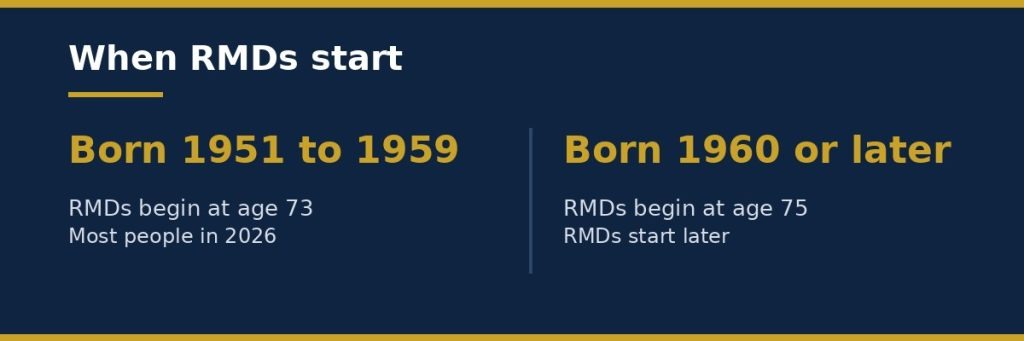
- Born January 1, 1951 to December 31, 1959: RMDs begin at age 73
- Born after December 31, 1959: RMDs begin at age 75
So if you turn 73 in 2026, you must start taking RMDs this year. If you were born in 1960 or later, your RMDs will not begin until you turn 75. The starting age will rise to 75 for everyone on January 1, 2033, under current law, but the birth-year schedule above is what applies now.
It helps to plan a few years ahead. The RMD is based on your balance, so a large traditional account means a large required withdrawal, and that withdrawal counts as taxable income in the year you take it. How Much Should I Have Saved for Retirement by Age? gives a simple sense of where your balance should stand at each age. People who expect a big RMD sometimes spread withdrawals over the years before RMD age, or convert some money to a Roth account, to keep any single year from pushing them into a higher tax bracket. Those are planning choices with tax consequences, so they are worth discussing with a qualified professional before you act.
RMD Deadlines: The April 1 Rule and the December 31 Rule
You must take your first RMD by April 1 of the year after you reach RMD age. Every RMD after the first must be taken by December 31 of its year. That first-year delay sounds helpful, but it has a catch: if you wait until April 1 of the next year for your first RMD, you will have to take two RMDs in that next year, your first one and your second one, both counting as income in the same tax year. That can mean a bigger tax bill.
Here is an example. Ben turns 73 in 2026, so he must start taking RMDs. He is allowed to delay his first withdrawal until April 1, 2027, but his second withdrawal must be taken by December 31, 2027. If he waits, both withdrawals land in his 2027 income. Many people take the first RMD in the year they turn RMD age, to spread the income across two years instead of one.
One exception: if you are still working, you may be able to delay RMDs from the 401(k) of your current employer until April 1 of the year after you retire. The plan must allow this, it applies only to that employer’s plan, and you cannot own more than 5 percent of the business. It does not apply to a traditional IRA. You must take RMDs from a traditional IRA at the right age whether you are working or not. If you change jobs, What Happens to My 401(k) When I Change Jobs? explains your options for the old plan, including a rollover to an IRA.
How to Calculate Your RMD
The formula is simple. Divide your account balance on December 31 of last year by the distribution period for your age, from the IRS Uniform Lifetime Table. That table is Table III in Appendix B of IRS Publication 590-B, and it has not changed since 2022.
RMD equals account balance on December 31 of last year, divided by the distribution period for the age you reach this year.
The distribution periods for common ages are:
- Age 73: 26.5
- Age 74: 25.5
- Age 75: 24.6
- Age 76: 23.7
- Age 77: 22.9
- Age 78: 22.0
- Age 79: 21.1
- Age 80: 20.2
- Age 85: 16.0
- Age 90: 12.2
The period gets smaller as you get older, so the required share of your balance grows each year. At 73, the RMD is about 3.8 percent of your balance. At 80, it is about 5 percent. At 90, it is about 8.2 percent.
There is one exception to the table. If your sole beneficiary is your spouse and your spouse is more than 10 years younger than you, you use a different table, the Joint Life and Last Survivor Expectancy Table. Everyone else uses the Uniform Lifetime Table.
Worked Example: A 250,000 Dollar IRA at Age 73
Here is the full math, with example numbers only. This is not a recommendation, and it is not your RMD. It shows how the calculation works.
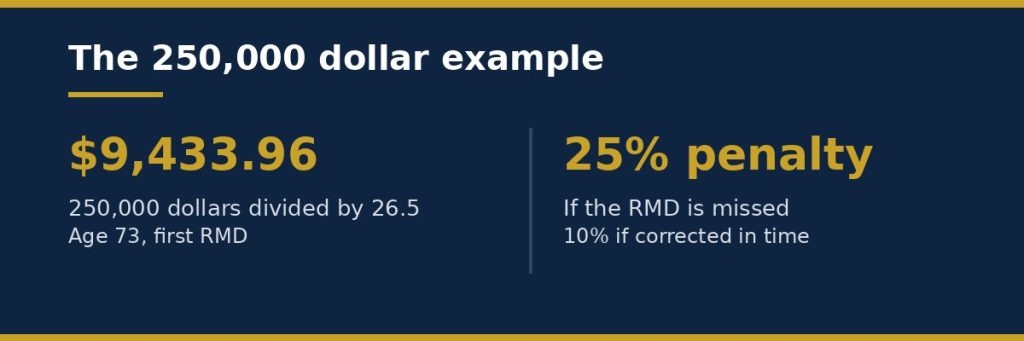
Sarah turns 73 in 2026. Her traditional IRA balance on December 31, 2025 was 250,000 dollars. Her distribution period at age 73 is 26.5. Her 2026 RMD is 250,000 divided by 26.5, which equals 9,433.96 dollars. She must withdraw at least that much during 2026, or by April 1, 2027 if she uses the first-year delay, and she will pay ordinary income tax on the amount she withdraws.
The same method works at any age. If Sarah’s balance were 100,000 dollars at age 73, her RMD would be 100,000 divided by 26.5, which equals 3,773.58 dollars. At age 80, with the same 250,000 dollar balance, her RMD would be 250,000 divided by 20.2, which equals 12,376.24 dollars. The balance is the same, but the smaller divisor makes the required withdrawal bigger.
If you have more than one IRA, you calculate the RMD for each IRA separately, but you can take the total from one IRA or split it across them. That is called aggregation. For 401(k) plans, there is no aggregation: each 401(k) must have its own RMD taken from that plan. For 403(b) plans, you can aggregate only with other 403(b) accounts. Your plan provider usually calculates the RMD for you and tells you the amount, but the responsibility to take it on time is yours.
What Happens If You Miss an RMD?
Missing an RMD is expensive. The penalty is an excise tax of 25 percent of the amount you should have withdrawn but did not. That is on top of the ordinary income tax you will pay when you do take the money out. If you correct the mistake by taking the full missed amount and filing IRS Form 5329 with a letter explaining why it was missed, the IRS may lower the penalty to 10 percent.
Here is what that means in dollars. If your RMD was 9,433.96 dollars and you took nothing, the penalty could be 25 percent of 9,433.96, which is 2,358.49 dollars. If the IRS accepts your correction, the penalty could drop to 10 percent, which is 943.40 dollars. Either way, it is money lost for no reason, and it is easy to avoid by setting a reminder or asking your provider to automate the withdrawal.
To avoid a miss, put the deadline in your calendar, and check in November that the full amount has been taken. Many providers will send the RMD automatically each year if you ask them to. If you do miss one, take the missed amount as soon as you notice, file Form 5329, and explain the reason. Do not wait for the IRS to find it first. Taking money out early is a separate question, and When Can I Take Money Out of My 401(k) Without a Penalty? explains the penalty rules before RMD age.
Other Ways to Handle an RMD
You do not have to spend the RMD. Once it leaves the retirement account and the tax is paid, the money is yours. You can spend it, save it in a regular account, or reinvest it in a taxable brokerage account. The rule only says the money must come out. It does not say what you must do with it afterwards.
If you give to charity, a qualified charitable distribution, or QCD, may help. In 2026, you can transfer up to 111,000 dollars directly from a traditional IRA to a public charity, and that transfer counts toward your RMD but is not included in your taxable income. The money must go directly from the IRA to the charity, and it cannot also be claimed as a charitable deduction. This is a planning tool with strict rules, so check the current limits and conditions before using it.
You can also take more than the minimum. Some people take extra in a low-income year, when the tax cost is lower, to reduce future RMDs. Others keep withdrawals at the minimum and let the account keep growing. Either way, the choice is yours, as long as you take at least the required amount by the deadline.
Frequently Asked Questions
What is a required minimum distribution in simple terms?
It is the smallest amount the IRS makes you withdraw each year from a tax-deferred retirement account, such as a traditional IRA or 401(k), once you reach RMD age. In 2026, that age is 73 for people born between 1951 and 1959, and 75 for people born in 1960 or later. You divide your December 31 balance by a number from the IRS Uniform Lifetime Table to find the amount.
Do Roth IRAs have RMDs?
No, not while the original owner is alive. A Roth IRA has never had RMDs for its owner. Since 2024, Roth 401(k), Roth 403(b), and Roth 457(b) accounts also have no RMDs while the owner is alive. RMDs do apply to inherited Roth accounts, under different rules.
What happens if I do not take my RMD?
You owe a penalty of 25 percent of the amount you should have taken, on top of the income tax on the withdrawal. If you correct the miss by taking the full amount and filing IRS Form 5329 with an explanation, the IRS may reduce the penalty to 10 percent.
Can I take my RMD from just one IRA if I have several?
Yes. You calculate the RMD for each IRA separately, then you can take the total from one IRA or split it across them. For 401(k) plans, each plan must have its own RMD taken from that plan. You cannot take a 401(k) RMD from an IRA, or the other way around.
Do I have to spend my RMD?
No. The rule only requires the money to leave the retirement account. After tax, you can spend it, save it, or reinvest it in a regular taxable account. If you give to charity, a qualified charitable distribution sent directly from a traditional IRA to a charity can count toward your RMD without being taxed as income.
Can I delay my first RMD?
Yes, until April 1 of the year after you reach RMD age. But then you will take two RMDs in that next year, your first and your second, and both count as income in the same tax year. Many people take the first RMD in the year they reach RMD age instead, to spread the income over two years.
Conclusion
A required minimum distribution is the IRS collecting tax on money that has grown tax-deferred for years. It starts at age 73 for most people in 2026, it is calculated from your December 31 balance divided by a number from the IRS Uniform Lifetime Table, and it must be taken by December 31 each year, except the first one, which can wait until April 1 of the next year. Miss one, and the penalty can be 25 percent of the amount you should have taken.
The best way to handle RMDs is to plan for them before they start. Know your start age, know your balance, and know the deadline. Ask your provider to calculate the amount and automate the withdrawal if you can. And if the amount looks large, talk to a qualified tax professional a few years early, because the choices you make before RMD age, such as Roth conversions or spreading withdrawals, are much harder to make after the RMDs have begun.
This article is for general information and education only. It is not legal or financial advice.
