


When Can I Withdraw From My IRA Without a Penalty?
When can I withdraw from my IRA without a penalty?
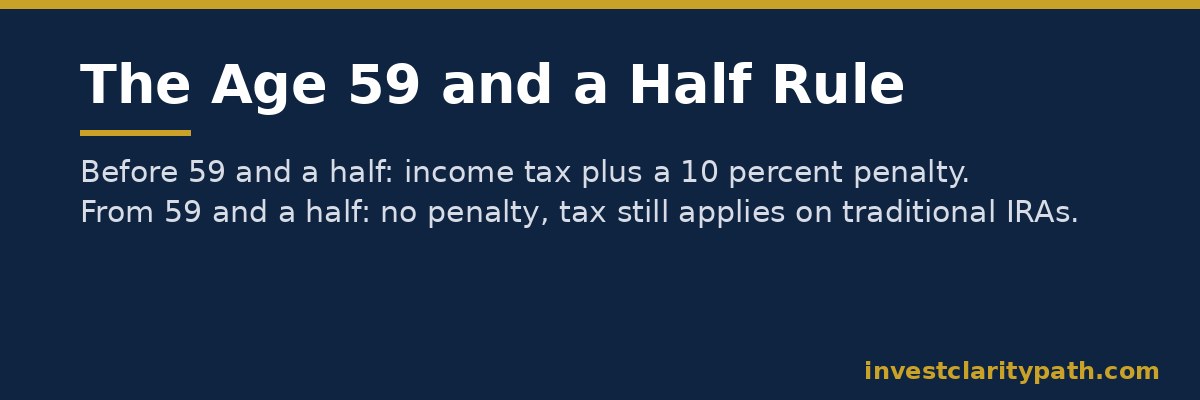
You can withdraw from your IRA without a penalty once you reach age 59 and a half. Before that age, taking money out of a traditional IRA usually means paying ordinary income tax plus a 10 percent early withdrawal penalty. Roth IRAs work differently: you can withdraw the money you contributed at any time without tax or penalty, but withdrawing the earnings early usually triggers tax and the 10 percent penalty unless an exception applies. There are also several exceptions that let you withdraw early without the penalty, such as a first home purchase, higher education costs, disability, and the birth or adoption of a child.
This guide covers IRA rules only: traditional IRAs and Roth IRAs. It does not cover 401(k) plans, which have their own withdrawal rules. If you have a 401(k), check its rules separately, because the exceptions and the age limits are not the same.
This post is educational only. It is not financial advice and it is not tax advice. IRA rules have details and deadlines that matter, so check the IRS guidance or speak to a qualified tax professional before you withdraw.
The two ages that matter: 59 and a half, and 73
Two ages run the whole system. The first is 59 and a half. From that age, you can withdraw from your IRA without the 10 percent early withdrawal penalty. You do not have to withdraw, and there is no deadline to start, but the penalty goes away. The second age is 73. From age 73, the government requires you to take a minimum amount out of a traditional IRA each year, called a required minimum distribution, or RMD. That age rises to 75 in 2033.
The years between 59 and a half and 73 are the flexible years. You can take money out or leave it invested, and no penalty applies either way. If you leave it invested, it can keep growing tax-deferred in a traditional IRA. If you take it out, you pay income tax on a traditional IRA withdrawal, but no penalty.
Roth IRAs are different on the second age. You are never required to take money out of your own Roth IRA during your lifetime. RMDs do not apply to Roth IRAs for the original owner, though they do apply to inherited IRAs.
Traditional IRA withdrawals: tax plus penalty before 59 and a half
A traditional IRA is tax-deferred. You did not pay tax on the money when you put it in, or on the growth while it sat there, so the IRS collects tax when the money comes out. Every dollar you withdraw from a traditional IRA is taxed as ordinary income in the year you take it.
Before age 59 and a half, there is an extra cost: a 10 percent early withdrawal penalty on the taxable part of the withdrawal. So an early withdrawal costs you twice, once in tax and once in penalty. That is why early withdrawals are usually the most expensive way to get cash.
After age 59 and a half, the penalty goes away but the tax does not. A withdrawal from a traditional IRA at age 65 is still taxed as ordinary income, just without the extra 10 percent. The only way to avoid tax on a traditional IRA withdrawal is if part of your contributions were made with after-tax money, known as nondeductible contributions, in which case that part comes out tax-free. Most people hold only deductible contributions, so most withdrawals are fully taxable.
If you miss a required minimum distribution after age 73, or take less than the required amount, the IRS can charge a 25 percent tax on the amount you failed to withdraw. If you correct the shortfall within two years, that tax may be reduced to 10 percent. The lesson is simple: once RMDs start, take them in full and on time.
Roth IRA withdrawals: contributions first, earnings second
A Roth IRA works the opposite way around. You already paid tax on the money when you contributed it, so the IRS treats your contributions and your earnings differently.
You can withdraw your Roth IRA contributions at any time, at any age, without tax and without penalty. The government has already taxed those dollars. If you contributed $30,000 over the years, you can take that $30,000 back out whenever you need it, for any reason, with no tax and no penalty.
Earnings are different. To withdraw earnings tax-free and penalty-free, you must meet two conditions: you must be at least 59 and a half, and your Roth IRA must have been open for at least five years. This is the five-year rule. If you are 59 and a half but your Roth IRA is less than five years old, withdrawing earnings can still trigger the 10 percent penalty. If you are under 59 and a half, withdrawing earnings usually means income tax plus the 10 percent penalty, unless an exception applies.
The ordering rule helps here. When you withdraw from a Roth IRA, the IRS treats the money as coming out in this order: your contributions first, then money converted from a traditional IRA, then earnings last. That means a partial withdrawal often reaches only your contributions, which are tax-free and penalty-free, even if you are under 59 and a half. Keep records of what you contributed, because that number decides how much you can take out safely.
Worked example: Tom takes $20,000 out of a traditional IRA at 45
Tom is 45 and has a traditional IRA worth $60,000. He needs $20,000 for an emergency and is thinking about withdrawing it early. No exception applies to his situation. Here is what it would cost him.
His tax rate is 22 percent. Income tax on the withdrawal is 22 percent of $20,000, which equals $4,400. The early withdrawal penalty is 10 percent of $20,000, which equals $2,000. His total cost is $4,400 plus $2,000, which equals $6,400. He keeps $13,600 of the $20,000 he withdrew. The math is simple: $20,000 minus $6,400 equals $13,600.
There is a second cost that does not show up in that math. The $20,000 is gone from his retirement account, so it stops growing. If that money had stayed invested and grown at 6 percent a year, it would have been worth about $64,000 in twenty years, when Tom is 65. The calculation is $20,000 times 1.06 to the power of 20, which equals about $64,143. That is the real price of an early withdrawal: the tax and penalty today, plus decades of lost growth.
Now compare a Roth IRA. Suppose Maya is also 45. She contributed $30,000 to her Roth IRA over the years, and her balance is now $42,000. She needs $20,000. Because withdrawals come from contributions first, her $20,000 comes entirely from the $30,000 she contributed, so she pays no tax and no penalty. But if she needed $35,000, the first $30,000 would be tax-free and the last $5,000 would come from earnings, which would be taxed and hit with the 10 percent penalty.
Exceptions that remove the 10 percent penalty
Normally you must wait until 59 and a half. But the IRS lists exceptions that let you withdraw early without the 10 percent penalty. The tax still applies on a traditional IRA withdrawal in most cases; only the penalty is removed. These are the main exceptions for IRAs.
A first home purchase lets you withdraw up to $10,000 over your lifetime toward buying your first home. If you buy with a spouse, each of you can withdraw up to $10,000, for a total of $20,000. The money must be used within 120 days of the withdrawal.
Qualified higher education expenses let you withdraw to pay for post-secondary education for yourself, your spouse, your children, or your grandchildren. This covers tuition, fees, books, and supplies at an eligible institution. Many people use this exception, but remember that the withdrawal is still taxed as income, and it reduces your retirement savings.
Disability and death are exceptions too. If you become totally and permanently disabled, you can withdraw without penalty. If you die, your beneficiary or estate can withdraw without penalty.
Medical expenses are an exception when they are large. You can withdraw without penalty to pay unreimbursed medical expenses that exceed 7.5 percent of your adjusted gross income. If you have been unemployed for twelve weeks or more, you can also withdraw without penalty to pay health insurance premiums.
The birth or adoption of a child lets each parent withdraw up to $5,000 in the year following the birth or adoption, without penalty. The money can also be repaid within three years without counting toward the annual contribution limit.
A Substantially Equal Periodic Payment plan, known as SEPP, lets you take penalty-free withdrawals at any age, but you must commit to taking a set amount for five years or until you turn 59 and a half, whichever is longer, and you must stop contributing to the IRA while the plan runs. Breaking the plan early brings the penalty back on all the withdrawals.
Other exceptions include an IRS levy on the account, reservists called to active military duty for 180 days or more, a federally declared disaster (up to $22,000), a one-time emergency distribution of up to $1,000 per year, and a distribution for a survivor of domestic abuse, limited to the smaller of 50 percent of the account or $10,500 in 2026. This list is the main set, not every detail, so check the IRS page on exceptions before you rely on any of them.

The 60-day rollover: a risky way to borrow from your IRA
The IRS allows you to take money out of a traditional IRA and use it for any reason, as long as you return the full amount before the end of 60 days. This is called a 60-day rollover, and you can only do it once in any 12-month period across all your IRAs.
It sounds like a free short-term loan, but it is risky. If you miss the 60-day deadline, even by one day, the whole amount becomes a taxable distribution, plus the 10 percent penalty if you are under 59 and a half. If the IRA withheld tax when you took the money out, you must replace that withheld amount too, or the shortfall counts as a distribution. Unless it is a real emergency and you are certain the money will be back in time, it is usually best to avoid the 60-day rollover.
A safer route for moving money between retirement accounts is a direct trustee-to-trustee transfer, where the money moves from one account to another without ever touching your hands. That is not a withdrawal, it has no 60-day clock, and it does not count against the once-per-year rollover limit.
Common mistakes to avoid
The first mistake is forgetting the tax. People plan for the penalty and forget that a traditional IRA withdrawal is also taxed as ordinary income. The combined cost is often a third of the withdrawal or more.
The second mistake is using a Roth IRA as an emergency fund without checking the five-year rule. Contributions come out free, but earnings do not, and a withdrawal that dips into earnings before the five-year mark can trigger tax and penalty.
The third mistake is treating a 401(k) exception as an IRA exception. The rules are different. A 401(k) has a rule for leaving a job at 55, and a loan option, that IRAs do not have. Do not assume a rule you read about a 401(k) applies to your IRA.
The fourth mistake is taking a 60-day rollover without a firm plan to repay it. One missed deadline turns a temporary loan into a taxable distribution with a penalty.
The fifth mistake is ignoring RMDs after age 73. The 25 percent tax on a missed distribution is the harshest penalty in the IRA rules, and it applies to money you were supposed to take out, not money you chose to take out.
Frequently asked questions
Can I withdraw from my IRA at 59 and a half without a penalty?
Yes. From age 59 and a half, the 10 percent early withdrawal penalty no longer applies. You will still owe income tax on withdrawals from a traditional IRA. Roth IRA earnings also need the account to be at least five years old to be fully tax-free.
Can I withdraw my Roth IRA contributions at any time?
Yes. You can withdraw the money you contributed to a Roth IRA at any time, at any age, without tax or penalty, because those dollars were already taxed. Earnings are different, and they need both age 59 and a half and the five-year rule to come out tax-free.
What is the penalty for withdrawing from an IRA before 59 and a half?
The penalty is 10 percent of the taxable amount withdrawn, on top of ordinary income tax for a traditional IRA. For a $20,000 early withdrawal at a 22 percent tax rate, that is $4,400 in tax plus $2,000 in penalty, for a total of $6,400.
Can I use my IRA to buy my first home?
Yes, up to $10,000 over your lifetime, without the 10 percent penalty. The money must be used within 120 days. If you buy with a spouse, each of you can withdraw up to $10,000. The withdrawal is still taxed as income if it comes from a traditional IRA.
Do I have to withdraw from my IRA at 73?
Yes, if it is a traditional IRA. Required minimum distributions start at age 73 and rise to age 75 in 2033. Roth IRAs have no required distributions for the original owner during their lifetime.
Can I borrow from my IRA like a 401(k) loan?
No. IRAs do not offer loans. The closest option is the 60-day rollover, which lets you hold the money for up to 60 days, but only once per 12 months, and missing the deadline makes it a taxable distribution with a penalty if you are under 59 and a half.
Conclusion, and your first step today
The simple rule is age 59 and a half. Before that, a traditional IRA withdrawal costs income tax plus a 10 percent penalty, and a Roth IRA earnings withdrawal costs the same unless an exception applies. Roth contributions are the one part you can always take back free. The exceptions cover real life events such as a first home, education, disability, and a new child, but they remove the penalty, not the tax, and they all have conditions worth reading before you act.
Your first step is simple. Before you withdraw, check three things: your age, whether the money is a contribution or an earning, and whether an exception applies. Then read the IRS exceptions page and, for a large withdrawal, speak to a qualified tax professional.
This post is educational only. It is not financial advice and it is not tax advice.
Sources
- IRS, Retirement Topics: Exceptions to Tax on Early Distributions
- IRS, Retirement Topics: IRA Contribution Limits
- SoFi, Traditional and Roth IRA Withdrawal Rules and Penalties
- NerdWallet, A Guide to Traditional IRA Withdrawal Rules
- The Motley Fool, IRA Withdrawals: Laws, Penalties, and Life Event Exceptions
