


How Much Should I Spend on Rent?
How much should I spend on rent?
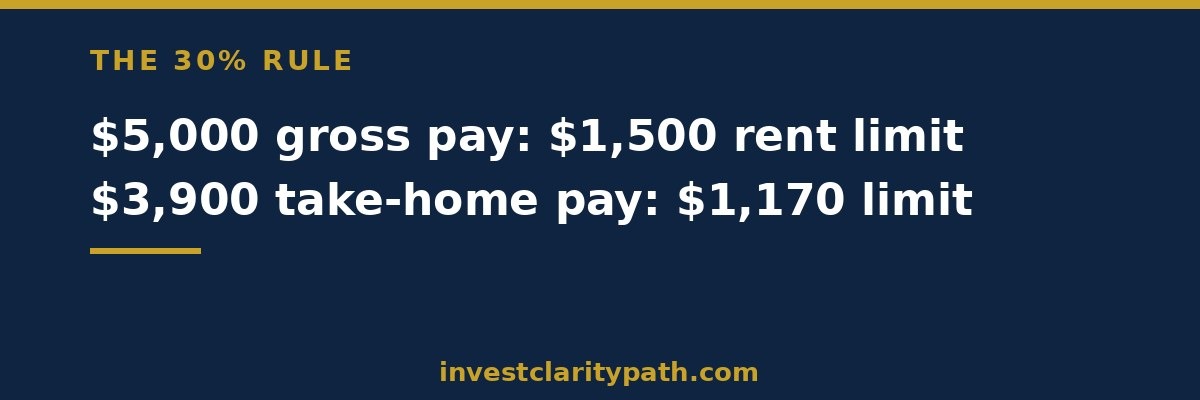
A good starting point is to spend no more than 30 percent of your gross monthly income on rent. Gross income is your pay before taxes and other deductions. If you earn 5,000 dollars a month before tax, 30 percent is 1,500 dollars, so that is your starting rent limit. But the 30 percent rule is a guideline, not a law. Your debts, your other bills, your savings goals, and rents in your area all matter, and in some places 30 percent is simply not possible. The right number is the highest rent that still leaves room for your other essentials, your savings, and a little fun.
This post is educational only. It is not financial advice. It does not recommend a specific rent or a specific home. Use the numbers here as a starting point, then test them against your real budget.
The 30% rule, explained simply
The 30 percent rule says your rent should be no more than 30 percent of your gross monthly income. It has been used for decades as a quick test of whether housing is affordable. If rent takes 30 percent or less, about 70 percent of your pay is left for everything else, including food, transport, bills, debt payments, and savings.
To use it, find your gross monthly pay. If you are paid every two weeks, multiply one paycheck’s gross pay by 26, then divide by 12. If you are paid twice a month, multiply one paycheck’s gross pay by 2. Then multiply the monthly gross pay by 0.30.
Here is the math for three pay levels. At 3,000 dollars gross a month, 30 percent is 900 dollars. At 5,000 dollars, it is 1,500 dollars. At 7,000 dollars, it is 2,100 dollars.
The rule has a real weakness. It uses gross pay, but you cannot spend gross pay. Taxes, health insurance, and retirement contributions come out before the money reaches you. A rent of 1,500 dollars feels very different when your take-home pay is 3,900 dollars than when it is 4,400 dollars, even though the gross pay is the same 5,000 dollars. For that reason, many advisers suggest running the same test on your take-home pay, which is a stricter, safer limit. On a take-home pay of 3,900 dollars, 30 percent is 1,170 dollars.
The 50/30/20 rule, a better test for most budgets
The 50/30/20 rule divides your take-home pay into three buckets: 50 percent for needs, 30 percent for wants, and 20 percent for savings and extra debt payments. Rent sits inside the 50 percent needs bucket, along with groceries, utilities, transport, insurance, and minimum debt payments.
This rule is a better test than the 30 percent rule on its own, because it checks rent against everything else you need, not just your pay. A rent of 1,500 dollars may pass the 30 percent test on 5,000 dollars of gross pay, yet still break your budget if your other needs are large.
To use it, start with your take-home pay. Multiply it by 0.50 to find your needs budget. Then subtract your other needs, everything except rent. What is left is the most you can spend on rent while keeping the rule.
For example, take-home pay of 4,000 dollars gives a needs budget of 2,000 dollars. If your other needs are groceries 400 dollars, utilities 150 dollars, transport 200 dollars, phone 80 dollars, insurance 120 dollars, and minimum debt payments 250 dollars, that totals 1,200 dollars. Subtract 1,200 from 2,000 and you get 800 dollars. Under this rule, your rent limit is 800 dollars.
If the 50/30/20 numbers feel too strict, remember they are a target, not a pass or fail test. Many households, especially in expensive cities, spend more than 50 percent on needs. The United States Census Bureau found that between 2017 and 2021, over 40 percent of renter households, about 19 million households, spent more than 30 percent of their income on rent. If that is your situation, the rule still helps, because it shows exactly how much is being squeezed.
What counts as housing cost, not just the rent
Rent is not your only housing cost, and a cheap rent with expensive extras can cost more than a higher rent that includes them. Before you compare two homes, add up the full monthly housing cost for each one.
Start with the rent itself. Then add utilities you pay separately: electricity, gas, water, heating, and internet. Add renters insurance, which is usually cheap, often 15 to 30 dollars a month. Add parking if it is charged separately, and any building fees, pet fees, or laundry costs. If the home is far from work, add the extra transport cost too, because a cheap rent with a long commute can cost more than a higher rent close to work.
Here is a quick comparison. Home A charges 1,200 dollars rent, plus 180 dollars utilities, 25 dollars renters insurance, and 100 dollars parking, for a total of 1,505 dollars a month. Home B charges 1,400 dollars rent, with utilities, insurance, and parking included, for a total of 1,400 dollars. Home B looks more expensive on the listing, but it costs 105 dollars less each month.
Also count the one-off costs of moving in: a security deposit, often one month of rent, the first month of rent, moving costs, and basic furniture if the home is unfurnished. A home with a 1,500 dollar deposit and 1,500 dollars first month needs 3,000 dollars before you get the keys. Plan for that before you sign.
When spending more than 30% can make sense
Sometimes spending more than 30 percent of gross pay on rent is the right choice. A higher rent can be worth it if it cuts another big cost, such as a long commute, or if it protects your income, such as living close to a job that pays well. A safe neighbourhood, a home office that lets you earn more, or a short commute can all be worth extra rent.
It can also make sense for a short time. If you are new to a city, a higher rent for twelve months may be a fair price for flexibility while you learn the area. The key word is short. A rent that is too high for a year is a cost. A rent that is too high for five years is a trap that stops you saving, paying off debt, and building a cushion.
If you do spend more than 30 percent, make the trade-off explicit. Write down what you are giving up: the savings, the debt payment, or the fun money that the extra rent replaces. If the trade is worth it to you, keep the rent.
When to aim lower than 30%
Aim lower than 30 percent when your other costs are high. If you have large student loan payments, a car loan, or credit card debt, a rent below 30 percent frees money to pay that debt down faster, which saves interest. Our guide to paying debt or saving first helps you decide which to prioritise.
Aim lower when you have a big savings goal, such as a house deposit, a new car, or starting a business. A rent of 1,200 dollars instead of 1,500 dollars frees 300 dollars a month, which is 3,600 dollars a year toward that goal. Aim lower when your income is irregular, because a cheaper rent is easier to pay in a slow month.
Aim lower when you are early in your career and your pay is likely to rise. A cheaper rent now, while your pay is low, lets you save and build habits that will serve you when your pay grows.
Worked example: Sara finds her rent number
Sara earns 5,000 dollars a month before tax and takes home 3,900 dollars after tax, health insurance, and her retirement contribution. She has no debt except a small student loan payment of 200 dollars a month. She wants to save 400 dollars a month.
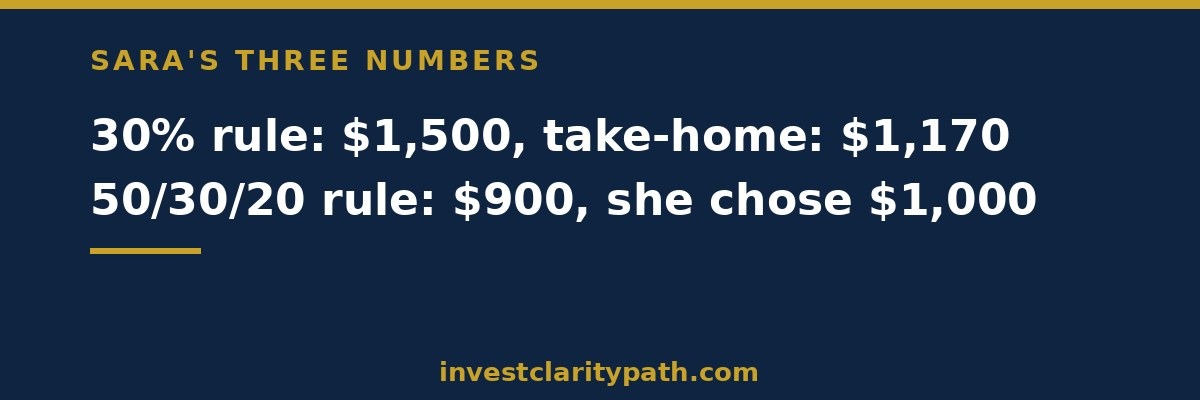
First, the 30 percent rule on gross pay: 5,000 times 0.30 equals 1,500 dollars. That is her starting limit. The stricter version on take-home pay: 3,900 times 0.30 equals 1,170 dollars.
Next, the 50/30/20 rule. Her take-home pay of 3,900 dollars gives a needs budget of 1,950 dollars, a wants budget of 1,170 dollars, and a savings budget of 780 dollars. Her other needs are groceries 380 dollars, utilities 140 dollars, transport 160 dollars, phone 70 dollars, insurance 100 dollars, and her student loan minimum of 200 dollars. That totals 1,050 dollars. Subtract 1,050 from 1,950 and her rent limit under this rule is 900 dollars.
Three numbers, three answers: 1,500 dollars from the gross pay rule, 1,170 dollars from the take-home rule, and 900 dollars from the 50/30/20 rule. Sara looks at real rents in her area. The national median rent in the United States was 1,370 dollars in April 2026, according to Apartment List, down 5 percent from its 2022 peak, but her city is cheaper, and decent one-bedroom homes start at 950 dollars.
Sara chooses a home at 1,000 dollars a month, with utilities of 120 dollars and renters insurance of 20 dollars, for a total housing cost of 1,140 dollars. That is 22.8 percent of her gross pay and 29.2 percent of her take-home pay. Her needs now total rent 1,000 dollars, utilities 120 dollars, insurance 20 dollars, groceries 380 dollars, transport 160 dollars, phone 70 dollars, and her student loan payment of 200 dollars, which adds to 1,950 dollars, exactly 50 percent of her take-home pay. She keeps her wants at 900 dollars and saves 500 dollars a month, which beats her 400 dollar goal, and she still has 550 dollars of slack for surprises. The rent is not perfect by the 30 percent rule alone, but the whole budget works, and she can see exactly where the trade was made.
The lesson is that no single rule gives the answer. The three rules together give a range, and your real budget picks the number inside it.
How to lower your rent without moving
If your rent is already too high, moving is not the only fix. First, negotiate at renewal. Landlords prefer a reliable tenant who stays to the cost and risk of finding a new one. Ask for the same rent for another year, or for a smaller increase than proposed, and offer something in return, such as a longer lease. A polite ask backed by a record of on-time payments works more often than people expect.
Second, add a roommate. Splitting a 1,500 dollar rent two ways turns 1,500 into 750 dollars each, which is a bigger saving than almost any other single change. Check your lease first.
Third, cut the housing extras. Review your renters insurance, your parking, and your storage. A parking space you rarely use, or a storage unit you could empty, is money back every month. If your lease allows it, subletting a spare room for a few months can help while you decide on a longer-term move.
If none of that closes the gap, a move may still be the right answer. Compare the cost of moving with the saving from a cheaper home. Moving costs of 1,000 dollars are worth it if the new home saves 200 dollars a month, because the move pays for itself in five months.
Common mistakes to avoid
The first mistake is using gross pay and forgetting tax. Your budget spends take-home pay, so always test your rent against take-home pay too. The second mistake is forgetting the extras: utilities, insurance, parking, and the commute.
The third mistake is renting the most expensive home you can afford. The most you can pay is not the most you should pay. A rent at the top of your range leaves no room for a surprise bill or a pay cut. Leave a margin.
The fourth mistake is ignoring the deposit and moving costs. A home you cannot afford to move into is not affordable, even if the monthly rent fits. The fifth mistake is signing a lease without reading it. Check the length, the renewal terms, the fees, the pet rules, and what happens if you need to leave early.
Frequently asked questions
How much should I spend on rent?
A good starting point is no more than 30 percent of your gross monthly income on rent. Also test 30 percent of your take-home pay and the 50/30/20 rule, which puts rent inside a needs budget of 50 percent of take-home pay.
Is the 30% rule gross or net income?
The classic 30 percent rule uses gross income, your pay before taxes and deductions. Many advisers prefer the stricter version on take-home pay, because that is the money you actually have to spend.
What if rent in my area is more than 30% of my income?
You are not alone. Between 2017 and 2021, over 40 percent of renter households in the United States spent more than 30 percent of their income on rent. If your area is expensive, use the 50/30/20 rule to see what is being squeezed, cut other needs where you can, and consider a roommate or a cheaper area.
Should utilities count toward the 30%?
Yes, for a true picture. The 30 percent rule is often stated for rent alone, but the smarter test is total housing cost: rent plus utilities, renters insurance, parking, and the extra commute cost. Compare homes by their total, not by rent alone.
How much is the average rent in the United States?
The national median rent was 1,370 dollars in April 2026, according to Apartment List, down 5 percent from its peak in 2022. Averages hide big local differences, so check rents in your own city and neighbourhood before deciding.
Can I afford rent if I have a lot of debt?
It depends on the size of the debt payments. Aim below 30 percent so the freed money can pay debt down faster. Use the 50/30/20 test: if rent plus your other needs and minimum debt payments use more than 50 percent of take-home pay, your rent is likely too high for your debt load.
Conclusion, and your first step today
How much you should spend on rent is not one number. The 30 percent rule on gross pay gives a starting limit, the 30 percent test on take-home pay gives a safer limit, and the 50/30/20 rule checks rent against everything else you need.
Your first step is simple. Write down your gross monthly pay and your take-home pay, run the three calculations, and write the three numbers on one line. Then look at real rents in your area.
This post is educational only. It is not financial advice.
Sources
- Experian, How Much Should I Spend on Rent? (200, verified 2026-11-29). Source for the 30% rule, the 50/30/20 rule, the 5,000 dollar example giving 1,500 dollars, and the nationwide average rent of 1,713 dollars.
- PNC, How Much Should I Spend on Rent? (curl returned 000 on 2026-11-29, page content read from search results). Source for the Census Bureau finding that over 40% of renter households, 19 million households, spent more than 30% of income on rent between 2017 and 2021, and for the 30% calculation on 5,000 dollars of gross pay.
- Chase, How Much of Your Income Should Go to Rent? (200, verified 2026-11-29). Source for the 30% rule on gross pay, the 50/30/20 rule, and calculating gross monthly pay from biweekly and semimonthly paychecks.
- Quicken Loans, How Much Of My Income Should Go To Rent? (200, verified 2026-11-29). Source for the national median rent of 1,370 dollars in April 2026, down 5% from its 2022 peak, the 28/36 rule, and applying the 30% rule to take-home pay.
- Redfin, Budgeting for Rent: What Can You Afford? (200 on first check 2026-11-29, 403 on re-check the same day, page content read from search results). Source for starting from net income, using the 30% rule or the 50/30/20 rule, and building a monthly rental and living expense budget.
