


How Do I Budget When My Income Drops?
How do I budget when my income drops?
When your income drops, budget from your new pay, not your old one. Write down exactly how much money now comes in each month, list every expense, pay the essentials first, and cut or pause everything else until the numbers fit. A smaller budget is not a failure. It is a plan that keeps a roof over your head, food on the table, and the lights on while you recover.
This post is educational only. It is not financial advice. It does not tell you which bills to skip or which debts to ignore. If you are behind on rent, a loan, or a utility bill, talk to the lender or provider early.
Start with your new number, not your old one
The first step is to find your new monthly income, and to be honest about it. Add up your new pay after tax, plus any other money that reliably comes in, such as unemployment benefits, a part-time job, or support from a family member. Do not count money that might arrive.
If your income changes from month to month, use your lowest recent month as your planning number. Build the budget on the worst month, and send any extra from a better month to savings or catching up. Our guide to irregular expenses explains the same idea for costs that come and go.
Write the new number at the top of your budget. If your pay fell from 4,200 dollars a month to 2,900 dollars, you need a plan that fits 2,900 dollars, not one that wishes for 4,200.
List every expense, then sort it into two piles
Before you cut anything, list everything you spend money on. Look back through three months of bank and card statements, because memory misses the small regular payments. The list should include rent, utilities, groceries, transport, insurance, phone, internet, debt payments, subscriptions, eating out, clothes, gifts, and fun money. Most people find at least one payment they had forgotten, often a subscription or an app charge.
Then sort every item into two piles. Essentials are what you need to live and keep earning: housing, food, utilities, transport, insurance, medicine, and minimum debt payments. Everything else is a want for now, even if it feels important. Eating out, streaming, new clothes, holidays, and gifts are wants. They are not bad, and you do not give them up forever, but they come after the essentials in a tight month.
Add up the essentials. If they cost more than your new income, cutting wants cannot fix the gap, and you need bigger moves, like negotiating bills, finding extra income, or asking for help. If the essentials fit inside your new income, you have a workable budget, and the wants get whatever is left.
Build a survival budget for the next three months
A survival budget is a bare-bones plan for a short period, usually one to three months. It is the smallest amount you can live on while your income is low, and it answers one question: what does it cost to keep the essentials covered and nothing else?
To build one, start with your essentials list and strip it to the minimum: rent, basic groceries, utilities, transport, insurance, medicine, and minimum debt payments. Pause subscriptions, eating out, new clothes, and non-essential shopping. Cut grocery spending by planning meals, cooking at home, and buying store brands. The goal is a number you can actually live on, not one that looks good on paper and fails in week two.
Write the survival budget down, on paper or in a simple spreadsheet, and review it every week. A tight budget needs weekly attention, because one unplanned expense can break it. Each Sunday, check what you spent, what is left, and what is due next week.
Keep a small amount of fun money in the plan, even if it is only 20 or 30 dollars a month. A budget with zero room for joy is a budget you will quit.
Cut the big costs first, because small cuts cannot close a big gap
When income drops by hundreds of dollars a month, cutting a 12 dollar subscription will not fix it. Start with the three biggest costs: housing, transport, and food. A change in one of these can save more than a dozen small cuts combined.
Housing is usually the biggest cost, and the hardest to change quickly. If you rent, ask your landlord about a short-term reduction or a payment plan. If you own, call your mortgage lender before you miss a payment and ask about forbearance or a modified payment. A smaller place, a roommate, or a cheaper area can cut housing costs by hundreds of dollars a month, though moving itself costs money, so count that too.
Transport is the next lever. If you have two cars and only need one, selling the second removes a payment, insurance, and fuel in one move. If public transport reaches your job, compare the monthly pass with what you spend on fuel, parking, insurance, and repairs.
Food is the third lever, and the one you control fastest. Cook at home most nights, plan meals before you shop, and shop with a list. Buy store brands for the basics, and buy in bulk only when the unit price is truly lower. A family that spends 800 dollars a month on food and eating out can often cut 200 dollars or more without eating worse, simply by cooking more and wasting less.
Cut, pause, or shrink the smaller costs
Once the big three are handled, work through the rest of the list. Call your phone, internet, and insurance providers and ask for a cheaper plan or a loyalty discount. A ten-minute call can save 20 or 30 dollars a month. Cancel subscriptions you have not used in the last month, and pause gym memberships, meal kits, and delivery apps until income recovers.
Look at your debt payments too. Minimum payments are essentials, and missing them damages your credit and adds fees. Call each lender and ask about a hardship plan, a lower rate, or a temporary reduced payment. Many lenders have programs for people whose income has dropped, but you usually have to ask. If you have high-interest debt, paying down the most expensive debt first can help, and our guide to paying debt or saving first walks through that choice.
Do not cancel insurance to save money. A month without car insurance can cost far more than the premium if there is an accident, and a gap in health cover can turn one illness into a large bill.
Call your lenders and providers before you miss a payment
This is the step most people skip, and one of the most valuable. If you think you will miss a payment, call before the due date. Lenders, landlords, and utility companies are far more flexible with people who call early than with people who stop paying.
Ask each one the same questions: is there a hardship program, can the payment be reduced for a few months, can the due date move, and is there a fee for a late payment? Write down who you spoke to, the date, and what they offered. A utility company may offer a payment plan, a card company may offer a lower rate for a few months, and a landlord may accept a partial payment while you catch up.
If your income dropped because you lost a job, check what benefits you can claim. Unemployment benefits, food assistance, utility help, and local community programs exist for exactly this situation. A local food bank or a community help line, such as the 211 service in the United States, can point you to support in your area. Using help while you recover is what the help is for.
Find extra income while you recover
Cutting costs has a limit. Your essentials cost what they cost, and below that line there is nothing safe left to cut. When the gap is still there after the cuts, the income side has to grow, even by a little.
Start with what you already have. Sell items you no longer use, such as electronics, furniture, or clothes in good condition. Pick up extra shifts at your current job if they are offered, and ask about overtime or weekend work. If you have a skill, such as writing, design, repairs, tutoring, or driving, a few hours a week can add 100 to 300 dollars a month. That can be the difference between a budget that works and one that does not.
Be careful with quick-money offers. Any job that asks you to pay upfront to start, promises large pay for almost no work, or asks for your bank login is almost certainly a scam. Real extra work pays modestly and never asks you to pay to get hired.
Protect the savings habit, even at 25 dollars a month
Saving feels impossible when income drops. But a small, automatic transfer, even 25 dollars a month, keeps the habit alive and starts rebuilding your cushion. The goal is not to save a large amount now. It is to keep the habit so that when income recovers, saving is already automatic.
If you have an emergency fund, this is the moment it exists for. Use it to cover essentials, not wants, and use it slowly. If your fund holds 3,000 dollars and your monthly gap is 500 dollars, it covers six months of the gap. If you have no emergency fund yet, start one with the first 25 dollars you can spare. Our guide to saving when money is tight explains how small automatic transfers add up.
Pause retirement contributions only if you must, and only for a short time. Cutting your contribution can also lose your employer match. If you must pause, set a date to restart, and put it in your calendar now.
Worked example: Maya rebuilds her budget after a pay cut
Maya earns 4,200 dollars a month after tax. Her hours are cut, and her new pay is 2,900 dollars a month, a drop of 1,300 dollars. Her old spending was 4,050 dollars a month, so her old budget is 1,150 dollars short.
She lists her spending and sorts it. Her essentials are rent 1,200 dollars, groceries 450 dollars, utilities 180 dollars, transport 150 dollars, phone and internet 90 dollars, insurance 110 dollars, and minimum debt payments 220 dollars, which total 2,400 dollars. Her wants are eating out 200 dollars, streaming and apps 45 dollars, clothes 100 dollars, fun money 150 dollars, and gifts and holidays 120 dollars, which total 615 dollars, plus 1,035 dollars she had been saving and paying extra on debt.
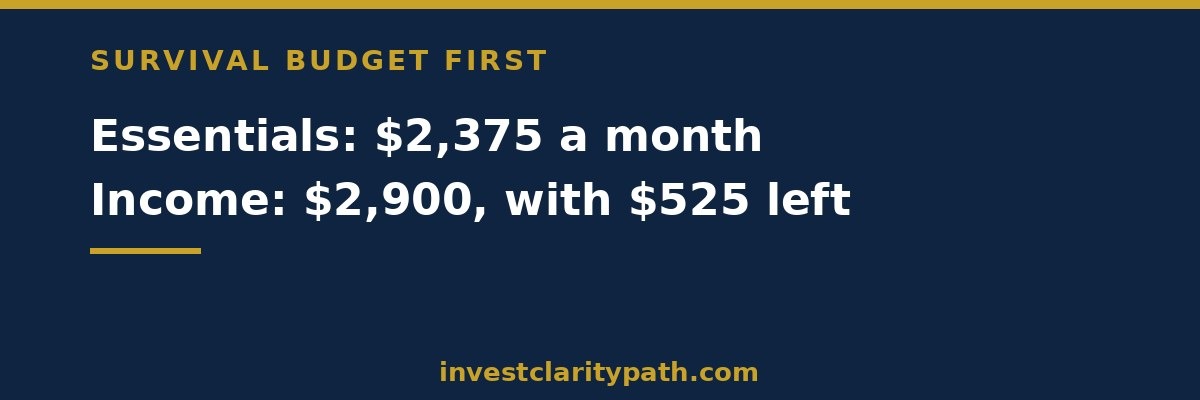
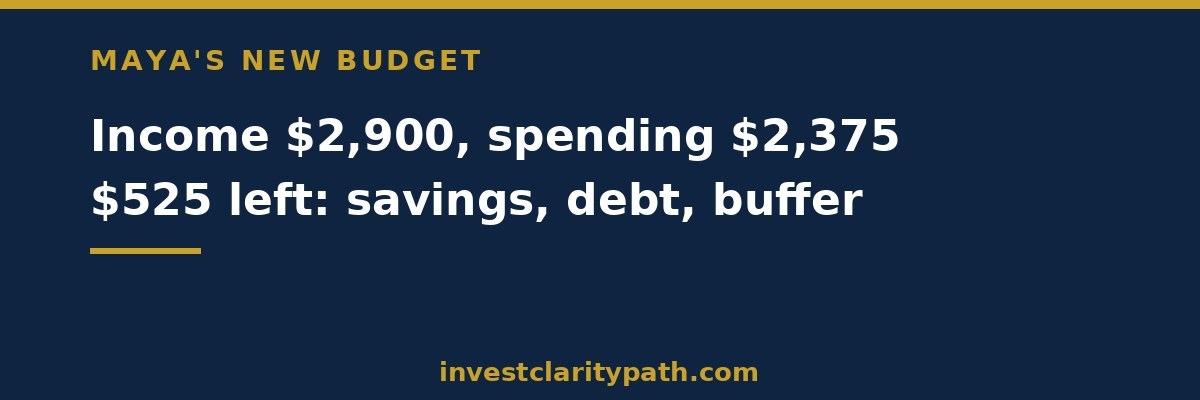
First, Maya builds her survival budget. Essentials stay at 2,400 dollars. She cuts groceries to 380 dollars by meal planning, which brings essentials to 2,330 dollars. She pauses eating out, clothes, and gifts, keeps one streaming service at 15 dollars, and keeps 30 dollars of fun money. Her survival budget is 2,375 dollars a month, so against income of 2,900 dollars, she has 525 dollars left.
She uses that 525 dollars in this order: 200 dollars to her emergency fund, 200 dollars extra on her highest-interest card, and 125 dollars to a small buffer for irregular costs like a car repair. She is not saving as much as before, but she is not going into debt. When her hours return to normal, she restores the paused spending gradually, starting with the emergency fund target of three months of expenses.
The math is simple. New income of 2,900 dollars, minus survival spending of 2,375 dollars, leaves 525 dollars. Every dollar has a job.
Common mistakes to avoid
The first mistake is budgeting from your old income. A budget built on pay you no longer receive is a plan to go into debt, slowly, every month.
The second mistake is cutting only the small things. Cancelling a 10 dollar subscription feels productive, but it cannot fix a 500 dollar gap. Cut the big costs first.
The third mistake is stopping all debt payments. Minimum payments protect your credit and stop fees from growing. Call the lender and ask for help instead of missing the payment.
The fourth mistake is using credit cards to cover the gap without a plan. A card can bridge one tight month, but if it bridges every month, the debt grows while the income stays low.
The fifth mistake is waiting too long to ask for help. Lenders, landlords, and assistance programs can do far more before a payment is missed than after.
Frequently asked questions
How do I budget when my income drops suddenly?
Start with your new monthly income, list every expense, and sort it into essentials and wants. Build a survival budget that covers the essentials first, cut the big costs before the small ones, and call lenders before you miss a payment.
What should I cut first when my income drops?
Cut the big costs first: housing, transport, and food. Then pause subscriptions, eating out, new clothes, and non-essential shopping. Keep insurance, minimum debt payments, and medicine in the budget.
Should I stop saving when my income drops?
Try not to stop completely. Even 25 dollars a month keeps the habit alive. If you have an emergency fund, use it for essentials only, and use it slowly. Pause retirement contributions only if you must, and set a date to restart.
What is a survival budget?
A survival budget is a short-term, bare-bones plan that covers only the essentials: housing, food, utilities, transport, insurance, medicine, and minimum debt payments. It usually lasts one to three months, until income recovers.
Should I use credit cards to cover the gap?
A card can bridge one tight month, but it should not bridge every month, because the debt grows while income stays low. If you use a card, write down how and when you will pay it back.
Where can I get help if I cannot cover the essentials?
Contact your lenders and utility providers early and ask about hardship programs and payment plans. Check unemployment benefits and food or utility assistance in your area, and ask a local help line, such as the 211 service in the United States, about food banks and other support.
Conclusion, and your first step today
Budgeting when your income drops means starting from your new pay, covering the essentials first, and cutting the big costs before the small ones. A survival budget is a short-term plan, not a punishment.
Your first step is simple. Tonight, write down your new monthly income and list your last three months of spending. Sort it into essentials and wants, add up the essentials, and see whether they fit inside your new income.
This post is educational only. It is not financial advice.
Sources
- Experian, 7 Budgeting Tips to Try After a Pay Cut (200, verified 2026-11-29). Source for creating a budget after a pay cut, the 50/30/20 split, tracking spending, and the three to six months emergency fund goal.
- Utah State University Extension, Ask an Expert: What to Do if Your Income Drops, A Four-Step Financial Survival Plan (200, verified 2026-11-29). Source for the four-step plan: take inventory, cut costs and boost income, create a short-term plan, and review and rebuild; and for prioritising food, housing, utilities, transport, insurance, and medicine.
- First Alliance Credit Union, How to Budget When Your Income Is Not Consistent (200, verified 2026-11-29). Source for the baseline income method, covering essentials first, and saving during peak months for slower months.
- GOBankingRates, 9 Budgeting Tips If You Are Facing an Unexpected Pay Cut (200, verified 2026-11-29). Source for taking inventory from three months of statements, cutting large expenses first, and building a bare-bones survival budget.
