
How Do I Pick My First Index Fund?
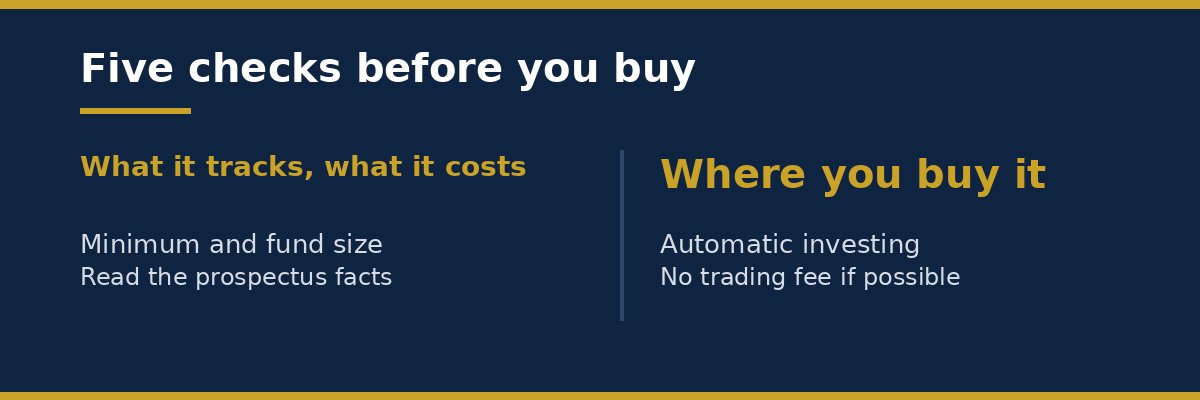
Picking your first index fund comes down to five checks: what index it tracks, what it costs, what the minimum investment is, how big the fund is, and where you buy it. A good first fund for most beginners is a broad, low cost fund that tracks a large market index, such as the S&P 500 or a total stock market index, with a low expense ratio and no minimum you cannot meet. You do not need the perfect fund. You need a reasonable one, bought on a steady schedule, and held for years.
An index fund is a fund that tries to match the performance of a market index, rather than trying to beat it. It holds the same stocks, in about the same proportions, as the index it tracks. That is why index funds are usually cheap and diversified: they do not pay a manager to pick winners, and they spread your money across hundreds of companies at once.
This guide walks through the five checks one by one, compares two funds side by side with real arithmetic, and shows the common mistakes to avoid. It is educational only. It is not financial advice.
Check 1: what index does it track
The index decides what you actually own. A fund that tracks the S&P 500 owns about 500 large US companies. A fund that tracks a total stock market index owns thousands of companies of all sizes. A fund that tracks an international index owns companies outside the US. A fund that tracks a bond index owns bonds, not stocks.
For a first fund, a broad index is the simplest choice, because it spreads your money widely and you do not have to guess which sector will do well. A narrow fund that tracks one industry, such as technology or energy, can swing much harder, and it is a bet on that industry, not a plain starting point.
When you look at a fund, read its name and its description carefully. The name usually tells you the index, such as “S&P 500 Index Fund” or “Total Stock Market Index Fund”. Then check the top holdings: if the fund tracks the S&P 500, its largest holdings should be the largest US companies, and no single stock should dominate the fund.
Check 2: what does it cost
Cost is the check that matters most over time, because two funds can track the same index and charge very different amounts. The main cost is the expense ratio, which is the yearly cost of running the fund, shown as a percentage of the money invested. You can find it in the fund’s prospectus or on the broker’s fund page.
A fund with a 1.00 percent expense ratio costs 100 dollars a year on a 10,000 dollar balance, because 10,000 times 0.01 is 100. A fund with a 0.10 percent expense ratio costs 10 dollars a year on the same balance, because 10,000 times 0.001 is 10. That 90 dollar yearly difference sounds small, but over 30 years it can grow into thousands of dollars, because the money you pay in fees cannot grow for you.
Broad index funds are usually cheap, and many charge less than 0.20 percent a year. If a fund tracking a plain index charges more than that, ask why, and compare it with a cheaper fund tracking the same index. Some brokers also offer index funds with no expense ratio at all, but those are the exception, not the rule.
Also check for other costs. Some funds charge a fee when you buy or sell, and some brokers charge a trading cost. Most large brokers now let you buy their own index funds without a trading fee, but it is worth checking before you buy.
Check 3: what is the minimum investment
The minimum is the smallest amount you need to start. Some index funds have no minimum at all, and you can start with any amount. Others require 1,000 dollars, 2,500 dollars, or 3,000 dollars to open. Once you have crossed the threshold, most funds let you add money in smaller amounts.
If you have 500 dollars to start, a fund with a 3,000 dollar minimum is not an option for you, no matter how good it is. Look for a fund with no minimum, or an exchange traded fund version of the same index, which you can buy by the share, often for under 100 dollars.
Do not let the minimum push you into waiting. If the fund you want needs 3,000 dollars and you have 500 dollars, either pick a no-minimum fund that tracks the same index, or keep saving until you reach the minimum. Waiting a few months to reach a minimum is fine, but waiting years for a perfect fund is not.
Check 4: how big is the fund, and how long has it run
A bigger fund is usually safer to buy and sell, because more investors trade it and the price tracks the index more closely. A very small fund can be harder to exit, and it can be closed down if it does not attract enough money. For a first fund, a fund with billions of dollars in assets, run by a large provider, is a plain, low risk choice.
Also check the fund’s age and its tracking record. A fund that has run for ten years or more has a history you can read, and you can see how closely it followed its index. A new fund tracking a new index has no such record. That does not make it bad, but it gives you less to judge it by.
You do not need to study the fund’s past returns in detail. Past returns do not predict future returns, and two funds tracking the same index should return almost the same amount, before fees. The differences that matter are cost, size, and what the fund tracks.
Check 5: where do you buy it
You can buy an index fund directly from a fund company, or through a brokerage account. A brokerage account is the more flexible choice for most beginners, because you can hold funds from different providers in one place, and you can add other investments later.
When you choose where to buy, check three things. First, fund selection: does the broker offer the fund you want, or a close match? Second, convenience: can you set up automatic monthly investing, so money goes in without you thinking about it? Third, trading costs: is there a fee to buy or sell the fund? Most large brokers charge nothing to buy their own index funds, and many charge nothing for other providers’ index funds too.
Do not open an account just because it offers one fund. Open it because it fits your whole plan: low costs, automatic investing, and a fund list that covers the basics.
A worked example: two funds tracking the same index
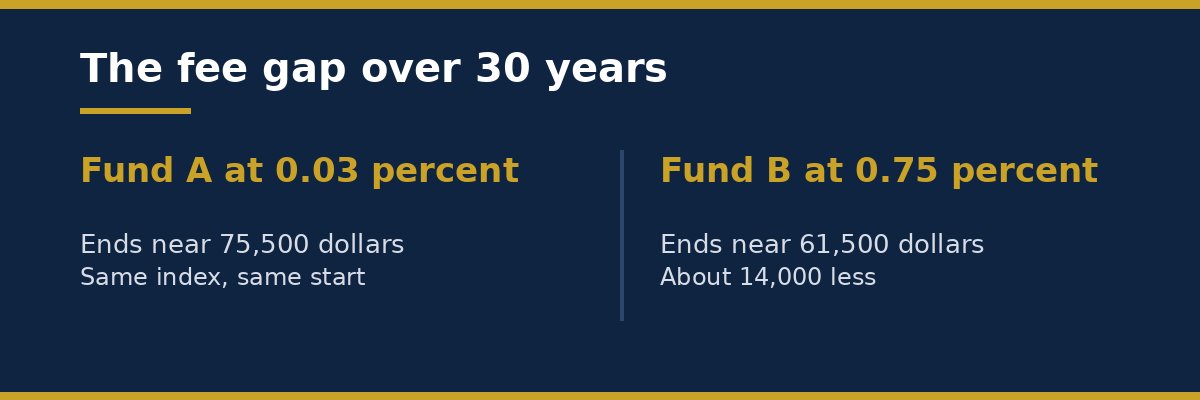
Imagine two funds that both track the S&P 500. Fund A charges 0.03 percent a year. Fund B charges 0.75 percent a year. You invest 10,000 dollars in each, and both grow at 7 percent a year before fees.
In the first year, Fund A costs 3 dollars, because 10,000 times 0.0003 is 3. Fund B costs 75 dollars, because 10,000 times 0.0075 is 75. That is a difference of 72 dollars in one year, which seems small.
Over 30 years, the difference grows. If the funds grew at 7 percent with no fees at all, 10,000 dollars would become about 76,123 dollars, because 10,000 times 1.07 to the power of 30 is about 76,123. With Fund A’s tiny fee, the yearly growth is about 6.97 percent, and the balance after 30 years is about 75,500 dollars. With Fund B’s fee, the yearly growth is about 6.25 percent, and the balance after 30 years is about 61,500 dollars. The gap is about 14,000 dollars, because 75,500 minus 61,500 is 14,000, and it comes entirely from the fee difference.
The exact figures depend on the real returns, which nobody can predict, but the lesson is plain: a small fee difference, repeated every year for decades, becomes a large difference. That is why cost is the first check after the index itself.
Mistakes to avoid
Do not pick a fund because it had the best returns last year. A fund tracking a hot sector can look great for a year and then fall hard. A broad index fund will never be the best performer in a single year, and that is the point: it is built to be steady, not spectacular.
Do not buy several funds that track the same index. Three S&P 500 funds are not diversification, they are the same bet three times. One broad fund is enough to start, and you can add a different index later, such as an international fund or a bond fund.
Do not check the price every day and trade on the news. An index fund is a long term holding, and frequent trading adds costs and taxes, and usually makes results worse. Set up automatic investing, check the balance once a month or once a quarter, and let time do the work.
Do not ignore the prospectus. You do not need to read all of it, but do read the fund’s objective, its expense ratio, its top holdings, and its minimum. Those four facts tell you almost everything you need to know about a first fund.
Related reading in the Investing Basics cluster: what an index fund is and why beginners use it, what an ETF is and how it is different from a stock, what a simple first investment plan looks like, what fees in investing are and how they hurt returns, and how much money you need to start investing.
Frequently asked questions
What is the difference between an index fund and an ETF?
An index fund is a type of mutual fund that tracks an index, and you buy it once a day at the closing price. An ETF, or exchange traded fund, also tracks an index, but you buy and sell it during the day like a stock. Both can be cheap and diversified. For a beginner investing a fixed amount each month, either can work.
How much money do I need to start with an index fund?
It depends on the fund. Some index funds have no minimum, so you can start with any amount. Others need 1,000 to 3,000 dollars to open. An ETF version of the same index can often be bought by the share, sometimes for under 100 dollars.
Is one index fund enough?
For a start, yes. One broad fund that tracks a large index, such as the S&P 500 or a total stock market index, gives you hundreds or thousands of companies in one holding. You can add other funds later, such as an international fund or a bond fund, as your plan grows.
What expense ratio should I look for?
For a broad index fund, less than 0.20 percent a year is a good target, and many charge less than 0.10 percent. If a fund tracking a plain index charges much more than that, compare it with a cheaper fund tracking the same index.
Should I pick a fund based on past returns?
No, not on its own. Past returns do not predict future returns, and two funds tracking the same index should return almost the same amount before fees. Choose on what the fund tracks, what it costs, and whether you can buy it easily.
Conclusion, and your first step today
Picking your first index fund is five checks, not a mystery. Find a broad index you understand, pick the cheapest fund that tracks it, make sure you can meet the minimum, check that the fund is large and established, and buy it somewhere that lets you invest automatically. In our example, the fund charging 0.03 percent left about 14,000 dollars more after 30 years than the fund charging 0.75 percent, on the same 10,000 dollar start, and the only difference was the fee.
Your first step today is to look up two funds that track the same index and compare their expense ratios. If the cheaper one is also large and has no minimum you cannot meet, you have found your first fund. Then set up a monthly amount you can sustain, and start.
Disclaimer: This article is for education only. It is not financial advice, and it does not guarantee any result. Investment values can fall as well as rise, and past performance does not guarantee future results. Fund fees, minimums, and availability change over time and differ by provider and by where you live. Your income, costs, debts, and goals are personal, and you should consider your own situation, and speak to a qualified professional if you need personal advice, before making a financial decision.
Sources
- NerdWallet, The Best Index Funds and How to Start Investing
