


How Do I Budget When Living Paycheck to Paycheck?
How do I budget when living paycheck to paycheck?
Living paycheck to paycheck means the money runs out just as the next payday arrives. There is no room for a surprise bill, and saving feels impossible. A normal monthly budget does not work well here, because it assumes you have the whole month’s money at once. You do not. You get paid in chunks, so your budget should work in chunks too.
The fix is a payday budget. You plan each paycheck on its own: when it lands, what it must cover before the next one, and a small amount set aside first. You pay needs first, you keep a small buffer, and you give every dollar a job before you spend it.
This post shows you how to build that budget, with a worked example using real numbers, and the small steps that break the cycle over time. It is educational only. It is not financial advice.
Step 1: list your paydays and the money from each one
Write down every payday for the next month, and the amount you take home each time, after tax. If you are paid every two weeks, you get two paychecks most months, and three in some months. If you are paid weekly, you get four or five.
For the worked example in this post, imagine you are paid every two weeks, and you take home 1,400 dollars per paycheck. That is 2,800 dollars a month. Your numbers will be different, but the method is the same. Use your real take-home pay, not your salary before tax.
If your pay changes from week to week, use the lowest paycheck you usually get. A budget built on your smallest paycheck still works when a bigger one arrives. A budget built on your biggest paycheck breaks in a short week.
Step 2: pay needs first, on payday
Needs are the bills you must pay to live and keep working: rent, utilities, groceries, transport, your phone, and the minimum payment on any debt. List them with their amounts and their due dates.
Here is the example, for one month, on 2,800 dollars of take-home pay:
- Rent: 1,100 dollars
- Utilities: 180 dollars
- Groceries: 400 dollars
- Transport: 160 dollars
- Phone: 60 dollars
- Minimum debt payment: 120 dollars
- Total needs: 2,020 dollars
Check the math: 1,100 plus 180 is 1,280. Add 400 for groceries and you get 1,680. Add 160 for transport and you get 1,840. Add 60 for the phone and you get 1,900. Add 120 for the debt minimum and you get 2,020 dollars.
Now split the needs across your two paychecks. Each paycheck is 1,400 dollars, and half of the needs is 1,010 dollars. So from each paycheck, 1,010 dollars goes to needs. The trick is to pay each need on the payday before it is due, not on the due date itself. If rent is due on the 1st, pay it from the paycheck that lands before the 1st. That way a late paycheck cannot make you late on rent.
Step 3: pay yourself a small buffer first
Before anything else, take a small amount from each paycheck and move it to a separate account, or a separate envelope, the same day you are paid. Start with 25 dollars per paycheck if that is all you can manage, and raise it later. On two paychecks a month, 25 dollars per paycheck is 50 dollars a month. On 2,800 dollars of pay, that is less than 2 percent, and it is the start of your buffer.
The buffer has one job: to catch the small surprise, like a flat tyre, a school fee, or a higher utility bill, so it does not go on a credit card. When the buffer reaches 500 dollars, it becomes a starter emergency fund. Keep adding to it until it reaches 1,000 dollars. After that, the same money can go to savings or extra debt payments.
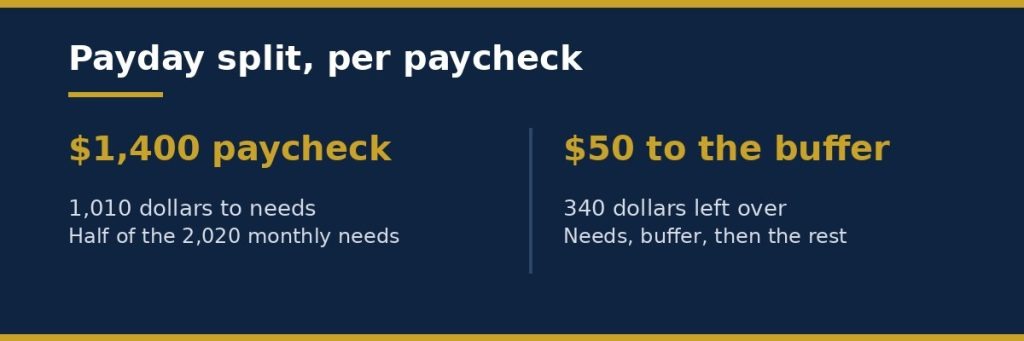
In the example, the buffer is 50 dollars per paycheck, which is 100 dollars a month. So each paycheck of 1,400 dollars is now split into 1,010 dollars for needs and 50 dollars for the buffer. That leaves 340 dollars per paycheck.
Step 4: give the rest a job before you spend it
After needs and the buffer, the example leaves 340 dollars per paycheck, which is 680 dollars a month. This is the money for everything else: extra debt payments, saving for a goal, and wants like eating out or streaming. Decide the split before the paycheck arrives, not after.
A simple split for the example is 300 dollars a month extra to the highest-interest debt, 200 dollars a month to a savings goal, and 180 dollars a month for wants. Add it up: 300 plus 200 is 500, plus 180 is 680 dollars, which is exactly what is left. If you spend the 180 dollars of wants money, that is fine, because the needs, the buffer, the debt, and the savings are already covered.
If your leftover is smaller, shrink the wants first, not the buffer. Wants are flexible. The buffer is what keeps the next surprise from breaking the plan.

Step 5: track spending for two weeks, then fix one leak
For two weeks, write down every dollar you spend, in a notebook or on your phone. Do not judge it while you write it down. Just record it. At the end of two weeks, look for the leak: the spending that surprises you. It is often food delivery, small daily purchases, or a subscription you forgot about.
Fix one leak only. If delivery food costs 120 dollars a month, cook three extra meals a week and cut it to 60 dollars. That frees 60 dollars a month. Send it to the buffer or the debt. One leak fixed is worth more than a perfect budget you never follow.
The $27.40 rule, and why small daily amounts matter
You may have seen the $27.40 rule online. It says that if you save 27.40 dollars a day, you will have about 10,000 dollars in a year. The math checks out: 27.40 times 365 is 10,001 dollars. But 27.40 dollars a day is too much for most people living paycheck to paycheck, so do not start there.
Start with the version that fits your pay. Saving 5 dollars a day is 1,825 dollars in a year, because 5 times 365 is 1,825. Saving 3 dollars a day is 1,095 dollars in a year. The rule is not the amount. The rule is that a small daily amount, kept up every day, turns into a real sum.
How to break the cycle over time
A payday budget stops the bleeding, but breaking the cycle takes more. Work on these in order, one at a time.
First, build the buffer to 1,000 dollars. That is the shield against surprises.
Second, pay off the highest-interest debt with the extra money, while still paying the minimum on the rest. Each debt you clear frees its minimum payment for the next one.
Third, look for a small income raise, not a second job you cannot sustain. An extra shift a month, a skill that pays more, or a side income of 100 dollars a month all count. One hundred dollars a month is 1,200 dollars a year.
Fourth, review the budget on every payday. It takes ten minutes. Check what is due before the next payday, move the buffer, and adjust the split. A budget you review is a budget that works.
Related reading in the Budgeting cluster: how to create a monthly budget, how to budget on an irregular income, how to build an emergency fund from zero, what a sinking fund is, and how to stop impulse buying.
Frequently asked questions
What is the $27.40 rule?
The $27.40 rule says that saving 27.40 dollars a day adds up to about 10,000 dollars in a year, because 27.40 times 365 is 10,001 dollars. It is a useful way to see how small daily amounts add up, but 27.40 dollars a day is too much for most people on a tight income. Start with 3 or 5 dollars a day instead, and raise it when your pay rises.
How do I budget if my pay changes every week?
Use your lowest usual paycheck as the base. Build the whole budget on that amount, so it works even in a short week. In a bigger week, send the extra straight to the buffer or to debt. Never build the budget on your biggest week, because a short week will break it.
Should I save or pay off debt first when I live paycheck to paycheck?
Do both, in order. First build a small buffer of 500 to 1,000 dollars, so the next surprise does not go on a credit card. Then send every spare dollar to the highest-interest debt, while paying the minimum on the rest. Once the high-interest debt is gone, send that money to savings.
How much should I keep for wants in a tight budget?
There is no fixed amount, but wants should come after needs and the buffer, never before them. In the example in this post, wants were 180 dollars a month out of 2,800 dollars of pay. If your leftover is smaller, keep wants small, but do not cut them to zero. A budget with no fun in it is a budget you will quit.
Is living paycheck to paycheck normal?
It is common, even for people who earn good money, because costs rise with pay. It is not a personal failure, but it is risky, because one surprise can turn into debt. A payday budget, a small buffer, and one leak fixed at a time are the practical way out.
Conclusion, and your first step today
A monthly budget fails when you live paycheck to paycheck, because you do not get a month of money at once. A payday budget works, because it plans each paycheck on its own. List your paydays, pay needs first, move a small buffer the day you are paid, and give the rest a job before you spend it.
Your first step today is to write down your next payday, the amount, and the needs it must cover before the one after it. That one page is the start of your budget.
Disclaimer: This article is for education only. It is not financial advice, and it does not guarantee any result. Your income, costs, debts, and goals are personal, and you should consider your own situation, and speak to a qualified professional if you need personal advice, before making a financial decision.
Sources
- US Consumer Financial Protection Bureau, consumer tools: https://www.consumerfinance.gov/consumer-tools/
- Google keyword research, 2026-11-28, keyword “how do I budget when living paycheck to paycheck”. Top results included Chase Bank, Huntington Bank, U.S. Bank, Ramsey Solutions, Zen Habits, FloatMe, Reddit, and The Bay State Banner. People also ask included “What is the $27.40 rule?” and “How to save $2000 in 3 months biweekly pay?” No volume, difficulty, or CPC figure was shown on any Google results page.
