

What Is the Difference Between a Savings Account and a Money Market Account?
What is the difference between a savings account and a money market account?
A savings account and a money market account are both safe places to keep money, and both usually pay interest. The main difference is access. A money market account often comes with a debit card and checks, so you can spend from it directly, like a checking account. A savings account usually does not offer checks, and you move money out when you need it. Their interest rates are often similar, and both are usually insured up to 250,000 dollars per depositor.
In short, pick a savings account when the money is for saving and you do not need to spend from it directly. Pick a money market account when you want to earn interest and still be able to write a check or use a debit card from the same account.
This post compares them side by side, with a worked example, and tells you which one fits each goal. It is educational only. It is not financial advice.
The comparison table
Here is the whole comparison in one place. Details follow below.
| Feature | Savings account | Money market account |
|---|---|---|
| What it is for | Saving money | Saving money, with easier access |
| Interest | Usually paid, varies by bank | Usually paid, often similar |
| Debit card | Usually no | Often yes |
| Checks | Usually no | Often yes |
| Withdrawals | Move money to checking first | Often direct, by card or check |
| Monthly fees | Often none, or waived | Sometimes, if balance is low |
| Minimum balance | Often low or none | Often higher, sometimes 500 to 2,500 dollars |
| Insurance | FDIC up to 250,000 dollars (banks), NCUA for credit unions | Same, FDIC up to 250,000 dollars (banks), NCUA for credit unions |
| Best for | Emergency fund, goals, money you do not spend directly | Emergency fund plus easy access, large purchases, money you may need by check |
Read the table once, then read the details below for the parts that matter to your goal.
Interest: usually similar, so check the rate, not the name
A money market account does not automatically pay more than a savings account. Some do, some do not. The rate depends on the bank, not on the name of the account.
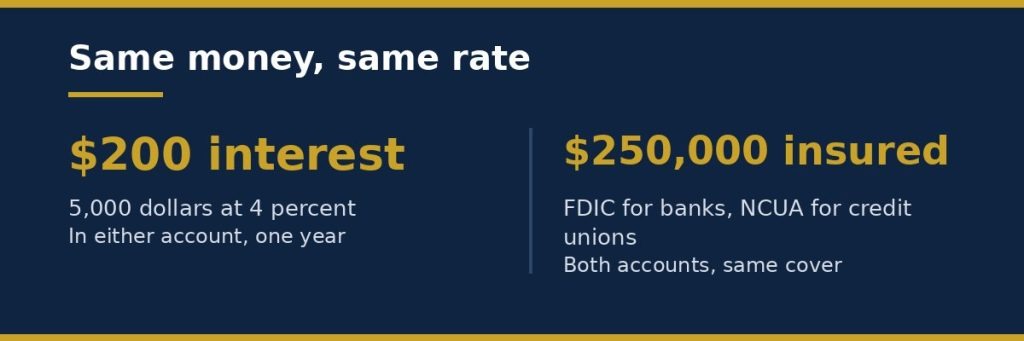
The worked example below uses the same rate for both, to show that the rate is what matters. Take 5,000 dollars at 4 percent interest for one year. The interest is 5,000 times 4 percent, which is 200 dollars. After one year, you have 5,200 dollars, in either account, if the rate is the same.
So do not pick a money market account just because you think it pays more. Compare the actual rate on the two accounts at the same bank, or at the banks you are choosing between. Pick the higher rate for the same job, and check whether a minimum balance or a fee eats the extra interest.
High-yield versions exist for both types. A high-yield savings account and a high-yield money market account both pay much more than a normal account at a big bank. The high-yield label matters more than the savings or money market label.
Access: the real difference
Access is where the two accounts differ most.
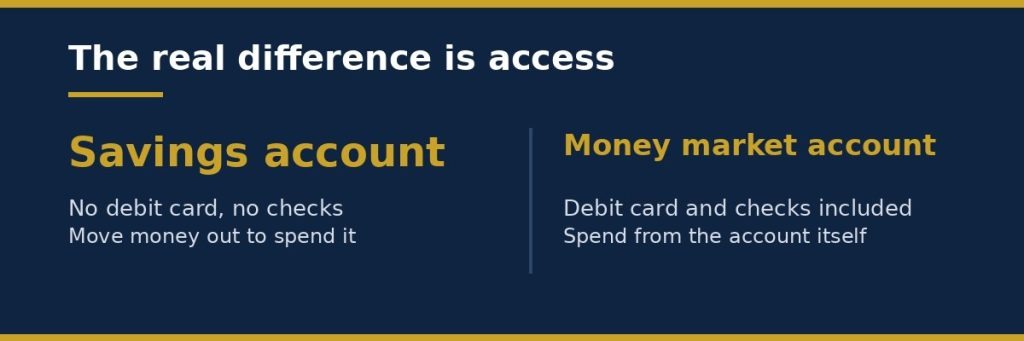
A savings account is a place to store money. You put money in, it earns interest, and when you need it, you move it to your checking account, usually online, and then you spend it. There is usually no debit card and no checks attached to a savings account. That is a feature, not a flaw, for money you want to leave alone, because it adds one step between you and spending it.
A money market account is a place to store money and spend from it. Many money market accounts come with a debit card and checks. You can pay a bill by check, or use the card, directly from the account. That is useful for money you may need to spend quickly, like a large purchase, or for an emergency fund you want to reach in any way possible.
Ask yourself one question: will I need to spend from this account directly, by card or check? If yes, a money market account fits. If no, a savings account is simpler, and usually has a lower minimum balance.
Minimums and fees: money market accounts often ask for more
A savings account often has no minimum balance, or a very low one, like 1 dollar or 25 dollars. A money market account often asks for more, sometimes 500 dollars, 1,000 dollars, or 2,500 dollars to open, and sometimes to avoid a monthly fee.
Fees work the same way. A savings account often has no monthly fee, or the fee is waived easily. A money market account may charge a monthly fee if your balance falls below the minimum.
Before you open either account, check three numbers: the minimum to open, the minimum to avoid a fee, and the monthly fee itself. Then check the interest rate. A money market account that pays 4 percent but charges 10 dollars a month when your balance is low is a bad deal for a small balance.
Worked example: you keep 1,000 dollars in a money market account that pays 4 percent but charges 10 dollars a month. The interest for the year is 1,000 times 4 percent, which is 40 dollars. The fees for the year are 10 dollars times 12, which is 120 dollars. You lose 80 dollars in the year. The same 1,000 dollars in a free savings account at 4 percent earns 40 dollars, and you keep all of it. Fees beat rates when the balance is small.
Safety: both are insured the same way
Both account types are insured the same way, up to 250,000 dollars per depositor, per bank, by the FDIC for banks, or by the NCUA for credit unions. That means if the bank fails, your money up to that limit is protected by the government insurer.
Insurance covers the account type, not the name. A savings account and a money market account at the same insured bank are both covered. A money market account is not the same as a money market fund, which is an investment product, and which is not FDIC insured. If you see the word “fund”, stop and check, because that is a different product.
Keep your total at one bank below the insurance limit if you want full coverage. If you have more than 250,000 dollars, spread it across banks, or ask the bank how the limit applies to joint accounts, which can have a higher limit.
Which one should you pick?
Pick a savings account if:
- The money is an emergency fund you want to leave alone
- The money is for a goal, like a house deposit or a holiday
- Your balance is small, and you want no minimum and no fee
- You do not need a debit card or checks for this money
Pick a money market account if:
- You want to earn interest and still write checks or use a debit card
- You keep a larger balance, above the minimum, so fees do not apply
- You want one account that can both save and spend
- You want your emergency fund reachable by card as well as by transfer
Many people use both. They keep their main emergency fund in a high-yield savings account, and a smaller amount in a money market account for easy access. That split gives you the higher rate on the big pot, and the easy access on the small pot.
Related reading in the Saving and Banking cluster: what a money market account is, the difference between a checking and a savings account, what APY is and why it is different from the interest rate, whether a high-yield savings account is safe, and how to choose between a credit union and a bank.
Frequently asked questions
Which is better, a savings account or a money market account?
Neither is better in general. A savings account is better for money you want to leave alone, with a low minimum and no fee. A money market account is better when you want to earn interest and still spend by check or debit card. Compare the rate, the minimum, and the fee, then pick for your goal.
What is the downside of a money market account?
The usual downsides are a higher minimum balance, and a monthly fee if your balance falls below it. Some money market accounts also limit how many withdrawals you can make in a month. A savings account usually has a lower minimum and no fee.
Is a money market account the same as a savings account?
No, but they are close cousins. Both are deposit accounts, both pay interest, and both are insured up to 250,000 dollars. The difference is access: a money market account often comes with a debit card and checks, while a savings account usually does not.
Do money market accounts have higher interest rates than savings accounts?
Not always. Sometimes a money market account pays more, sometimes a savings account pays more. It depends on the bank. Compare the actual rates, and remember that a fee can eat the extra interest on a small balance.
Is my money safe in a money market account?
Yes, if it is a deposit account at an insured bank or credit union, it is covered up to 250,000 dollars per depositor by the FDIC or NCUA. Be careful not to confuse it with a money market fund, which is an investment and is not insured.
Can I use a money market account as my main account?
You can, but it is not the best fit for daily spending. A checking account is built for daily use, with no limits and easy access. Use a money market account for saving with occasional access, and a checking account for daily spending.
Conclusion, and your first step today
A savings account and a money market account are both safe, insured places to keep money. The difference is access and minimums, not safety. A savings account is simpler and cheaper for money you leave alone. A money market account is more flexible when you want to spend by card or check. Pick by your goal, compare the rate, the minimum, and the fee, and do not pay a fee to earn interest on a small balance.
Your first step today is to check the rate, minimum, and fee on the account you use now. If the rate is low and the fee is high, compare it with a high-yield savings account and a high-yield money market account, and move the money to the one that fits your goal.
Sources
Federal Deposit Insurance Corporation, deposit insurance: https://www.fdic.gov/resources/deposit-insurance/
National Credit Union Administration, share insurance: https://ncua.gov/support-services/share-insurance-fund
Consumer Financial Protection Bureau, checking and savings accounts: https://www.consumerfinance.gov/consumer-tools/bank-accounts/
Disclaimer: This article is for education only. It is not financial advice, and it does not guarantee any result. Your income, costs, debts, and goals are personal, and you should consider your own situation, and speak to a qualified professional if you need personal advice, before making a financial decision.
