

How Do I Celebrate Debt Payoff Milestones Without Overspending?
The Short Answer
Yes, celebrate your debt payoff milestones, but keep the celebration small, planned, and paid for in cash. A good example rule is to spend no more than 25 dollars, or 1 percent of the amount you just paid off, whichever is smaller, and only if that money was already set aside.
Paying off a large debt can take months or years, and that long stretch is where most people lose heart. A small, planned reward breaks the long road into short, winnable stages. The danger is a celebration that costs more than the progress it marks, or one paid for with a card and added back to the debt you just reduced.
Why Celebrating Milestones Helps
Debt payoff is slow work. You make the same payment every month, and for a long time the balance seems to move only a little. Without a visible win, it is easy to think nothing is changing and to give up.
A milestone makes progress visible. When you cross a line you set in advance, you can stop and say, this part is done. Small rewards along the way keep the habit alive. A planned celebration also stops unplanned spending: if you know a small treat is coming, you are less likely to spend on impulse in between.
How to Set Milestones That Work
A good milestone is clear, easy to check, and close enough to reach. If your next milestone is a year away, it will not help you this month. Set several small milestones, and let each one feel like a win.
Every 1,000 Dollars Paid Off
Mark a line every 1,000 dollars you pay off. If your total debt is 8,000 dollars, your milestones are 1,000, 2,000, 3,000, and so on until you reach zero. This works because 1,000 dollars is big enough to feel real and small enough to reach in a few months for many households. If your extra payment is small, use 500 dollars instead. Write the milestones down and tick each one off as you pass it.
Every Debt Cleared
Clearing a whole debt is a milestone of its own, even if the balance was small. Closing an account feels different from reducing a balance: one less minimum payment, one less debt to track. Many people like the snowball method, where you clear the smallest debt first. Our guide What Is the Debt Snowball Method? explains it. If you prefer to clear the highest interest debt first, that is the avalanche method, and our guide What Is the Debt Avalanche Method? explains that choice. When you clear a debt, send its minimum payment toward your next debt.
The Halfway Point
Mark the halfway point in advance. If your total debt is 12,000 dollars, halfway is 6,000 dollars paid off. In the middle, the work can feel flat, so pause there and look back at how far you have come. You have already done half the work, using steps you already know.
A Time Milestone
Time milestones help too: three months of on time payments, or six months without a missed payment, reward consistency, the habit that actually clears debt.
Start With a Plan, Not a Party
Celebration works best when it sits inside a plan, not outside it. Before you pick your first reward, write down your payoff plan: how much you owe, to whom, at what interest rate, what the minimum payment is, and how much extra you can pay each month. Our guide How Do I Make a Debt Payoff Plan? walks through those steps. Add your milestones and your celebration budget to the same page, so the reward is part of the plan, not a surprise cost. Our guide How Long Will It Take to Pay Off My Debt? shows how to work out your timeline.
A Small Celebration Budget Rule
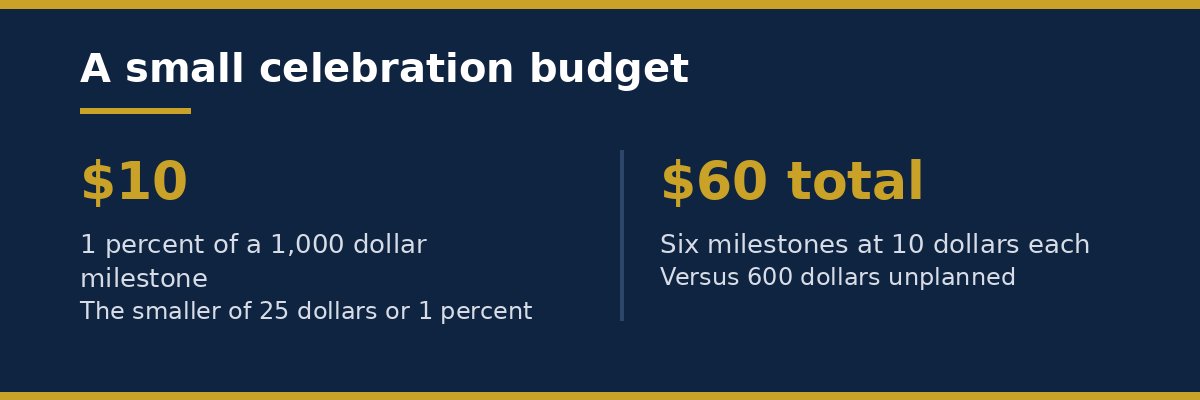
Decide the budget before you reach the milestone, and set the money aside in advance. Here is an example rule: for each milestone, spend no more than 25 dollars, or 1 percent of the amount you just paid off, whichever is smaller. This is an example, not a fixed standard.
For a 1,000 dollar milestone, 1 percent is 10 dollars, so the budget is 10 dollars. For a 5,000 dollar milestone, 1 percent is 50 dollars, so the budget is 25 dollars. A reward that costs 1 percent of what you paid off leaves 99 percent of the progress intact.
Put the money aside a little at a time. If your budget is 25 dollars and your milestone is three months away, set aside about 8 dollars a month, kept separate so it does not drift into everyday spending. Pay in cash, or with money already in your bank account. Do not put a celebration on a credit card, and do not use a buy now pay later plan. A celebration paid for with new debt is not a celebration.
Free and Low Cost Celebration Ideas
You do not need to spend much to mark a milestone well. The best celebrations are often the ones that cost nothing, because they are about the moment, not the price.
Free ideas include cooking a favourite meal at home, taking a walk in a favourite place, having a film night at home with snacks you already have, writing down the milestone, the date, and the new balance somewhere you will see it, taking a free morning off from chores, or calling a trusted friend to share the news. The common thread is intention: the same evening, planned in advance with a clear reason, becomes a celebration.
Low cost ideas that fit a 10 to 25 dollar budget in many places include a takeaway coffee and a pastry, a small bunch of flowers, a paperback book bought second hand, a picnic with food from home, ice cream for the family, or a modest meal out ordered carefully. Check your own prices first, and pick one idea, not all of them.
How to Avoid Undoing Your Progress
The risk with any celebration is scope creep: a small coffee becomes lunch, lunch becomes shopping, and shopping becomes a new card balance. Decide the plan before the day. Write down what you will do, where, and how much it will cost, then follow that plan. If you go out, take only the cash you planned to spend, and leave the credit card at home. If shopping or eating out helped cause the debt, do not use that same thing as the reward.
A Worked Example: Paying Off 6,000 Dollars
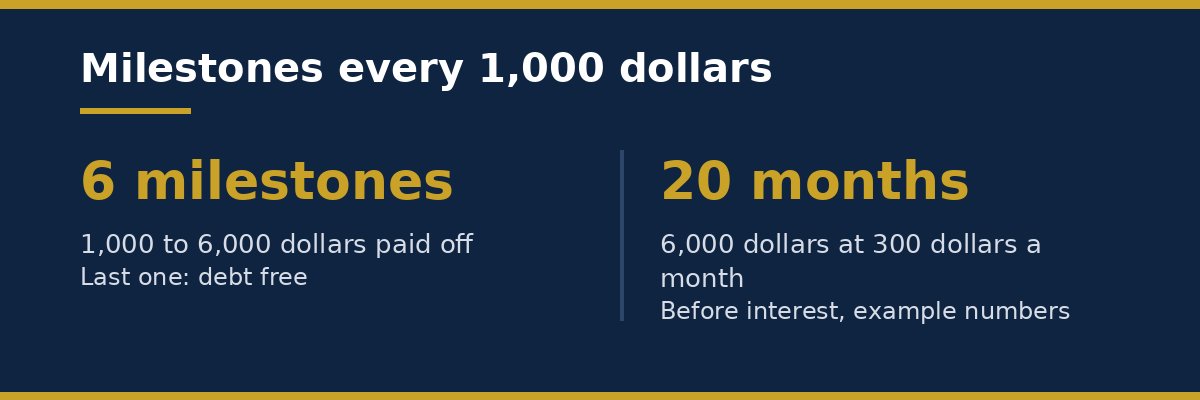
Here is a worked example with round numbers. All figures below are example numbers, not a promise about your own situation. Suppose you start with 6,000 dollars of debt and can pay 300 dollars a month toward it, including the minimum and any extra amount. At 300 dollars a month, 6,000 dollars divided by 300 dollars is 20 months to clear the balance, before interest. In real life, interest adds to the total, so treat 20 months as a simple example, not an exact forecast.
Set milestones every 1,000 dollars paid off: 1,000, 2,000, 3,000, 4,000, 5,000, and 6,000 dollars, where the last one is debt free. For each 1,000 dollar milestone, 1 percent is 10 dollars, so the budget is 10 dollars. Six milestones at 10 dollars each is 60 dollars in total, which is 1 percent of the 6,000 dollars cleared.
Compare that with an unplanned version: six milestones at 100 dollars each is 600 dollars, or 10 percent of the debt cleared, and if paid on a card it would be new debt. The difference is 540 dollars, which is 600 dollars minus 60 dollars.
What to Do When a Milestone Slips
Milestones slip. An unexpected bill arrives, your income drops for a month, or a payment is smaller than planned. That does not mean the plan has failed.
First, do not celebrate a milestone you have not reached. Waiting until it is truly passed keeps the link between progress and reward. Second, move the milestone, do not erase it. If you planned to reach 1,000 dollars by March and reach it in April instead, change the date and keep going.
Third, look at what caused the slip and fix one thing. Was it a surprise cost, a missed payment, or spending that drifted? If it was spending, find the one category that drifted most and set a simple limit for next month. Fourth, celebrate consistency, not only the number: three months of on time payments is worth a free celebration, even if the balance fell slower than hoped.
If a milestone slips by a long way, check your plan, not just your willpower. Our guide What Is a Debt-Free Plan for the Next 12 Months? helps you rebuild a realistic 12 month plan, with milestones you can actually reach.
Keeping the Plan Going After the Celebration
A celebration is a pause, not a stop. The day after a milestone, the plan should pick up where it left off. Decide the next step before the celebration, not after it. As soon as you mark the current milestone, write down the next one and its expected date. That stops the drift where a week without a target turns into a month.
Keep the debt payment automatic if you can. An automatic payment on payday keeps the plan moving while your attention is elsewhere. Review the plan once a month for ten minutes: check the balance, the next milestone, and whether the celebration fund needs a small top up.
When you reach the last milestone, debt free, plan that celebration with the same care. It is a bigger win, so a slightly larger celebration can fit, but the same rules apply: decide the budget in advance, pay in cash, and do not borrow to celebrate being debt free. After that, many people use the money that used to go to debt payments to build savings or start investing. Our guide Should I Pay Off Debt or Invest First? explains how to think about that choice once the debt is gone.
Common Mistakes to Avoid
Do not celebrate before the milestone is reached. Wait until the balance has actually passed the line. Do not turn one treat into a whole weekend. Keep the celebration to one event, with one budget, on one day, then return to the plan. Do not use credit to pay for it. If you cannot pay cash, pick a free idea instead. Do not set milestones too far apart. Break large debts into smaller stages, even if a stage is only 500 dollars. Do not hide the plan from your household, and do not stop the plan after a big win. Keep the payment going, move the freed up money to the next debt, and set the next milestone the same week.
FAQ
How much should I spend to celebrate a debt payoff milestone?
Keep it small and planned. As an example, use the smaller of 25 dollars, or 1 percent of the amount you just paid off. For a 1,000 dollar milestone, that is 10 dollars. Decide the amount before the milestone, set it aside in advance, and pay in cash.
What is a good first milestone?
A good first milestone is 500 dollars or 1,000 dollars paid off, whichever you can reach in two to three months. Clearing your smallest debt in full is also a good first milestone, because closing an account feels like a clear win.
Can I celebrate if I am still in a lot of debt?
Yes. That is exactly when small celebrations help most. A long plan without any wins is hard to keep. A small, planned treat at each milestone keeps you going, as long as it is paid for in cash.
What if my family wants a bigger celebration?
Talk about it together before the milestone. Agree on one shared treat that fits the budget, such as a family film night. Save a bigger celebration for the day you become debt free.
Should I tell other people about my milestones?
That is your choice. Sharing with a trusted friend can make the win real and bring support. Others prefer to keep it private. Do not share details you are not comfortable sharing, such as exact balances.
What if I overspend on a celebration by mistake?
Do not panic, and do not give up on the plan. Note the extra amount, and adjust next month: put the extra back toward debt if you can, or reduce the next celebration budget by the same amount. One mistake does not erase your progress.
Conclusion
Celebrating debt payoff milestones is not a luxury. It is part of how you finish a long plan. Small, planned rewards mark your progress, keep your motivation alive, and make the long road feel shorter.
Set your milestones before you start: every 1,000 dollars paid off, every debt cleared, and the halfway point. Set a small celebration budget, such as the smaller of 25 dollars or 1 percent of the milestone, as an example rule. Pick a free or low cost idea, enjoy it, check the balance the next day, and write down the next milestone.
Further reading
This article is for general information and education only. It is not legal or financial advice.
