

How Do I Sell Things I No Longer Need for Extra Money?
The Short Answer
Selling things you no longer need is one of the simplest ways to make extra money. You do not need a new skill or a product to buy. You already own the stock, and it is sitting in cupboards, on shelves, and in the garage. Clean it, photograph it, describe it honestly, price it fairly, and list it where buyers look.
What Sells Well Second Hand
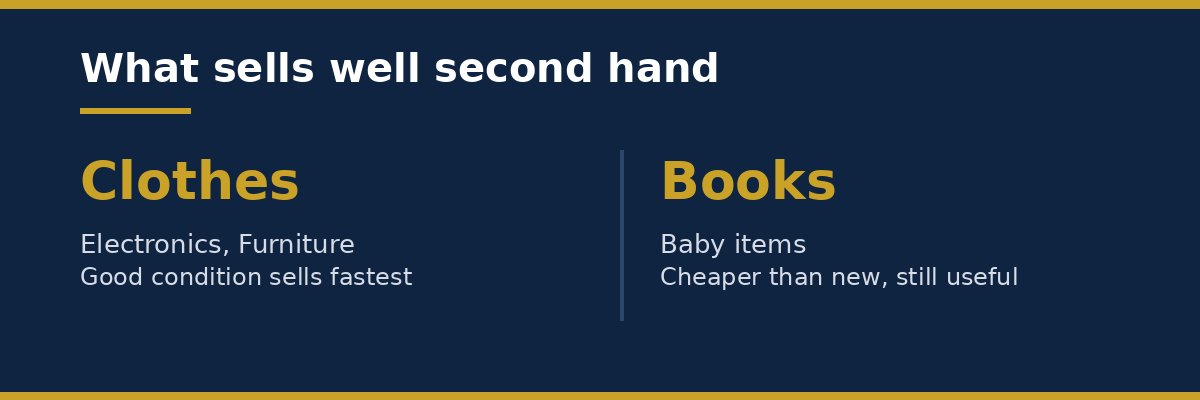
Buyers look for items that are still useful, in good condition, and cheaper than buying new. Be honest about condition before you list anything.
Clothes
Clothes sell well when they are clean, in good condition, and from a style people still want. Check for stains, missing buttons, worn cuffs, and broken zips. Wash and iron each item first. If an item is faded, stained, or torn, do not list it as good condition.
Electronics
Phones, tablets, laptops, headphones, cameras, game consoles, and small kitchen gadgets are popular second hand items, because new ones are costly. Test the item before you list it. Include the charger, cable, case, or box if you still have them. Reset the device to factory settings and remove your accounts, photos, and passwords first. Never sell a device with your personal data still on it.
Furniture
Tables, chairs, shelves, bedside tables, and small sofas sell well to people setting up a first home. Measure the item and write the measurements in the listing. Take a photo from the front and from the side, and a close photo of any marks. Large furniture is often easier to sell to a local buyer who can collect it, because posting it is hard and costly.
Books
Books sell best when they are popular titles, textbooks, children’s books, or a complete set. Check that the pages are clean and the cover is not torn. Grouping books by topic or by author can make a listing more attractive than selling one book at a time.
Baby Items
Baby clothes, prams, cots, high chairs, and toys sell well, because babies outgrow things fast. Safety matters most here. Check for recalls, missing parts, broken straps, and worn safety labels. Only sell baby items that are clean, complete, and safe to use.
How to Pick What to Sell First
Do not try to sell everything in one weekend. Start with the easy wins. Pick one room and go through it shelf by shelf. Make three piles: keep, sell, and let go.
If you have not used an item in a year, and it is not seasonal or sentimental, it is a good candidate for the sell pile. It is better to list five good items than twenty poor ones. A good first batch might be ten items: a few clothes, a book set, a small gadget, and a piece of furniture a local buyer can collect.
If you want a side income that starts with no money to spend, selling what you already own fits well. Our guide How Can I Start a Side Income With No Money? explains other ways to begin without spending first.
Photos and Honest Descriptions
Good photos and an honest description do more for a sale than any clever wording. Buyers cannot touch the item, so your photos and words have to do that job. Use natural light if you can. Put the item on a plain surface, with no clutter behind it. Take at least three photos: one from the front, one from the side or back, and one close photo that shows the condition.
A good description answers the questions a buyer will ask. What is it? What brand and size is it? What condition is it in? What is included? How will the buyer get it? Write in short, plain sentences. Say if there are any marks, scratches, or missing parts. Do not copy text from another listing or from a shop website.
Pricing in Simple Steps
First, look at similar items. Search for the same item, or a very similar one, in the same condition, on the place where you plan to sell it. Look at what similar items are listed for, and what they actually sold for if that information is shown. A listed price is not a sold price.
Second, remember the fee and the postage. Marketplaces take a fee, and postage costs money. The exact fee depends on the marketplace and the listing, so check the fee on the listing page before you set your price. Do not guess it, because fees change. A heavy item costs more to post, and that cost comes out of what you keep. Work out what you keep after the fee and postage, not just what the buyer pays.
Third, set a price you can explain. Start close to similar sold items. Decide in advance the lowest price you will accept, and do not go below it in the moment. If an item does not sell after a week or two, check the photos, the description, and the price.
If you are turning a skill into paid work as well as selling items, pricing matters there too. Our guide How Do I Turn a Skill Into Side Income? walks through that step by step.
Where to Sell
Where you sell depends on the item. Local groups, community boards, and neighbourhood apps are good for furniture, baby items, and other large or heavy things. The buyer collects the item, so there is no postage. The trade off is a smaller audience, so it may take longer to sell.
Online marketplaces reach more buyers, which helps for clothes, electronics, books, and other items that are easy to post. More buyers can mean a faster sale, but it also means a fee and postage to manage. Read the rules of the marketplace before you list. Check what the fee is on the listing page, how payment works, and how returns are handled.
A car boot sale or a local market is a good way to sell a lot of small items in one go. There is no photo, no listing, and no postage, but there is a pitch fee and a morning of your time.
Use this simple guide. Large and heavy items: try local first. Small, light, and popular items: try an online marketplace. A big batch of small, low value items: try a car boot sale.
If you want to start something in a single weekend, selling items is a good fit. Our guide What Side Income Can I Start in One Weekend? covers other weekend ideas too.
Safety Tips for Meeting Buyers
Most buyers are honest, but a little care keeps you safe. Meet in a public place in daylight if you can, such as outside a shop or in a busy car park. Tell someone where you are going and when you expect to be back. Bring a friend if you can, especially for a large item or a first sale. Do not share your home address in a public listing. Agree the meeting place by message first.
Take payment in a way you understand. Cash on collection is simple, but count it before the buyer leaves. For a bank transfer, check that the money is in your account before you hand the item over. Do not accept a cheque from a stranger, and do not send an item before payment has cleared. Keep messages on the marketplace or app where possible. If a buyer asks you to pay in an unusual way, or pay extra for a courier, stop and think. Trust your instinct.
A Worked Example: Selling Ten Items in a Month
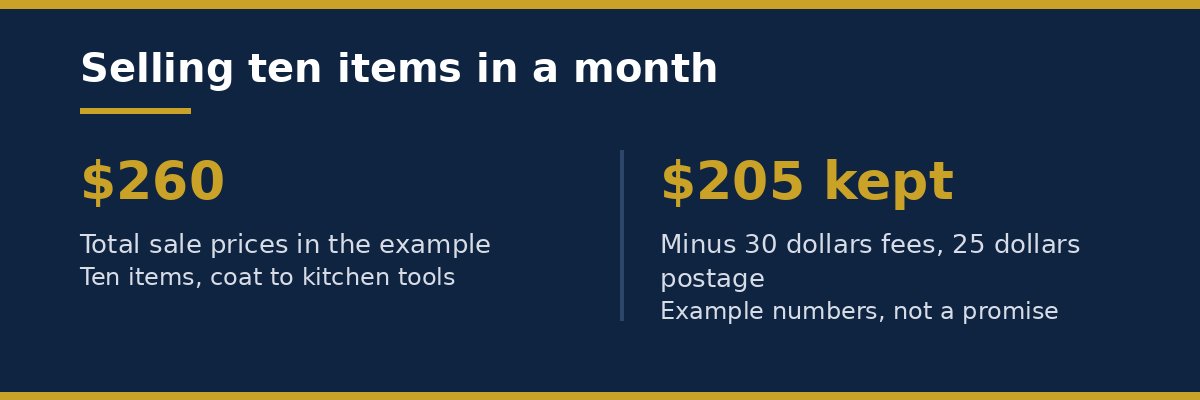
Here is a simple example with round numbers, clearly labelled as example numbers. Suppose you list ten items in a month. The example sale prices, before any fee or postage, are: a coat 30 dollars, jeans 15 dollars, a phone 80 dollars, headphones 20 dollars, a small table 40 dollars, children’s books 12 dollars, a baby high chair 25 dollars, a board game 10 dollars, a lamp 18 dollars, and kitchen tools 10 dollars. The total sale price in this example is 260 dollars: 30 plus 15 is 45, plus 80 is 125, plus 20 is 145, plus 40 is 185, plus 12 is 197, plus 25 is 222, plus 10 is 232, plus 18 is 250, plus 10 is 260.
Now suppose, in this example only, the total marketplace fees shown on the listing pages come to 30 dollars, and the total postage you paid comes to 25 dollars. Those are example numbers, not real fee or postage rates. Subtract them: 260 minus 30 is 230, minus 25 is 205. In this example, you keep 205 dollars from 260 dollars of sales. The sale price is not what you keep. What you keep is the sale price, minus the fee, minus the postage. These are example numbers, not a promise.
Tracking the Money and Tax Basics
Use a notebook, a spreadsheet, or a notes app. For each item, write the date sold, the sale price, the fee, the postage, and what you kept. Add a column for where you sold it, so you learn which place works best. Check the total once a week.
Our guide How Do I Track Side Income for Tax in Simple Terms? explains a simple tracking routine that works for selling as well as for other side income.
Tax rules differ by country, and they change, so this section is general information only, not tax advice. Check the rules where you live, or ask a qualified adviser if you are unsure. In simple terms, selling your own used belongings from time to time is different from running a business that buys items to resell them. If you start buying items to sell them on, selling often, or making a regular profit from it, the tax rules may treat it differently. Keep a note of what you sold, when you sold it, and for how much, and keep any receipts for postage or fees. Do not guess about tax. If your selling grows, or if you are unsure, check the official guidance for your country.
If you are pricing paid work as well as selling items, the same habit of recording income helps. Our guide How Do I Price My First Freelance Service? explains how to set a price and keep a record of what you earn.
Common Mistakes Beginners Make
Start with ten items, not fifty. Use fresh, clear photos for each item, in good light, showing the true condition. Do not hide damage in the description. Say what is wrong in plain words, and price the item for its true condition. Do not forget the fee and postage. Do not sell items you still need. Do not give up after one slow week. If an item has had a fair chance and has not sold, lower the price a little, take a better photo, or give it away and move on.
FAQ
Do I need to buy anything to start selling?
No. You start with items you already own. The only costs are your time, and in some cases a marketplace fee and postage.
What if an item does not sell?
Check the photo, the description, and the price first. A clearer photo or a lower price often helps. If it still does not sell, try a different place to sell it, or give it away.
How do I know what price to set?
Look at similar items in the same condition on the place where you plan to sell. Use sold prices as a guide, not just listed prices. Then check the fee and the postage cost, and work out what you will keep.
Is it safe to meet a buyer in person?
Meet in a public place in daylight if you can, tell someone where you are going, and keep messages on the marketplace or app. Do not share your home address in a public listing.
Do I need to pay tax on selling my old things?
Tax rules differ by country, and this article is general information only, not tax advice. Selling your own used belongings from time to time is often different from running a business, but if you sell often or buy items to resell, the rules may treat it differently. Keep a note of what you sold and for how much, and check the official guidance where you live.
What sells fastest second hand?
Items that are still useful, in good condition, and cheaper than new tend to sell fastest. Condition and clear photos matter more than the category alone.
Conclusion
Selling things you no longer need is a simple place to start with extra money. Pick items in good condition, take clear photos, write an honest description, price with the fee and postage in mind, and sell where buyers already look. Meet buyers safely, and keep a simple record of what you sold and what you kept. Start with one room and ten items.
If you are looking for the simplest way to begin earning on the side, selling what you already own is a strong first step. Our guide What Is the Simplest Side Income for Beginners? explains other simple starting points too.
Further reading
This article is for general information and education only. It is not legal or financial advice.
