
What Are CD Rates, and How Do I Compare Them?
The Short Answer
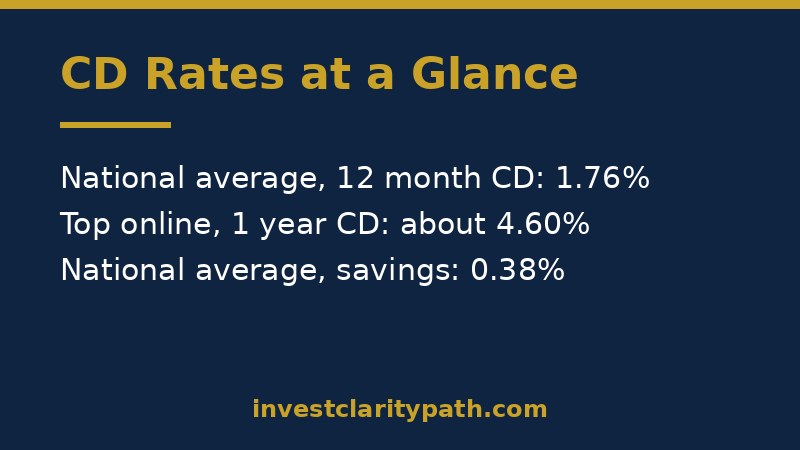
A CD rate is the interest a bank pays you for locking your money in a certificate of deposit for a set term, usually shown as APY, which stands for annual percentage yield. The rate matters a lot, because the gap between banks is wide. In the FDIC’s October 2026 table, the national average for a 12 month CD was 1.76 percent. In the same month, some online banks paid 4.45 to 4.60 percent on a 1 year CD. On $5,000, that gap is worth about $142 in one year.
To compare CD rates, look at five things in this order: the APY, the term length, the minimum deposit, the early withdrawal penalty, and what happens at maturity. The highest APY is not the best CD if the term does not fit your plans or the penalty wipes out the extra interest. Compare the same term at three or more banks, check the penalty in writing, and only lock in money you will not need before the term ends.
What a CD Rate Actually Means
A certificate of deposit, or CD, is a savings product where you agree to leave your money untouched for a set term, such as 3 months, 12 months, or 5 years. In return, the bank pays you interest at a fixed rate. When the term ends, the CD matures, and you get your deposit back plus the interest it earned.
The rate is shown as APY, annual percentage yield. APY includes the effect of compounding, which is interest earned on interest, over one year. If a CD shows an APY of 4.00 percent, a $5,000 deposit earns about $200 in one year if the rate holds and you leave the money alone. A rate shown as a plain interest rate without compounding would look slightly lower for the same product, so always compare APY to APY, not APY to a plain rate.
CD rates are fixed for the term. If rates fall after you open a CD, your rate stays the same, which is good for you. If rates rise, your money stays at the old rate until maturity, which is the trade off. That is why the term matters as much as the rate: a long term locks in a rate for longer, in both directions.
For a plain explanation of how a CD works, read our guide on what a certificate of deposit is.
What CD Rates Look Like Right Now
The Federal Deposit Insurance Corporation, the FDIC, publishes a table of national average rates every month. The national rate is the average of what insured banks and credit unions pay, weighted by each institution’s share of domestic deposits. It is the benchmark for what a typical bank pays, not what the best bank pays.
In the FDIC’s October 2026 table, published October 19, 2026, the national averages were: savings 0.38 percent, money market 0.63 percent, 6 month CD 1.39 percent, 12 month CD 1.76 percent, 24 month CD 1.55 percent, 36 month CD 1.39 percent, and 60 month CD 1.41 percent. The full table is on the FDIC’s National Rates and Rate Caps page.
Notice that longer terms do not always pay more. In October 2026, a 12 month CD paid more than a 5 year CD on average. That can happen when banks expect rates to fall, so they pay less to lock money in for longer. It is one more reason to compare the actual numbers for each term instead of assuming longer means better.
The best rates are far above the average. A November 2026 check by NerdWallet found some online banks paying 4.45 percent to 4.60 percent on a 1 year CD, with the figures accurate as of November 20, 2026. Online banks can pay more because they spend less on branches. A rate that high is roughly two and a half times the national average, which is why comparing is worth your time.
Why CD Rates Differ So Much
Four things explain most of the gap between banks.
First, the type of bank. Online banks and credit unions often pay more than large branch banks, because their costs are lower. The national average is pulled down by the biggest banks, which pay very little, while smaller and online banks pay much more.
Second, the term. Each term has its own rate, and the pattern changes with what banks expect from the wider market. Short terms can pay more than long terms, as the October 2026 table shows, so check each term on its own.
Third, the minimum deposit. Some CDs open with $500. Some need $1,000 or $2,500. A few top rates need $1,500 in a single deposit. A rate you cannot reach because of the minimum is not a real option for you, so check the minimum before you compare the rate.
Fourth, the bank’s own funding needs. A bank that wants deposits will pay more to attract them. A bank that already has plenty of deposits will pay less. That is why the best rate changes from month to month, and why a rate you saw last month may not be there today.
How to Compare CD Rates in 5 Steps
Step 1: Fix the Term First
Decide how long you can leave the money untouched. If you need the money in a year, compare 12 month CDs only. Comparing a 3 month rate with a 5 year rate tells you nothing, because they answer different questions. If you are not sure about the term, a CD ladder can split the money across several terms, so some of it matures sooner. Read our guide on what a CD ladder is to see how that works.
Step 2: Compare APY Across Three or More Banks
Check the same term at three or more banks, including at least one online bank. Write down the APY and the minimum deposit for each. Ignore any rate that needs a minimum above your deposit. The best APY among the ones you can actually open is your starting point.
Step 3: Read the Early Withdrawal Penalty
This is the step most people skip, and it matters. If you take money out of a CD before it matures, the bank charges a penalty, usually a set number of months of interest. A common penalty is 90 days of interest for a 12 month CD, and 180 days for a longer term. Ask for the penalty in writing before you open the account. A high rate with a harsh penalty can cost more than a slightly lower rate with a gentler penalty, if you end up needing the money early.
Step 4: Check What Happens at Maturity
Ask what the CD does when the term ends. Most CDs renew automatically into a new CD at the rate in force on that day, often for the same term. If you do nothing, your money may lock in again at a rate you did not choose. Mark the maturity date on your calendar and set a reminder a week before it, so you can decide whether to renew, move the money, or spend it.
Step 5: Check the Safety Net
Make sure the bank or credit union is insured. Bank deposits are insured by the FDIC up to $250,000 per depositor, per bank, for each ownership category. Credit union deposits are insured by the NCUA up to the same limit. A CD at an insured institution is one of the safest places to keep money, which is the point of the product. If you are not sure an institution is insured, check the FDIC or NCUA before you deposit.
A Worked Example: What the Rate Gap Is Worth
Here is the math on a $5,000 deposit in a 1 year CD, using the figures above. This is simple interest for one year, to show the size of the gap.
At the national average of 1.76 percent, $5,000 earns $88.00 in a year. That is $5,000 times 0.0176, which equals $88.00.
At a top online rate of 4.60 percent, the same $5,000 earns $230.00 in a year. That is $5,000 times 0.046, which equals $230.00.
The difference is $142.00 for the same deposit and the same term. That is $230.00 minus $88.00. The only difference is which bank holds the money.
The gap is bigger on a larger deposit. On $10,000, the national average earns $176.00 in a year, and the top rate earns $460.00, a difference of $284.00. On $1,000, the difference is $28.40. Even a small deposit is worth comparing, because the comparison takes ten minutes and the extra interest repeats every year you hold a CD.
The same check works for longer terms. At the October 2026 national average for a 5 year CD, 1.41 percent, $5,000 earns about $70.50 a year. At 5.00 percent, the rate some online banks paid on a 5 year CD in November 2026, the same $5,000 earns $250.00 a year. The gap is about $179.50 a year, every year of the term.
When a CD Fits, and When It Does Not
A CD fits money you will not need until a known date: a house deposit in two years, a holiday fund, or money you want to keep safe while it earns more than a savings account. The fixed rate is the appeal. You know what you will earn, and the money is insured.
A CD does not fit your emergency fund. Emergency money must be reachable at once, and a CD charges a penalty for early withdrawal. Keep your emergency fund in a savings account you can reach the same day. Read our guide on how much to keep in an emergency fund to set that amount first, then think about CDs for money beyond it.
A CD also does not fit money you may need soon for a bill you cannot date. If the timing is uncertain, a high yield savings account is a better home, because it pays interest and lets you withdraw without a penalty. Read our guide on whether a high yield savings account is safe to compare the two.
If you want a middle path, a money market account pays interest and keeps the money reachable, though usually at a lower rate than a CD. Read our guide on what a money market account is to see how it compares.
Common CD Rate Mistakes to Avoid
First, chasing the highest rate without checking the term. A 5 year rate of 5 percent is not better than a 1 year rate of 4.6 percent if you need the money in a year. Match the term to your plan first, then chase the rate.
Second, ignoring the penalty. A CD with a 4.6 percent rate and a 180 day penalty can cost you more than a CD at 4.2 percent with a 60 day penalty, if you withdraw early. Read the penalty before you open the account.
Third, forgetting the maturity date. A CD that renews on its own can lock your money into a new term at a rate you never checked. Put the date in your calendar the day you open the CD.
Fourth, putting all your savings in one CD. If rates rise, all your money is stuck at the old rate. A ladder, with equal amounts in CDs that mature in 1, 2, 3, 4, and 5 years, gives you a maturing CD every year to move at the new rate.
Fifth, comparing a plain interest rate with an APY. They are not the same number. Always compare APY to APY, and check whether the rate is fixed for the whole term.
FAQ
What is the difference between APY and interest rate?
The interest rate is the simple yearly rate on the deposit. APY, annual percentage yield, includes compounding, which is interest earned on interest, over one year. For the same CD, the APY is slightly higher than the plain interest rate. When you compare CDs, compare APY to APY so you are comparing the same thing.
Are CD rates fixed or do they change?
CD rates are fixed for the term once you open the account. Your rate does not change if market rates fall, and it does not rise if market rates go up. New CDs opened later will carry the new rates, but your CD keeps its rate until maturity.
What is the minimum deposit for a CD?
It varies. Some CDs open with $500. Many need $1,000 or $2,500. A few top rates need $1,500 deposited in a single transaction. Check the minimum before you compare the rate, because a rate you cannot reach is not an option.
Can I lose money in a CD?
At an insured bank or credit union, your deposit is insured up to $250,000, so you do not lose the deposit if the institution fails. You can lose interest if you withdraw early, because of the penalty. You can also lose buying power if inflation is higher than your rate, which is true of any savings product.
Should I choose a CD or a high yield savings account?
Choose a CD for money you will not need until a set date, because it usually pays more and the rate is fixed. Choose a high yield savings account for money you may need at any time, because you can withdraw without a penalty. Many people hold both: savings for emergencies, and CDs for money with a date attached.
Conclusion
CD rates reward a ten minute comparison. The national average for a 12 month CD was 1.76 percent in the FDIC’s October 2026 table, while some online banks paid 4.45 to 4.60 percent on the same term. On $5,000, that gap is worth about $142 in one year. Fix your term first, compare APY across three or more banks, read the early withdrawal penalty, mark the maturity date, and check the insurance. Then lock in only the money you will not need before the term ends, and let the rate do its work.
This article is for general information and education only. It is not legal or financial advice.
