

How Do I Budget for Groceries Each Week?
The Short Answer
To budget for groceries each week, pick one weekly amount, write it down, and shop with a list that fits inside it. Start with your monthly food spending, divide it by four, and that gives you a simple weekly amount to try. Then track what you spend for two or three weeks and adjust the number until it fits your real life. A grocery budget works best when it is simple enough to follow every week and flexible enough to change when your life changes.
Groceries are one of the few bills you can change quickly. Rent stays the same each month, but a grocery bill changes with every trip. That makes it a good place to start if you want more control over your money. You need a number, a list, and a habit of checking the total before you pay.
How Much Should You Spend on Groceries Each Week?
There is no single right number for everyone. A single person who eats most meals at home will spend less than a family of four. A person who buys ready meals will spend more than a person who cooks from basic ingredients. Your weekly amount should fit your income, your household, and the way you eat.
Start With Your Income and Your Monthly Budget
A weekly grocery budget starts with your monthly budget, not with the store. Look at what you bring home each month after tax. Then look at what you already spend on food. If you do not know the number, check your bank statements for the last two or three months and add up the grocery spending. Divide the total by the number of months you checked. That gives you your average monthly food spending.
If you do not have a monthly budget yet, start there first. Our guide on how to create a monthly budget walks through the steps in order. Once it is set, you can see what is left for food after rent, bills, and savings.
Pick a Weekly Number You Can Actually Keep
Many people use a simple rule to set their food budget. Food often takes up about 10 to 15 percent of take home pay for a household that cooks most meals at home. That is only a starting point, not a rule you must follow. If your income is low, food may take a larger share. If your income is high, it may take a smaller share.
Multiply your monthly take home pay by the percentage you choose. That gives you a monthly food budget. Then divide by four to get a weekly amount. Some months have a little more than four weeks, so check your number after a full month and adjust it if you often run short in the last week.
Use the 50-30-20 Rule as a Guide
A simple way to check whether your food budget fits your whole budget is the 50-30-20 rule. In that plan, about 50 percent of your take home pay goes to needs, 30 percent goes to wants, and 20 percent goes to savings and extra debt payments. Groceries sit in the needs group, along with rent and bills. You can read more in our guide to what the 50-30-20 budget rule is.
The rule is a guide, not a test you must pass. If your rent is high, your needs may sit above 50 percent through no fault of yours. The point is to see the full picture. Food is one part of your needs, and it should leave room for your other needs and for saving.
A Worked Example: A Weekly Grocery Budget in Real Numbers
Here is a worked example with real math, so you can copy the steps with your own numbers.
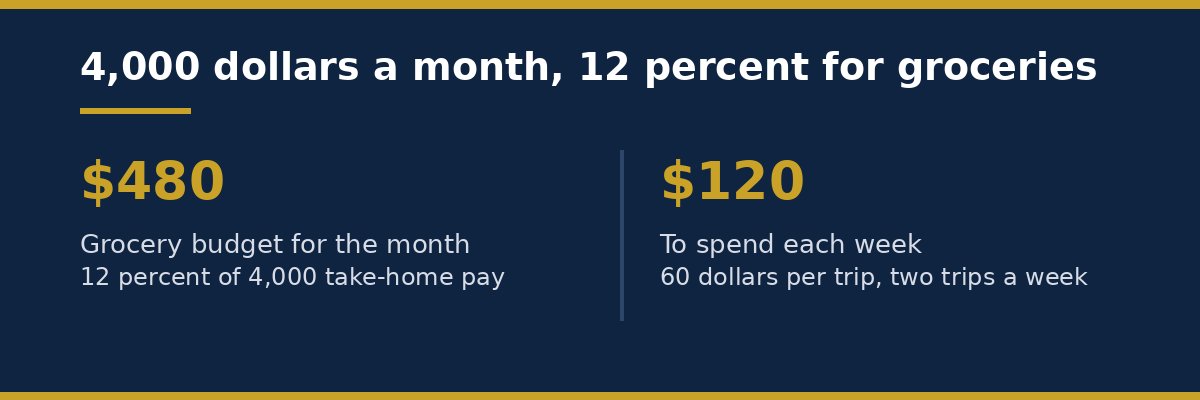
Imagine a household of two people. Their take home pay is $4,000 a month. They choose 12 percent of take home pay for food. That is in the middle of the common 10 to 15 percent starting range.
Step 1: Find the monthly food budget. Multiply $4,000 by 12 percent. $4,000 times 0.12 equals $480. Their monthly food budget is $480.
Step 2: Find the weekly amount. Divide $480 by 4 weeks. $480 divided by 4 equals $120. Their weekly grocery budget is $120.
Step 3: Find the amount per trip. If they shop once a week, each trip gets the full $120. If they shop twice a week, divide $120 by 2. $120 divided by 2 equals $60. Each trip gets $60.
Step 4: Check the month. Four weeks at $120 a week equals $480, which matches the monthly budget. That is the check that the math works. $120 times 4 equals $480.
Now imagine they spend $132 in the first week. That is $12 over the weekly amount. $132 minus $120 equals $12. To stay on track for the month, the next week gets $108 instead of $120. $120 minus $12 equals $108. They do not need to feel bad about the extra $12. They just move it to the next week and keep going. A budget that can bend a little is a budget you can keep.
If they go over by a large amount most weeks, the weekly number is probably too low, so raise it by $10 or $20 and test it again. If they finish most weeks with money left over, lower the number and move the extra money to savings. The right number is the one you can keep for months, not the one that looks best on paper.
How to Plan Your Weekly Shop
A weekly amount only works if the shopping trip fits inside it. A short plan before each trip saves more money than any coupon, because it stops the extra items that add up at the checkout.
First, check what you already have. Before you write a list, look in your fridge, freezer, and cupboards. Many people buy a second bag of rice or a second pack of chicken when they already have one at home. A two minute check stops those repeat buys.
Second, plan five to seven simple main meals. You do not need a plan for every meal. Let breakfast and lunch stay simple and repeatable. Pick meals that share ingredients. If you buy chicken for one meal, plan a second meal that uses the rest. Shared ingredients mean less waste and fewer items on the list.
Third, write the shopping list from the meals, not from memory. A list built from meals is shorter and cheaper than a list built from walking down every aisle. Write your weekly amount at the top of the list. If your budget is $120, write $120 at the top so you see it the whole trip.
How to Stay Inside Your Weekly Amount
A budget is a habit, not a one time task. These steps will help you stay inside your amount week after week.
Shop once a week if you can. Every extra trip is another chance to buy things you did not plan to buy. One planned trip a week is cheaper than three quick trips, even if the quick trips feel small. If you do need a second trip, keep it small and take a short list.
Shop with cash or a separate card for groceries if that helps you. When the money is set aside, the limit feels real. Some people take out the weekly amount in cash and leave the card at home. When the cash runs out, the shopping stops.
Check the total before you pay. Most stores show a running total at self checkout, or you can add items up on your phone as you go. If the total is over your amount, put back the least needed item. It is easier to put one item back now than to fix an overspend later.
Track your spending each week. Write down what you spent after every trip, then add up the four weeks at the end of the month and compare the total to your monthly budget. If you want to move from a monthly view to a weekly view for your whole budget, our guide on how to set a weekly budget instead of a monthly one explains how the two fit together.
What to Do When You Go Over Budget
Going over budget will happen. Prices rise, guests come over, or a week simply costs more. One bad week does not mean the budget has failed. It means the budget needs a small fix.
Start by finding out why you went over. Was it a one off event, like a birthday dinner or a bulk buy that will last for weeks? Or was it a pattern, like buying lunch at the store every day? A one off event needs no change. A pattern needs a small change in the plan.
Next, move the extra amount to the following week, as in the worked example above. If you spent $12 over this week, spend $12 less next week. If you spent $40 over, spread the fix over two weeks, $20 less each week.
If you go over most weeks, raise the budget. A budget that is too low will fail every week, and a budget that fails every week will be dropped. Raise it by a small amount, test it for a month, and see if it holds. It is better to have a slightly higher budget that you keep than a lower budget that you quit.
Ways to Spend Less Without Eating Less Well
Cutting food spending does not have to mean cutting meals. Small changes in what you buy and how you cook can lower the weekly total while keeping meals filling and enjoyable.
Cook more meals from basic ingredients. Rice, beans, lentils, oats, eggs, and seasonal vegetables cost less per meal than ready meals and takeaway food. You do not need to cook everything from scratch. Even cooking three or four meals at home each week instead of buying them ready made can lower the total by a useful amount.
Buy store brands for basic items. Store brand rice, pasta, tinned tomatoes, and frozen vegetables are often much cheaper than name brands and taste very similar in a cooked meal. Try one swap at a time and keep the ones you like.
Use your freezer. Freeze leftovers, bread, and meat bought on sale. Food in the freezer is food you have already paid for. Throwing food away is the same as throwing money away, so use what you buy before it goes bad.
For more ideas on lowering food costs without skipping meals, read our guide on how to cut food spending without cutting meals. It covers practical swaps and habits that fit well with a weekly grocery budget.
How a Grocery Budget Fits Your Whole Budget
A grocery budget does not live on its own. It is one part of your full monthly budget. Money left over after groceries, bills, and other needs is the money you can save or use for other goals. If groceries take too much, there is less left for saving. If groceries are kept in check, saving becomes easier.
Money left after all your needs and wants are covered is called discretionary income. It is the money you can choose how to use. Keeping grocery spending steady protects that money. You can read more about it in our guide to what discretionary income is.
Review your grocery budget once a month. Did you stay inside the weekly amount most weeks? Did the amount feel fair, or was it too tight? Is there one change that would make next month easier? One small change a month is enough. Over a year, twelve small changes add up to a much better budget.
FAQ
How do I start a grocery budget if I have never had one?
Add up your last three months of grocery spending and divide by three to get your average month. Divide that by four to get a weekly starting amount. Use that amount for a month and track every trip, then adjust it up or down based on what you actually spent. Your first number does not need to be perfect. It only needs to be a starting point you can test.
Should I budget weekly or monthly for groceries?
Weekly works better for most people, because grocery shopping happens weekly. A monthly amount is easy to forget by the third week, while a weekly amount is easy to remember at each trip. Keep a monthly total as well, so you can check that four weekly amounts add up to your monthly budget. The weekly number is the one you use at the store. The monthly number is the one you check at the end of the month.
What if my grocery spending changes a lot each week?
Uneven spending is normal. Some weeks need a big shop with cleaning products and pantry items. Other weeks need only fresh food. Use an average weekly amount and let the weeks balance each other. If one week is high, the next week should be lower. If every week is high, the average is too low and needs to rise. A four week average is a better guide than any single week.
How do I budget for groceries for one person?
The same steps apply, only the numbers are smaller. Find your monthly food spending, divide by four, and shop once a week with a list. Cook in small amounts, freeze leftovers in single portions, and buy smaller packs of food that goes bad quickly. A weekly amount of $50 to $80 is a common starting point for one person who cooks most meals at home, but your real number depends on your income and where you live.
What should I do if food prices go up?
When prices rise, first check whether your budget still fits. If a weekly amount that worked last year no longer works, raise it by a small amount rather than giving up. Then look for savings in how you shop. Buy more seasonal food, cook more meals at home, and cut waste. A budget that moves with prices is a budget you can keep.
Conclusion
A weekly grocery budget is a simple tool. Pick a weekly amount that fits your income, shop with a list, track what you spend, and adjust the number until it fits your real life. Start with your monthly spending, divide by four, and test the number for a month. When you go over, move the extra amount to the next week instead of giving up. Small, steady steps will bring your grocery spending under control without cutting the meals you enjoy.
Further reading
This article is for general information and education only. It is not legal or financial advice.
