
How Do I Buy My First Stock?
The Short Answer
You buy your first stock by opening a brokerage account, adding money to it, finding the stock you want, and placing a buy order. The whole process can take less than a day once your account is open, and many brokers now let you start with a small amount of money. You do not need to be rich or know everything about the market first.
A stock is a small piece of ownership in a company. When you buy a share, you own a tiny part of that business. If the company does well over time, the value of your share may rise. If the company does badly, the value may fall. That is why it helps to learn the basics first, start small, and only use money you can afford to leave invested for a long time.
What Happens When You Buy a Stock
When you buy a stock, your money goes to another investor who is selling their shares. A stock exchange matches buyers and sellers, and your broker carries out the trade for you. The price you pay is the market price at the moment your order is filled, which can move by small amounts during the day. Once the trade is complete, the shares sit in your brokerage account. You can watch their value change, receive dividends if the company pays them, and sell the shares later if you choose. If any of these terms feel new, our guide What Is a Stock in Simple Terms? explains ownership, shares, and dividends in plain words.
Before You Buy: Three Things to Settle First
Know Your Goal
Ask yourself why you want to buy a stock. Saving for retirement in ten or twenty years suits steady investing, while money you need next month for rent does not suit the stock market, because prices can fall in the short term. Write your goal down in one sentence.
Use Money You Can Leave Alone
Only invest money you will not need soon. Keep an emergency fund for three to six months of basic costs in a savings account first, and pay off high interest debt before you invest. If you only have a small amount to start, that is fine. Many people start with 25 or 50 dollars, and building a regular habit matters more than the starting amount.
Learn the Main Risks
Stocks can lose value. A company can report weak results, a whole market can fall, or a sector can go out of favour, and no one can predict the next move with certainty. That is why spreading your money across many investments, instead of putting it all in one stock, is a common beginner approach. Our guide What Is Risk in Investing? explains the main types of risk in simple terms.
Step 1: Choose a Brokerage Account
A brokerage account is the account you use to buy and sell stocks. Think of it like a bank account, but for investments. You open it with a broker, a company licensed to carry out trades for you. When you compare brokers, look for no or low commission on stock trades, no or low account minimum, fractional shares, a simple app or website, and good customer support.
Fractional shares let you buy part of a share, so you can invest 25 dollars in a stock that costs 300 dollars per share. Also check account protection. In the United States, the Securities Investor Protection Corporation, known as SIPC, protects securities in a brokerage account up to 500,000 dollars if the broker fails. This is not protection against market losses. You can move your investments to another broker later.
Step 2: Open Your Account
Opening a brokerage account is much like opening a bank account. You fill in a form online, and the broker checks your identity. You will usually need your name, date of birth, address, Social Security number or tax ID, employment details, and bank account details. Most applications take 10 to 20 minutes, and the broker may approve your account the same day, or in a day or two if extra checks are needed.
Step 3: Add Money to Your Account
Once your account is open, move money into it from your bank account. This is called funding your account. A bank transfer or an electronic transfer from your checking account are the common ways to do it, and the money usually takes one to three business days to arrive. Start with an amount you are comfortable with, such as 100 dollars. There is no need to deposit a large lump sum for your first stock.
Step 4: Pick Your First Stock, or a Fund
Many beginners start with a company they know well, such as a business whose products they use every day. Before you buy, ask a few basic questions: What does the company sell, and how does it make money? Has it been profitable? Does it pay a dividend? How has its price moved over the past year, and why?
You do not need to become an expert analyst. The point is to buy something you understand, not something you heard about in a quick tip. The U.S. Securities and Exchange Commission offers free investor education at investor.gov, a good place to check the basics before you trade.
Some beginners prefer a fund instead of one single stock. A fund holds many stocks at once, so your money is spread across many companies. An index fund follows a broad market index, such as the S&P 500, which tracks about 500 large U.S. companies. Our guide What Is an Index Fund and Why Do Beginners Use It? explains how they work. An ETF works in a similar way but trades on the stock exchange like a single stock, and our guide What Is an ETF and How Is It Different From a Stock? explains the difference.
Step 5: Place Your Buy Order
In your broker app or website, search for the company by its name or its ticker symbol. A ticker is a short code for a stock, such as AAPL for Apple. Check that you have the right company before you continue, because similar names can belong to different companies.
You will then choose an order type. The two main types for beginners are a market order and a limit order. A market order buys the stock at the best price available right now. It is simple, it usually fills at once, and the price you pay may be a few cents above or below the last price you saw. A limit order buys only if the price falls to a level you set, or below it. For example, a limit of 40 dollars fills only if the price reaches 40 dollars or less. This gives you control over the price, but the order may never fill if the price stays above your limit. Most beginners start with a market order for a small amount, because it is simple and completes at once.
Next, enter how many shares you want, or how much money you want to invest. If your broker offers fractional shares, you can enter a dollar amount instead of a whole number of shares. Review the order carefully, including the company name, the number of shares, the estimated total cost, and any fee, then confirm it. Your broker will show the order as filled, usually within seconds for a market order, with the exact price you paid, the number of shares, and the total cost.
Step 6: Check Your First Purchase
After your order fills, check that the shares are in your account. The confirmation should show the company name, the number of shares, the price per share, any fee, and the total paid. Save it for your records, and look at the total cost, not just the share price, because any fee is part of your cost.
A Worked Example: Buying 5 Shares
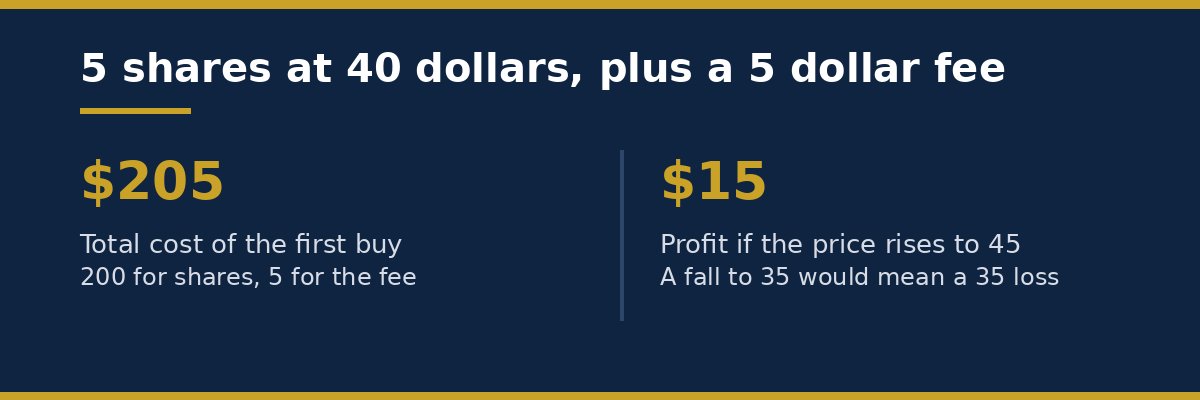
Here is a simple example with real numbers. Suppose you buy 5 shares, each costs 40 dollars, and your broker charges a 5 dollar fee per trade.
- Cost of the shares: 5 times 40 dollars equals 200 dollars
- Broker fee: 5 dollars
- Total cost: 200 dollars plus 5 dollars equals 205 dollars
So you pay 205 dollars in total for 5 shares. Your effective cost per share is 205 dollars divided by 5, which is 41 dollars per share, not 40 dollars. That extra 1 dollar per share is the effect of the fee.
Now suppose the share price rises to 45 dollars, and you sell all 5 shares. Your broker charges another 5 dollar fee for the sale:
- Sale value: 5 times 45 dollars equals 225 dollars
- Money you receive: 225 dollars minus 5 dollars equals 220 dollars
- Profit: 220 dollars minus 205 dollars equals 15 dollars
You made 15 dollars. Without the two fees, the gain would have been 25 dollars, so fees matter, especially on small trades. This is one reason many brokers now offer zero commission trades.
If the price had fallen to 35 dollars instead, the sale value would be 5 times 35 dollars, which is 175 dollars. After a 5 dollar sale fee, you would receive 170 dollars, a loss of 35 dollars on your 205 dollar cost. Prices can move in either direction.
How Much Money Do You Need to Start?
There is no single minimum that fits everyone. Many brokers let you start with no minimum deposit, and fractional shares let you invest with as little as 5 or 10 dollars. A useful starting point for many beginners is 50 to 100 dollars for a first purchase, then a regular monthly amount you can afford. What matters more than the first amount is the habit: 50 dollars a month for a year adds up to 600 dollars, plus any growth. Our guide How Much Money Do I Need to Start Investing? works through starting amounts in more detail. Do not borrow money to buy stocks, and do not invest money you need for rent, bills, or an emergency.
Common Mistakes Beginners Make
Buying on a Hot Tip
A friend, a social media post, or a headline says a stock is about to rise. That is not research. By the time a tip reaches you, the price may already reflect the news. Buy only what you have looked into yourself, even briefly.
Putting Everything in One Stock
If that one company has a bad year, your whole investment suffers. Spreading money across many companies, through a fund or through several different stocks over time, reduces this risk.
Checking Prices Every Hour
Stock prices move all day. Watching them constantly can lead to rushed decisions, such as selling during a normal dip. A long term investor can check a portfolio once a week or once a month and still stay informed.
Selling in a Panic
Markets fall from time to time. In the past, broad markets have recovered from falls, but no recovery is guaranteed. Selling in a panic often locks in a loss, so having a plan before you buy helps you stay calm when prices drop.
Forgetting About Fees and Taxes
Fees reduce your returns, as the worked example shows. Taxes can also apply when you sell shares for a profit, and the rules depend on where you live and how long you held the shares. Keep records of every buy and sell, including dates and prices.
What to Do After You Buy
Your first purchase is the start, not the end. Read the company’s news every few months, check your account statement each month, and decide in advance whether you will add money regularly. Many investors set up a monthly deposit so investing becomes a habit. Review your goal once a year. You do not need to trade often: buying a stock you understand, holding it while the business does well, and adding money over time is a simple plan that many beginners follow.
FAQ
Do I need a lot of money to buy my first stock?
No. Many brokers allow fractional shares, so you can start with 25 or 50 dollars. What matters is starting with money you can leave invested for a long time.
What is the difference between a market order and a limit order?
A market order buys at the best price available right now, and it usually fills at once. A limit order buys only if the price reaches a level you set, or below it.
Can I lose all my money on a stock?
It is possible for a single company to lose most or all of its value, though this is rare for large, established companies. This is why beginners often spread their money across many investments.
Should I buy one stock or a fund first?
Both can work. One stock lets you learn how owning a company feels, while a fund spreads your money across many companies at once. Some people start with a fund and add a single stock later.
How long does it take to buy a stock?
Opening a brokerage account can take a day or two, and moving money in can take one to three business days. Once the money is in your account, a market order usually fills within seconds.
Do I need to watch the stock market every day?
No. Daily price moves are noisy, and checking them constantly can lead to rushed decisions. Many long term investors check their portfolio weekly or monthly.
What happens to my money if my broker fails?
In the United States, SIPC protects securities in a brokerage account up to 500,000 dollars if the broker fails. This protection does not cover market losses.
Conclusion
Buying your first stock is simple once you break it into steps: open a brokerage account, add money, choose something you understand, place a small order, and check the result. The first step feels hardest, because the terms are new, but the process becomes familiar after your first trade.
Start small, learn as you go, and keep your goal in sight. Over time, regular investing and patience matter more than picking the perfect first stock. If you take one idea from this guide, let it be this: understand what you buy, know what it costs, and only invest money you can leave alone for years.
This article is for general information and education only. It is not legal or financial advice.
