
What Is Debt Consolidation, in Simple Terms?
Debt Consolidation in One Sentence
Debt consolidation means combining several debts into one single debt, usually one loan with one monthly payment. Instead of paying three credit cards and a personal loan separately, you take out one new loan, use it to pay off the old debts, and then you owe money on only that one loan.
This article explains how consolidation works in plain language, walks through a worked example with real numbers, and shows how to decide whether it fits your situation.
How Debt Consolidation Works
Consolidation follows the same steps almost every time. Knowing them in advance helps you spot a bad offer before you sign anything.
First, you add up the debts you want to combine. These are often credit card balances, but they can also include personal loans, store cards, and medical bills. Write down each balance, each interest rate, and each monthly payment.
Second, you apply for a new loan large enough to pay off those debts. A lender checks your income and your credit history, then offers you an amount, an interest rate, and a repayment term.
Third, if you accept, the new lender either sends the money to you or pays your old creditors directly. Your old accounts show a zero balance. You now have one debt instead of several.
Fourth, you make one monthly payment on the new loan until it is paid off.
Nothing about your total debt disappears in this process. Consolidation moves debt from several places into one place. It can lower your interest rate or your monthly payment, but it does not erase what you owe.
The Main Ways to Consolidate Debt
There is no single consolidation product. People usually use one of the methods below, and each one suits a different situation.
A Personal Loan
A personal loan is the most common way to consolidate debt. You borrow a fixed amount from a bank, a credit union, or an online lender, and you repay it in equal monthly payments over a set period, often two to five years. The interest rate is usually fixed, so your payment stays the same each month.
This method works best when the loan rate is clearly lower than the rates on your current debts. A credit union is often worth checking, because credit unions sometimes offer lower rates than large banks.
A Balance Transfer Credit Card
A balance transfer card lets you move balances from other cards onto one new card, often with a low or zero percent interest rate for a set introductory period, commonly 12 to 18 months. During that period, more of your payment goes toward the balance itself instead of interest.
This method can work well for smaller balances that you can realistically pay off before the introductory period ends. After that period, the rate usually rises sharply.
A Home Equity Loan or Line of Credit
A homeowner can sometimes borrow against the equity in their home, which is the part of the home’s value they already own outright. These loans often carry lower rates because the home secures the loan. That security is also the risk. If you cannot keep up with payments, you could lose your home, so this is not a light decision.
A Debt Management Plan
A debt management plan is not a loan. A nonprofit credit counseling agency works with your creditors to lower your interest rates and combine your payments into one monthly payment to the agency, which then pays your creditors. A legitimate agency will explain its fees in full before you join, and it will not promise to erase your debts.
A Worked Example With Real Numbers
Numbers make the idea concrete. Here is a simple example using two debts and one consolidation loan.
Maya owes 5,000 dollars on a credit card at 22 percent interest, and 3,000 dollars on a personal loan at 12 percent interest. Her total debt is 8,000 dollars.
If she pays each debt off over 36 months, her payments look like this. The credit card payment is 190.95 dollars a month. Over 36 months she pays 6,874.28 dollars in total, which means 1,874.28 dollars of that is interest. The personal loan payment is 99.64 dollars a month. Over 36 months she pays 3,587.15 dollars in total, which means 587.15 dollars of that is interest.
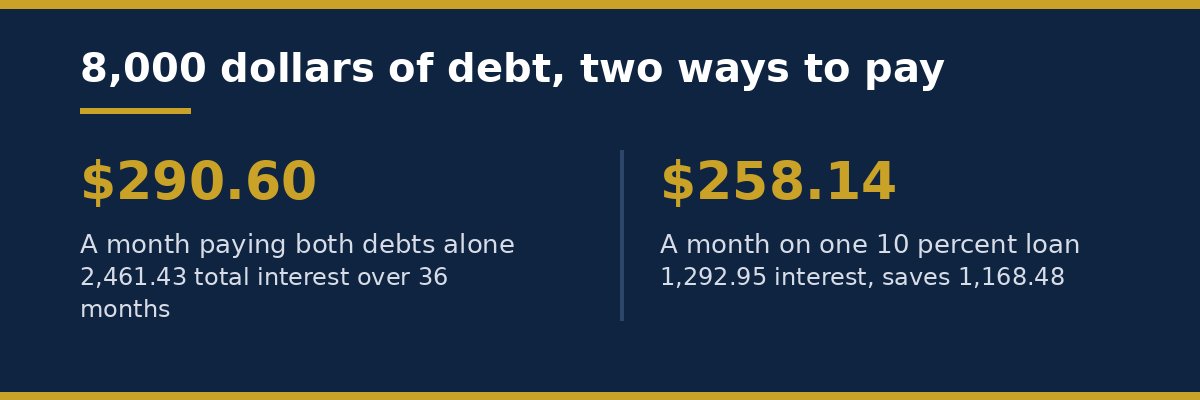
Added together, Maya pays 290.60 dollars a month before consolidation, and 2,461.43 dollars in total interest across both debts.
Now suppose Maya takes out a consolidation loan for the full 8,000 dollars at 10 percent interest, also over 36 months. Her new monthly payment is 258.14 dollars. Over 36 months she pays 9,292.95 dollars in total, which means 1,292.95 dollars of that is interest.
Compare the two paths. Her monthly payment drops from 290.60 dollars to 258.14 dollars, a saving of 32.46 dollars a month. Her total interest drops from 2,461.43 dollars to 1,292.95 dollars, a saving of 1,168.48 dollars.
The example works because the new rate of 10 percent is lower than both old rates, and because the repayment period stays the same at 36 months. If the new loan stretched over five years instead of three, the monthly payment would fall further, but the total interest paid would rise, because interest is charged for longer. Always compare the total cost, not just the monthly payment.
When Consolidation Can Help
Consolidation is a tool, not a cure. It helps most in a few clear situations.
It helps when your new interest rate is clearly lower than the rates you pay now. A drop of a few percentage points on a large balance can save real money, as the example above shows.
It helps when several payments are hard to track. One payment on one date is easier to manage than five payments on five different dates. Fewer due dates means fewer chances to miss a payment and pick up a late fee.
It helps when a fixed payoff date matters to you. A personal loan has a set end date, while a credit card balance can drag on for years if you only pay the minimum.
It can also help your credit picture over time if you keep up with the single payment and do not run up new balances on the cards you just paid off.
When Consolidation Can Hurt
Consolidation can also make things worse, and it is worth knowing the warning signs before you sign.
It hurts when the new rate is not actually lower. Some offers advertise a low monthly payment but hide a high rate or stretch the loan over many years. The monthly number looks small, but the total interest is larger than before.
It hurts when fees eat the saving. Balance transfer cards often charge a fee of 3 to 5 percent of the amount moved. Personal loans can carry origination fees. Add every fee into your comparison before you decide.
It hurts when the low rate is only temporary. A zero percent card is useful only if the balance is gone before the introductory period ends. If it is not, the rate can jump to 20 percent or more.
It hurts most when old spending habits return. Consolidation frees up your credit cards. If you use them again while still paying the consolidation loan, your total debt grows instead of shrinking.
It also hurts when a secured loan puts an important asset at risk. Borrowing against a home or a car to pay off unsecured debt trades a flexible problem for a riskier one.
How to Decide If It Fits Your Situation
A short checklist can turn a vague idea into a clear decision. Work through these steps in order.
Step one, list every debt you want to consolidate, with its balance, interest rate, and monthly payment. Add up the total balance and the total monthly payment. This is your starting point.
Step two, look at the best consolidation offer you can realistically get. Write down the interest rate, the fees, the monthly payment, the loan length, and the total amount you will pay over the life of the loan.
Step three, compare the totals. The new loan should cost less in total interest and fees than the debts it replaces, or at least give you a monthly payment you can truly afford while keeping the total cost reasonable. If neither is true, the offer is not helping you.
Step four, check the fine print. Look for prepayment penalties, which charge you for paying the loan off early, and for rates that change after a few months. A fixed rate is simpler to plan around than a rate that can rise.
Step five, make a plan for the freed up cards. Decide in advance whether you will close them or keep them open with a zero balance, and set a rule for yourself about new spending. A consolidation loan without a spending plan is a fresh start that can be wasted.
Step six, keep an emergency cushion. If the new monthly payment leaves you with nothing spare, one surprise bill can push you back into debt. A small buffer, even a few hundred dollars, makes the plan far more likely to survive.
Common Mistakes to Avoid
Most consolidation mistakes are easy to spot once you know them. Here are the ones that cause the most trouble.
Mistake one is comparing monthly payments only. A lower payment over a longer term can cost far more in total. Always compare the total amount paid, including fees.
Mistake two is ignoring the fees. A balance transfer fee or a loan origination fee is real money. Add it to the cost of the new loan before you compare.
Mistake three is consolidating without fixing the cause. If overspending created the debt, a new loan does not fix the spending.
Mistake four is choosing the longest term available. A longer term lowers the monthly payment, but it also means more months of interest. Pick the shortest term whose payment you can comfortably afford.
Mistake five is missing a payment on the new loan. One missed payment can add a late fee and damage your credit record. Set up an automatic payment for at least the minimum, and pay extra when you can.
Mistake six is consolidating a debt that is almost paid off. If a small balance has only a few months left, the fees and effort of moving it may cost more than simply finishing it. Focus consolidation on the larger, higher rate debts.
If you are choosing between payoff methods once your debts are organized, the guides on What Is the Debt Snowball Method? and What Is the Debt Avalanche Method? explain two simple approaches, one that builds momentum with small wins, and one that saves the most interest by targeting the highest rate first. For the decision itself, read Should I Consolidate My Debt? and How Do I Make a Debt Payoff Plan?.
Frequently Asked Questions
Does debt consolidation hurt my credit score?
It can cause a small, short term dip, because applying for a new loan usually triggers a credit check, and opening a new account lowers the average age of your accounts. Over time, though, steady on-time payments on the new loan can help your credit record. Paying off several cards can also lower your credit utilization, which is the share of your available credit that you are using.
Is debt consolidation the same as debt settlement?
No, they are different. Consolidation means you still pay the full amount you owe, just through one new loan. Debt settlement means a company tries to negotiate with your creditors to accept less than the full amount, usually after you stop paying and let the accounts fall behind. Settlement can damage your credit badly, and forgiven debt can have tax consequences.
Can I consolidate student loans?
Federal student loans have their own consolidation program, called a Direct Consolidation Loan, which combines federal loans into one loan with one payment. It does not usually lower your interest rate, because the new rate is a weighted average of your old rates. Private student loans can sometimes be refinanced through a private lender at a lower rate, but doing that with federal loans means giving up federal protections such as income driven repayment plans.
What credit score do I need to consolidate debt?
There is no single minimum score, because each lender sets its own rules. In general, a higher score earns a lower rate, and a lower rate is the whole point of consolidating. If your score is low, the offers you receive may not beat your current rates, and consolidation may not save you money. Improving your score first, even by a little, can lead to a much better offer.
Should I close my credit cards after consolidating?
It depends. Closing a card can shorten your credit history and raise your credit utilization, because you lose that card’s available credit limit. Keeping a card open with a zero balance is often better for your credit record, as long as you can resist using it. If a card tempts you to spend, closing it may still be the right choice for you.
Does a balance transfer card count as consolidation?
Yes, in a practical sense. Moving balances onto one card with a low introductory rate combines several debts into one payment, which is the same goal as a consolidation loan. The same rules apply. Know when the low rate ends, know the transfer fee, and have a plan to pay the balance off before the rate rises. If you want more detail on this option, see What Is a Balance Transfer?.
Conclusion
Debt consolidation is a simple idea with real consequences. It combines several debts into one loan with one monthly payment, and it helps when the new rate is lower, the fees are small, and the loan term is not stretched out so far that the total cost grows. It hurts when the rate is not really lower, when fees eat the saving, or when the freed up credit cards fill up again.
Before you consolidate, list your debts, compare the total cost of the new loan against the total cost of the old debts, and make a plan for the cards you pay off. If the numbers work and the plan is realistic, consolidation can make your debt simpler and cheaper to pay off. If the numbers do not work, the honest answer is to hold off and keep paying down the highest rate debt first.
For a longer view, a 12 month debt free plan can help you turn a single decision into a full year of steady progress.
This article is for general information and education only. It is not legal or financial advice.
