
What Is the Difference Between a Stock and a Bond?
The Short Answer
A stock makes you a part owner of a company. A bond makes you a lender to a company or a government. That one difference explains almost everything else: how you earn money, how much risk you take, and what happens when things go wrong.
With a stock, you buy a small piece of a business. If the business grows and earns more, your share may become more valuable, and the company may pay you part of its profits as dividends. If the business struggles, your share may fall in value, and dividends may stop.
With a bond, you lend money and get a promise in return: regular interest payments, and your original money back when the bond matures. The payments are set in advance, so a bond feels steadier than a stock, but the return is usually lower over long periods, and the borrower could still fail to pay.
Neither one is better in every case. Most beginner plans use both, in different amounts, for different jobs.
What a Stock Really Is
A stock is a share of ownership in a company. When you buy one share, you own a tiny part of that business, with the same kind of claim on its future earnings as every other shareholder.
You can earn money from a stock in two ways. First, the price can rise. If you buy a share for 50 dollars and later sell it for 65 dollars, you made 15 dollars, before fees and taxes. Second, the company may pay dividends, which are regular cash payments from its profits. Not every company pays dividends. Young, fast growing companies often keep their profits to grow the business instead.
You can also lose money. If the company reports weak results, loses customers, or the whole market falls, the share price can drop. In the worst case, if a company fails completely, shareholders are last in line to get anything back, and they often get nothing. Our guide What Is a Stock in Simple Terms? explains ownership, shares, and dividends in plain words.
What a Bond Really Is
A bond is a loan you make to a borrower, usually a company or a government. The borrower promises to pay you interest, usually twice a year, and to return the full loan amount on a set date, called the maturity date.
Think of it like this: the company needs money to build a factory, and instead of borrowing only from a bank, it borrows small amounts from thousands of investors. Each bond is one of those small loans. The interest rate is fixed when the bond is issued, so you know what the payments will be if the borrower pays as promised.
The main risk is that the borrower cannot pay. A government with a strong credit record is seen as safer than a small company with shaky finances. That is why safer bonds usually pay lower interest: the borrower does not need to offer much to attract lenders. Riskier borrowers must offer higher interest to make the loan worth the risk.
The Key Differences, Side by Side
| Stock | Bond | |
|---|---|---|
| What you are | Part owner | Lender |
| How you earn | Price gains and dividends | Interest payments |
| Payments | Not guaranteed, can change | Set in advance, if the borrower pays |
| Risk | Higher, prices move a lot | Lower, but the borrower can fail |
| If the borrower fails | Last in line | Paid before shareholders |
| Typical use | Long term growth | Steadier income and balance |
A Worked Example: 1,000 Dollars in Each
Here is a simple example with round numbers. Suppose you put 1,000 dollars in a stock and 1,000 dollars in a bond, and you hold both for one year.
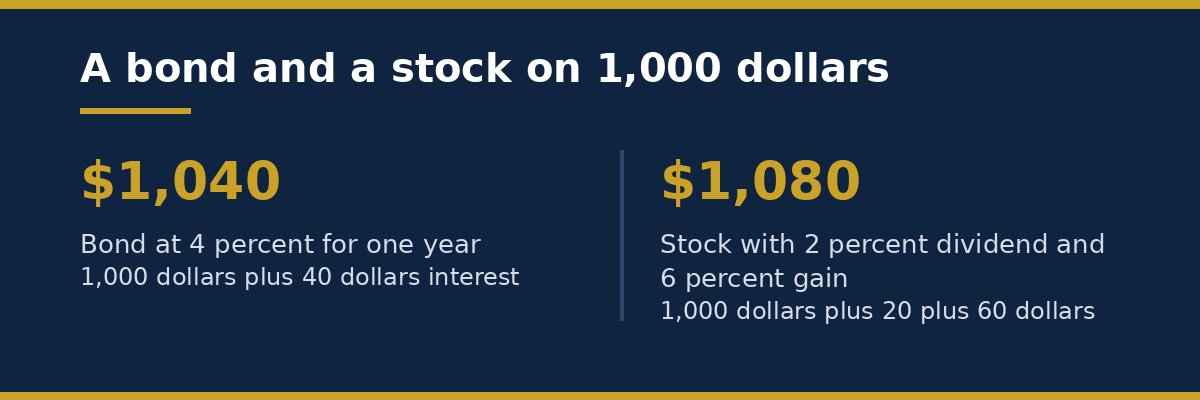
The bond pays 4 percent interest per year. Your interest for the year is 1,000 dollars times 4 percent, which is 40 dollars. At the end of the year you have your 1,000 dollars of principal plus 40 dollars of interest, a total of 1,040 dollars, if the borrower pays as promised.
The stock pays a 2 percent dividend and its price rises 6 percent over the year. Your dividend is 1,000 dollars times 2 percent, which is 20 dollars. Your price gain is 1,000 dollars times 6 percent, which is 60 dollars. Your total is 1,000 dollars plus 20 dollars plus 60 dollars, which is 1,080 dollars, before fees and taxes.
In this example the stock earned more. But now suppose the stock price falls 10 percent instead, while the dividend stays at 20 dollars. Your price loss is 100 dollars, so your total is 1,000 dollars minus 100 dollars plus 20 dollars, which is 920 dollars. The bond still pays its 40 dollars and ends at 1,040 dollars. That is the trade off in one picture: the stock can win more, and it can lose more, while the bond stays close to its promise.
These numbers are an illustration, not a forecast. Real returns move every year, and no one can promise what a stock or a bond will earn next year.
Which One Pays More Over Time?
Over long periods, stocks have usually earned more than bonds, because owners take more risk and are rewarded for it on average. But “on average” hides the rough years. A stock portfolio can fall 20 percent or more in a bad year, while a bond portfolio usually moves much less.
Bonds pay less on average because the return is capped by the interest rate. You will not get a sudden windfall from a bond, but you are also less likely to get a sudden loss, as long as the borrower stays healthy.
This is why beginners are often told to hold both. The stocks aim for growth over years, and the bonds soften the falls along the way. How much of each you hold depends on your goal, your time horizon, and how much of a drop you can sit through without selling in a panic.
How Beginners Usually Combine Them
Start With Your Time Horizon
Money you need in the next year or two, such as an emergency fund or a house deposit, does not belong in stocks. Short term money suits savings accounts or short term bonds, where the value stays steady. Money you will not need for ten years or more can take more stock risk, because it has time to recover from falls.
A Simple Mix to Learn From
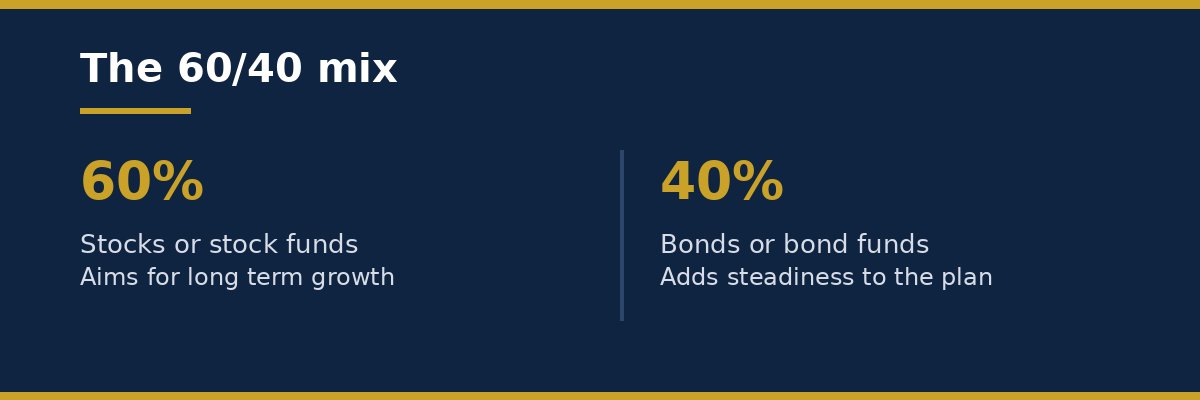
A common beginner mix is 60 percent stocks and 40 percent bonds, often written as 60/40. For example, with 10,000 dollars to invest, that means 6,000 dollars in stocks or stock funds and 4,000 dollars in bonds or bond funds. It is a starting point, not a rule for everyone. A younger investor with decades ahead may hold more stocks, while someone close to retirement may hold more bonds.
Our guide How Do Stocks, Bonds, and Funds Work Together? walks through the 60/40 idea with a worked example.
Use Funds to Hold Many at Once
Most beginners do not buy single stocks and single bonds one by one. They buy funds, which hold hundreds of stocks or bonds at once. A stock index fund spreads your money across many companies, and a bond fund spreads it across many borrowers. Our guide What Is an Index Fund, and Why Do Beginners Use It? explains how funds work.
Common Mistakes Beginners Make
Thinking Bonds Are Risk Free
Bonds are steadier than stocks, but they are not risk free. The borrower can fail to pay, and if interest rates rise, the market price of an existing bond usually falls. A bond held to maturity still pays its promised interest and principal if the borrower pays, but a bond sold early can lose value.
Chasing the Highest Interest Rate
A bond paying far more than others is usually paying more for a reason: the borrower is riskier. That extra interest is compensation for extra risk, not free money. Check why the rate is high before you buy.
Holding Only One of Them
Holding only stocks means every market fall hits your whole portfolio. Holding only bonds means your money may grow too slowly to beat inflation over decades. Most plans use both, in amounts that fit the goal.
Ignoring Inflation
A bond paying 3 percent while prices rise 3 percent a year leaves your spending power flat. Stocks have no promise either, but over long periods their growth has more often kept ahead of rising prices. Inflation matters for both, which is why the mix, not just the choice, counts.
What to Do Next
First, decide what the money is for and when you need it. Then choose a simple mix, such as a stock fund and a bond fund, in amounts you can live with. Finally, write the mix down, add money regularly, and review it once a year instead of reacting to every market move. Our guide What Is Risk in Investing? explains the main risks in simple terms, and What Is Diversification, and Why Does It Matter? shows how spreading money reduces risk. If you are ready to buy, How Do I Buy My First Stock? walks through the steps.
FAQ
Is a stock riskier than a bond?
Usually, yes. Stock prices move more, dividends can be cut, and shareholders are paid last if a company fails. Bondholders get set interest payments and are paid before shareholders. But a bond from a weak borrower can be riskier than a stock in a strong company, so the borrower matters too.
Can I lose money on a bond?
Yes. The borrower can fail to pay, and the market price of a bond can fall if interest rates rise and you sell before maturity. A bond held to maturity pays its promised interest and principal only if the borrower pays as promised.
Do bonds pay dividends?
No, bonds pay interest, not dividends. The payments are usually fixed and arrive on a set schedule, often twice a year. Dividends come from company profits and can change or stop.
What is a bond fund?
A bond fund is a fund that holds many different bonds at once, so your money is spread across many borrowers. It pays out the interest it collects, and its price moves up and down with the bond market.
Should a beginner hold both stocks and bonds?
For most beginners, yes. Stocks aim for long term growth and bonds add steadiness. The right mix depends on your goal, your time horizon, and how much of a fall you can sit through.
How do I choose the mix?
Start with your time horizon. Money needed soon suits steadier holdings, while money needed in ten years or more can hold more stocks. A 60 percent stocks and 40 percent bonds mix is a common starting point to learn from, not a rule for everyone.
Conclusion
A stock makes you an owner, and a bond makes you a lender. Owners can earn more and lose more, while lenders get steadier payments and are paid first if things go wrong. Neither one is the whole answer. A simple mix of both, held through a fund, reviewed once a year, gives most beginners growth and steadiness in one plan.
Start with your goal and your time horizon, pick a mix you can live with, and let time do the heavy work.
Further reading
This article is for general information and education only. It is not legal or financial advice.
