

What Side Income Is Worth It, and What Is Not?
What Side Income Is Worth It, and What Is Not?
A side income is worth it when the money you keep, after costs and tax, is fair pay for the hours you give. A side income is not worth it when it eats your evenings, costs more than it earns, or pays less per hour than a simple part time job would.
That is the whole test, and it fits on one line: work out your real pay per hour, then compare it with your other options. Most side income ideas fail that test. A few pass it clearly. This article shows you how to tell the difference before you spend weeks on an idea that was never going to pay.
The Hourly Pay Test
Before you start any side income, work out three numbers.
First, your gross pay: the money clients or buyers pay you, before any costs.
Second, your costs: supplies, fees, travel, tools, and anything else you must pay to do the work.
Third, your hours: all of them, including finding clients, answering messages, and doing admin, not just the time you spend delivering the work.
Your real pay per hour is (gross pay minus costs) divided by hours. If that number is below what a local part time job pays, the idea is probably not worth it, unless it gives you something else you value, such as a skill you want to learn or a portfolio you need.
A Worked Example With Real Numbers
Compare two side incomes, each taking 6 hours a week.
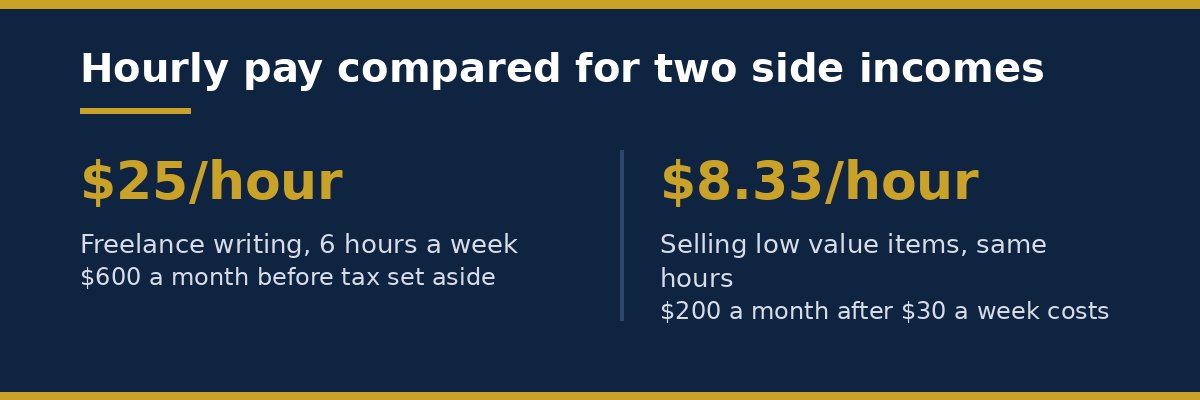
Option A: Freelance writing. You charge 25 dollars an hour and work 6 hours a week.
- Gross pay: 6 hours x 25 dollars = 150 dollars a week, or 600 dollars a month.
- Costs: about 0 dollars, because you already have a computer.
- Real pay per hour: 150 dollars divided by 6 hours = 25 dollars an hour.
- Tax set aside: 25 percent of 600 dollars = 150 dollars a month, so you keep about 450 dollars a month after setting tax aside.
Option B: Selling low value items online. You spend 6 hours a week listing, packing, and posting, and you make 80 dollars a week in sales.
- Gross pay: 80 dollars a week.
- Costs: 30 dollars a week for the items, packaging, and postage.
- Net pay: 80 minus 30 = 50 dollars a week, or 200 dollars a month.
- Real pay per hour: 50 dollars divided by 6 hours = about 8.33 dollars an hour.
- Tax set aside: 25 percent of 200 dollars = 50 dollars a month, so you keep about 150 dollars a month after setting tax aside.
Option A pays 25 dollars an hour. Option B pays about 8.33 dollars an hour for the same 6 hours. Option B is not worthless, but it is worth far less than Option A, and less than many part time jobs. That is what the hourly pay test is for. It turns a vague feeling into a clear number.
Remember that side income is usually taxed. Set aside part of every payment for tax, and keep records from day one. For the tax basics in simple terms, read How Do I Track Side Income for Tax in Simple Terms?
Side Income That Is Usually Worth It
These ideas usually pass the hourly pay test for beginners, because they use a skill people already pay for, need little money to start, and can charge a fair hourly rate.
Freelance services. Writing, design, bookkeeping, virtual assistance, and simple website help all sell by the hour or by the project. You start with a skill you already have, and you can raise your rate as you gain clients. To choose one that fits you, read How Do I Choose a Side Income That Fits My Skills?
Online tutoring. If you know a school subject, a language, or a test well, tutoring pays by the hour and needs almost no startup cost. One or two regular students can bring in steady money each week. For more on this, read How Do I Earn Side Income From Online Tutoring?
Skilled local services. Cleaning, gardening, dog walking, and simple repairs pay by the job, and clients often become repeat customers. The work is physical, but the pay per hour is clear and the demand is steady.
Selling a service is usually worth more per hour than selling a low priced product, because a service has almost no cost of goods. That is the first filter to apply to any new idea.
Side Income That Is Usually Not Worth It
These ideas often fail the hourly pay test, even though they look easy online.
Surveys and microtasks. They pay a few cents per task, and the hourly rate often works out to 2 or 3 dollars an hour. The only cost is your time, but your time is the most valuable part.
Buying stock to resell at a small margin. If you buy an item for 10 dollars and sell it for 12, you made 2 dollars before fees, postage, and your time. You would need to sell hundreds of items a month for it to matter.
Paid to click, watch ads, or test apps for pennies. These pay almost nothing per hour, and they teach you no skill you can charge more for later.
Anything that asks you to pay first. A real client pays you. If an opportunity asks you to buy a starter kit, pay a joining fee, or pay for training before you can earn, walk away. For the warning signs in detail, read How Do I Avoid Side Income Scams?
Four Questions Before You Start Anything
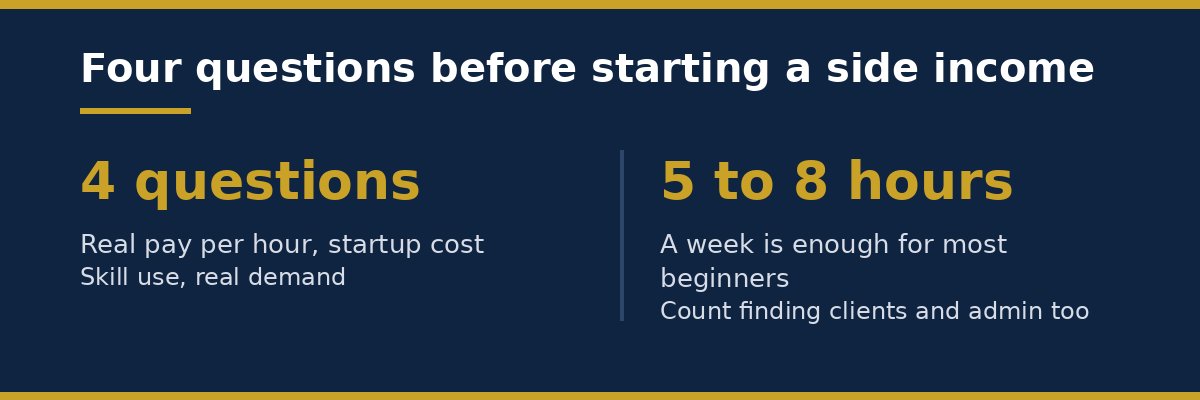
Ask these four questions about any side income idea. If it fails two or more, it is probably not worth your time.
- What is my real pay per hour, after costs? Work it out with the formula above, using honest hours.
- What does it cost to start? The best beginner ideas cost little or nothing. An idea that needs 500 dollars of stock or tools before your first sale is a risk, not a side income.
- Does it use a skill I already have, or one I want to build? Skills raise your hourly rate over time. Ideas with no skill, such as clicking ads, never pay more.
- Is there real demand? One paying client is proof. A hundred likes on a post is not. Before you commit weeks, try to get one paying client or one sale.
If an idea passes all four questions, it is worth a small test. Give it four weeks, track your hours and money honestly, then run the hourly pay test again with real numbers.
How Much Time Should You Give It?
A side income should fit your life, not take it over. Most beginners do well with 5 to 8 hours a week. That is enough to earn real money from a service, and small enough to keep your main job and your rest intact.
Count the whole job when you track time. Finding clients, answering messages, and fixing mistakes are all work. If you only count the delivery time, your hourly rate will look better than it really is. For a realistic look at weekly hours, read How Much Time Does a Side Income Really Take?
If you have no money to start, begin with a service, not a product. A service needs your time and a skill, not stock or tools. Read How Can I Start a Side Income With No Money? and What Is the Simplest Side Income for Beginners? for step by step starting points. For a broad list of ideas to filter with the test above, read Side Income Ideas for Beginners: Filter by Time, Cost, and Skill
Frequently Asked Questions
How much can a beginner realistically earn from side income?
Most beginners earn 100 to 500 dollars a month in the first few months from a service based side income. More is possible, but it usually takes time to find clients and raise rates. Anyone promising thousands in the first month is selling a dream, not a plan.
Is it better to sell a service or a product?
For most beginners, a service is better. A service has almost no startup cost, you get paid for your time, and you can start this week. A product needs stock, storage, postage, and upfront money, and the profit per sale is often small.
How do I know if my hourly rate is fair?
Compare it with two numbers: what local part time jobs pay, and what other freelancers charge for the same service. If your rate is below a part time job, raise it or pick a different idea. If it is far above what others charge, you need strong proof of skill to win clients.
Should I quit my job if my side income grows?
Not until the side income has paid you steadily for at least six months, covers your costs with room to spare, and you have savings to cover a slow month. A side income that looks strong for one month can be quiet the next.
Do I need to pay tax on side income?
In most countries, yes. Side income is usually taxable, even if it is small. Set aside a share of every payment, keep records of income and costs, and check your local tax rules. The IRS has a Gig Economy Tax Center with plain guidance for the United States, and your own tax authority will have similar pages.
What if I try an idea and it fails the test?
That is useful information, not a failure. You learned the real hourly rate in four weeks instead of a year. Keep the skill, drop the idea, and test the next one. Most successful side earners tried two or three ideas before one worked.
Conclusion
A side income is worth it when your real pay per hour is fair, the startup cost is low, the idea uses a skill, and real people will pay for it. It is not worth it when the hourly rate is tiny, the costs eat the profit, or you have to pay to join.
Use the hourly pay test on every idea, count all your hours, set tax aside, and give a good idea four honest weeks. The right side income is not the one that sounds easiest online. It is the one that pays fairly for your time and grows with your skill.
Further reading
This article is for general information and education only. It is not legal or financial advice. Tax rules differ by country and situation, so check your local tax authority or speak to a qualified adviser before you act.
