

What Is a 401(k) Match, and How Do I Get the Full Amount?
Introduction
A 401(k) match is extra money from your employer for your retirement, but only if you put in enough of your own money to earn it. Many workers leave part of this match on the table simply because they do not know how their plan works or how much they need to contribute.
This guide explains what a 401(k) match is in plain terms, how the most common match formula works, what vesting means, and the steps to check your plan and get the full amount.
What Is a 401(k) Match?
A 401(k) is a retirement account offered through an employer. You put part of your pay into the account, usually before tax, and the money is invested for retirement. A 401(k) match is extra money your employer adds to that account based on how much you contribute.
Your employer does not match every dollar without limit. Most plans set a formula. The formula tells you how much you must contribute to get the full match, and how much your employer will add when you do.
Think of it this way. Your contribution is the trigger. Your employer match is the reward for pulling that trigger. If you contribute less than the amount needed for the full match, your employer adds less. If you contribute nothing, your employer usually adds nothing.
A match is different from your salary. You do not receive it in your pay check. It goes straight into your 401(k) account, where it is invested along with your own contributions. That is why missing it year after year can add up to a large amount.
If you are new to this type of account, start with a simple explainer of what a retirement account is in simple terms.
The Short Answer
A 401(k) match is money your employer adds to your retirement account when you contribute part of your pay. To get the full amount, contribute at least the percentage your plan requires for the full match. For many plans, that is 5 percent or 6 percent of your pay, but the exact number depends on your plan.
Check your plan documents or your benefits portal for the match formula. Then set your contribution at or above that level if you can afford it. If you cannot reach it right away, contribute as much as you can now and raise it in small steps until you reach the full match.
How a Common Match Formula Works
Match formulas look confusing at first, but they follow a simple pattern. The plan states a percentage of your pay that it will match, and a rate for each part of your contribution.
One of the most common formulas is this: 100 percent of the first 3 percent you contribute, plus 50 percent of the next 2 percent you contribute.
Let us break that down in plain words. For the first 3 percent of your pay that you put into your 401(k), your employer adds the same amount, dollar for dollar. That is the 100 percent part. For the next 2 percent of your pay that you put in, from 3 percent up to 5 percent, your employer adds half of that amount. That is the 50 percent part. For any contribution above 5 percent of your pay, your employer adds nothing extra under this formula. You can still contribute more for your own retirement, but the match stops at 5 percent.
So under this formula, you need to contribute 5 percent of your pay to get the full match. Your employer then adds 4 percent of your pay. That 4 percent comes from 3 percent matched in full plus 1 percent, which is half of the next 2 percent.
Other plans use different numbers. Some match 100 percent of the first 4 percent. Some match 50 percent of the first 6 percent. The idea is the same in every case. There is a contribution level that unlocks the full match, and contributing less than that level means a smaller match.
A Worked Example With Real Math
Let us use a clear example so you can see the dollars. Suppose your salary is 60,000 dollars a year, and your plan uses the formula above: 100 percent of the first 3 percent, plus 50 percent of the next 2 percent.
Step 1: Work out 5 percent of your salary. 5 percent of 60,000 dollars is 3,000 dollars. This is the amount you need to contribute over the year to get the full match.
Step 2: Work out the first part of the match. The first 3 percent of your salary is 1,800 dollars. Your employer matches this part at 100 percent, so the employer adds 1,800 dollars.
Step 3: Work out the second part of the match. The next 2 percent of your salary is 1,200 dollars. Your employer matches this part at 50 percent, so the employer adds 600 dollars. That is half of 1,200 dollars.
Step 4: Add the two parts together. 1,800 dollars plus 600 dollars is 2,400 dollars. That is the full employer match for the year when you contribute 5 percent.
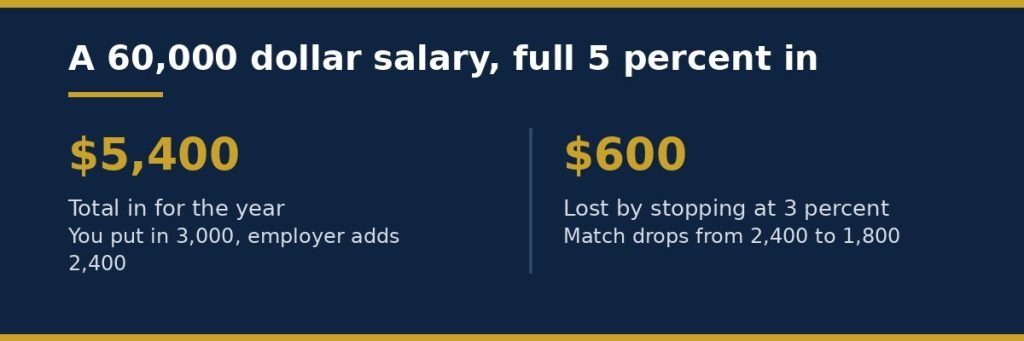
Step 5: Add your money and the match together. Your contribution of 3,000 dollars plus the employer match of 2,400 dollars is 5,400 dollars going into your retirement account for the year.
Now look at what happens if you contribute less. If you contribute only 3 percent, that is 1,800 dollars. Your employer matches it in full and adds 1,800 dollars. You get no second part, because you did not contribute the next 2 percent. You miss 600 dollars of match for the year.
If you contribute 0 percent, you put in nothing and your employer adds nothing. You miss the full 2,400 dollars of match for the year. That missed money does not come back later. Each year has its own match, and a missed year is a missed year.
You can repeat this same math with your own salary. Take your yearly pay, find your plan formula, and work out the contribution that earns the full match.
What Is Vesting?
Vesting is a word that confuses many people, so here it is in plain terms. Vesting means ownership over time.
Your own contributions to a 401(k) are always yours. The money you put in belongs to you from the start.
Employer matching money is different in some plans. Some plans let you own the match right away. Others require you to work for the company for a set period before the match fully belongs to you. That waiting period is called a vesting schedule.
A common schedule gives you a larger share of the match each year you stay, until you reach 100 percent after a set number of years. Another plan might give you 0 percent until you reach three years, then 100 percent all at once. Some plans give you full ownership from day one.
If you leave a job before you are fully vested, you may lose the part of the match that has not vested yet. Your own contributions stay yours.
This is why you should check whether your match vests right away or over time, and how many years it takes to reach 100 percent.
A Match Is Not the Same as Profit Sharing
A 401(k) match and profit sharing both involve employer money going into your retirement account, but they work in different ways.
A match depends on what you do. You must contribute to receive it. The amount is set by a formula tied to your contribution.
Profit sharing depends on what the company does. The company decides each year whether to add money, and how much, often based on company profits. You usually do not need to contribute to receive a profit sharing amount, and the amount can change from year to year or be zero in a year when the company chooses not to pay it.
Some employers offer both. Some offer only a match. Some offer only profit sharing. Do not assume one means the other. Check your plan documents to see which type your employer offers.
How to Check Your Plan
You do not need to guess your match formula. Your employer must provide plan documents that state it clearly.
Step 1: Log In to Your Benefits Portal
Start with your employer benefits portal or the website of the company that runs your 401(k). Look for a section called retirement, 401(k), or savings plan. If you do not know the provider name, ask your human resources team.
Step 2: Find the Match Formula
Look for words such as employer match or company match. The page should state the formula in plain numbers, for example 100 percent of the first 3 percent plus 50 percent of the next 2 percent. Note the contribution percentage needed for the full match. That is your target.
Step 3: Check Your Current Contribution Rate
Find your current contribution rate on the same portal. It is usually shown as a percentage of your pay. Compare it with the target from Step 2. If your rate is below the target, you are not getting the full match right now.
Step 4: Check the Vesting Schedule
Find the vesting section. Note whether the match is yours right away or whether it vests over time, and how many years it takes to reach 100 percent.
Step 5: Check How to Change Your Contribution
Find the page where you change your contribution rate. Note whether changes take effect on the next pay period, and whether you can change it at any time. If anything is not clear, ask your human resources team these three questions: What contribution earns the full match? When does the match vest? How do I change my contribution?
How to Raise Your Contribution to the Full Match
If you are below the full match level, raising your contribution is usually a simple change, but it affects your take home pay. Here is a calm way to do it.
First, work out the gap. If the full match needs 5 percent and you now contribute 2 percent, the gap is 3 percent. Work out what 3 percent of your pay is per month.
Second, check your monthly budget for room. Many people raise their contribution by 1 percent at a time, then raise it again after a few months. A 1 percent rise is easier to absorb than a jump of 3 percent at once.
Third, use a pay rise to close the gap. When your pay goes up, raise your contribution by part of the rise before you get used to the higher take home pay.
Fourth, set the new rate in your benefits portal. Enter the new percentage, save the change, and check your next pay slip to confirm the new rate is in place.
Fifth, set a reminder to review it once a year. Check that you are still at or above the full match level after any pay change or job change. A new job means a new plan, a new formula, and a new target.
If you cannot reach the full match right now, contribute what you can and plan the next rise. A partial match is better than no match. Do not borrow money or miss essential bills to reach the full match. Your own contributions also have a yearly limit set by the tax rules, and the IRS publishes current 401(k) rules at https://www.irs.gov/retirement-plans/401k-plans. If you are close to a limit, check with your plan provider before you raise your contribution.
For a wider view of how a 401(k) fits into your retirement plans, read our guide on financial planning for retirement. It explains how to think about saving, timing, and long term goals together.
If you are older and catching up on retirement saving, the match still matters. Our guide on how to catch up on retirement savings at 50 explains how to think about later saving in a practical way.
Frequently Asked Questions
What is a 401(k) match in simple terms?
A 401(k) match is money your employer adds to your retirement account when you contribute part of your pay. The amount is set by a formula in your plan. You must contribute enough to earn the full match.
How much do I need to contribute to get the full match?
It depends on your plan. A common formula needs 5 percent of your pay for the full match, but some plans need 4 percent or 6 percent. Check your plan documents or benefits portal for the exact target.
What happens if I contribute less than the full match amount?
Your employer adds a smaller match. In the example in this guide, a salary of 60,000 dollars with a 5 percent target gives a full match of 2,400 dollars. Contributing only 3 percent gives a match of 1,800 dollars, so 600 dollars is missed for that year.
Can I lose my 401(k) match if I leave my job?
You keep your own contributions and the vested part of the match. You may lose the unvested part of the match if you leave before the vesting period ends. Check your vesting schedule before you leave.
Conclusion
A 401(k) match is one of the simplest ways to add to your retirement saving. Your employer offers extra money, and the only condition is that you contribute enough to earn it.
Start by finding your plan formula and the contribution level that earns the full match. Check your current rate against that target. Check the vesting schedule so you know when the match fully belongs to you. Then raise your contribution in steps you can afford until you reach the target.
Use the worked example in this guide with your own salary to see the dollars involved. A small gap in your contribution rate can mean hundreds of dollars missed each year.
If you are thinking about timing, our guide on when you can retire can help you see how steady saving, including the match, fits into a longer plan. If you are deciding how much to save each month, and whether to save a lump sum or a little at a time, our guide on whether to invest a lump sum or a little each month can help you think through the choice in simple terms.
Check your plan today, set your contribution to earn the full match if you can, and review it once a year. That short check is a practical step toward a stronger retirement plan.
This article is for general information and education only. It is not legal or financial advice.
