
What Is a Debt Management Plan, and Should I Use One?
The short answer
A debt management plan, often called a DMP, is a structured repayment plan set up through a nonprofit credit counselling agency. You make one monthly payment to the agency, and the agency sends agreed payments to each of your creditors. In many cases the agency asks your creditors to lower your interest rates or waive some fees, so more of your payment goes toward the balance itself.
A DMP is not a loan. You do not borrow new money to pay old debts. It is also not debt settlement, where you pay less than you owe. With a DMP, you usually repay the full amount you borrowed, but on easier terms and over a set period, often three to five years.
Should you use one? It can help if you have steady income, you can afford a regular monthly payment, and most of your debt is unsecured debt such as credit cards. It is less useful if your income is very irregular, if you cannot afford the monthly payment, or if most of your debt is secured debt such as a mortgage or a car loan.
What a debt management plan is
A debt management plan is an agreement between you, a credit counselling agency, and your creditors. The agency reviews your income, your spending, and your debts, then contacts your creditors and proposes a plan. If the creditors agree, you pay the agency once a month, and the agency distributes that money to your creditors.
Most plans cover unsecured debts, which are debts not tied to an asset a lender can take back. Credit card balances are the most common example. Some store cards and personal loans can also be included. Secured debts, such as a mortgage or an auto loan, are usually not included.
While you are on a plan, you usually agree not to use the credit cards included in it. Many plans also ask you to close those accounts, or the creditors close them when they join the plan.
Who runs a debt management plan
A debt management plan is run by a credit counselling agency, usually a nonprofit organisation. A well known example in the United States is a member agency of the National Foundation for Credit Counseling. You can also find general guidance on credit counselling from the Consumer Financial Protection Bureau.
A reputable agency starts with a counselling session. A counsellor looks at your full budget with you, including income, rent, food, transport, and every debt. The counsellor should explain all of your options, not only a DMP. If a DMP is not the best fit, the counsellor should say so.
Be careful about the difference between a nonprofit credit counselling agency and a for profit debt settlement company. A credit counselling agency helps you repay what you owe in full, usually with lower interest. A debt settlement company tries to negotiate a lower payoff amount, often after you stop paying your creditors for a time, which can damage your credit and lead to collection calls or legal action.
How a debt management plan works
First, you attend a counselling session, by phone, online, or in person. Bring a list of your debts, your income, and your monthly spending. The session usually takes 30 to 60 minutes. Second, the counsellor helps you build a realistic budget. The monthly DMP payment must fit your real life. If it is too high, you may miss payments and the plan may fail. Third, if a DMP looks suitable, the agency contacts each creditor and asks for better terms, such as a lower interest rate, a waived late fee, or a lower minimum payment. Creditors do not have to agree, but many do, because a DMP gives them a better chance of being repaid in full than if the account goes to collections. Fourth, once the plan is accepted, you pay the agency one amount each month, and the agency sends the agreed amount to each creditor. You should receive a statement showing how your payment was divided. Keep these statements and check them against your own creditor statements. Fifth, you keep paying each month for the life of the plan, usually three to five years. If your income changes, tell the agency at once. Missing payments can cause creditors to cancel the plan terms and return your interest rate to its original level.
A worked example: the same debt, with and without a plan
Assumptions, stated plainly: you owe $5,000 on one credit card. You pay $150 every month. You add no new charges. Fees are not included. The interest rate stays fixed. This is an illustration only, not a promise of what any creditor will offer.
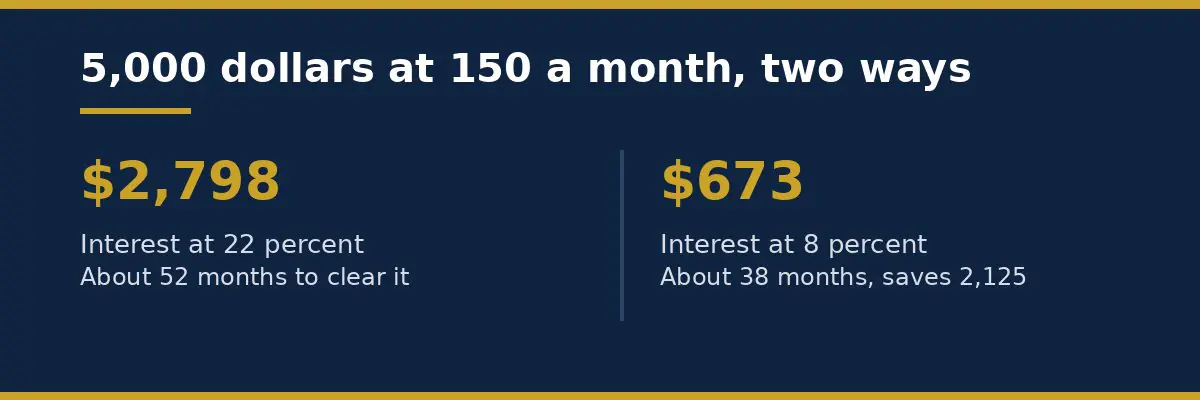
Without a plan, at 22 percent interest per year, the monthly rate is 22 percent divided by 12, about 1.83 percent. Interest in the first month is $5,000 times 1.83 percent, which is $91.67. From your $150 payment, $91.67 goes to interest and only $58.33 reduces the balance. Paying $150 a month, it takes about 52 months to clear the $5,000, and total interest paid is about $2,798.
With a plan, suppose the creditor agrees to cut the rate to 8 percent per year, with the same $150 monthly payment. The monthly rate is 8 percent divided by 12, about 0.67 percent. Interest in the first month is $5,000 times 0.67 percent, which is $33.33. From your $150 payment, $33.33 goes to interest and $116.67 reduces the balance. Paying $150 a month, it takes about 38 months to clear the $5,000, and total interest paid is about $673.
The plan saves about $2,125 in interest ($2,798 minus $673) and clears the debt about 14 months sooner. The monthly payment is the same in both cases. The change comes from the lower interest rate, which lets more of each payment reduce the balance. Still, the example shows the core idea: a DMP works mainly by cutting the interest cost, not by cutting the amount you owe.
Debt management plan vs debt consolidation loan
With a debt consolidation loan, you borrow a new loan and use it to pay off your existing debts. If the new loan has a lower interest rate than your cards, you can save money. But you need a good enough credit score to qualify for a loan with a good rate. If your credit score is low, the loan rate may not be much better than your card rates, or you may not qualify at all.
With a DMP, you do not take out a new loan. The agency negotiates lower rates on your existing debts, and you repay them through the agency. You do not need a high credit score to start a DMP, because no new credit is involved. That makes a DMP an option for people whose credit score is too low for a good consolidation loan.
There is also a risk difference. A consolidation loan moves your debt, but it does not stop you from using your cards again. Some people pay off their cards with a loan, then run the cards up again, and end up with the loan plus new card debt. A DMP usually requires you to stop using the included cards, which removes that temptation.
If you are weighing these two options, start by making a debt payoff plan that lists every debt, its balance, and its interest rate.
Debt management plan vs debt settlement
In debt settlement, a company negotiates with your creditors to accept less than the full amount you owe, often as a lump sum. To build up that lump sum, you usually stop paying your creditors and instead pay money into a special account. During that time, interest and late fees keep growing, your credit score usually falls, and creditors may send your account to collections or take legal action. Forgiven debt can also count as taxable income in some cases.
In a DMP, you keep paying your creditors every month, and you usually repay the full balance. Your creditors may lower your rate, but they are not asked to forgive part of the debt. Because you keep paying, the damage to your credit is usually smaller than with settlement, though closing card accounts can still affect your credit record.
Settlement is sometimes presented as a faster fix, but it carries more risk, because creditors do not have to accept a settlement offer. A DMP is slower and requires steady payments for years, but the terms are agreed in advance and the path to zero is clearer.
What a debt management plan costs
A DMP is not free, but the fees are usually modest and regulated in many states. There are two common types of fee. First, a setup fee, a one time charge for setting up the plan, often $30 to $75. Some agencies waive it if your income is low. Second, a monthly maintenance fee, often $25 to $50 per month, and many states cap it by law.
Ask the agency for the exact fees in writing before you sign anything, and ask whether they can be reduced or waived. To judge the cost fairly, compare it with the interest you save. In the worked example, the plan saved about $2,125 in interest. Even after three to five years of monthly fees, the saving could still be large. But if the rate cut is small and the fees are high, the benefit shrinks. Ask the agency to show you the total cost of the plan, including all fees, and the total interest you would pay with and without it.
How a plan affects your credit, and who it suits
A DMP itself is not a loan, so it does not appear on your credit report as a new account. But when creditors join a plan, they often close the included accounts. Closing accounts can lower your available credit, which can raise your credit utilisation, the share of your available credit that you are using. High utilisation can lower your credit score in the short term. On the positive side, a DMP helps you pay on time every month, and payment history is a large part of a credit score, so a long run of on time payments can help your score recover. As balances fall, your utilisation falls too.
A DMP tends to suit you if most of your debt is credit card debt, you have steady income and can afford a regular monthly payment, and you are willing to stop using the included cards for a few years. It tends not to suit you if most of your debt is secured, such as a mortgage or a car loan, if your income is irregular or very low, if your total debt is small enough to clear in a few months on your own, or if you are looking for a way to pay less than you owe.
If you are unsure, a counselling session can help. The two common self managed payoff orders are the debt snowball method, where you pay the smallest balance first for quick wins, and the debt avalanche method, where you pay the highest interest rate first to save the most interest.
Questions to ask before you sign up
Do not sign a DMP agreement until you have clear answers to these questions. Write the answers down, and keep a copy of the agreement.
- Is your agency a nonprofit, and is it a member of the National Foundation for Credit Counseling or a similar body?
- What is the setup fee, and what is the monthly fee? Can either fee be reduced or waived?
- Which of my debts can be included, and what interest rate has each creditor agreed to, in writing?
- How much will my monthly payment be, and how long will the plan last?
- What happens if I miss a payment, or if my income drops? Can the plan be changed?
- What happens if I want to leave the plan early? Is there a fee, and do the old interest rates return?
If an agency pressures you to sign on the spot, refuses to put fees in writing, or promises a specific credit score result, treat that as a warning sign. A reputable agency gives you time to think and answers questions plainly. Read the agreement before you sign, and do not sign a blank form.
As a starting point for the wider choice, see whether you should pay off debt or invest first. If a balance transfer card is part of your thinking, read what a balance transfer is before you compare its fees and its introductory rate with a DMP.
Frequently asked questions
How long does a debt management plan take?
Most plans take three to five years. The length depends on how much you owe, what you can pay each month, and what terms your creditors accept.
Will a debt management plan stop interest completely?
Usually not. Creditors often lower your interest rate, but they rarely cut it to zero. In the example earlier, the rate fell from 22 percent to 8 percent, which still left some interest to pay.
Can I include all my debts in a plan?
Not always. Credit cards and some personal loans are usually included. Mortgages, car loans, and student loans are usually not included.
Can I use my credit cards while on a plan?
Usually no. Cards included in the plan are normally closed or frozen, and you agree not to use them.
What happens if I miss a payment?
Tell your agency at once. A single missed payment may be fixable, but repeated missed payments can cause creditors to cancel the plan terms and restore your original interest rate.
Conclusion
A debt management plan is a structured way to repay unsecured debts, mainly credit cards, through a nonprofit credit counselling agency. You make one monthly payment, the agency pays your creditors, and in many cases your interest rates fall, so your payments reduce the balance faster. You repay the full amount you owe, usually over three to five years, and you agree not to use the included cards while the plan runs.
It is not a loan, and it is not settlement. It does not cut the amount you owe, but it can cut the interest cost a lot, as the worked example showed. Before you sign up, choose a reputable nonprofit agency, get every fee and every agreed rate in writing, and ask the questions listed above. Compare the total cost of the plan, including fees, with the cost of paying the debts yourself.
This article is for general information and education only. It is not legal or financial advice.