

How Do I Earn Side Income From Online Tutoring?
Short Answer
Yes, you can earn side income from online tutoring, and you can start with skills you already have. If you know a school subject well enough to explain it in simple words, you can teach it to a student over a video call. Most beginners start with one or two students, a few hours a week, and a simple hourly rate.
This guide walks through each step in plain language. It covers the subjects that sell, the equipment you need, how to find your first students, how to set a fair rate, and how to track the income for tax in simple terms.
What Online Tutoring Really Is
Online tutoring is teaching one student, or a small group, over the internet. Lessons usually happen on a video call. You share your screen, talk through a problem, and help the student practise. Sessions often last 30 minutes or one hour.
Tutors help with school homework, exam preparation, language learning, music lessons, and basic computer skills. Some tutors help adults too, for example with English conversation or with learning a new skill for work.
What Subjects Sell
Start with a subject you already know well. You do not need to know everything. You need to be one step ahead of your student and able to explain ideas clearly.
These subjects are in steady demand:
School Maths and English
Maths is one of the most requested subjects at every level, from primary school sums to high school algebra. English help is also common, including reading, writing, grammar, and spelling. Parents look for tutors who can make homework less stressful and help a child catch up.
Science
Biology, chemistry, and physics tutors are wanted by high school students, especially before exams. If you studied science at school or college and still remember the basics, this can be a good fit.
Test Preparation
Students preparing for school entrance tests, college entrance tests, or language tests often want a tutor. This work pays well because the goal is clear and the student is motivated. Only offer test preparation if you know the test format and have practised with sample questions yourself. If you speak a second language well, you can also teach it, and conversation practice is often enough for beginners.
Music and Practical Skills
Piano, guitar, and singing lessons also work online, as long as the sound quality is good. Basic computer skills, such as using a spreadsheet or learning to type, are useful for adult learners too.
How to Choose Your Subject
Pick one subject to start with, not five. A clear offer is easier to sell. “I help high school students with algebra” is stronger than “I teach everything.” You can add a second subject later, once the first one is bringing in students.
If you are starting from scratch, starting a side income with no money is a useful first read, because tutoring needs almost no money to begin.
What Equipment a Beginner Needs
You do not need expensive gear. Most beginners already own what they need.
The Basics
A laptop or a desktop computer with a webcam is the main tool. A phone can work for a short call, but a computer is better for sharing your screen and showing notes. You also need a stable internet connection. Test your connection before your first lesson. A frozen screen in the middle of a lesson is frustrating for both sides.
A headset with a microphone helps a lot. It keeps your voice clear and cuts background noise.
A Quiet Space
Find a quiet corner with good light. Sit facing a window or a lamp so the student can see your face. Tidy the background, or sit in front of a plain wall. Tell people at home when your lessons are, so you are not interrupted.
Free Tools for Lessons
You can run lessons with free tools. A video call app, a shared document, and a simple digital whiteboard cover most needs. Keep a notebook or a simple file for each student. Note what you covered, what homework you set, and what to review next time.
What You Do Not Need Yet
Do not buy a course, a paid platform subscription, or a new computer before your first student. Start with what you have. Spend money only after you have earned your first payment and you know which tool would actually help.
How to Find Your First Students
Finding the first student is the hardest part. After that, word of mouth does much of the work. Here is a simple plan.
Step 1: Tell People You Know
Tell friends, family, neighbours, and work colleagues that you tutor. Say your subject, your level, and your price in one short sentence. For example, “I tutor high school maths online for 25 dollars an hour.” Many first students come from a personal recommendation.
Step 2: Join a Tutoring Platform
Tutoring platforms list your profile and match you with students. They take a fee or a share of your rate, but they handle payments and bring you students. Read the rules of each platform before you join, and check how and when you get paid.
Step 3: Post Where Parents Look
Local community groups, school notice boards, and parent groups are good places to offer tutoring. Keep your message short. Say what you teach, who it is for, how lessons run, and your price. Add one line about your background, such as a degree or work experience, if it is relevant.
Step 4: Offer a Short Introductory Lesson
A short first lesson, often 20 to 30 minutes, lets the student and parent see how you teach. Ask what the student finds hard, work through one problem together, and explain what the next lessons would cover. Do not give away a full free lesson every time.
Step 5: Ask for Reviews and Referrals
After a few good lessons, ask the parent or student for a short review you can share, and ask if they know another family who might need help. One happy student can lead to two more.
Finding clients is a skill of its own, and the same ideas apply in other kinds of freelance work. This guide on how to find your first freelance client covers the basics in more detail.
How to Set Your Rate
Your rate is your hourly price. Setting it well matters, because a rate that is too low burns you out, and a rate that is too high scares away your first students.
Check What Others Charge
Look at tutoring platforms and local adverts for your subject and level. Note the range. A beginner often starts near the lower end of the range, then raises the rate after gaining reviews and experience.
Start Simple
Many beginners start between 15 and 30 dollars an hour, depending on the subject, the level, and the country. Test preparation and advanced subjects often sit higher. Simple homework help often sits lower. These are example ranges, not rules. Your local market decides the real number.
Charge by the Lesson, Not by the Minute
Set a clear price for a 30 minute lesson and a one hour lesson. State it before the first lesson. Confirm how payment works, and when it is due. Most tutors ask for payment before the lesson, or on the same day.
Raise Your Rate Over Time
Once you have regular students and good reviews, raise your rate a little for new students. You do not need to raise it for existing students at once. Tell them in advance if a change is coming, and explain it simply. Good teaching is worth paying for, and steady students usually stay.
Do Not Work for Free for Long
A short introductory call is fine. Regular free lessons are not a business. If someone asks for free lessons every week, say no politely and offer your paid rate. Your time has value.
Worked Example: What You Could Earn in a Month
This is an example only, with simple numbers, so you can see how the maths works. Your real income will depend on your rate, your hours, and how many students you keep.
Here is the example, step by step:
Step 1, your hourly rate: 25 dollars per hour. This is an example rate, not a promise.
Step 2, your hours per week: 6 hours per week. That could be three students, two hours each, or six students, one hour each.
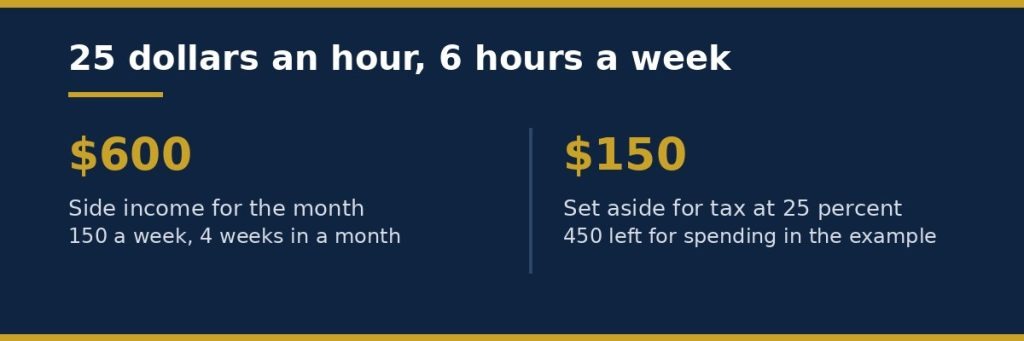
Step 3, your weekly income: 25 dollars per hour times 6 hours equals 150 dollars per week.
Step 4, your monthly income: 150 dollars per week times 4 weeks equals 600 dollars per month.
So, in this example, tutoring 6 hours a week at 25 dollars an hour gives about 600 dollars a month.
Now, think about costs and tax. Suppose the platform you use takes no fee in this example, and your only cost is a small headset you already own. Your main cost is your time. For tax, many tutors set aside a share of each payment. In this example, setting aside 25 percent for tax would mean 150 dollars from the 600 dollars goes into a separate savings pot, leaving 450 dollars for spending. The exact share depends on your country and your total income, so treat this as a planning habit, not as tax advice.
Try the same steps with your own numbers. Change the rate, change the hours, and see what the monthly total looks like. A small change in hours makes a big difference over a month.
If you want a fast start, tutoring is one of the options in this list of side income ideas you can start in one weekend.
How to Track the Income for Tax in Simple Terms
Tutoring income is usually self-employment income. That means you need to keep simple records. You do not need accounting software to start. A notebook or a basic spreadsheet is enough.
Keep a Simple Record
For every payment, write down four things: the date, the student or parent name, the amount, and how it was paid. Do the same for costs, such as a headset, a whiteboard subscription, or internet use for lessons. Keep receipts or screenshots of payments. For a fuller walkthrough, see this simple guide on how to track side income for tax in simple terms.
Keep Business Money Separate
Open a separate savings account, or at least a separate pot in your banking app, for tutoring money. When a payment arrives, move a set share into that pot for tax. This stops you from spending money you may owe later.
Know the Basics in Your Country
Tax rules differ by country. In the United States, self-employment income is reported on a tax return, and the IRS publishes guidance on self-employment tax. You can read the IRS page on self-employment tax at https://www.irs.gov/businesses/small-businesses-self-employed/self-employment-tax-social-security-and-medicare-taxes to see how it is described in official words. If your income grows, or the rules confuse you, speak to a qualified tax professional in your country. That is the safest step.
A Simple Monthly Habit
Once a month, spend 15 minutes on your records. Add up what you earned, add up what you spent, and check your tax pot. This small habit prevents a stressful pile of paperwork at the end of the year.
Common Mistakes Beginners Make
Many new tutors make the same few mistakes. Avoiding them saves time.
First, trying to teach too many subjects at once. A clear offer wins more students than a long list.
Second, charging too little for too long. Low prices attract students, but they also lead to burnout. Raise your rate as your reviews grow.
Third, no plan for the lesson. Even a short plan helps. Know what you will teach, what the student will practise, and what homework you will set.
Fourth, no records. If you do not track payments, tax time becomes a guessing game. Write every payment down on the day you receive it.
Fifth, taking on too many students at once. Start with a number you can handle well. A few happy students are better than many rushed lessons.
How to Keep Students Coming Back
Good teaching keeps students. Start each lesson on time and end on time. Give clear homework, and check it next time. Tell parents, briefly, what the student learned and what comes next. Ask the student what they found hard, and adjust the next lesson to that answer.
FAQ
Do I need a teaching degree to tutor online?
No, you do not need a teaching degree to start. You need to know your subject and explain it clearly. Some platforms ask for a degree or a test, and some do not. Check the rules of any platform you join. A degree can help you charge more, but it is not required to help a student.
How many hours a week should I tutor to start?
Start with 2 to 6 hours a week. This is enough to learn how lessons feel without taking over your evenings. Add more hours only when you have steady students and you enjoy the work.
What if a student asks a question I cannot answer?
Say so honestly, then work it out together or check it after the lesson. Students respect a tutor who is honest. Guessing, or pretending to know, breaks trust fast. Come back next lesson with a clear answer.
Should I use a tutoring platform or find students myself?
Both work. A platform brings students faster but takes a fee. Finding students yourself keeps the full rate but takes more time. Many tutors start on a platform, build reviews, and then add their own students later.
Can I tutor while I have a full time job?
Yes, many tutors do this. Teach in the evening or at the weekend, and keep the number of students small. Check your work contract first, in case it has rules about extra work.
Conclusion
Online tutoring is a practical side income because it starts with what you already know. Pick one subject, gather the basic equipment, set a fair rate, and find your first student through people you know or a tutoring platform. Teach a few hours a week, keep simple records, and set aside a share of each payment for tax.
This article is for general information and education only. It is not legal or financial advice.
