
What Is Dollar Cost Averaging, in Simple Terms?
Dollar cost averaging means investing the same amount of money on a regular schedule, no matter what the price is on that day.
For example, you might invest $100 on the first day of every month into the same fund. Some months the price is high, so $100 buys fewer shares. Some months the price is low, so $100 buys more shares. You do not change the amount because of the news, and you do not try to pick the best day to buy.
That is the whole idea. It is a buying schedule, not a prediction about where prices will go next. It can help a beginner build a steady habit. It does not remove risk or guarantee a profit.
What it means in plain English
The name sounds technical, but the meaning is simple. First, the amount stays fixed. You choose an amount, such as $50, $100, or $200, and use that same amount each time. Second, the timing stays fixed, such as every month, often on payday. Third, the price does not change the plan. You buy on the scheduled day whether prices rose, fell, or stayed about the same. The number of shares changes with the price, but the dollar amount does not.
Investor.gov, the investor education site of the U.S. Securities and Exchange Commission, defines dollar cost averaging as investing your money in equal portions, at regular intervals, regardless of the ups and downs in the market. It also explains that by making regular investments with the same amount each time, you will buy more of an investment when its price is low and less when its price is high. You can read that definition on Investor.gov.
Think of it like buying fruit with a fixed weekly budget. If apples are cheap, your budget buys more. If they are dear, it buys fewer. You are not trying to guess the cheapest week of the year.
How dollar cost averaging works
1. Choose an amount you can repeat
Start with an amount that fits your budget after your main bills and savings for short term needs. It should be small enough to repeat without stress, even in a month when other costs are higher. A smaller amount kept up over time is more useful than a large amount that stops after two months. If you are not sure what amount fits, read how much money do I need to start investing.
2. Choose a schedule and what to buy
Pick a day and a gap that match how you are paid. Monthly is common and easy to remember. Weekly or every two weeks can also work. Dollar cost averaging is about when and how much you buy, not about which investment to choose. Many beginners use it with a broad fund, such as an index fund or an exchange traded fund, because those funds hold many investments in one place. Learn the difference in what is an index fund and why do beginners use it and what is an ETF and how is it different from a stock.
3. Automate it, then keep going
Many brokerage accounts and retirement plans let you set up an automatic transfer and purchase. Automation removes the weekly decision, though you should still check your account from time to time. The hard part is keeping the plan steady through rises and falls. When prices fall, it can feel wrong to keep buying. When prices rise fast, it can feel tempting to buy more than planned. Review the plan once in a while, and check whether the amount still fits your budget.
A worked example with real math
This example is made up to show the math. It is not a real fund, and it is not a prediction of what any real investment will do.
Imagine you invest $100 each month into the same fund for three months.
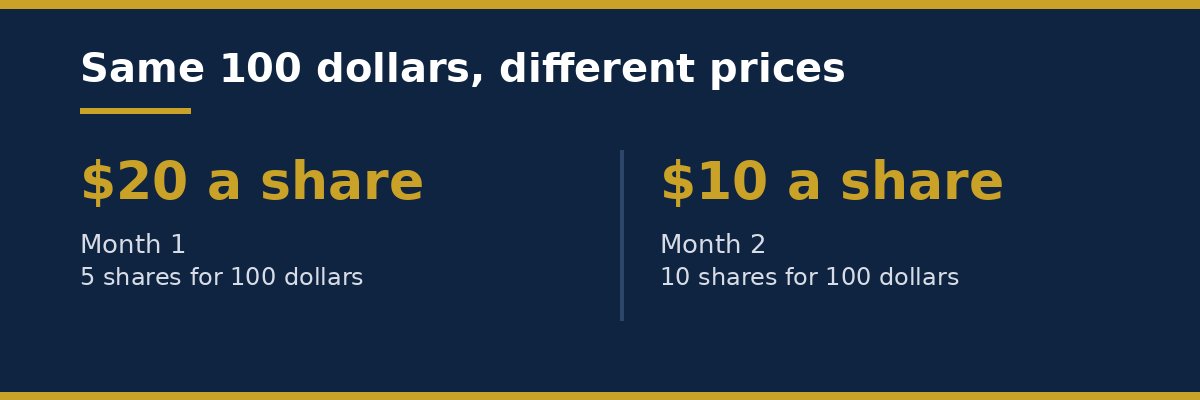
Month 1: the price is $20 per share. You invest $100. You buy 5 shares, because 100 divided by 20 equals 5.
Month 2: the price falls to $10 per share. You invest $100 again. You buy 10 shares, because 100 divided by 10 equals 10.
Month 3: the price rises to $25 per share. You invest $100 again. You buy 4 shares, because 100 divided by 25 equals 4.
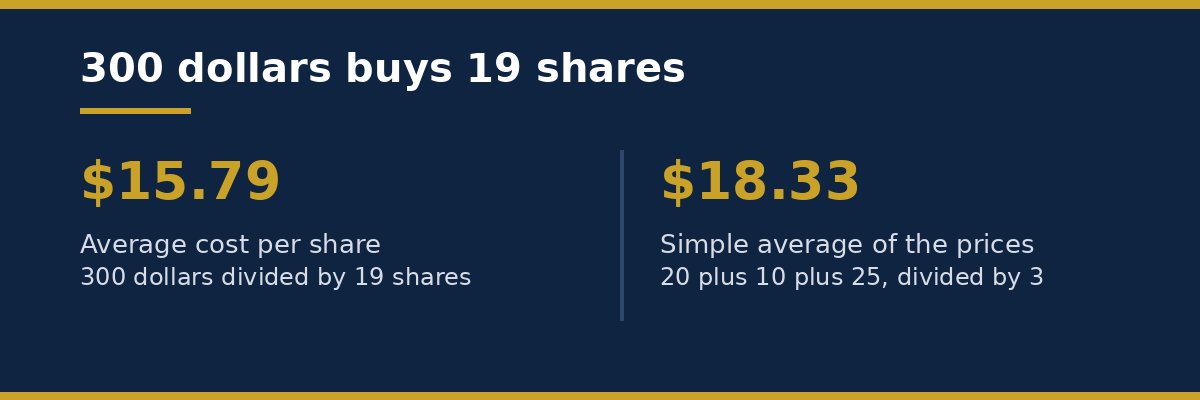
Total invested: $100 plus $100 plus $100 equals $300. Total shares bought: 5 plus 10 plus 4 equals 19 shares. Average cost per share: $300 divided by 19 equals $15.79, rounded to the nearest cent.
That average cost is lower than the simple average of the three prices, $20 plus $10 plus $25, divided by 3, which equals $18.33. Your average cost is lower because the low price month bought more shares.
At the final price of $25 per share, 19 shares times $25 equals $475, or $175 more than the $300 invested in this example. If the final price had been $15 instead, the same 19 shares would be worth $285, or $15 less than the $300 invested. The same pattern can end with a gain or a loss, because the final price matters as much as the average cost.
Average cost per share equals total amount invested divided by total shares bought.
Why many beginners like it
It removes the timing question. Many beginners wait because they want to buy at the lowest price. That wait can last for months, while the money sits unused. A fixed schedule gives a clear answer: buy on the scheduled day, with the scheduled amount.
It builds a habit. A regular amount on a regular day turns investing into a routine, like a bill or a savings transfer.
It can soften a bad first purchase. If you invest a large amount all at once just before prices fall, the whole amount feels the fall at once. If you spread the same total over several months, later purchases buy at the lower prices. That does not remove the loss, but it can make a sharp fall easier to live with.
What dollar cost averaging does not do
It does not guarantee a profit. No buying schedule can guarantee a profit. If the price falls over a long period and stays low, regular purchases will still lose value. A lower average cost can mean a smaller loss than buying everything at the first high price, but it is still a loss.
It does not protect against loss in a falling market. It spreads out when you buy, but it does not stop prices from falling. If the investment keeps falling, every purchase can fall in value after you buy it. The plan does not make a weak investment safe.
It does not choose a good investment for you. The schedule is only a method of buying. You still need to understand what you are buying. A clear plan helps, so read what is a simple first investment plan before you choose the investment itself.
It can cost more in a steadily rising market. When prices rise steadily, buying later means buying at higher prices. In that case, investing the full amount earlier would have bought more shares at lower prices. Dollar cost averaging trades that chance for a smoother path and less worry about a single badly timed purchase.
It does not remove fees or taxes. Fees can reduce the value of each purchase, and taxes may apply to gains or income, depending on the account and the rules where you live. Check the fees, and keep records of what you buy and when.
Dollar cost averaging versus a lump sum, and versus timing the market
A lump sum means investing all the money you have available at once. Dollar cost averaging means splitting that money into equal parts and investing one part at a time. A lump sum puts all the money to work at once. If prices rise after that day, the lump sum benefits from the full rise. If prices fall, the lump sum feels the full fall. Dollar cost averaging puts part of the money to work at once and keeps the rest aside for later purchases. If prices fall, later purchases buy at lower prices. If prices rise, later purchases buy at higher prices.
There is no single right answer for every person. It depends on how much money is involved, how long you plan to keep it invested, and how you react to a fall in price. If you are investing from regular income, with no lump sum waiting, the choice is simpler: you invest the money as it arrives.
Timing the market means trying to buy only when prices are low and sell only when prices are high. It needs two correct calls, again and again. Dollar cost averaging takes the opposite approach. It accepts that you cannot know the best day in advance, so it buys on a fixed schedule instead, with less time spent watching prices and less pressure on a single decision.
How to set up a simple plan
These steps are for learning, not a recommendation to buy any particular investment.
Step 1: write down your goal and your time frame. Write one clear sentence about what the money is for and when you may need it. The goal should come before the purchase.
Step 2: check your budget first. Make sure your main bills are covered and you have savings for short term needs before you set a regular investing amount. Investing money you may need soon can force a sale at a bad time.
Step 3: choose an amount you can repeat. Pick an amount that is easy to repeat each month. Test it for two or three months before you treat it as fixed. If it feels tight, lower it. A plan you can keep is better than a plan that stops.
Step 4: choose a broad investment you understand. Many beginners start with broad funds that hold many companies at once, rather than a single company share. That is a form of spreading risk, explained in what is diversification and why does it matter. Read the basic facts about any fund before you buy it, including what it holds and what it costs to own.
Step 5: automate the transfer and the purchase, and keep a simple record. Set up an automatic transfer and purchase on the same schedule, if your account offers it. Note the date, the amount, the price, and the shares for each purchase.
Common mistakes to avoid
Changing the amount with every headline breaks the plan. If you raise the amount after good news and cut it after bad news, you are timing the market with extra steps. Skipping purchases when prices fall also breaks the plan, because it removes the part that buys more shares at lower prices. Forgetting about fees is another mistake, because a small fee on every purchase can add up. Using money you need soon is also a mistake, because the value can fall in the short term. Finally, do not treat the plan as a promise of a low average price. The average cost can be higher than the lowest price you saw, and higher than the price at the end.
Frequently asked questions
Does dollar cost averaging guarantee that I will buy at a low price?
No. It guarantees a regular purchase, not a low price. Some purchases will be at high prices and some at low prices. The average cost is the total amount invested divided by the total shares bought, and that average can still be above the final price.
How often should I invest?
Many people invest monthly, because it matches a monthly pay cycle and is easy to remember. Weekly or every two weeks can also work. The best gap is the one you can keep without missing purchases, and that fits how you are paid.
How much should I invest each time?
There is no set amount that fits everyone. The amount should fit your budget after bills and short term savings, and it should be small enough to repeat without stress. If the amount feels tight after a month or two, lower it rather than stopping the plan.
Can I use dollar cost averaging with an index fund or an ETF?
Yes, in general, many people use this buying schedule with a broad fund, such as an index fund or an ETF, because the schedule is about when and how much to buy, not about the type of fund. The fund itself still needs to be understood on its own, including what it holds and what it costs.
Conclusion
Dollar cost averaging is a simple idea: invest the same amount, on the same schedule, whatever the price is that day. You buy more shares when the price is low and fewer shares when the price is high, and your average cost is the total amount invested divided by the total shares bought.
It can help a beginner build a steady habit and avoid waiting for a perfect day that may never come. It can also soften the effect of buying just before a fall. At the same time, it does not guarantee a profit, it does not protect against loss, and it can cost more than a lump sum when prices rise steadily.
Start with a clear goal, choose an amount you can repeat, pick a broad investment you understand, automate the purchase, and keep a simple record. Then keep the schedule steady, and review it from time to time.
This article is for general information and education only. It is not legal or financial advice.
