
What Is a High-Yield Checking Account?
A high-yield checking account is a checking account that pays a higher interest rate than a regular checking account, while still giving you the everyday features of checking, such as a debit card, bill pay, and the ability to send money.
In simple terms, it is a checking account that tries to do two jobs at once. It holds the money you use for daily spending and monthly bills, and it also earns interest on the balance. A regular checking account often pays little or no interest. A high-yield checking account pays more, though the exact rate varies by bank and can change over time.
That does not make it the same as a savings account. It is still a checking account first. The money is meant to be easy to reach. The interest is an extra benefit, not the main purpose.
If you keep a steady balance in checking and it earns almost nothing today, this guide explains how such an account works and what to check.
How a High-Yield Checking Account Works
A high-yield checking account works like a normal checking account for day-to-day money. Your pay can be deposited into it. You can pay bills from it. You can use a debit card, an ATM, or a mobile app to move money.
The difference is the interest. The bank pays interest on your balance, usually calculated daily and paid monthly. The rate is shown as APY, which stands for annual percentage yield. APY shows what you would earn in one year if the rate stayed the same and the interest stayed in the account.
To learn the difference between APY and a simple interest rate, read our guide on what APY is and why it is different from an interest rate.
Many high-yield checking accounts come from online banks or credit unions, which often have lower running costs and may pass part of that saving on as a higher rate.
Some accounts pay the higher rate on the full balance. Others pay it only up to a set balance limit, and pay a lower rate on any amount above that limit. Read that limit carefully, because it changes how much interest a large balance will actually earn. Rates can also change, so check the rate from time to time, and look at the other terms too, not the rate alone.
Common Requirements to Earn the Higher Rate
Many high-yield checking accounts ask you to meet certain conditions each month to earn the full rate. If you miss a condition, you may earn a much lower rate that month, or no interest at all. Common conditions include direct deposit, a set number of debit card purchases, signing up for electronic statements, logging in to online or mobile banking, or keeping a minimum balance.
Read the full list before you open an account, and ask: can I meet these conditions in a normal month, without changing how I spend? If not, the higher rate may not help. Also check what happens if you miss a condition. Some banks pay a low base rate that month, others pay no interest.
High-Yield Checking Compared With Regular Checking
| Feature | Regular checking | High-yield checking |
|---|---|---|
| Main purpose | Daily spending and bills | Daily spending and bills, plus interest |
| Interest | Often little or none | Higher, if conditions are met |
| Monthly conditions | Often few or none | Often direct deposit, debit use, or e-statements |
| Fees | May have a monthly fee | May have a monthly fee, sometimes waived |
| Access | Debit card, ATM, checks, app | Debit card, ATM, checks, app |
| Balance limit for top rate | Usually not relevant | Sometimes applies above a set balance |
A high-yield checking account is not a replacement for an emergency fund or long-term savings. It is a place for money you will spend soon. If you want a simple side-by-side of checking and savings in general, read the difference between a checking and a savings account.
High-Yield Checking Compared With a High-Yield Savings Account
A high-yield savings account and a high-yield checking account both pay more interest than their regular versions. The difference is the purpose. A checking account is for money in motion: pay coming in, bills going out, and daily card spending. A savings account is for money you set aside, often for an emergency fund or a short-term goal.
Many people use both: spending money in checking, savings in a savings account. A high-yield savings account may pay a higher rate, or it may not, since rates change. Compare both side by side. For a closer look, read is a high-yield savings account safe and high-yield account vs normal savings account.
Is the Money Insured?
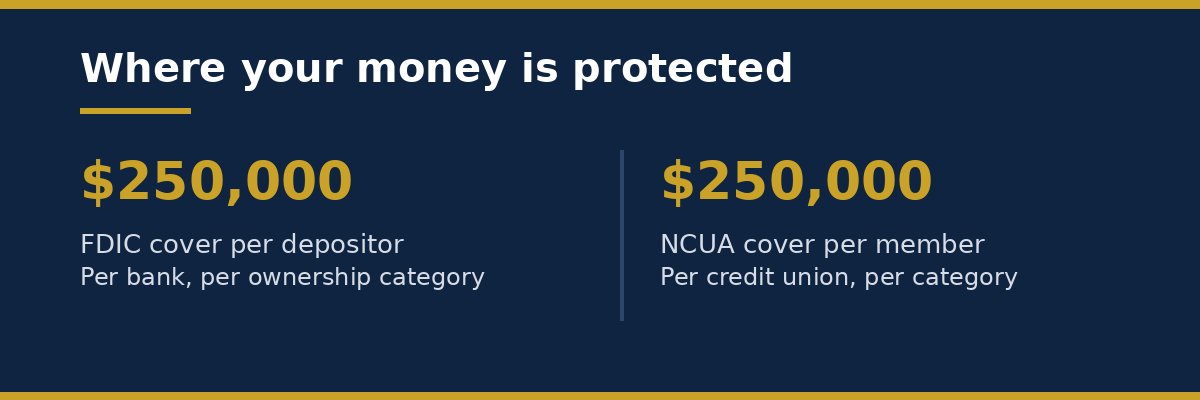
If the account is at an FDIC-insured bank, deposits are insured by the Federal Deposit Insurance Corporation, the FDIC. The standard insurance amount is $250,000 per depositor, per FDIC-insured bank, per ownership category. This was verified on fdic.gov on 2026-11-19.
Coverage depends on how the account is owned, not only on the balance. A single account and a joint account are in different ownership categories, and deposits in different categories at the same bank can be insured separately, up to the standard amount for each, if FDIC rules are met.
You can check whether a bank is FDIC-insured on the FDIC website, and you can use the FDIC Electronic Deposit Insurance Estimator, known as EDIE, to check your own coverage. See the FDIC Deposit Insurance FAQs and the FDIC Deposit Insurance at a Glance page for the full rules.
Credit unions have their own federal insurance system, run by the National Credit Union Administration. Check its insurance status directly before relying on it. Insurance covers deposits if the bank fails, up to the limit. It does not insure investments.
Worked Example: What the Interest Could Look Like
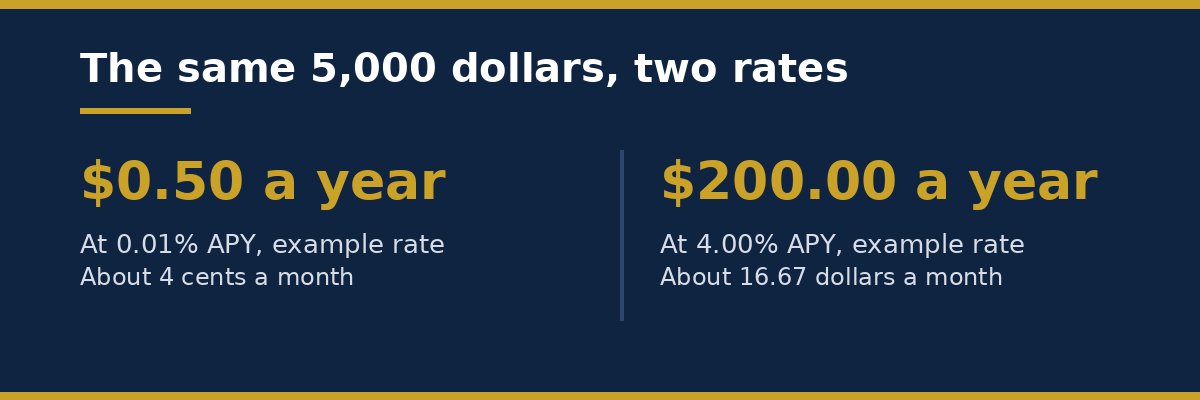
The example below uses a balance of $5,000 and two clearly labelled example rates. These are example rates only. They are not current rates from any bank, and they are not a promise of what any account will pay. The balance stays at $5,000 for the full year in both cases, and the rate does not change. This keeps the math simple.
Example A is a low rate of 0.01% APY. Example B is a higher rate of 4.00% APY.
Yearly interest in Example A: $5,000 times 0.01% equals $5,000 times 0.0001, which equals $0.50 per year. Monthly interest: $0.50 divided by 12 equals $0.04 per month, rounded to the nearest cent.
Yearly interest in Example B: $5,000 times 4.00% equals $5,000 times 0.04, which equals $200.00 per year. Monthly interest: $200.00 divided by 12 equals $16.67 per month, rounded to the nearest cent.
Difference per year: $200.00 minus $0.50 equals $199.50 more per year in Example B. Difference per month: $16.67 minus $0.04 equals $16.63 more per month in Example B.
| Example | Balance | Example APY | Interest per year | Interest per month |
|---|---|---|---|---|
| A, low rate | $5,000 | 0.01% | $0.50 | $0.04 |
| B, higher rate | $5,000 | 4.00% | $200.00 | $16.67 |
| Difference | Same balance | Not applicable | $199.50 | $16.63 |
This is simplified. In real life, your balance moves as pay arrives and bills leave, interest is usually calculated on the daily balance, and the rate can change. The point is the gap: a low rate earns almost nothing on the same balance, while a higher rate earns a visible amount, though $200 a year is still modest next to $5,000.
Try it with your own balance: multiply it by the APY as a decimal, then divide by 12 for a rough monthly figure. For example, $2,000 at an example 4.00% APY is $80.00 per year, or about $6.67 per month.
Benefits and Drawbacks to Weigh
Benefits are clear if the terms suit how you bank: spending money earns interest instead of sitting idle, you keep full checking access, and some accounts offer no monthly fee when conditions are met, free ATM use, or ATM fee refunds.
Drawbacks matter too. The higher rate often depends on monthly conditions, and the top rate may apply only up to a balance limit. Fees can cost more than the interest you earn, rates can fall, and an online-only bank may have no branch near you if you often deposit cash or need in-person help.
How to Choose a High-Yield Checking Account
1. Start with your own banking habits
Look at a normal month: average balance, debit purchases, direct deposit, ATM use, and cash deposits. These answers show which conditions you can meet without effort.
2. List the rate, the limit, and the conditions
For each account, note the APY, the balance limit for that APY, the monthly conditions to earn it, and what rate applies if you miss a condition. If any of those four is missing from the bank page, do not guess it. Ask the bank, or move on.
3. Add up the fees
Note the monthly fee, the fee waiver rules, ATM fees, overdraft fees, and any fee for services you use. Work out a simple monthly total for your normal use, and compare it with the interest you expect to earn. If fees are higher than interest, the account is not paying you in net terms.
4. Check insurance and access
Check that the bank is FDIC-insured, or that the credit union is federally insured. Check ATM access, mobile deposit, bill pay, and how to reach support. For a wider beginner checklist, read how to choose a bank account as a beginner.
5. Compare two or three accounts, then test one for a month
Compare at least two or three accounts on rate, limit, conditions, fees, and access. The best choice is often the one with fair terms you can meet every month, not the highest headline rate. After opening, watch the first month: did you meet the conditions, did interest arrive, did any fee appear? Keep your old account open until the new one works, and move bills one at a time.
Who It May Suit, and Common Mistakes
It may suit you if you keep a steady balance in checking, already have direct deposit, use a debit card often, and check the account online. It may not suit you if you keep only a small balance, rarely use a debit card, have no direct deposit, or keep a large sum in checking for a long time.
Common mistakes are easy to avoid. Do not chase the highest rate and ignore the conditions or the balance limit. Do not ignore fees: a $10 monthly fee is $120 a year, more than half of the $200 example interest above. Do not leave the account unchecked, and do not treat checking as long-term savings. For general consumer guides, see the Consumer Financial Protection Bureau.
FAQ
Is a high-yield checking account safe?
If it is at an FDIC-insured bank, deposits are insured up to $250,000 per depositor, per insured bank, per ownership category, under FDIC rules. It does not insure investments. Always confirm the bank is FDIC-insured.
Do I have to use my debit card a set number of times?
It depends on the account. Some ask for a set number of debit purchases each month, others do not. If you rarely use a debit card, look for an account without that condition.
Can the interest rate change?
Yes. A bank can raise or lower APY at any time. The rate at opening is not fixed for life, unless the bank states a fixed term, which is uncommon for checking.
Is a high-yield checking account better than a high-yield savings account?
Neither is better in every case. Checking is for daily spending and bills, savings is for money set aside. Compare current rates, conditions, and limits for both, and use each for its purpose.
Will I pay tax on the interest?
Interest is generally taxable income in the United States, but rules depend on your situation. The bank usually reports it above a reporting threshold. This is general information only, not tax advice. For tax advice, speak to a qualified tax professional.
Conclusion
A high-yield checking account is a checking account that pays more interest than a regular checking account, while keeping the same everyday access to your money. It can be useful if you keep a steady balance in checking and you can meet its monthly conditions without effort.
The rate alone is not enough. Check the balance limit, monthly conditions, the rate if you miss a condition, and the fees. Work out the net result for your normal month, and check that the bank is FDIC-insured.
If the terms fit how you bank, it can make your spending money work a little harder. If not, a simple checking account plus a separate savings account may be easier. Either way, choose by the terms you can meet, not by the headline rate alone.
This article is for general information and education only. It is not legal or financial advice.
